Why Poultry Processing Wastewater Needs a Different Filter Press Design
A filter press for poultry processing wastewater design is built around the fact that poultry slaughterhouse wastewater carries blood, paunch contents, feathers, fat, and suspended solids at concentrations that municipal biosolids defaults do not anticipate. EPA Fact Sheet 832-F-00-057 (September 2000) flags this directly: "Wastewater solids with higher concentrations of oil and grease can result in blinding the belt filter and lower solids content cake."
The same fact sheet sizes presses on "weight or volume of solids to be dewatered rather than the wastewater flow to the plant," which means the engineering work is in the feed characterization, not the hydraulic balance. The EMO France case at a Monseñor Nouel (Dominican Republic) poultry slaughterhouse confirms the standard retrofit architecture: an existing anaerobic/aerobic/lagoon train that can no longer meet discharge limits is upgraded with a dissolved air flotation (DAF) unit ahead of a belt filter press, with the DAF doing the FOG and suspended-solids removal the lagoons can no longer absorb. For a plant engineer writing the basis of design, the four inputs that diverge from municipal defaults are FOG fraction in the DAF underflow, total suspended solids variability across a shift, expected polymer dose, and target cake dryness for rendering or disposal. The first question to close with the project manager is whether the existing upstream train already includes DAF; if not, the filter press specification has to be reworked because raw slaughterhouse solids and oil content will sit outside the EPA Table 1 feed-solids window of 0.5–10% w/w.
Step 1 — Characterize the Sludge Entering the Press
Size the press from dry-solids throughput, not from plant flow. EPA 832-F-00-057 (Sept 2000) lists the inputs explicitly: daily primary solids, daily waste-activated or trickling-filter solids, daily thickened-solids volume, the range of dry-solids concentration in the feed, and an allowance for future increases and feed-quality changes. For poultry, the same checklist applies to the DAF underflow rather than to clarifier underflow, and the same excess-capacity rule applies so the plant can keep running if one unit is offline. For a plate-frame design, the realistic operating window for feed total solids is 2–5% w/w; the BRIN plate-frame study (National Research and Innovation Agency, ejournal.brin.go.id/JTL/article/view/218) tested 1–4% w/w CaCO3 as a sludge surrogate and reported a 56.00% solids removal efficiency at 4% w/w with cotton cloth, against a lower result for drill cloth. That study is on a mineral surrogate, not biological sludge, so treat the 56.00% figure as a cloth-selection data point, not a guaranteed field removal. The DAF ahead of the press must deliver an underflow that the cloth can hold; suppliers typically quote residual FOG below 50–100 mg/L and suspended solids below 150–300 mg/L as the operating target that protects a downstream press, and a dissolved air flotation (DAF) system sized to that envelope is the standard poultry duty. Confirm both numbers with the DAF vendor on the actual slaughterhouse effluent before locking the press specification.
| Parameter | Sample location | Test method | Design implication |
|---|---|---|---|
| Total solids (w/w) | DAF underflow, composite over 1 shift | SM 2540 B | Sets hydraulic load and cake yield |
| FOG (mg/L or % of dry solids) | DAF underflow, composite | EPA 1664 / Soxhlet | Drives polymer dose; high FOG blinds belt filters per EPA 832-F-00-057 |
| Total Kjeldahl nitrogen / protein | DAF underflow | SM 4500-N | Affects polymer selection and odor load on press room |
| Suspended solids (mg/L) | DAF effluent | SM 2540 D | Confirms DAF is protecting the press |
| Fiber / feather content (visual + sieve) | DAF underflow | Sieve + dry mass | Sets cloth weave and pre-screen requirement |
| Particle size distribution | DAF underflow | Sieve stack | Determines if grinding is needed ahead of the press |
Step 2 — Choose Plate-and-Frame or Belt Filter Press
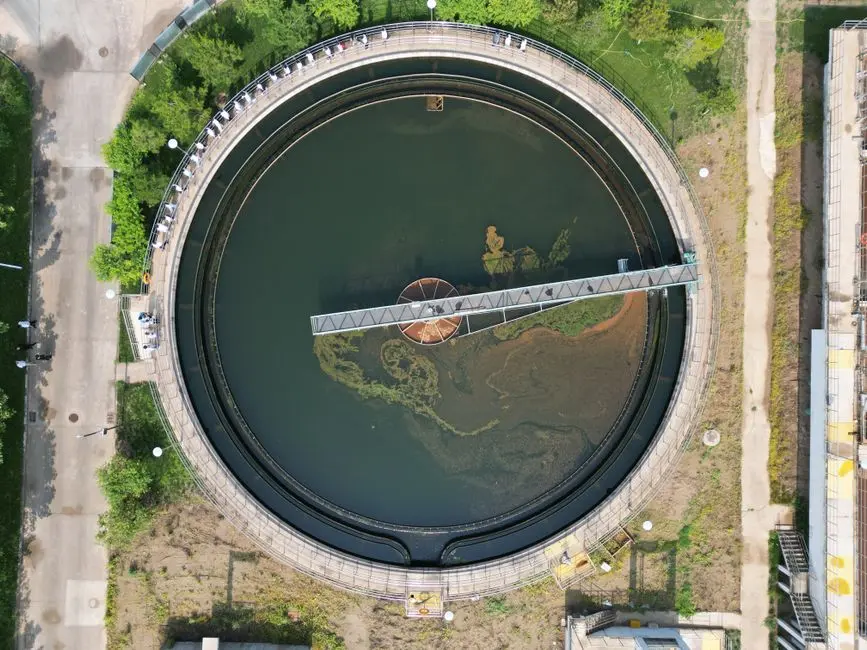
The choice between a plate-and-frame unit and a belt filter press is the single biggest design call on this duty, and EPA 832-F-00-057 (Sept 2000) provides the only verified municipal-benchmark data. The BRIN plate-frame study (National Research and Innovation Agency) adds a cloth-selection data point for the plate-and-frame alternative. The two technologies are not equivalent on a poultry line; they trade footprint, staffing, and cake dryness against each other, and the trade-off changes when the feed carries feathers and FOG.
| Criterion | Plate-and-frame filter press | Belt filter press |
|---|---|---|
| Operation mode | Batch; fill, press, open, discharge | Continuous; gravity drainage then low- and high-pressure zones |
| Typical cake solids on raw primary + WAS | Higher than belt press on equivalent feed (vendor data) | 20–44% w/w (EPA Table 1, raw primary + WAS) |
| Polymer demand | Lower per ton of dry solids (vendor data) | 1–10 g/kg dry solids (EPA Table 1) |
| Footprint | Larger per m² of filtration area | Compact; common on space-constrained retrofits |
| Operator intervention per cycle | Higher; plate shift, cloth wash, cake discharge | Lower once running; routine attention is on feed variability |
| Start/stop behaviour | Slower; batch timing dominates | "Can be started and shut down quickly compared to centrifuges" (Henderson and Schultz, 1999, cited in EPA 832-F-00-057) |
| Sensitivity to feed variation | Tolerant of variable solids if polymer dose is trimmed per cycle | "Require more operator attention if the feed solids vary in their solids concentration or organic matter" (Henderson and Schultz, 1999, cited in EPA 832-F-00-057) |
| High-FOG risk | FOG blinds cloth; pre-DAF is mandatory | "Wastewater solids with higher concentrations of oil and grease can result in blinding the belt filter and lower solids content cake" (EPA 832-F-00-057) |
| Cloth / belt selection evidence | BRIN study: 56.00% removal at 4% w/w CaCO3 with cotton cloth, drill cloth lower | EPA: "evaluate different weaves, permeability, and solids retention abilities of dewatering belts" |
| Available product envelope | 1–500 m² filtration area, manual / hydraulic / PLC (HydropureWater plate and frame filter press) | 0.5 m to 1.5 m belt width per EPA cost table |
On a single-shift poultry line, the EPA note that belt presses "can be started and shut down quickly compared to centrifuges" is a real advantage over centrifuges, but it is a smaller advantage than the same fact sheet's warning that belt presses "require more operator attention if the feed solids vary in their solids concentration or organic matter" — and poultry DAF underflow does vary across a shift. The cloth-selection signal from the BRIN study (56.00% removal at 4% w/w CaCO3 with cotton cloth against a lower figure for drill cloth) is the only verified plate-frame cloth data in the research set, so weave and material are a primary specification on poultry duty, not an accessory.
Step 3 — Size the Press, the Polymer System, and the Ancillary Equipment
Size the press on dry-solids throughput and design for excess capacity, per EPA 832-F-00-057 (Sept 2000). The fact sheet lists the inputs in order: primary solids per day, waste-activated or trickling-filter solids per day, thickened-solids volume per day, dry-solids concentration range in the feed, and an allowance for future increases and changes in solids quality. Polymer system geometry is also pinned by the EPA fact sheet: a conditioning zone of approximately 70 to 100 gallons (265 to 379 L) located 0.6 to 1.8 m (2 to 6 ft) from the press, with multiple polymer feed points for flexibility and gentle mixing to avoid floc shear. The polymer demand will fall in the 1–10 g/kg dry-solids range that EPA Table 1 gives for raw biological sludges; poultry DAF underflow will trend toward the higher end of that window because of the FOG and protein load, and the only honest way to set the dose is by jar test on the actual underflow, not by calculation. The ancillary-equipment checklist in EPA 832-F-00-057 — polymer make-up and aging tank, feed pump, odor control and ventilation, conveyor or pump for cake, and an enclosed truck- or container-loading area — applies directly to a poultry installation; add a pre-screen or grinder if feather content in the underflow is high enough to risk cloth puncture. The polymer system is normally supplied as an automatic polymer dosing system with make-up, aging, and day-tank stages, so polymer concentration and dose are reproducible shift-to-shift.
Step 4 — Integrate the Filter Press with Upstream DAF and Downstream Disposal
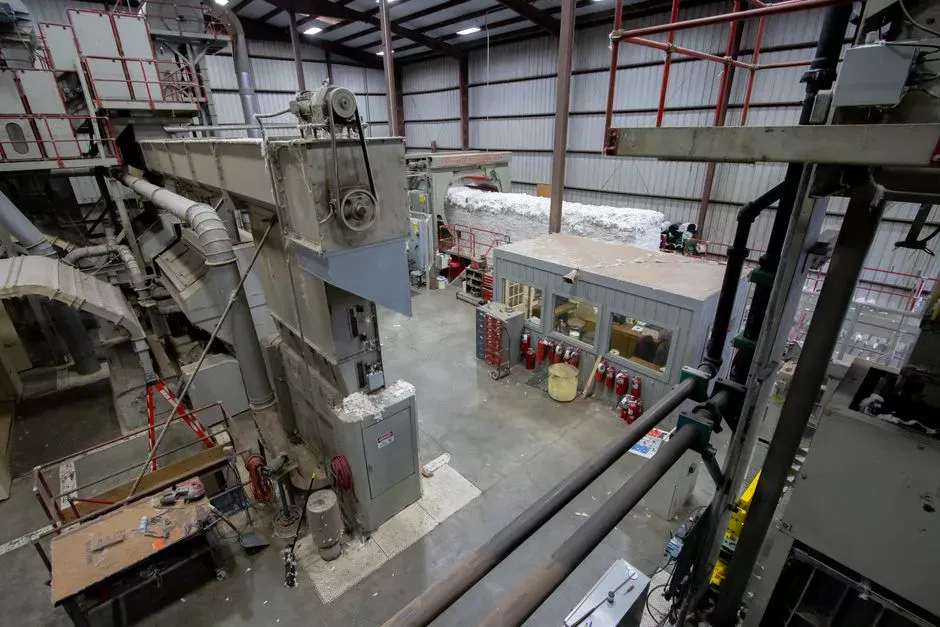
The filter press is one unit in a four-stage train, and the P&ID has to show that explicitly. Upstream, the dissolved air flotation (DAF) system is the FOG and suspended-solids workhorse that protects the press — both the EMO France poultry case at Monseñor Nouel and the EPA 832-F-00-057 (Sept 2000) note on oil-and-grease blinding converge on the same conclusion. If the DAF underflow sits below about 2% total solids, add a lamella clarifier for sludge thickening ahead of the press so cycle count and polymer consumption stay in their design windows. Downstream, cake at 20–44% total solids (EPA Table 1 range for raw primary + WAS) can be containerized for off-site rendering or land application; the dewatering step is the primary economic case because it cuts transport weight and free-liquid handling. Filtrate return is the last integration call: route press filtrate back to the head of the DAF or to the biological train, not to the clean-out, so the organic load on the existing treatment process stays visible during commissioning and the plant does not silently exceed its discharge consent. For plants that are still on lagoon-only duty and considering a dewatering retrofit, the same integration logic underpins the filter press design for food processing wastewater walkthrough and the DAF-vs-clarifier choice discussed in the DAF vs clarifier selection guide.
Filter Press Cost, Labor, and Operating Benchmarks
The only verified cost reference in the research set is EPA 832-F-00-057 (Sept 2000), and it is municipal. Capital cost: $47,500 for a 0.5 m belt (≈500 dry lb/h) up to $115,000 for a 1.5 m belt (≈1,625 dry lb/h), based on 5% feed solids; the figures exclude installation, shipping, and ancillaries such as flow control and centrate management. Overall O&M cost: $80 to $200 per dry ton of solids. Polymer conditioning cost: a range of $2.65 to $91.15 per million gallons, averaging $24.38 per million gallons, with the spread driven by feed dewaterability. Belt life averages 2,700 running hours with a range of 400 to 12,000 hours, which is the main consumable line item on a belt-press OPEX model. Labor: a single belt press needs 4–8 staff-hours per day including lab testing; six to eight presses can be operated with 8–10 staff-hours per day, so labor scales sub-linearly with unit count. None of these figures are poultry-specific, and the EPA fact sheet is dated September 2000, so use them as a sanity check and then request a poultry-specific quote from the press manufacturer supported by jar test and, if the project justifies it, pilot data. For a comparable food-industry envelope, the filter press design for fruit juice wastewater guide uses the same EPA cost table as its CAPEX anchor.
Frequently Asked Questions
Does poultry slaughterhouse wastewater always need DAF ahead of the filter press?
Yes, on any plant that sees blood, paunch contents, feathers, or rendering fats in the effluent. EPA 832-F-00-057 (Sept 2000) warns that "wastewater solids with higher concentrations of oil and grease can result in blinding the belt filter and lower solids content cake," and the EMO France case at the Monseñor Nouel poultry plant upgraded an existing train specifically by adding a DAF unit in front of a belt filter press. Without DAF, polymer dose climbs, cloth life shortens, and cake-solids targets slip.
Plate-and-frame or belt filter press for a poultry plant — which is the right default?
Neither is a universal default; the call is footprint, staffing, and cake-solids target. EPA 832-F-00-057 (Sept 2000) shows belt presses achieving 20–44% cake solids on raw primary + WAS with 1–10 g/kg polymer, and the same fact sheet notes belt presses "can be started and shut down quickly compared to centrifuges" but "require more operator attention if the feed solids vary." A plate-and-frame unit such as the HydropureWater 1–500 m² range trades footprint and operator intervention for higher achievable cake dryness and lower polymer demand per ton. Decide on duty cycle (batch-friendly plate-and-frame vs continuous belt), cake-solids target, and how variable the DAF underflow is across a shift.
What cake-solids percentage should I target on a poultry DAF sludge?
EPA 832-F-00-057 (Sept 2000) Table 1 gives 20–44% total cake solids for raw primary + WAS at 1–10 g/kg polymer; expect the lower end of that range on poultry DAF underflow because of the FOG and protein load, and the higher end only if the upstream DAF is delivering low-FOG, well-thickened feed and the polymer is jar-test optimized. Confirm by pilot, not by datasheet.
What budget figure should I put in the CAPEX line for the press?
Use the EPA 832-F-00-057 (Sept 2000) municipal-belt figures as a sanity check: $47,500 for a 0.5 m belt (≈500 dry lb/h) to $115,000 for a 1.5 m belt (≈1,625 dry lb/h) at 5% feed solids, excluding installation, shipping, and ancillaries. Then request a poultry-specific quote from the press manufacturer supported by jar test or pilot data on your DAF underflow, because the EPA cost table is municipal and dated September 2000, and a poultry retrofit typically adds DAF integration, odor control, and a covered cake-load area that the EPA figure does not include.