Why Palembang Rewrites the Standard Blowdown Balance
South Sumatra's 28–32°C wet-bulb regime is the first variable that breaks generic blowdown sizing. The Musi basin sits in the same humidity band as Metro Manila, where PAGASA records mean annual relative humidity between 78% and 85% (S3, 2025-12) — that humidity ceiling suppresses evaporative cooling efficiency, so an operator has to push cycles of concentration (CoC) higher to reject the same heat load. Higher CoC concentrates blowdown faster than dry-climate references assume, and blowdown mass balance carried over from a temperate site underestimates the dissolved-solids load a Palembang tower will actually discharge.
Source water compounds the problem. PDAM Palembang potable, a Musi River intake, and Banyuasin wetlands supply each carry a different TDS baseline and seasonal swing. Surface intakes on the Musi and Banyuasin face salinity intrusion during the August–October dry season, the same pattern that lifts Manila Bay intake TDS to 300–600 mg/L during the February–May dry season (S3, 2025-12) — an analog worth pressure-testing with intake sampling before final design. The binding regulatory instruments are PERMEN LHK No. 5/2014 on industrial effluent quality standards and the site-specific ceilings in Pergub Sumsel, both of which apply to any release into the Musi watershed; Banyuasin-adjacent sites also need to plan for emerging watershed coordination similar to the LLDA clearance mechanism on Laguna de Bay (S3, 2025-12).
The economic pressure is real. Direct discharge fees in water-stressed basins now run $5–15 per 1,000 gallons (S1, 2025-12), and commercial potable rates have moved upward across major data center markets (S1, 2025-12; S3, 2025-12). For a 2026 greenfield, freshwater-as-baseline is the wrong assumption — engineering reference for a Vadodara data center blowdown treatment guide uses the same logic, but the Palembang climate and watershed permit pathway are distinct enough to require their own datasheet.
The Four Wastewater Streams a Palembang Data Center Produces
Tropical hyperscale sites do not produce a single blowdown stream — they produce four, and an RFQ that scopes only stream one will fail at commissioning. Stream 1 is cooling tower blowdown, the largest by volume: 25–30% of makeup at 4 CoC, with TDS 1,200–6,000 mg/L, SS 10–50 mg/L, residual biocides, scale inhibitors, corrosion products, and biofilm fragments that thrive in 28–32°C loop water (S1, 2025-12). Stream 2 is reverse osmosis reject from humidification and process-water polishing — 20–30% of feed flow as concentrate that re-enters the waste train and raises the total dissolved load to the discharge point. Stream 3 is diesel generator cooling water, floor wash, and humidifier bleed: lower volume and intermittent, but often oily, and it must be routed through oil-removal pretreatment before joining the membrane train — the same routing principle called out for Philippine sites (S3, 2025-12). Stream 4 is habagat-season stormwater contacting outdoor equipment pads: high-volume, seasonal suspended-solids spikes that need to be segregated from the blowdown train to avoid shocking the UF pretreatment skid.
Each stream has different chemistry, different peak flow, and different PERMEN LHK exposure. Treating blowdown in isolation while ignoring streams 2–4 is the most common scoping error on Indonesian sites (S3, 2025-12) — a buyer's reference for the Diyarbakir data center blowdown treatment guide shows the same four-stream structure applies across tropical and arid tropical builds, but the local permit pathway and tariff context shift the engineering balance.
Reuse and Discharge Targets for 2026 Palembang Sites
Reuse targets are tighter than discharge targets, so the design driver for a hyperscale build is reuse — not just compliance. The table below maps the numeric envelope an engineer can paste into a process datasheet or RFQ, anchored to PERMEN LHK No. 5/2014 and downstream reuse constraints; site-specific ceilings in Pergub Sumsel can be tighter for Banyuasin-adjacent sites, so confirm current values against the 2026 Pergub before final design.
| Parameter | Cooling-tower makeup reuse target | PERMEN LHK No. 5/2014 industrial discharge ceiling |
|---|---|---|
| TDS | 500–1,500 mg/L | Per permit; many Indonesian jurisdictions apply effluent caps that concentrated blowdown cannot meet without treatment |
| Suspended solids | 10–25 mg/L | Per permit; verify against receiving-water classification |
| pH | 6.5–8.5 | 6.0–9.0 typical industrial range |
| Silica (SiO₂) | < 150 mg/L to keep scaling risk manageable at 4–6 CoC | Per permit; not always a primary effluent parameter |
| Chloride, sulfate, BOD, COD, total phosphorus | Match cooling-tower chemistry compatibility | Apply per PERMEN LHK No. 5/2014 for any release to the Musi watershed |
| Biocide residuals | Must be neutralized before membrane pretreatment | Per permit; site-specific ceilings may apply |
Pushing from 4 to 6+ CoC cuts blowdown volume but raises scaling risk and pushes blowdown TDS toward the 6,000 mg/L upper bound (S1, 2025-12). Biocide and corrosion-inhibitor residuals accumulate proportionally with CoC, which is why downstream membrane pretreatment cannot rely on the same chemical program used in the open loop (S1, 2025-12). Process-water reuse for landscape irrigation or equipment washdown is a viable off-taker for the 15–50% of blowdown that RO recovery cannot economically capture, but the supplier should confirm nutrient and biocide residual limits with the local agricultural authority. A New York City data center blowdown treatment engineering reference shows the same reuse-versus-discharge priority, but the local water-stress economics that justify reuse are far more aggressive in Palembang.
Four Treatment Trains for Palembang: From Compliance Baseline to ZLD
Each option inherits the same side-stream filtration and UF pretreatment, then branches at the BWRO step — a structure that lets a developer phase the CapEx while keeping a single treatment philosophy across phases. The decision matrix below anchors each option to a 2026 decision trigger so the right depth of treatment is selected for the site and tenant contract.
| Option | Train description | Recovery / permeate quality | CapEx (USD) | OpEx (per 1,000 gal) | 2026 Palembang decision trigger |
|---|---|---|---|---|---|
| 1 — Side-stream filtration only | 10–25 µm self-cleaning filter on 1–5% of circulation flow | No volume reduction; SS < 15 mg/L enables higher CoC | $50,000–$200,000 (S1, 2025-12) | Minimal; solids disposal only | Minimum scope for any tropical site; does not by itself solve a PERMEN LHK TDS exceedance |
| 2 — UF + BWRO (2026 default) | UF pretreatment skid ahead of industrial RO sized for 50–85% recovery at 10–50 mg/L TDS permeate | 10–50 mg/L TDS permeate as cooling-tower makeup | $250,000–$500,000 for a 50,000 GPD skid (S1, 2025-12) | $1.50–$3.00 (S1, 2025-12) | Default for Palembang hyperscale; brings most sites inside PERMEN LHK discharge limits |
| 3 — UF + BWRO + NF polish | NF targets hardness rather than total TDS; NF permeate blends with RO permeate | 70–85% NF recovery; permeate TDS ~30–50% of feed (S1, 2025-12) | Incremental over Option 2 | Lower than full RO at matched recovery | Use where hardness is the binding constraint and total TDS discharge cap is looser |
| 4 — UF + BWRO + MVC brine concentrator (ZLD) | MVC processes RO concentrate to 95–98% recovery; crystallizer converts brine to solid salt cake | 95–99% overall recovery; distillate < 10 mg/L TDS at 15–25 kWh per 1,000 gal (S1, 2025-12) | $3–8M additional over Option 2 (S1, 2025-12) | $5–15 (S1, 2025-12) | Justified only when hyperscale tenant contractually requires ZLD or Pergub Sumsel restricts Musi discharge |
Process flow: every train begins with side-stream filtration that drops SS below 15 mg/L (S1, 2025-12), then routes through a HydropureWater UF pretreatment skid to protect downstream membranes. The Options 2–4 trains then send UF permeate to a HydropureWater industrial RO system, and Option 4 adds MVC and crystallization to push overall recovery into the 95–99% band (S1, 2025-12). A Santa Cruz de la Sierra data center blowdown treatment reference shows the same four-train structure, but the local climatic and permit context drives a different default option.
Membrane Pretreatment That Survives Palembang's Loop Water
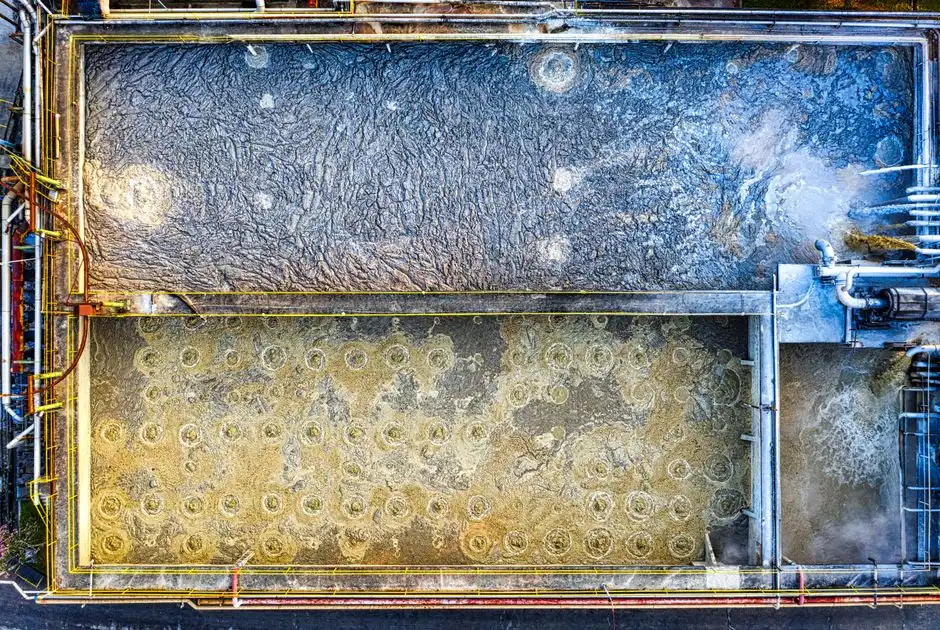
Membrane fouling is the dominant failure mode on tropical sites because warm, humid, biologically active feed water accelerates biofilm and scaling. Self-cleaning side-stream filtration at 10–25 micron keeps blowdown suspended solids below 15 mg/L before the UF pretreatment skid (S1, 2025-12; S3, 2025-12). Bio-organic flocculant dosing aggregates colloidal solids and biofilm fragments that bypass conventional filtration — a real problem in 28–32°C loop water (S1, 2025-12; S3, 2025-12). Antiscalant chemistry has to be tuned for silica and calcium sulfate: conventional BWRO caps at 75–80% recovery before scaling becomes unmanageable, so an automatic antiscalant and biocide dosing skid sized for silica-rich Musi source water is what pushes recovery toward 85%. A multi-media pre-filter ahead of the UF stage is the lowest-cost insurance for an ESG number that holds up to audit, and an HydropureWater ClO₂ generator provides chemical-free disinfection that controls planktonic bacteria and biofilm precursors without adding residuals that would accumulate at high CoC.
Skipping any one of these four pretreatment steps is what drives membrane replacement intervals from 3–5 years down to 12–18 months in tropical service (S3, 2025-12). Engineering reference for an RO system retrofit and upgrade guide covers the same pretreatment logic for brownfield retrofits, where the failure modes tend to be biofilm and silica scale rather than the suspended-solids shock a greenfield Palembang site sees at startup.
2026 CapEx, OpEx and Payback for a Palembang Hyperscale Build
A defensible CapEx/OpEx case for a 2026 Palembang hyperscale build sits in a narrow band. The base case is a 50,000 GPD UF + BWRO train at $250,000–$500,000 CapEx and $1.50–$3.00 per 1,000 gallons OpEx (S1, 2025-12). The ZLD overlay adds $3–8M and $5–15 per 1,000 gallons, with 95–99% overall water recovery and solid salt cake as the only waste stream (S1, 2025-12). The hyperscale water footprint pulls these numbers into a defensible payback: a 100 MW site drawing up to 2 million liters per day (S3, 2025-12, cross-referenced to S5, 2026-09) reaches payback faster than smaller sites through sheer volume of avoided PDAM Palembang purchases and avoided discharge fees.
The payback band is 3–5 years for an RO-only train in a 2026 Palembang context, calculated against $5–15 per 1,000 gallons avoided discharge costs and rising industrial potable rates (S1, 2025-12; S3, 2025-12). All costs in this section are quoted in USD on the 2025–2026 source basis; a final supplier proposal should convert to IDR at the prevailing project rate and re-validate against current PDAM Palembang industrial tariffs before RFP. The Dammam data center blowdown treatment guide carries the same ZLD-versus-RO payback logic, but the local discharge-fee structure and freshwater tariff make the Palembang payback tighter on the RO-only path.
Permitting, ESG Reporting and a 2026 Decision Framework
Map each train option to a 2026 decision trigger — climate, permit, tenant contract, ESG reporting — so the design review ends with a framework, not a parts list. The permit pathway is PERMEN LHK No. 5/2014 for effluent compliance, Pergub Sumsel for site-specific discharge ceilings, and AMDAL/UKL-UPL environmental assessment for facilities above the hyperscale threshold; confirm current thresholds with the local environmental office before RFP. Banyuasin-adjacent sites should plan for an emerging watershed coordination mechanism similar to the LLDA clearance that gates Laguna de Bay discharge (S3, 2025-12). On the ESG side, a 60–85% blowdown recovery rate translates directly into a Scope 3 water withdrawal reduction that hyperscale tenants report under CDP and IFRS S2 (S3, 2025-12).
The decision framework: minimum scope = side-stream filtration; default 2026 Palembang train = UF + BWRO; ZLD only when contractually required or where Musi watershed discharge is restricted; reuse non-potable off-takers should be locked in before final design. A Denpasar industrial wastewater treatment guide maps the same four-trigger decision framework for a different Indonesian watershed, and the engineering holds — only the local permit pathway and the freshwater tariff shift the default option.
Frequently Asked Questions
What CapEx should we budget for a 50,000 GPD RO train on a 2026 Palembang hyperscale site?
A 50,000 GPD UF + BWRO train runs $250,000–$500,000 CapEx and $1.50–$3.00 per 1,000 gallons OpEx on the 2025–2026 source basis (S1, 2025-12). A ZLD overlay adds $3–8M CapEx and $5–15 per 1,000 gallons OpEx, justified only when hyperscale tenants contractually require ZLD or Pergub Sumsel restricts Musi discharge. Request a vendor proposal that converts the USD figures to IDR at the prevailing project rate and re-validates against current PDAM Palembang industrial tariffs — those two inputs drive the final budget more than equipment list pricing.
How do we choose a supplier who can deliver a Palembang-compliant train in 2026?
Shortlist suppliers that can document prior BWRO + MVC builds in Indonesian or SEA tropical service, not just temperate references. Ask each bidder for a side-stream filtration to UF to BWRO P&ID, an antiscalant program tuned for silica and calcium sulfate in Musi source water, and a chemical-free disinfection skid sized for 28–32°C loop water (S1, 2025-12; S3, 2025-12). Confirm that the proposal includes a PERMEN LHK No. 5/2014 compliance test plan and a Pergub Sumsel site-specific discharge review — those two deliverables are the gate items for an Indonesian greenfield.
Do we need ZLD for a 2026 Palembang greenfield, or is RO-only sufficient?
RO-only is sufficient for most 2026 Palembang sites because PERMEN LHK No. 5/2014 and Pergub Sumsel typically allow treated discharge to the Musi watershed at 50–85% recovery. ZLD becomes the right answer when a hyperscale tenant contractually requires zero liquid discharge, when Pergub Sumsel restricts Musi watershed release for a Banyuasin-adjacent site, or when freshwater scarcity drives PDAM Palembang industrial tariffs high enough that the 95–99% ZLD recovery band pays back against the $3–8M ZLD CapEx overlay (S1, 2025-12). Treat ZLD as a tenant-contract and permit decision, not a default.
What hyperscale water footprint drives the payback math for a Palembang site?
A 100 MW hyperscale site drawing up to 2 million liters per day (S3, 2025-12, cross-referenced to S5, 2026-09) reaches payback faster than smaller sites through sheer volume of avoided PDAM Palembang purchases and avoided $5–15 per 1,000 gallons discharge fees (S1, 2025-12). At that footprint, an RO-only train typically pays back in 3–5 years against rising industrial potable rates and discharge-fee avoidance (S3, 2025-12). The buyer should request a vendor simulation that ties CoC, blowdown mass balance, and PDAM Palembang tariff escalation into a single payback curve rather than relying on generic hyperscale benchmarks.