What a New York City Data Center Actually Discharges
A 2026 data center in New York City generates at least six discrete wastewater streams that converge on a single NYCDEP sewer permit: cooling tower blowdown (CTBD), humidifier bleed-off, RO reject from makeup treatment, chiller purge, standby generator cooling water, and sanitary/greywater from staff areas. CTBD dominates the permit envelope by both volume and dissolved-solids load, but the smaller streams each carry parameters — temperature, residual oxidant, metals, BOD — that NYCDEP enforces independently, and a treatment train sized only to cooling water will fail the rest of the discharge compliance test. The numbers below set the envelope a New York operator must design to before any technology selection begins.
Industry data from Müller et al. (2024, Journal of Environmental Management) put typical data-center wastewater discharge in the 6–19 L/s range, peaking at 0.03–0.17 L/s per MW and reaching roughly 20 L/s at a medium facility during peak ambient temperature and IT load. A 100 MW facility can use up to ~2 million liters of water per day (IDE, 2026), on the order of thousands of households' daily demand. The takeaway is that even a mid-size 30–50 MW build in the five boroughs will routinely push hourly flow rates against the receiving capacity of a NYCDEP combined sewer — and the peak timing is the wrong side of the calendar, because it coincides with hot, dry periods when the city's combined sewer system is most capacity-limited and CSO triggers are easiest to trip.
| Stream | Typical quality signature | NYCDEP permit driver |
|---|---|---|
| Cooling tower blowdown (CTBD) | High TDS, silica, Ca/Mg hardness, suspended solids, treatment-chemical residues; warm | TSS, pH, temperature, metals, residual oxidant |
| Humidifier bleed-off | Low volume, similar dissolved solids to CTBD but lower TSS | TDS, pH |
| RO reject from makeup treatment | Concentrated permeate-side salts, antiscalant carryover | TDS, residual antiscalant species, flow |
| Chiller purge | Low TSS, low BOD, often warm; may carry glycol if a leak occurred | Temperature, BOD, oil & grease |
| Standby generator cooling water | Intermittent, may carry trace metals from heat exchangers, glycol if used | Metals, temperature, oil & grease |
| Sanitary/greywater | BOD, TSS, pathogens, conventional municipal character | BOD, TSS, fecal coliform, pH |
CTBD is the largest recoverable stream by far, and it is also the one with the most aggressive chemistry, which is why the rest of this guide centers on it. The other streams still have to be characterized, equalized, and metered into the same NYCDEP permit envelope — a packaged MBR for sanitary and greywater is the conventional pairing, sized to headcount and tied to the same SPDES permit (see compliance and equipment checklist for industrial wastewater for the broader permit-driven selection logic).
NYC Regulatory Envelope: SPDES, NYCDEP Sewer Limits and Local Law 97
Any data center discharging to the NYC sewer system needs a NYCDEP sewer connection permit, and above the federal thresholds in 6 NYCRR Part 750 a NYSDEC State Pollutant Discharge Elimination System (SPDES) permit is also required. The treatment train must be sized to these limits, not to a generic reuse target. New York City does not publish a single numerical sewer limit table in the same form the EPA does for surface-water discharges; the NYCDEP Sewer Use Regulations cap pH, temperature, oil & grease, BOD, TSS, and a metals list, with site-specific mass limits set in the connection permit. Engineers should obtain the actual permit limits from NYCDEP before they freeze equipment sizing, because the precise thresholds vary by receiving wastewater treatment plant and sewer shed.
Three local factors shape the design beyond the sewer limits themselves. First, residual oxidant from on-site disinfection (chlorine, chlorine dioxide) must be quenched — typically by dechlorination or sufficient contact time — before discharge, and most NYCDEP permits enforce a residual chlorine ceiling that is tight enough to drive the disinfection strategy. Second, energy and water performance are increasingly co-reviewed under NYC Local Law 97, which caps building carbon intensity; a water reuse loop that adds pumping and RO high-pressure energy should be checked against the building's LL97 margin, because a "green" water project that pushes the building into a carbon penalty is a net loss. Third, peak discharge into a combined sewer can push flow toward CSO triggers during rain events, so equalization storage is part of the regulatory design — it is not an operational nicety but a permit-shaping component, especially for sites in CSO-sensitive sewer sheds like Gowanus, Newtown Creek, or the East River outfalls.
Why Cooling Tower Blowdown Is the Center of Gravity for Reuse
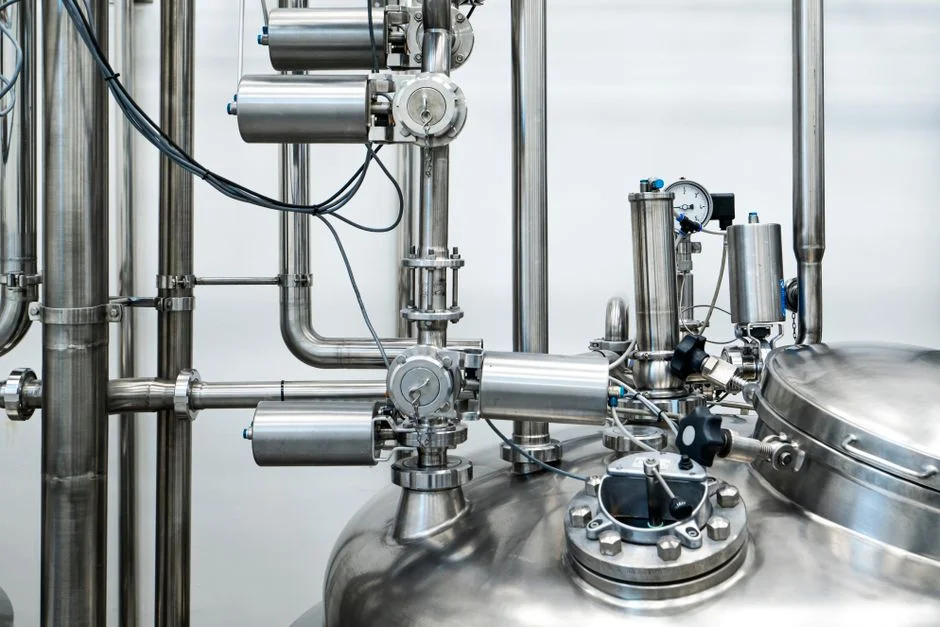
CTBD is the largest recoverable stream at a New York data center, and it is where capital deployed against water targets returns the most volume. The mechanism is straightforward: in an evaporative cooling system, water circulates through the tower, absorbs heat, and a fraction is lost as vapor; dissolved salts and treatment chemicals stay behind, so the operator periodically purges a portion of the circulating water to keep scale and corrosion in check (IDE, 2026). That purge is the blowdown. Everything else in this guide — DAF, softener, RO, EDI, ClO2 — exists to convert that purge stream back into something the cooling tower can accept as makeup.
The math is unforgiving if you get the cycles-of-concentration (CoC) framing wrong. Genesis Water Technologies (2025) makes the point sharply: the blowdown ratio equals 1/(CoC − 1), so at 4 CoC blowdown is 25% of makeup, and at 6 CoC it is 20% — a five-percentage-point absolute reduction, not the 50% relative improvement that gets quoted in vendor decks. The reason this matters for equipment selection is that the same source notes biological and scaling risks rise sharply above 5–6 CoC without advanced treatment, and microbiologically influenced corrosion (MIC) routinely forces operators back to lower CoC. The implication is that a treatment train which lets the tower hold 5–6 CoC reliably is worth more than one that nominally supports 8 CoC but triggers MIC excursions that drop the operator back to 4.
The scaling species that define how far a conventional RO can push recovery are silica, calcium carbonate, and calcium sulfate (IDE, 2026). Conventional brackish water RO typically plateaus at 75–80% recovery before scaling becomes unmanageable; pushing past that point in a conventional layout demands multi-stage RO with interstage boosting and recirculation loops, which is workable but expensive. The business case is real: every liter of CTBD that becomes cooling-tower makeup is a liter of NYCDEP potable water not purchased, a liter of sewer discharge not paid for, and one step closer to the 0.4 L/kWh WUE target in the Climate Neutral Data Centre Pact 2025 revision (cited in Santoro & Catucci, 2025, via LinkedIn). New York City is not formally a "cool climate" by the Pact's definition, but the same WUE number is what hyperscale operators are committing to globally, and it is the figure NYCDEP and the press will compare a site against when reuse performance is reviewed.
Unit-Process Selection: Matching Each Stream to the Right Treatment Step
The matrix below is the working artifact a New York engineer needs to brief procurement: each stream is matched to a primary and a polishing step, and each step is justified against a measurable limit on the NYCDEP permit. Selecting equipment without anchoring it to a permit parameter is how projects end up with an over-specified RO train upstream of a discharge point that only required TSS and pH control. Anchoring the unit process to a permit limit is also how the same engineer defends the capex number to a CFO — every line item has a compliance job.
| Stream | Primary treatment | Polishing | Permit parameter addressed |
|---|---|---|---|
| CTBD — front end | DAF unit for CTBD suspended-solids removal or lamella clarifier | multi-media filter to protect downstream RO | TSS, oil & grease, SDI for membranes |
| CTBD — softening | twin-tank softener for hardness reduction before RO; antiscalant for silica | 5 µm cartridge guard | Ca/Mg, silica scaling precursors |
| CTBD — bulk desalination | industrial RO train for blowdown desalination at conservative local recovery | Concentrate routed to solid handling, not sewer | TDS, sulfate, chloride |
| CTBD — makeup polish | EDI polishing on RO permeate | — | Conductivity, silica for high-CoC makeup |
| CTBD — microbiological control | on-site ClO2 generator for cooling-loop microbiological control or UV | Dechlorination / contact time before sewer | Legionella, MIC, residual oxidant at discharge |
| Sanitary / greywater | packaged MBR for sanitary and greywater | UV or chlorination | BOD, TSS, fecal coliform |
| RO reject from makeup | Blend into CTBD equalization | — | TDS, antiscalant species |
| Chiller purge, genset cooling | Equalization + oil/water separation if glycol present | — | Temperature, oil & grease, metals |
Three sequencing rules are worth stating explicitly. First, EDI replaces mixed-bed ion exchange only where the operator can accept the small amount of electrical waste heat and wants to eliminate acid/caustic regeneration waste; in dense urban sites that waste stream is itself a permit touchpoint, so EDI frequently wins on simplicity. Second, residual oxidant must be quenched before the stream reaches the sewer — PLC-controlled chemical dosing for the CTBD pretreatment train is the conventional way to make that quench reliable across load swings. Third, the sanitary/greywater MBR must discharge to the same SPDES-permitted outfall as the CTBD stream, because NYCDEP issues one permit per connection; splitting the streams into separate outfalls creates a second SPDES pathway and a second permit fee.
Pushing Past 80% Recovery: High-Recovery Blowdown Reuse Architectures
Conventional brackish RO at 75–80% recovery (IDE, 2026) leaves a concentrate stream that is still too large to sewer without a high discharge fee, and the chemistry of that concentrate is dominated by sparingly soluble salts that limit how much more water can be pushed through the membrane. The two technical moves that change that picture are (a) removing the scaling species as a solid stream in a fluidized-bed reactor, so they never accumulate in the brine in the first place, and (b) operating the RO in a pulsed, high-velocity flush mode that keeps supersaturation inside the induction window of crystallization so crystals do not nucleate on the membrane surface. IDE describes both moves as part of its MAXH2O Brine Desalter architecture, and reports an industrial installation at about 95% overall recovery with permeate silica near 1 mg/L — purity that supports very high cooling-tower cycles and reduces both the NYCDEP potable intake and the volume of brine that has to be sewered.
For a New York operator the practical effect is direct: higher cycles mean less potable water purchased, less brine sewered, and a smaller LL97-relevant pumping energy footprint on the reuse loop. The qualification that gates the decision is staffing: Genesis Water Technologies (2025) states explicitly that hyperscale high-recovery architectures (RO, IX, multi-stage filtration) require dedicated operators and economies of scale that 5 MW colocation sites usually lack. A high-recovery industrial RO train for blowdown desalination configured for pulsed operation and integrated with a precipitation step is a serious capital project; it belongs on a hyperscale or 30+ MW build, not on a 5–10 MW colocation hall. The right way to make that call is to size the blowdown flow, the staffing budget, and the target WUE together, and only then commit to a recovery ceiling.
Right-Sizing Treatment for a NYC Site: Hyperscale vs Colocation
Genesis Water Technologies (2025) states that hyperscale water reuse technology typically costs 3–4× more per gallon treated at 5 MW colocation scale than at 100+ MW hyperscale scale, because RO, IX, and multi-stage filtration demand operators and capital that do not scale linearly with flow. Translated to a New York rule of thumb: under roughly 10 MW, prefer modular physical-plus-targeted trains (a DAF or media filter for suspended solids, twin-tank softening for hardness, and polishing only where the cooling tower demands it) sized to the actual blowdown flow; reserve full RO/EDI blowdown-to-makeup trains for 30 MW and above, where staffing and load factors justify the operator headcount.
For a sizing anchor, the same source gives a 10 MW evaporative-cooled facility at 4 CoC as taking in about 15 million gallons per month with about 3.75 million gallons per month recoverable as blowdown — the modular trains to size against this are in the 100–300 GPM band that Genesis recommends. The buildout itself should follow the five-stage maturity roadmap that Genesis lays out — monitor, optimize existing systems, upgrade chemistry, add blowdown treatment, advanced integration — with each stage gated on measured data, not on vendor promises. A phased roadmap for building a water treatment plant keeps the CFO from approving a Stage 5 capex before the site has proven it can hold Stage 3 chemistry without MIC excursions, which is the failure pattern that has stalled most of the projects that did not get built.
Budget, Compliance Risk and Next Steps for a 2026 NYC Build
Genesis Water Technologies (2025) provides a worked example: a 15 MW facility recovering 60% of blowdown (about 3 million gallons per year) at a $200,000 capital cost shows a ~6.7-year simple payback on water alone, typically improving to 3–5 years once avoided discharge fees, pumping energy, and reputational risk are priced in. That same calculation should be re-run for a New York site with NYCDEP water and sewer rates substituted, because New York City water and sewer rates are materially higher than the generic U.S. average and they shift the simple payback down. The capex line itself depends on the equipment list the matrix above produces, so the first step is the matrix, not the budget.
Four compliance risks belong in the project risk register, not the opex line: a SPDES permit miss on a single parameter (the most common cause of consent-order penalties), NYCDEP sewer capacity during peak summer discharge, a Local Law 97 energy penalty if the reuse pump loop is oversized for the actual recovered flow, and CSO-related community opposition during the public-comment window. Before any vendor prices the system, the engineer should have on the table: an hourly blowdown flow profile, the full water chemistry (silica, Ca, Mg, alkalinity, conductivity, residual oxidant), the NYCDEP discharge limits from the actual connection permit, the target cycles of concentration, and the target WUE in L/kWh. Without those, any quotation is a guess. The owner of the water scope should be a single mechanical/process engineer of record, and a single permit lead, because in New York a water project that is not coordinated with the SPDES submission and the LL97 filing loses months in pre-design rework.
Frequently Asked Questions
Which wastewater streams and discharge limits apply to a New York City data center?
CTBD, humidifier bleed-off, RO reject, chiller purge, standby generator cooling water, and sanitary/greywater all discharge to the same NYCDEP sewer connection, and above federal thresholds a NYSDEC SPDES permit is also required. The permit typically sets site-specific limits on pH, TSS, BOD, oil & grease, temperature, metals, and residual chlorine; obtain the actual numerical limits from the NYCDEP connection permit before sizing equipment.
How much cooling tower blowdown can realistically be reused at a NYC site?
A 10 MW evaporative-cooled facility at 4 CoC can put roughly 3.75 million gallons per month through a blowdown treatment train (Genesis Water Technologies, 2025), and an industrial high-recovery system has reached about 95% overall recovery with permeate silica near 1 mg/L (IDE, 2026). For a New York operator, the practical reuse ceiling is set by staffing and load factor as much as by chemistry.
Which unit process goes where — DAF, media filter, softener, RO, EDI, ClO2, MBR?
The selection matrix earlier in this article maps each unit process to a specific stream and a specific NYCDEP permit parameter: DAF and media filter for TSS and SDI on the CTBD front end, twin-tank softener for Ca/Mg ahead of RO, industrial RO for the bulk TDS cut, EDI to polish RO permeate to high-cycle makeup quality, on-site ClO2 for microbiological control with dechlorination before the sewer, and a packaged MBR for sanitary and greywater tied to the same SPDES permit.
How do we size a blowdown treatment system for a 5 MW vs 50 MW NYC site without overpaying per gallon?
Hyperscale water reuse technology costs 3–4× more per gallon treated at 5 MW colocation scale than at 100+ MW hyperscale scale (Genesis Water Technologies, 2025), so the rule is to size modular physical-plus-targeted trains in the 100–300 GPM band for sub-10 MW sites and reserve full RO/EDI blowdown-to-makeup trains for builds at 30 MW and above, where operator headcount and load factors justify the capital.