Why a 2026 Kaduna Data Center Cannot Use a Generic Global Template
Kaduna sits inside the North-Central guinea-savannah belt, where the wet season delivers most of the annual rainfall between May and October and the harmattan (November–March) drives long dry periods that drop reservoir and borehole yield relative to the wet-season baseline. The Kaduna State University ERA5 study (1980–2020) over Jos, Minna and Lokoja confirms that North-Central Nigeria carries strong vertical radio-refractivity gradients and pronounced super-refraction conditions, so evaporative and humidification systems must be designed against documented seasonal refractivity, not assumed clear-air behaviour.
The same university's aeromagnetic and aero-radiometric study of the Kerang Highland, Jos Plateau reports an average radiogenic heat of 148.71 μW/m³ and heat flow values that vary from 40.30 to 212.32 mW/m² block-to-block, so any decision to use geothermal or absorption cooling has to reference the local block data, not a national average. Grid reliability in Kaduna still forces most operators to run diesel or gas generators for 8–18 hours per day, and the jacket cooling and exhaust-scrubber wastewater on those gensets add a second wastewater stream to the treatment train that a UAE or Ireland reference design never had to absorb. The KRPC study of the River Romi corridor shows that the local water environment is already hydrocarbon-stressed, which shapes Federal Ministry of Environment (FMEnv) permit scrutiny and pushes the design toward reuse over discharge.
Blowdown Chemistry and the Kaduna Makeup Water Profile
Borehole-fed Kaduna sites should plan against the groundwater hardness envelope documented for the comparable Abuja reference, with seasonal drift driven by wet-season dilution and harmattan concentration. At 4 cycles of concentration (CoC), cooling-tower blowdown will typically land between 1,200 and 6,000 mg/L TDS, with suspended solids of 10–50 mg/L and a free residual chlorine or bromine of 0.1–0.5 mg/L — the same envelope reported for the comparable Nigerian context. Ambient wet-bulb in the Kaduna dry season sits in the 28–31 °C range, which pushes operators toward 5–7 CoC to control evaporation loss, and that is the regime where silica breakthrough starts to govern recovery, so antiscalant selection must be high-silica-rated. Harmattan carries airborne dust and biofilm-loading material into the cooling loop, so the suspended-solids target in blowdown has to be set with seasonal dust events in mind, not on a calm-season average. The Genesis Water Technologies reference puts the standard industry Water Usage Effectiveness (WUE) range at 0.47–0.65 Gal (1.8–2.5 L)/kWh, but it also shows that WUE alone can mask the gap between consumed and recycled water, so a Kaduna design must report both figures, not WUE alone.
| Parameter | Makeup water (Kaduna borehole, indicative) | Blowdown at 4 CoC | Design implication |
|---|---|---|---|
| Total hardness as CaCO₃ | 150–300 mg/L | 600–1,200 mg/L | Antiscalant must tolerate high-silica tropical feed |
| Total dissolved solids (TDS) | 300–800 mg/L (per Abuja reference) | 1,200–6,000 mg/L | Brackish-water RO sized for 50–75% local recovery |
| Suspended solids | < 5 mg/L | 10–50 mg/L | Side-stream multimedia or spiral filtration to 10–15 µm |
| Free residual Cl₂/Br₂ | 0 | 0.1–0.5 mg/L | Non-persistent biocide or UV ahead of RO |
| Silica (SiO₂) | Tracks evaporation, harmattan spikes | Scales above 5–7 CoC | Recovery capped; pH trim to 6.5–7.0 |
| WUE (per Genesis 2026) | 0.47–0.65 Gal/kWh (1.8–2.5 L/kWh) | Blowdown ≈ 25% of makeup at 4 CoC | Report consumed vs recycled separately |
The 2026 Kaduna Treatment Train, Stage by Stage
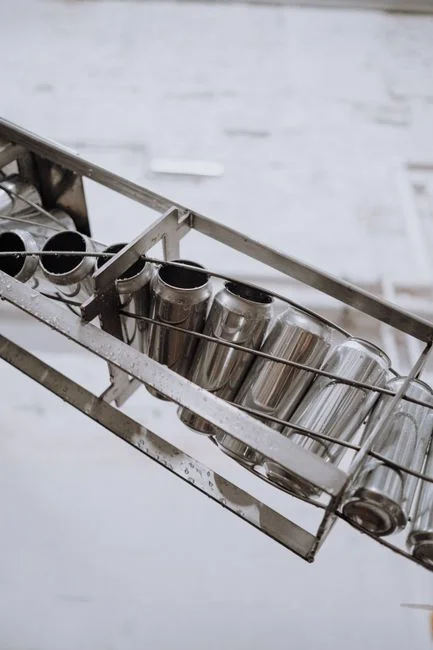
The treatment train takes blowdown from the cooling loop and converts it back into usable makeup without ever letting silica, hardness or biological fouling set the recovery ceiling. Stage 1 is a side-stream multi-media side-stream filter sized at 1–5% of circulation flow to keep suspended solids below the 10–15 micron feed requirement for the downstream membranes. Stage 2 is a PVDF ultrafiltration skid with 0.01–0.1 micron hollow-fibre membranes, operating at 10–30 psi with 90–95% recovery and automatic backwash; chemical cleaning typically runs only every 1–3 months under normal Kaduna loading. Stage 3 is a brackish-water RO system conservatively operated at 50–75% local recovery because Kaduna feed silica and hardness force a more cautious design than the global 75–80% benchmark; permeate at 10–50 mg/L TDS blends back as cooling-tower makeup. An antiscalant and biocide dosing skid formulated for high-silica tropical feed, paired with pH adjustment to 6.5–7.0, keeps RO recovery above 70% without accelerated membrane scaling. Stage 4 — mechanical vapour compression (MVC) — enters only when zero liquid discharge (ZLD) is required, the site sits inside a groundwater protection zone, or generator cooling constraints force a zero-discharge posture; MVC energy demand sits in the 15–25 kWh per 1,000 gallons of distillate band (per Genesis 2026), so against the 2026 industrial tariff band of roughly ₦140–₦220/kWh, MVC will dominate any opex case. A UV steriliser between UF and RO avoids accumulating oxidant residuals in the RO feed.
| Stage | Function | Operating envelope | Indicative role |
|---|---|---|---|
| 1 — Side-stream multimedia / spiral filter | TSS reduction to 10–15 µm | 1–5% of circulation flow | Pre-UF guard |
| 2 — PVDF ultrafiltration | Bacteria, virus, colloidal removal | 0.01–0.1 µm, 10–30 psi, 90–95% recovery | RO feed conditioning |
| 3 — Brackish-water RO | Dissolved solids, silica, hardness | 150–400 psi, 50–75% local recovery | Permeate back to cooling-tower makeup |
| Chemical dosing | Scale and biological control | pH 6.5–7.0, high-silica antiscalant | Keep RO above 70% recovery |
| UV steriliser | Non-persistent disinfection | Between UF and RO | Protects RO membrane from oxidant |
| 4 — MVC (Phase 3 only) | Brine concentration, distillate recovery | 15–25 kWh/1,000 gal distillate | ZLD trigger, not Day 1 |
Picking the Right End-Use for Treated Blowdown
The end-use choice drives both capex and the permit surface, so the engineer has to pick the right one before specifying pumps and membranes. Cooling-tower makeup reuse is the highest-value option at 60–85% recovery and directly displaces fresh water; it is the path a 2026 Kaduna build should default to because it shrinks both the borehole draw and the FMEnv permit surface. Non-potable on-site reuse (irrigation, equipment washdown, toilet flushing) accepts lower recovery but spreads capex across more end uses, which is useful for a campus with significant landscaping. Discharge compliance becomes the right choice only when reuse is genuinely infeasible and discharge fees are bearable; the global benchmark of $5–15 per 1,000 gallons in water-stressed regions (per Genesis 2026) is a defensible proxy for what Kaduna municipal treatment will charge once FMEnv tightens enforcement. ZLD is technically possible — Genesis cites 95–99% overall water recovery and 20–30% dissolved solids in the final brine — but is reserved for sites inside a groundwater protection zone or under a hyperscaler corporate mandate, not a Day 1 commitment for most Kaduna builds.
| End-use option | Typical recovery | Best fit on a Kaduna site | Watch-out |
|---|---|---|---|
| Cooling-tower makeup reuse | 60–85% | Default 2026 choice for 5–50 MW builds | Silica scaling above 70% local recovery |
| Non-potable on-site reuse | 40–70% | Campus sites with landscaping, washdown demand | Cross-connection control, plumbing segregation |
| FMEnv-compliant discharge | 50–75% (RO only) | Only when reuse is infeasible | Discharge fees $5–15/1,000 gal (per Genesis 2026) |
| Zero liquid discharge | 95–99% | Groundwater protection zones, ZLD-mandated sites | $3–8M capex, $5–15/1,000 gal OPEX (per Genesis 2026) |
Capex, Opex and the Naira Economics of a Kaduna Build
A 50,000 GPD RO skid sized for a Kaduna 5–10 MW edge site lands at roughly $250,000–$500,000 installed, with OPEX of $1.50–$3.00 per 1,000 gallons including energy, antiscalant and membrane replacement (per Genesis 2026). At a 2026 exchange band of roughly ₦1,500–₦1,800 per US dollar, the naira capex lands between ₦375M and ₦900M, with OPEX dominated by energy at the 2026 industrial tariff band of roughly ₦140–₦220/kWh; energy is 60–70% of OPEX, so generator hours per month directly determine payback. Full ZLD ($3–8M capex, $5–$15 per 1,000 gallons OPEX, per Genesis 2026) is rarely justified on a first build, so the financially defensible posture is to defer MVC and crystallisation until FMEnv tightening or a Phase 2 expansion forces the issue. The pragmatic build order is: Phase 1 (months 0–6) side-stream filtration plus UF plus an antiscalant and biocide dosing skid to stabilise the loop and drop TSS; Phase 2 (months 12–18) the industrial RO skid sized for Kaduna blowdown recovery, commissioned once the first 6–12 months of operating data confirm silica and hardness baselines; Phase 3 (on trigger) MVC and crystallisation. For a parallel sizing reference, the RO vs EDI sizing guide lays out the membrane and polishing trade-offs.
| Build phase | Scope | Indicative USD capex | Indicative USD OPEX (/1,000 gal) | Indicative naira capex (₦1,500–₦1,800/$) |
|---|---|---|---|---|
| Phase 1 (months 0–6) | Side-stream filtration + UF + dosing skid | $50,000–$200,000 | Low (chemical only) | ₦75M–₦360M |
| Phase 2 (months 12–18) | 50,000 GPD RO + post-neutralisation | $250,000–$500,000 | $1.50–$3.00 | ₦375M–₦900M |
| Phase 3 (on trigger) | MVC + crystalliser | $3,000,000–$8,000,000 | $5.00–$15.00 | ₦4.5B–₦14.4B |
FMEnv and NESREA Compliance Path for a Kaduna Site
The FMEnv National Environmental (Effluent Limitation) Regulations 2009 set parameter limits for pH, total suspended solids, BOD, COD, total residual chlorine, heavy metals and oil and grease, and the project design must demonstrate margin to those limits on the peak day, not the average day. Any blowdown entering a public drain in Kaduna State requires an FMEnv effluent discharge permit, and the permit conditions for ICT and power infrastructure typically include TDS, residual oxidant and temperature limits that an RO plus post-neutralisation train can meet. Operators should secure an FMEnv effluent discharge permit (or demonstrate zero discharge via reuse) and a NESREA compliance certificate before commissioning; site-specific water abstraction registration with the Kaduna State Water Board and a generator-stack emissions permit run in parallel. The regulatory arithmetic is straightforward: the more blowdown that is converted to cooling-tower makeup, the smaller the volume that has to be permitted, the lower the sampling burden, and the easier the renewal cycle — so a reuse-first design is also a compliance-first design. For a parallel benchmark on a comparable North-Central guinea-savannah build, the comparable Abuja data center guide walks through the same permit sequence; for a hot-arid comparator, the comparable Khartoum data center guide covers the high-evaporation case.
Frequently Asked Questions
What blowdown volume should a 1 MW, 5 MW and 50 MW Kaduna site plan around?
At 4 cycles of concentration, blowdown is roughly 25–30% of makeup. A 1 MW evaporative-cooled site in the Kaduna guinea-savannah belt should plan around 2,000–6,000 L/day of blowdown, a 5 MW site around 10,000–30,000 L/day, and a 50 MW site around 100,000–300,000 L/day — confirm with site-specific makeup, PUE and ambient wet-bulb before sizing RO skids.
Can untreated cooling-tower blowdown be sewer-discharged under the FMEnv 2009 Regulations without a permit?
No. Any industrial stream entering a public drain in Kaduna State requires an FMEnv effluent discharge permit, and the permit conditions typically include TDS, residual chlorine and temperature limits that untreated 1,200–6,000 mg/L blowdown will not meet, so RO or equivalent polishing is required before any sewer discharge. Secure the permit, or demonstrate zero discharge via reuse, before commissioning.
What should an engineer verify on a Nigerian wastewater equipment supplier before paying a deposit?
Request a Nigerian reference list with operating data (not just PO copies), a membrane warranty that names the OEM and the replacement cycle in years, and a written after-sales response time in hours for Kaduna State. Cross-check the reference list with a recent buyer and confirm the supplier stocks spares locally — a low headline price that ignores service coverage is not a defensible shortlist.
What is a realistic 2026 installed cost for a 50,000 GPD RO skid in naira for a Kaduna build?
Per Genesis Water Technologies (2026), a 50,000 GPD RO skid lands at $250,000–$500,000 installed, with OPEX of $1.50–$3.00 per 1,000 gallons. At a 2026 exchange band of roughly ₦1,500–₦1,800 per US dollar, the naira capex band is ₦375M–₦900M — request a site-specific quotation that itemises membrane count, antiscalant dosing and energy draw at the ₦140–₦220/kWh industrial tariff band before signing.
What is the typical lead time for a Phase 1 + Phase 2 blowdown treatment package shipped into Kaduna?
Plan for 16–28 weeks total for engineering, manufacturing, shipping and commissioning on a Phase 1 + Phase 2 package, dominated by membrane manufacturing and ocean or air freight to Apapa and onward road transport to Kaduna. Request a critical-path schedule with named milestones and hold-points for FMEnv permit submission and site acceptance testing before signing.
Related Equipment
- UV steriliser — specifications, capacity range, and technical data