What a Containerized MBR STP Actually Is
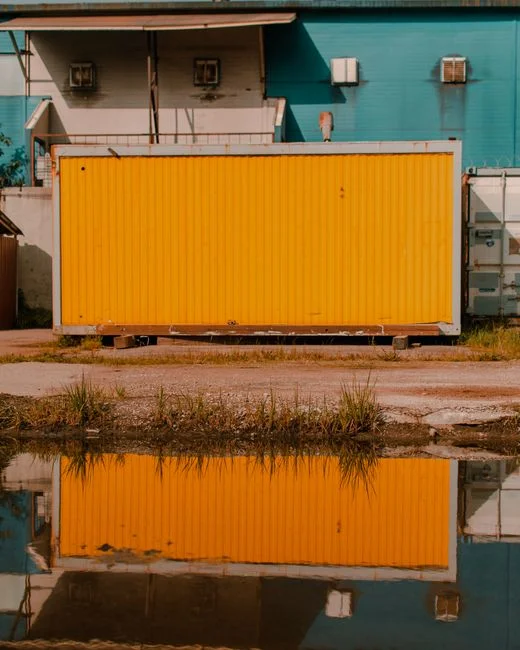
A containerized MBR STP is a packaged sewage treatment plant built inside a standard 20-foot or 40-foot high-cube (HC) ISO shipping container, with all biological and membrane stages pre-assembled on internal skids. Pure Aqua's MBR-C datasheet (2020-04) describes the system as a containerized membrane bioreactor using submerged hollow fiber (HF) ultrafiltration (UF) modules with a nominal pore size of 0.04 µm, designed for both municipal and industrial wastewater. MENA-Water offers a comparable package in the same ISO container format, with all main equipment pre-assembled for plug-and-play delivery.
Inside the container, raw sewage passes a 1.5 mm perforation drum screen to protect the membrane surface, then flows into an aeration tank where fine-bubble diffusers supply oxygen for biological oxidation of organic matter and nitrification of ammonia. Mixed liquor then overflows by gravity to the membrane tank, where the submerged HF UF modules retain biomass, suspended solids, and viruses. Coarse-bubble air scour keeps the membrane surface clear, with periodic chemical cleaning to control transmembrane pressure.
The membrane itself is PVDF produced by thermally induced phase separation (TIPS), which the MBR-C datasheet credits with high tensile strength, extended membrane lifetime, and tolerance to strong oxidation conditions. The datasheet lists the standard build as insulated container walls, zero water leakage, seaworthy structure, standby pumps for redundancy, and a remote monitoring option. For Malaysian sites, the format's main appeal is limited site work, quick installation, and the option to relocate the plant when a worker camp or temporary development reaches end of life, an approach that fits residential estates, worker camps, hospitals, golf courses, and resort clusters.
To see how a containerized MBR membrane bioreactor system is built up for residential or camp duty, the integrated MBR product page shows the same skidded architecture in a fixed-frame alternative.
Why Sizing in Kuala Lumpur Is Its Own Exercise
Kuala Lumpur's climate and utility standards push a generic MBR-C datasheet pick off its default assumptions. Ambient temperatures in the Klang Valley sit at or above the 20–30°C operating window and 20°C design temperature that Pure Aqua defines for the MBR-C, so biological kinetics are favourable; however, direct sun on a steel container can push internal air temperatures above the operating band, so ventilation, shading, or insulation upgrades should be confirmed before placement.
Occupancy profile matters as much as climate. Worker camps and resort staff housing produce sharp morning and evening peaks from shift-change showers and meals, while residential estates produce sustained evening peaks. Both profiles lift the peaking factor above 1.0× average dry-weather flow, which can push the selected container up one model size compared with a flat commercial load.
Feed strength in unsewered Malaysian developments typically trends higher in BOD and COD than EU defaults. The Pure Aqua reference feed is BOD 250 / COD 400 / TSS 200 / NH4-N 30 mg/L, and any local influent survey that exceeds these values needs supplier confirmation before container selection is frozen, because higher F:M ratios compress aeration tank margins.
The MBR-C datasheet specifies 460V/3Ph/60Hz, which is not the Malaysian industrial norm of 415V/3Ph/50Hz. A confirmed electrical re-spec, transformer, or VFD package has to be requested up front. The same applies to the discharge standard: the MBR permeate is excellent on BOD, COD, and solids, but Malaysian Department of Environment parameters for river discharge or irrigation reuse may still require polishing for nutrients, chlorine residual, or specific reuse-class parameters, and that polishing has to be added to the scope before the model number is selected.
The Sizing Workflow in Five Steps
The question a KL engineer actually asks on a Monday morning is "how many containers do I need for X people?" The answer is a five-step procedure that converts headcount into a defensible container count.
- Define the design population. For a residential development, multiply dwelling units by the standard occupancy used in the local planning submission; for a camp, use the maximum headcount with a shift factor if occupants rotate. Record both average and peak occupancy, because the peaking step later depends on having both numbers.
- Convert population to flow. Apply a per-capita flow rate consistent with Malaysian practice. The Pure Aqua MBR-C datasheet (2020-04) uses 50 gpd per capita as its reference basis for the published population table. Cross-check this number against the developer's water-supply records, because Malaysian residential per-capita consumption typically runs higher than the datasheet default, and the higher of the two figures should govern.
- Apply a peaking factor. Residential and camp flows are not flat. Apply a peaking multiplier to the average dry-weather flow to size the container, not just the average. A 1.5× multiplier is a common starting point for concentrated camp profiles; residential estates with sustained evening peaks often justify 1.3× to 1.5× depending on the unit mix.
- Match to a container. Round the design flow up to the nearest standard MBR-C model envelope, choosing between 1×20' HC (≈50 m³/d) and 1×40' HC (≈100–190 m³/d) per the Pure Aqua datasheet. For flows above the largest single-container envelope, plan multiple parallel containers with a common inlet manifold, not a single oversized train.
- Check envelope constraints. Confirm container footprint against site access roads, crane reach for a high-cube ISO container, slab loading, sludge storage volume, and reject or stormwater handling before the model number is frozen. Electrical, climate, and discharge polishing items from the previous section are part of this step, not a separate exercise.
Standard Container Sizes and Population Capacity
The Pure Aqua MBR-C datasheet (2020-04) publishes a model line that maps flow rate, approximate population at 50 gpd per capita, membrane count, and container size. That table is the fastest envelope reference for a KL engineer during early sizing. MENA-Water adds that its 40-foot ISO container can be arranged to filter more than 1,200 m³/day at the high-capacity end, so very large KL residential schemes are still feasible in a small container count, but require multi-skid internal layouts and are beyond the four-model MBR-C line shown below.
| Model | Flow (gpd) | Flow (m³/d) | Approx. Population (50 gpd/capita) | Skids / Modules | Container |
|---|---|---|---|---|---|
| MBR-C-13.2K-06 | 13,211 | 50 | 265 | 2 skids / 3 modules | 1 × 20' HC |
| MBR-C-26.4K-10 | 26,421 | 100 | 529 | 2 skids / 5 modules | 1 × 40' HC |
| MBR-C-39.6K-16 | 39,631 | 150 | 793 | 2 skids / 8 modules | 1 × 40' HC |
| MBR-C-50.2K-20 | 50,198 | 190 | 1,004 | 2 skids / 10 modules | 1 × 40' HC |
Two caveats apply before this table is used for hydraulic design. First, 50 gpd per capita is the manufacturer's basis; the engineer should re-derive per-capita flow from local water-supply or planning data and only use the table for envelope sizing, not for the design flow itself. Second, the table sizes the biological and membrane envelope; the actual container count on site must also accommodate any added pre-treatment (a rotary mechanical bar screen for higher-solid camp waste, for example), sludge holding, and chemical dosing skids that the datasheet lists as available options. Where a project wants flat-sheet UF rather than hollow fiber, a submerged MBR flat sheet membrane module is the usual alternative.
Worked Example: 500-Person Camp on the KL Fringe
Take a 500-person construction worker camp on the edge of the Klang Valley. Step 1: design population is 500 peak occupants. Step 2: applied at the Pure Aqua datasheet basis of 50 gpd per capita, the average design flow is 500 × 50 = 25,000 gpd, which is about 95 m³/d. Step 3: a camp with concentrated shift-change showers and meals is a textbook peaking case, so apply 1.5× to get a peak flow of roughly 142 m³/d.
Step 4 — match to a container. 142 m³/d sits between the MBR-C-26.4K-10 (100 m³/d, 1×40' HC) and the MBR-C-39.6K-16 (150 m³/d, 1×40' HC) envelopes, so the correct selection is 1×40' HC at the next model up, MBR-C-39.6K-16. This keeps peak flow and any feed-strength margin inside the design envelope without oversizing aeration. If the camp expands to about 800 people, the MBR-C-50.2K-20 (190 m³/d, 1×40' HC) still fits within a single 40-foot container; beyond that, the correct move is a second 40' HC unit in parallel rather than overloading a single train.
Step 5 — confirm before purchase. Three items must be re-confirmed against local conditions rather than datasheet defaults: feed BOD/COD sampling at the site, because Malaysian camp waste can run above the MBR-C reference of 250 mg/L BOD; an electrical re-spec from 460V/3Ph/60Hz to 415V/3Ph/50Hz, with a transformer or VFD package quoted by the supplier; and any required polishing such as chlorination, UV, or nutrient removal for the Malaysian discharge or reuse target. The same flow logic applies if a reader is working a Japanese site instead; a parallel method for containerized MBR sizing for Tokyo residential and camp projects is laid out in a comparable guide.
Pre-Purchase Checklist for a KL Residential or Camp Project
Sizing work only matters if it survives the supplier quotation. The following checklist converts the workflow into a vendor-ready specification for a Kuala Lumpur residential or camp enquiry.
- Confirm the design flow and population basis in writing, and ask the supplier to size against both average and peak flow, not just the average.
- Confirm influent assumptions (BOD, COD, TSS, NH4-N) match a recent local survey rather than the datasheet defaults of BOD 250 / COD 400 / TSS 200 / NH4-N 30 mg/L from the MBR-C datasheet.
- Confirm effluent targets. MBR-C permeate is TSS <5 mg/L, BOD <10 mg/L, COD <50 mg/L, NH4-N <2 mg/L, which is sufficient for many reuse and discharge routes, but check whether nutrient removal, disinfection polishing such as a UV sterilizer for effluent polishing, or an automatic chemical dosing system is needed for the Malaysian discharge or reuse class.
- Confirm electrical: the standard MBR-C supply is 460V/3Ph/60Hz; for Malaysia, request 415V/3Ph/50Hz or document the transformer package.
- Confirm mechanical envelopes: container dimensions and weights, crane and trailer access for a high-cube container, slab loading, sludge storage, and the standby pump and remote monitoring options that Pure Aqua lists as available options.
- Confirm documentation: factory testing, plug-and-play commissioning scope, operator training, membrane cleaning chemical supply, and access to spare membrane modules.
Frequently Asked Questions
What size containerized MBR do I need for X people?
Start with the design population, apply a per-capita flow rate, and add a peaking factor. The Pure Aqua MBR-C datasheet (2020-04) uses 50 gpd per capita as its reference basis and maps that to 1×20' HC for about 265 people (50 m³/d) and 1×40' HC from about 529 to 1,004 people (100 to 190 m³/d) depending on the model. The per-capita figure is the manufacturer's basis; for Malaysian projects the per-capita flow should be re-derived from local water-supply or planning data, and a peaking factor added for residential and camp profiles before the container envelope is selected.
How many containers for a 1,000-person residential or camp project?
At 50 gpd per capita, 1,000 people maps to about 50,000 gpd average, which lands at or above the largest single 40' HC MBR-C model (50,198 gpd on the MBR-C-50.2K-20). The selection is either one 40' HC unit at that model, or two smaller 40' HC units in parallel, depending on the redundancy and maintenance-access policy. The decision is a buying decision: one container reduces footprint and capex but removes redundancy during membrane service, while two containers add cost and slab area but keep the plant online during maintenance.
Does a containerized MBR in Malaysia need civil works?
The format is designed for limited site work and plug-and-play, but a level slab, crane access for a high-cube ISO container, and a sludge storage and disposal route are still required. Pre-treatment skids, an automatic chemical dosing system, and any polishing step (UV, chlorination, or nutrient removal) sit outside the container and need to be planned into the site layout.
What about voltage and climate for a Malaysian site?
The MBR-C datasheet specifies 460V/3Ph/60Hz, while the Malaysian industrial norm is 415V/3Ph/50Hz, so a transformer or VFD package has to be confirmed with the supplier before purchase. The datasheet operating window is 20–30°C with a 20°C design temperature; Klang Valley ambient is typically at or above that band, so direct sun on the container should be addressed with ventilation, shading, or insulation to keep internal temperatures inside the design envelope. Both items belong in the enquiry, not as afterthoughts after the unit has shipped.