Why sizing an MBR in Amman starts with people, not equipment
A containerized MBR (membrane bioreactor) is a pre-engineered package built around a population range, not a one-size-fits-all product. The sizing exercise is really a population-to-flow calculation layered onto a standard equipment envelope: 20' or 40' high-cube (HC) ISO containers fitted with equalization, aeration, an MBR cassette, blowers, pumps, and a control panel (Pure Aqua; Kaveri/CPG design note, 2025-09). Once you have population, per-capita flow, and target effluent quality, the container count falls out of the arithmetic — it is not a vendor decision.
For domestic sewage the two design inputs that drive everything are per-capita water use and influent BOD₅. The Pure Aqua MBR-C datasheet and the Kaveri/CPG design note both anchor sizing to 50 gpd per capita (about 190 L per person per day) and a BOD₅ around 400 mg/L for domestic sewage. In Amman, three additional considerations shape the design: summer peak water use is well above winter because buildings store intermittent supply, almost every decentralized plant is sized to reuse the treated water for irrigation in a water-scarce city, and summer ambient temperature is at or above the equipment rating. These local factors determine equalization volume, reuse-quality guarantees, and how aggressively you ventilate or shade the container.
Step 1 — Convert population into design flow (the per-capita number that actually matters)
The hydraulic sizing starts with one equation: design flow (m³/d) = population × per-capita flow. The Pure Aqua MBR-C datasheet uses 50 gpd per capita to size its containerized trains, which converts to roughly 190 L per person per day. The Kaveri/CPG design note uses 200 kL/d for 200 KLD of domestic flow, the same order of magnitude, and sizes downstream units for that flow. The simplest form of the calculation for an Amman spec is therefore:
- Design flow (m³/d) = population × 0.19 m³/c/d
- Design flow (gpd) = population × 50 gpd
Average flow is not what the equalization tank and transfer pumps see. Apply a peak factor — commonly 1.5–2.0 for residential, higher for camps with shift-change showers — to size the buffer and pump duties, even though the MBR tank is designed for average flow. The Kaveri/CPG design note (2025-09) explicitly states that sewage generation is not uniform, peaks occur in the morning and evening, and flow can fall to zero at midday and overnight, which is why a coarse-bubble mixed equalization tank with 8 hours of hydraulic retention is built into the train.
Worked numbers for two Amman scenarios:
- 200-person residential block: 200 × 0.19 m³ ≈ 38 m³/d average; with a 1.5–2.0 peak factor, peak flow is roughly 57–76 m³/d. The 8-hour equalization buffer is about 12–13 m³ of storage.
- 500-person labour camp: 500 × 0.19 m³ ≈ 95 m³/d average; peak flow is roughly 140–190 m³/d, and the equalization buffer is about 32 m³.
For both cases the transfer pump head is sized to about 12 m (Kaveri/CPG design note, 2025-09), and a containerized MBR system is selected against these flow numbers rather than against container count alone.
Step 2 — Convert flow into BOD load and aeration demand
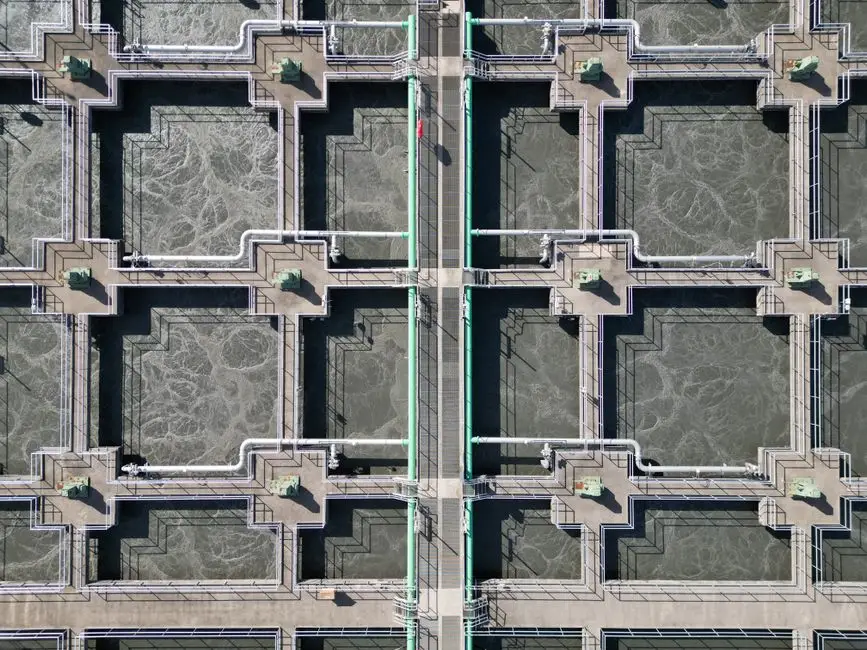
Hydraulic sizing tells you how big the tanks and pumps are; organic load tells you how much oxygen the blowers must deliver and how big the aeration tank has to be. The conversion is direct:
- BOD load (kg/d) = design flow (m³/d) × BOD₅ concentration (kg/m³)
At 400 mg/L, 1 m³/d of domestic sewage carries about 0.4 kg BOD/d, which is the influent basis used in the Kaveri/CPG design note (2025-09). The aeration tank then operates at an MLSS in the 3,000–6,000 mg/L range with fine-bubble EPDM diffusers, and oxygen demand is set at about 2 kg O₂ per kg of BOD applied. That 2:1 ratio is the same figure quoted in the Kaveri/CPG note and is the sizing basis for the lobe blower.
One detail that the spec sheet often hides: the same blower bank serves the equalization tank, aeration tank, sludge holding tank, and the MBR air-scour grid. The Kaveri/CPG design note lists blowers for "equalization tank, aeration tank, sludge tank and MBR product tank" on a (1W+1S) standby arrangement, and a separate blower feeds the membrane air-scour grid. The air requirement is the sum of those duties, not just the aeration tank, and the spec must reflect that.
Worked numbers for the two Amman scenarios:
- Residential block: 38 m³/d × 0.4 kg/m³ ≈ 15 kg BOD/d, requiring roughly 30 kg O₂/d.
- Labour camp: 95 m³/d × 0.4 kg/m³ ≈ 38 kg BOD/d, requiring roughly 76 kg O₂/d.
These loads are what the MBR must nitrify and what the blowers must supply; they are also the basis for the MLSS setpoint and the wasted sludge production rate.
Step 3 — Size the membrane area from flux and daily flow
Membrane area is the link between flow and a piece of hardware you can count on a general arrangement drawing. The conversion uses design flux:
- Membrane area (m²) = design flow (L/d) ÷ (design flux LMH × 24 h)
At a design flux of 25 L/m²·h, every square metre of PVDF membrane produces about 600 L of permeate per day. The Kaveri/CPG design note (2025-09) uses exactly this figure: PVDF hollow-fiber modules with a 0.1 µm pore size, ID/OD 0.8/2 mm, 20 m² effective area per module, design flux 25 LMH, with an operating range of 15–70 LMH. The Pure Aqua MBR-C datasheet is consistent with this, using TIPS PVDF hollow-fiber UF at a nominal 0.04 µm pore size. Either pore size meets the <5 mg/L BOD₅ reuse target the Kaveri/CPG note sets for the treated water.
Worked check for the Amman scenarios:
- Residential block at 38 m³/d ÷ 600 L/m²·d ≈ 63 m² of membrane — easily within a single 80–225 m² flat-sheet cassette with substantial headroom for the peak factor.
- Labour camp at 95 m³/d ÷ 600 L/m²·d ≈ 158 m² of membrane — still a single cassette, again with headroom for the peak factor that drives the equalization tank but not the membrane flux.
The key point for a specifier is that the cassette count is small (one or two) at these flow rates, and the PVDF flat-sheet MBR cassette envelope is what determines whether the cassette lives inside a 20' HC or 40' HC container, not the membrane area itself.
| Parameter | Residential block (200 persons) | Labour camp (500 persons) |
|---|---|---|
| Average flow | ~38 m³/d | ~95 m³/d |
| Peak flow (1.5–2.0×) | ~57–76 m³/d | ~140–190 m³/d |
| Equalization (8 h HRT) | ~12–13 m³ | ~32 m³ |
| BOD load at 400 mg/L | ~15 kg/d | ~38 kg/d |
| Membrane area at 25 LMH | ~63 m² | ~158 m² |
Step 4 — Fit the whole train into a 20' or 40' high-cube container
A containerized MBR is shipped in a standard 20' or 40' high-cube ISO container with insulated walls, zero water leakage, and an enhanced structure suitable for truck or sea freight (Pure Aqua MBR-C datasheet). The choice between them is set by tank volume, cassette count, and the number of blowers and pumps; it is not arbitrary.
The typical train inside the container, based on the Kaveri/CPG design note (2025-09) and the Pure Aqua MBR-C datasheet, runs: coarse bar screen → oil and grease separator → fine screen (~2 mm) → collection and equalization with coarse-bubble mixing (8 h HRT) → raw effluent transfer pumps (2W+1S) → aeration tank with fine-bubble EPDM diffusers → MBR tank with submerged PVDF cassettes and air-scour grid → sludge holding tank with coarse diffuser → filter press with screw pump for sludge → MBR cleaning tank → online UV or chlorination → final treated water sump. The control panel and the lobe blowers (1W+1S) sit at the service end of the container.
Equalization is usually the bulkiest item. At 8 h HRT the residential block needs about 12–13 m³ of buffer, which can be built into the container or in an adjacent civil tank. The labour camp needs about 32 m³, which is a strong argument for putting the equalization tank in civil works and using the container for the aeration, MBR, and disinfection stages. The cassette, blowers, dosing panel, and control cabinet then share the remaining container length, and clean-water piping must be laid out so individual membrane elements can be lifted out for service without removing the cassette frame.
Amman-specific constraints: climate, power, and the reuse target
A generic sizing sheet will not catch the issues that matter in Amman. Three constraints are local and need to be specified explicitly.
Climate. The Pure Aqua MBR-C datasheet rates the operating temperature range at 20–30°C (68–86°F) with a design point of 20°C (68°F), and the Kaveri/CPG design note lists a maximum membrane temperature of 40°C. Amman's summer ambient sits at or above the operating range, so aeration tank ventilation, container shading, and insulation of the walls become real design issues rather than optional extras. The membrane modules themselves tolerate 2–10 pH and up to 40°C (Kaveri/CPG, 2025-09), so the temperature stress shows up as flux derating and air-scour demand, not as membrane failure.
Power. The Pure Aqua MBR-C datasheet specifies 460 V/3 Ph/60 Hz, which is the North American supply. For Jordan, the spec must be confirmed against the local grid (400 V/3 Ph/50 Hz), a generator backup, and the option of solar-hybrid power for remote camps. Voltage mismatch is one of the most common reasons a containerized MBR delivered from outside Jordan has to be rewired on site.
Reuse and sludge. The Kaveri/CPG design note (2025-09) sets the treated-water targets at BOD₅ <5 mg/L, COD <20 mg/L, turbidity <2 NTU, TSS near nil, and unobjectionable odor — the same band a Jordanian reuse standard for landscape irrigation will require. These are guaranteed effluent numbers, not averages, and they should be written into the purchase specification as such. Sludge handling should also be specified up front: a sludge holding tank with a sludge dewatering filter press keeps the containerized plant within its footprint and avoids hauled-liquid sludge in Amman's traffic, and the UV disinfection for the MBR permeate is the standard polishing step for irrigation-reuse quality.
Procurement checklist for an Amman containerized MBR
Once the calculation is done, the engineering input turns into a buying specification. A supplier cannot size correctly without the design basis, and a Jordanian engineer should send the following with the enquiry so bids are comparable.
| Item to specify | What to write in the enquiry |
|---|---|
| Design basis | Population, per-capita flow (L/c/d), peak factor, influent BOD₅, target effluent BOD₅/COD/TSS/turbidity |
| Container envelope | 20' or 40' HC; insulated walls; zero water leakage; service access for cassette removal |
| Membrane spec | PVDF; HF or flat sheet; pore size 0.04 µm or 0.1 µm; design flux (LMH); MLSS range; number of cassettes with one redundant |
| Electrical and ambient | 400 V/3 Ph/50 Hz for Jordan; ambient design temperature; noise level at container boundary; ventilation for >30°C summer |
| Ancillaries | Bar screen, fine screen, oil/grease trap, blowers (1W+1S), transfer pumps, UV, control panel, sludge holding and dewatering |
| Documentation | P&ID, electrical single-line, general arrangement, O&M manual, and a list of consumables |
Send this as a single enquiry sheet and ask vendors to fill in the same cells. The differences between bids will then show up as design decisions (membrane pore size, cassette count, blower duty, equalization strategy) rather than as apples-to-oranges quotations. The same sizing method is used in other hot-climate, water-scarce cities; the containerized MBR sizing in Jakarta, containerized MBR sizing for Bandung projects, and containerized MBR sizing for Surat residential and camp projects guides walk through the same calculation with locally adjusted inputs.
Frequently Asked Questions
What per-capita flow should I use to size a containerized MBR for a 200-person residential block in Amman?
Use 190 L per person per day (about 50 gpd) for a residential block, which gives roughly 38 m³/d average flow for 200 people and a peak flow of 57–76 m³/d at a 1.5–2.0 peak factor (Pure Aqua MBR-C datasheet; Kaveri/CPG design note, 2025-09). For a labour camp with shift-change showers, hold the 190 L/c/d base but move the peak factor toward the upper end of the range so the equalization tank and transfer pumps are not undersized.
How many containers do I need for a 500-person camp in Amman?
At 95 m³/d average flow and a membrane area of about 158 m² at 25 LMH (Kaveri/CPG design note, 2025-09), the cassette, blowers, and UV fit inside a single 40' high-cube ISO container; the equalization tank at 8 h HRT is about 32 m³ and is usually built in civil works next to the container rather than inside it. Confirm with the vendor that the cassette, blowers, and control panel all fit in one 40' HC with service access for element replacement before signing the PO.
What reuse quality can a containerized MBR guarantee for landscape irrigation in Jordan?
The MBR plus UV polishing specified in the Kaveri/CPG design note (2025-09) is rated for BOD₅ <5 mg/L, COD <20 mg/L, turbidity <2 NTU, and TSS near nil — the same band a Jordanian reuse standard for landscape irrigation requires. Write these numbers into the purchase spec as guaranteed maximums, not typical values, and require the vendor to demonstrate them on the treated water sump before handover.
How do I compare containerized MBR suppliers for an Amman project?
Send the same design basis sheet (population, per-capita flow, peak factor, influent and effluent quality, container size, 400 V/3 Ph/50 Hz supply, ambient temperature) to each vendor and ask for a comparable return: P&ID, electrical single-line, general arrangement, membrane spec (PVDF, pore size, design flux, cassette count with redundancy), blower and pump duties, and a list of ancillaries. Bids that omit the documentation or quote a different design basis should be normalized back to the same envelope before price comparison; the lowest headline price is often the one with the thinnest ancillaries list or the smallest equalization tank.