Why Mombasa Projects Need a Different Sizing Approach
A containerized MBR sized from a generic inland template routinely under-performs on the Kenyan coast because three site factors shift at once: ambient temperatures in Mombasa stay high year-round, the water table on many coastal plots sits within 1–2 m of grade, and brackish groundwater intrudes into soak-away design. Each of these changes the real hydraulic and organic load that a packaged MBR must handle, so the first sizing decision should be site-specific, not catalogue-driven.
Residential communities, gated developments, and worker camps in Mombasa also have a population profile that breaks a "bed count equals flow" assumption. A construction camp or NGO facility can have a small overnight headcount but a much larger daytime population of shift workers, kitchen staff, and clinic visitors. Person-equivalents must therefore be derived from peak occupancy at the busiest hour, not from beds or apartments counted at night. Containerized MBR units in the 10–2,000 m³/day envelope, typically fitted with submerged PVDF membranes, are the practical range for this duty, and the calculation should end in cubic metres per day. According to the IDA Water Security Handbook (2019/2020), 1 m³ equals 1,000 litres, which is the unit every downstream datasheet, quotation, and NEMA submission will use. A Mombasa-specific containerized MBR sizing guide for residential and camp projects reuses the same unit logic applied in the Almaty containerized MBR sizing guide and the Tokyo containerized MBR sizing guide, with coastal inputs substituted at each step.
Step 1 — Convert the Population into Person-Equivalents
The person-equivalent (PE) count is the first defensible number in any Mombasa sizing calculation, rather than a raw flow. A PE is one resident's wastewater production averaged over 24 hours, and every other figure in the calculation scales from it.
For residential communities, count each apartment, villa, or staff house as one household and apply the household occupancy factor used by the local Water Services Provider — the Kenya urban planning default is 4–5 persons per household, but Mombasa County may apply a different multiplier, so confirm before sizing. For worker camps, count the maximum overnight occupants plus any day-shift visitors, because the peak hydraulic load on an MBR occurs at the morning shower and ablution window, not overnight. Add an allowance for on-site kitchens, laundries, clinics, and security or driver accommodation as additional person-equivalents rather than as a separate flow stream; this keeps the biological and hydraulic stages sized against one consistent number. Record the final PE figure as the single input that drives the next three steps, and resist the temptation to convert it to a flow until Step 2.
Step 2 — Apply the Design Per-Capita Sewage Flow
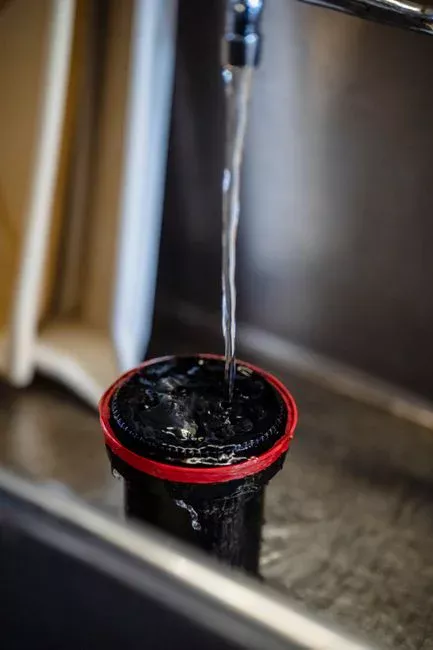
Multiplying the PE count by a design per-capita flow turns the population number into the average daily flow in m³/day, which is the unit every MBR datasheet is rated in. The conversion is straightforward: flow (m³/day) = person-equivalents × per-capita flow (L/person/day) ÷ 1,000. The IDA Water Security Handbook (2019/2020) confirms that 1 m³ = 1,000 L is the primary unit on a per-day basis, so the divisor is fixed.
For residential developments in East Africa, design per-capita flows typically sit in the 100–150 L/person/day band, while camps with shared ablutions, mess halls, and laundry facilities run higher because of cleaning water, food preparation, and uniform washing. The exact figure must be confirmed against the project's own water-balance data or a measured consumption reading from a similar facility, because the supplied research does not provide a Kenya-specific number. Where on-site greywater is recycled for landscape irrigation, subtract that volume from the biological stage sizing but keep it in the hydraulic load on the screening and equalisation stages, since those see the total flow. Express the final number in m³/day; this is the value an MBR supplier will ask for first, and it matches the unit conventions used in any MBR sizing calculation for industrial duty covered in a BOD/COD removal technology buyer guide.
Step 3 — Apply the Right Peak and Peaking Factor
An MBR sized only on the average daily flow will be undersized at the membrane tank, the feed pump, and the equalisation buffer, because wastewater does not arrive uniformly over 24 hours. A peaking factor converts the average flow into a peak hourly flow that the screen, transfer pumps, and membrane modules must handle without surge damage or trans-membrane pressure spikes.
A peaking factor of 2.0–2.5 is normally applied to residential communities, where morning and evening peaks are spread across a wider population. Worker camps, schools, and shift-change facilities are more aggressive — 70–80% of the daily volume can occur in a 4–6 hour window — and a factor of up to 3.0 may be needed. The exact value applied in Kenya is project-specific and must be confirmed with the local Water Services Provider or with the NEMA Design Manual; the supplied research does not state a Kenyan peak factor value. Size the equalisation tank to absorb the difference between the peak and average flow over the peak window, not over 24 hours, because a buffer that "looks right" on a 24-hour average will still let the membrane tank see a surge.
Step 4 — Match Capacity to a Containerized MBR Configuration
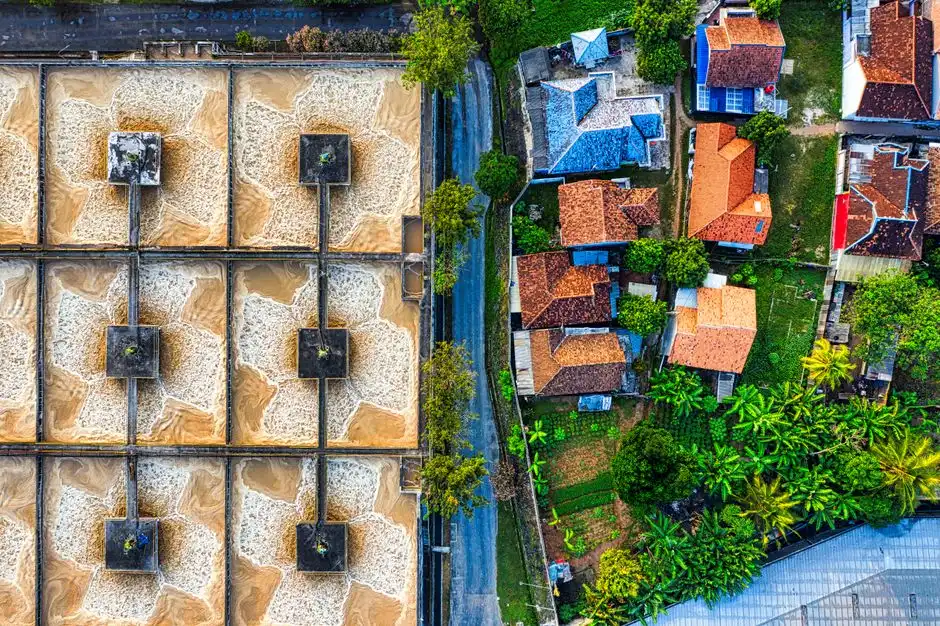
Selecting a unit rated 20–30% above the calculated average daily flow ensures the membranes operate below their nominal flux and trans-membrane pressure stays inside the supplier's clean-water envelope. Containerized MBR systems in the 10–2,000 m³/day range are the standard envelope for this duty, and the chosen rating must be cross-checked against the available plot area, access road, and crane reach on the Mombasa site — coastal plots are often narrow, and a 40 ft container needs hardstand and lift clearance.
Specify submerged PVDF modules — flat-sheet or hollow-fibre — and confirm that the supplier has an installed reference list in East Africa at a similar climate. Confirm that the aeration blower is sized for Mombasa's coastal ambient temperature, since warmer water reduces oxygen solubility and the biological stage needs more air per kg BOD removed. A comparable bid should include an upstream rotary mechanical bar screen, an equalisation tank with mixing, a clean-in-place system, and a downstream disinfection stage. A representative unit selection for this duty is a containerized MBR wastewater treatment system fitted with a PVDF flat-sheet MBR membrane module and a UV sterilizer for water treatment on the permeate line.
| Parameter | Residential community | Worker camp / NGO facility |
|---|---|---|
| Typical design flow range | 10–500 m³/day | 10–500 m³/day |
| Per-capita sewage flow | Confirm against project water balance (typical East African band 100–150 L/person/day — verify) | Confirm against project water balance (camp duty usually higher than residential) |
| Peaking factor | 2.0–2.5 (confirm with local Water Services Provider) | Up to 3.0 (confirm with local Water Services Provider) |
| Membrane type | Submerged PVDF, sub-1 µm nominal pore | Submerged PVDF, sub-1 µm nominal pore |
| Pre-treatment | Rotary bar screen + equalisation | Rotary bar screen + equalisation + grease trap for kitchen waste |
| Disinfection for reuse | UV or chlorine dioxide sized to peak reuse flow | UV or chlorine dioxide sized to peak reuse flow |
| Compliance reference | Kenya Environmental Management and Coordination (Water Quality) Regulations — obtain exact limits from NEMA | Kenya Environmental Management and Coordination (Water Quality) Regulations — obtain exact limits from NEMA |
Step 5 — Worked Example for a 300-Person Mombasa Camp
Walking through the steps with a 300-person construction camp on a coastal Mombasa plot requires confirming the per-capita figure against the project's water meter rather than assuming a value.
Step 1 — 300 overnight occupants plus 30 day-shift kitchen and clinic staff = 330 person-equivalents at peak. Step 2 — 330 PE × 130 L/person/day ÷ 1,000 = 42.9 m³/day average flow (1 m³ = 1,000 L per the IDA Water Security Handbook 2019/2020). Step 3 — Apply a camp peak factor of 2.5 to obtain a peak hourly flow of roughly 4.5 m³/h, which an equalisation buffer of about 40–50 m³ can absorb over a typical morning peak window. Step 4 — Round up to a standard containerized MBR rating of 50 m³/day, which leaves margin for kitchen and laundry surges, future expansion, and the next phase of the camp. Before issuing a purchase order, cross-check the 50 m³/day unit's footprint, power consumption, salinity tolerance for brackish groundwater intrusion, and effluent quality against the Mombasa site survey and the chosen discharge or reuse route.
Step 6 — Discharge, Reuse, and Compliance Checks for Mombasa
The final sizing check is legal, not hydraulic. Confirm the discharge route with Mombasa Water Supply and Sanitation Company and with NEMA before finalising capacity, because the chosen route sets the effluent target the MBR must hit.
The effluent must satisfy Kenya's Environmental Management and Coordination (Water Quality) Regulations for BOD, COD, TSS, faecal coliforms, and nutrients — the exact local limits are not stated in the supplied research and must be obtained directly from the regulator before any datasheet is locked in. Where the project targets reuse for toilet flushing or landscape irrigation, the MBR must be followed by disinfection — UV or chlorine dioxide — sized for the peak reuse flow, not for the average discharge flow, because a reuse line that is undersized at peak hour will back up the membrane tank. The same logic appears in an Amman containerized MBR sizing guide, where reuse targets change the downstream equipment list rather than the upstream MBR rating. Document the chosen discharge or reuse pathway in the design report so the supplier can match the disinfection duty and the instrumentation (flow, TSS, residual chlorine or UV transmittance) to the actual compliance target, and so a NEMA audit can verify the design intent against the installed plant.
Frequently Asked Questions
What is the realistic budget for a containerized MBR STP sized for a 300-person Mombasa camp?
No Kenyan MBR price is provided in the supplied research, and any figure quoted without a confirmed flow, footprint, and reuse target is unreliable. The actionable check is to send the supplier three inputs — the average daily flow in m³/day (42.9 m³/day from the worked example), the peak factor (2.5), and the discharge or reuse target — and request a written quotation itemised by container, membrane module, pre-treatment, disinfection, and instrumentation.
How do I select a supplier for a containerized MBR STP in Mombasa?
The decision should be made on documented East African reference plants, not on catalogue capacity. Ask the supplier for a list of installed containerized MBR units of similar m³/day rating in Kenya or Tanzania, a sample effluent test report against the Environmental Management and Coordination (Water Quality) Regulations, and confirmation that the membrane modules are submerged PVDF. A vendor that cannot produce those three items is not yet qualified for a Mombasa camp duty.
What is a realistic lead time for a 50 m³/day containerized MBR delivered to Mombasa?
The supplied research does not give a Kenyan delivery window, so the buyer must request a written lead time broken into four stages — engineering drawing approval, container fabrication, membrane delivery, and sea-freight plus Mombasa road transport — and confirm which stage gates the payment milestones. Without that breakdown, an advertised "12-week delivery" can hide a