Which regulation actually controls a Hercules sewer discharge
For a mining or metals plant in or near Hercules, US, the controlling number on a 2026 sewer discharge is the local publicly owned treatment works (POTW) limit set under 40 CFR Part 403, not the federal categorical ceiling. Metal-ore operations classified under NAICS 2122 (Ore Mining and Dressing) sit beneath 40 CFR Part 440, which EPA promulgated in 1975 and last amended in 1988 and which establishes national BAT/AEL ceilings rather than site-specific caps.
Industrial-mineral operations (aggregates, dimension stone, sand and gravel, kaolin, feldspar, garnet, lithium, and the other named subparts) follow 40 CFR Part 436 (Mineral Mining and Processing); most quarries and aggregate producers in the Hercules area fall under Part 436, not Part 440. Iron and steel smelters use 40 CFR Part 420 Subpart C, and nonferrous smelters and refiners use 40 CFR Part 421; a mine-mill that does not run a smelter cannot borrow limits from those categories. Where the discharge goes to a municipal sewer, 40 CFR Part 403 (General Pretreatment) layers on top, and the local POTW's sewer-use ordinance is the binding number.
Hercules-area plants must design against the Carquinez Strait receiving-water context. The local POTW must protect its activated-sludge biomass and downstream water quality, so its industrial pretreatment program (IPP) will be stricter than the federal floor for copper, lead, zinc, mercury, arsenic, cyanide, sulfate, ammonia, and oil and grease. EPA is also reviewing the Part 440 effluent limitation guidelines (ELGs) for copper, lead, zinc, gold, silver, and molybdenum for possible revision, so a 2026 design needs headroom against tighter limits in the next permit cycle (per EPA effluent guidelines, 2026). Confirm three items on the discharge authorization before any equipment is ordered: the local metal-by-metal limits, the maximum daily and instantaneous loading rates, and any slug-control or flow-equalization conditions the POTW has added.
The wastewater signature a Hercules plant has to treat
Mining wastewater has a four-parameter signature that drives every equipment decision: high total suspended solids (TSS), acidic pH, dissolved heavy metals and metalloids (iron, arsenic, manganese), and, in some operations, a brackish or elevated total dissolved solids (TDS) character (per EPA industrial wastewater characterization summarized in Genesis Water Tech's 2026 mining treatment brief). Acid rock drainage (ARD), which SME defines as the reaction of water and oxygen with sulfide minerals such as pyrite and pyrrhotite in exposed rock or tailings, is the dominant source of acidity and dissolved metal loading. ARD mobilizes sulfate and toxic metals into solution; not every deposit generates ARD, but metals can still be released from non-sulfide ores, so the influent panel must be tested rather than assumed.
Haul-road runoff, crushing circuits, and tailings contact water deliver the bulk of TSS and create the dissolved-oxygen and turbidity problems that set the clarification stage design. Process-specific contaminants include mercury and cyanide from legacy gold processing, residual flotation reagents (xanthates, dithiophosphates), and heap-leach chemistries that may add ammonia or chloramines. The 2026 influent panel should include TSS, pH, total and dissolved metals, sulfate, TDS, and cyanide where applicable. The U.S. inventory exceeds 500,000 abandoned or inactive mines (McLemore 2008, cited in SME's Mining and Water Quality briefing), so even an operating plant must check whether historical drainage commingles with its own process streams before specifying a train.
Parameter-by-parameter treatment map for 2026
The matrix below maps each regulated parameter to its source, the required pretreatment step, and the equipment class that delivers it. Two practical notes make or break compliance. First, hydroxide precipitation is most effective between pH 9 and 11, but each metal has its own optimum: copper around pH 9–10, lead 9.5–10.5, cadmium 10–11 (per watertechusa metal precipitants guide, 2026). A single pH set point cannot hit all of them; two-stage precipitation (pH 7–8 for Fe/Mn/Cd, then 9.5–10.5 for Cu/Zn) is common on acid mine drainage (AMD) streams. Second, competing chelants (EDTA, citric acid, ammonia) bind metal ions and defeat hydroxide precipitation, which is the single most common cause of failed compliance on AMD streams. The precipitation stage should be piloted before full-scale design is committed.
| Parameter / source | Required pretreatment step | Equipment class |
|---|---|---|
| Suspended solids (haul roads, crushing, tailings contact water) | Coagulation + clarification, with surface loading 20–40 m/h on the clarifier | DAF or lamella clarifier, followed by multimedia filter |
| Acidity (sulfide oxidation, pyrite/pyrrhotite exposure) | Automatic chemical dosing with pH probe and feedback loop | Lime or caustic dosing skid; reagent selected against local POTW slug-control rules |
| Dissolved metals — Fe, Mn, Cu, Zn, Pb (ARD, leaching, ore-body geochemistry) | Oxidation (aeration / chlorine) + pH adjustment to metal-precipitation range | DAF + multimedia polishing; sulfide precipitation for tighter Hg and Cd targets |
| High TDS / brackish makeup (process water reuse cycles, sulfide oxidation) | Membrane concentration or selective ion exchange, sized to recovery target | Reverse osmosis or ion exchange at 50–70% recovery on AMD and high-sulfate streams to manage sulfate scaling (per AMPAC USA, 2026) |
| Residual metals below precipitation threshold (soluble complexes, chelating agents, low-level feed swings) | Ion exchange or membrane (NF/RO) polishing stage | Industrial RO polishing stage; chelant-fouling monitored by SDI |
| Cyanide (legacy gold circuits, historic processing commingled with active streams) | Alkaline chlorination or INCO SO2/air destruction | ORP-controlled chlorine dioxide generator for cyanide destruction |
The three 2026 train options a Hercules plant actually chooses between
There is no single train across a particular mining area; site-specific water character and discharge economics drive the selection (per NREL/OSTI mine water study, 2021). The three realistic 2026 options for a Hercules-area site, ordered from lowest to highest capex/opex, are summarized below and then expanded in prose.
| Driver / feature | Train A — Conventional + RO | Train B — MBR-led | Train C — ZLD |
|---|---|---|---|
| Best-fit site condition | Willing POTW with hydraulic capacity; AMD-dominant stream | Stream carries ammonia, cyanide-breakdown products, or variable organics | Inland water-stressed site, no POTW, or TSF closure demands zero liquid escape |
| Core stages | Equalization → pH adjustment → precipitation → DAF or lamella → multimedia → industrial RO polishing stage | Equalization → precipitation → DAF → MBR (submerged PVDF, 0.1–0.4 µm) → cartridge → RO | Train B plus brine concentrator and crystallization |
| RO recovery | 50–70% | 50–70% | 70–85% (thermal stage handles remainder) |
| Rejection / discharge quality | Meets local POTW limits; permeate reusable | Low SDI feed to RO; ammonia and COD removed in one stage | >99% (RO) plus solids from crystallizer; zero liquid discharge |
| OPEX vs discharge-permitted train | Baseline | Modest uplift from MBR aeration | 2–4× the OPEX of a discharge-permitted train, driven almost entirely by thermal energy (per AMPAC USA, 2026) |
| Key fouling risk | Sulfate scaling, oil/grease fouling | Sulfate scaling, struvite scaling in MBR | Crystallizer scaling, high energy demand |
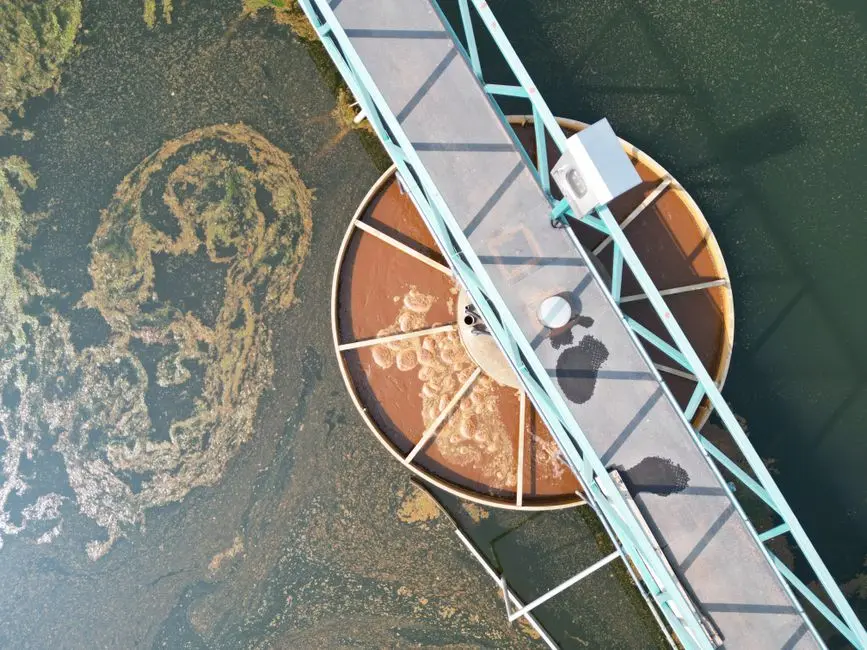
Train A — Conventional + RO: equalization, PLC-controlled chemical dosing for lime pH adjustment, hydroxide or sulfide precipitation, a DAF clarifier for AMD and metal-hydroxide sludge or a lamella clarifier for the precipitation stage, multimedia filtration ahead of RO, and an industrial RO polishing stage. It is the right call where the POTW has hydraulic capacity and the stream is AMD-dominant. Train B — MBR-led: equalization, precipitation, DAF, an MBR stage (submerged PVDF, 0.1–0.4 µm) for ammonia and reagent-bearing streams, cartridge filtration, and RO. The MBR protects the RO by simultaneously removing COD and ammonia and producing a consistently low-SDI feed water. Train C — ZLD: Trains A or B plus a brine concentrator and crystallization. It is required where the receiving body is sensitive, the site is inland with no POTW, or TSF closure demands demonstration of zero liquid escape — increasingly a 2026 design requirement for new mines rather than an option (per AMPAC USA reverse osmosis in mining treatment guide, 2026). For a Hercules-area site with a willing POTW and an AMD-dominant stream, Train A or B is the economic answer.
Water reuse and sludge handling that determine 2026 capex
SME's technical position supports maximizing water recycling during operations to reduce both freshwater demand and discharge volume; on-site reuse cuts permit risk and haulage costs. Internal reuse enabled by RO can reduce freshwater intake 40–60% versus once-through operation, and is often the largest single economic lever in a 2026 capex decision at water-stressed sites (per AMPAC USA, 2026). For plants with limited footprint, the recycle fraction typically targets 60–80% of clarified effluent, with the balance sent to sewer under permit; the exact split is set by the local POTW's hydraulic and mass-loading limits.
Sludge from metal-hydroxide precipitation is typically classified as hazardous waste and is dewatered with a filter press for hazardous metal sludge to a 60–70% dry-solids cake before landfill disposal. Flow-management controls — leachate collection, run-on/run-off diversions, grout curtains for underground workings — should be considered alongside the wastewater plant to reduce the hydraulic load on the treatment train. For context on DAF versus clarifier selection, see the DAF vs clarifier decision guide for mining wastewater, and for downstream solids handling, the filter press troubleshooting field guide covers the operating problems most often seen on mining-sludge presses.
Six-step compliance checklist before you order equipment
This workflow closes the gap between "we know the limits" and "we have a defensible purchase order" — a step the top three search results do not provide.
- Pull the local POTW permit and confirm three things on the discharge authorization: the local limits for each metal on the analytical panel, the maximum daily and instantaneous loading rates, and any slug-control or flow-equalization conditions the POTW has added.
- Run a full influent panel (TSS, pH, total and dissolved metals, sulfate, TDS, cyanide where applicable) and identify the dominant sub-stream: AMD, process water, tailings pond decant, or dewatering discharge.
- Select the train by site driver (willing POTW with hydraulic capacity → Train A; reagent or ammonia load → Train B; zero-discharge requirement → Train C) and document the decision against the permit limits.
- Pilot the precipitation stage. Competing chelants (EDTA, citric acid, ammonia) bind metal ions and defeat hydroxide precipitation; budget the pilot at 3–6% of full-scale capex and treat it as non-optional.
- Specify an ORP-controlled chlorine dioxide generator for cyanide destruction where legacy gold streams are present, and protect the headworks with a rotary mechanical bar screen so solids do not blind downstream stages. Where hexavalent chromium is in scope, review the chrome-6-free industrial pretreatment guide before finalizing the reagent strategy.
- Lock the reuse fraction, the sludge-disposal classification, and the discharge-monitoring data set required to populate GRI 303 water disclosures before the final equipment proposal is issued, because a 2026 spec that does not generate flow, recovery, and reuse data is out of date before it ships.
Frequently Asked Questions
What capital cost should we budget for a compliant 2026 mining wastewater train near Hercules?
The research does not quote a turnkey 2026 price for a Hercules-area train; cost is set by influent load, target recovery, and discharge driver. Instead of asking for a flat number, request three line items from each bidder: the equipment capex broken by stage (equalization, precipitation, clarification, filtration, RO or MBR/RO), the installed auxiliary cost (chemical skids, instrumentation, civil), and the annual OPEX divided by chemical cost, energy, and sludge disposal. ZLD runs 2–4× the OPEX of a discharge-permitted train, driven almost entirely by thermal energy, and is justified only where reuse value, avoided discharge fees, or TSF closure liability offset the cost (per AMPAC USA, 2026). The pilot should be budgeted at 3–6% of full-scale capex and treated as non-optional, not as a discretionary study.
How do we choose the right supplier and confirm sizing before we issue a PO?
Validate three things before signing: a reference list of operating mining or AMD sites on the same precipitation chemistry, a guaranteed RO recovery figure at the design sulfate and TDS (50–70% is the standard 2026 band on AMD; pushing above 70% on AMD is the most common cause of premature membrane replacement, per AMPAC USA, 2026), and a written MBR flux and SDI guarantee for Train B bidders. Require a process guarantee tied to your local POTW limits, not generic Part 440 ceilings, and a clarifier surface-loading check at 20–40 m/h. Delivery lead time and the supplier's pilot-or-journey-of-water data should be requested alongside the price, not after the shortlist is set.
What is acid mine drainage and why does it dominate the design envelope?
ARD is the reaction of water and oxygen with sulfide minerals such as pyrite and pyrrhotite in mined or exposed rock, producing sulfuric acid that leaches Fe, Mn, Cu, Zn, As, and Cd from the rock matrix (per SME's Mining and Water Quality briefing). It is low-pH, metal-loaded, often high in TDS, and is the primary driver of the hydroxide- or sulfide-precipitation stage and any downstream RO. Metals can also be released from non-sulfide ores, so the influent panel must be tested rather than assumed.
Why do we need an MBR instead of a conventional clarifier when the stream carries ammonia?
An MBR stage protects the RO by simultaneously removing COD and ammonia to a consistently low-SDI feed water, which is the safest default for gold-mill and copper-mill streams with reagent residue. Submerged PVDF membranes at 0.1–0.4 µm give the RO a stable feed, and the ammonia removal addresses local POTW caps of roughly 10 mg/L in a single stage. If ammonia and organics are absent and the local POTW has hydraulic capacity, a Train A clarifier-plus-RO configuration is typically lower capex and shorter schedule.