
Why Havana's Water Question Is Discharge, Not Withdrawal
Cooling-tower blowdown is the concentrated stream left after evaporation, carrying elevated salts, heavy metals, biocides, corrosion inhibitors, and altered pH (Water Utility Report, 2026-04-14). At 4 cycles of concentration, blowdown equals 25% of makeup volume by the 1/(CoC-1) rule (Genesis Water Tech, 2025-12) — so even a modest Havana facility produces a meaningful concentrated stream. A February 2026 TNFD case study (cited in Water Utility Report, 2026-04-14) flags mismanaged data-center blowdown as a salt, metal, and pollutant source, while a 2026 PLOS Water paper (also cited in Water Utility Report, 2026-04-14) notes utilities rarely publish the chemistry data communities need to evaluate it.
Havana-specific binding constraints reorder the design. The Vento/Almendares system is coastal-influenced with elevated chlorides; the municipality runs intermittent chlorination that destabilizes pretreatment; dry-season rationing is episodic and unpredictable; and there is no Class I brine-disposal network reachable in normal logistics. The supply scarcity plus the absence of a brine sink makes discharge — not freshwater volume — the binding design constraint for a 2026 Havana data center build.
The Four Liquid Streams a Havana Site Produces
Mapping every wastewater stream on site before specifying equipment prevents cross-contamination that has destroyed RO membranes on other Caribbean commissioning events. Each stream carries different chemistry and different regulatory exposure under CITMA oversight.
| Stream | Profile | Frequency | Routing |
|---|---|---|---|
| Cooling-tower blowdown | 1,200-6,000 mg/L TDS, 10-50 mg/L TSS, biocides, scale/corrosion inhibitors (Genesis Water Tech, 2025-12) | Continuous; 25-30% of makeup at 4 CoC | RO train → reuse as tower makeup; concentrate to MVC |
| Air-handler / equipment-room condensate | Low TDS but elevated Cu and Al from coil corrosion | Continuous | Separate collection; blend into RO feed only after metals check |
| Domestic wastewater (kitchen, toilet, HVAC humidifier bleed) | BOD 200-400 mg/L, COD 400-800 mg/L, surfactants, nutrients | Continuous | Separate biological train; never combine with blowdown RO feed |
| Fire-suppression test water & generator cooling bleed | Glycol, diesel residues, rust, possible PFAS from foam concentrates | Episodic (monthly to quarterly) | Dedicated holding tank with diversion valve; not the recovery skid |
Operators must follow two rules to protect system integrity. First, condensate should not be piped into the blowdown line by default — copper and aluminum spikes foul UF and shorten RO membrane life. Second, the fire-suppression test volume looks small in a P&ID but can dump 5,000-20,000 gallons of glycol-contaminated water in a single discharge; that volume must hit a holding tank with a diversion valve, not the recovery skid.
Four-Block Treatment Train for a Havana Hyperscale Site
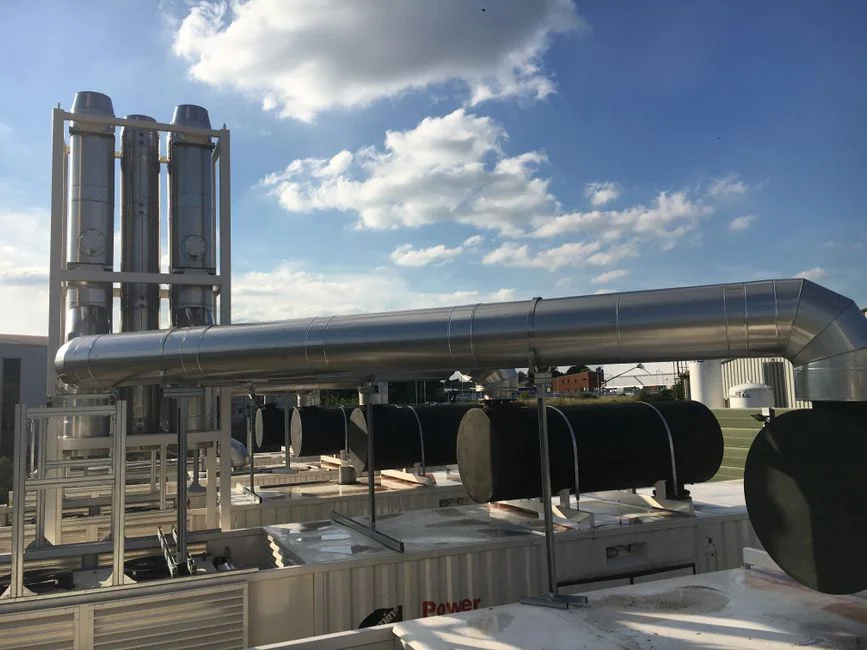
A four-block train is the economic answer for a Havana hyperscale site: side-stream self-cleaning filtration → hollow-fiber UF → two-pass brackish-water RO → partial ZLD via mechanical vapor compression on the RO concentrate. Each block is sized to the previous block's output and the cooling tower's chemistry limits, not to a generic template.
| Block | Function | Operating envelope | Capex / OPEX |
|---|---|---|---|
| 1. Side-stream self-cleaning spiral filter | Remove SS from circulating water; protect downstream membranes | 10-25 micron; 1-5% of circulation flow | $50,000-200,000 (Genesis Water Tech, 2025-12) |
| 2. Hollow-fiber UF (PVDF, 0.03 micron) | TSS, bacteria, biocide residual stripping | 10-30 psi; 90-95% recovery; permeate backwash; tolerates up to 300 NTU feed spikes | 2,000-40,000 L/h modules (HydropureWater UF line) |
| 3. Brackish-water RO | Dissolved solids, hardness, silica removal | 150-400 psi; 50-85% recovery; permeate 10-50 mg/L TDS; hybrid antiscalant + optional GCAT | $250,000-500,000 installed; OPEX $1.50-3.00/kgal (Genesis Water Tech, 2025-12) |
| 4. MVC on RO concentrate (partial ZLD) | Recover 95-98% of concentrate as distillate; reduce brine hauling | Distillate <10 mg/L TDS; 15-25 kWh/kgal | $1-3M for 10,000-30,000 GPD (Genesis Water Tech, 2025-12) |
Block 1 is a side-stream self-cleaning spiral filter at 10-25 micron, sized to 1-5% of circulation flow, which reduces suspended solids to levels downstream membranes can absorb without rapid fouling. The capital is modest ($50,000-200,000 per Genesis Water Tech, 2025-12) and the operating cost is essentially solids disposal, but the lift it gives the rest of the train is the difference between RO membranes that last 3 years and ones that last 18 months in Vento/Almendares water. Block 2 is a hollow-fiber UF system with 0.03 micron PVDF membranes operating at 10-30 psi with 90-95% recovery and automatic permeate backwash. The UF tolerates up to 300 NTU feed turbidity, which matters during Vento/Almendares main-flush events when raw-water turbidity can swing by an order of magnitude inside a day. Block 3 is a brackish-water RO unit at 150-400 psi and 50-85% recovery, fed by a hybrid antiscalant with optional GCAT catalytic pretreatment. Permeate at 10-50 mg/L TDS goes directly back to the cooling tower as high-quality makeup; concentrate moves to Block 4. Block 4 is partial ZLD via mechanical vapor compression on the RO concentrate, achieving 95-98% recovery with distillate below 10 mg/L TDS at 15-25 kWh/kgal. Capex sits at $1-3M for 10,000-30,000 GPD, which is the only honest way to handle the 15-30% of incoming flow that becomes RO brine when discharge permits are restricted or hauling costs spike during rationing. Specify sodium bisulfite or activated-carbon biocide reduction upstream of the UF fibers; oxidizing residuals collapse PVDF backwash cycles from days to hours in tropical ambient.
Havana Source-Water Risks That Reshape the Design
Coastal-influenced Vento/Almendares source water pushes chloride and conductivity bands higher than a temperate design assumes. Hardness and reactive silica scale RO membranes aggressively, so the antiscalant and multi-media filter pairing must be specified together at the design stage, not retrofitted after the first CIP event. Aging Havana distribution piping introduces iron and manganese spikes that foul hollow-fiber UF within days if not addressed — manganese greensand or aeration-filtration upstream of the UF rack is the lowest-risk answer. Sanctions-driven import lead times of 90-180 days for membranes and spares force the commissioning spare-parts kit to cover two full membrane replacements plus 90 days of antiscalant, biocide neutralizer, and CIP chemicals, dispensed through a PLC-controlled antiscalant and biocide-neutralizer skid.
Cost, Payback, and the Partial vs Full ZLD Decision
| System | Capacity | Capex | OPEX | Trigger / payback |
|---|---|---|---|---|
| RO blowdown recovery | 50,000 GPD | $250,000-500,000 | $1.50-3.00/kgal (Genesis Water Tech, 2025-12) | 18-36 months with $5-15/kgal discharge-fee avoidance |
| MVC concentrate polisher | 10,000-30,000 GPD | $1-3M | 15-25 kWh/kgal | 36-60 months on its own; right call when freshwater trucking > $15/kgal |
| Full ZLD with crystallizer | Site-dependent | $3-8M | $5-15/kgal | Only if discharge permit denied, trucking structurally > $15/kgal, or lender requires ZLD |
Adding MVC for the concentrate polisher adds $1-3M capex. Full ZLD with a crystallizer adds another $3-8M capex and $5-15/kgal OPEX, and is only justified when discharge permits are denied outright, freshwater trucking is structurally above $15/kgal year-round, or the lender requires zero liquid discharge for ESG-linked financing. Integrate on-site generator waste-heat into the MVC brine heater to cut the 15-25 kWh/kgal electrical demand by 30-50% (S4 brine-concentrator economics) — material to a finance sign-off in Cuba's grid-constrained operating environment.
Permit, Disclosure, and Ride-Through for a 2026 Havana Build
Freeze TDS, heavy-metals, phosphorus, and biocide-residual limits in the CITMA design basis before the discharge permit is signed; ambiguous brine fate is the single most common reason permit reviews stall. Benchmark the project against 2026 TNFD and PLOS Water disclosure expectations (both cited in Water Utility Report, 2026-04-14) so ESG-linked financing is not jeopardized by a missing water-quality section; install water-quality monitoring data ports on the discharge line so inspectors can pull readings without a site visit. Specify the RO high-pressure pump and MVC compressor on a dedicated UPS with at least 30 minutes of autonomy plus an automatic permeate-flush shutdown sequence — leaving RO elements dry and warm during extended grid outages is the fastest way to destroy membranes, and replacements take months under sanctions logistics. For EPC and developer teams new to Cuban permitting, the Caracas data center treatment train reference documents how a similarly sanctions-exposed Caribbean jurisdiction structures its disclosure package.
Frequently Asked Questions
What capex band should we budget for a 50,000 GPD Havana data center blowdown recovery train in 2026?
A 50,000 GPD RO blowdown recovery package runs $250,000-500,000 installed with $1.50-3.00/kgal OPEX (Genesis Water Tech, 2025-12). Adding an MVC concentrate polisher adds $1-3M, bringing the realistic partial-ZLD budget to roughly $1.25-3.5M. To verify site-specific numbers, request an influent water analysis (TDS, hardness, silica, Fe/Mn) and a discharge-permit draft from the EPC before locking the spec — these two documents typically move the final capex by 20-30% in either direction.
How do we choose between partial ZLD and full ZLD with a crystallizer for a Havana site?
Full ZLD with a crystallizer adds another $3-8M capex and $5-15/kgal OPEX, and is only justified when discharge permits are denied outright, freshwater trucking is structurally above $15/kgal year-round, or the lender requires zero liquid discharge for ESG-linked financing. For most
Frequently Asked Questions
What treatment train does a Havana data center need for cooling-tower blowdown in 2026?
In 2026, a compliant treatment train for Havana facilities typically requires a sequence of filtration, softening, and membrane separation. The process begins with multi-media filtration to remove suspended solids, followed by ion exchange softening to prevent scaling in downstream equipment. The primary treatment relies on high-recovery Reverse Osmosis (RO) operating at 75% to 85% recovery rates to concentrate reject streams before chemical stabilization or evaporation.
How much does a partial ZLD system cost for a 50,000 GPD data center in Cuba?
For a 50,000 GPD facility, a partial Zero Liquid Discharge (ZLD) system featuring Mechanical Vapor Compression (MVC) typically requires a capital expenditure ranging from $1.2 million to $1.8 million USD. This price variability accounts for the logistics of importing specialized modular equipment, the necessity of redundant components due to supply chain volatility, and the integration of site-specific corrosion-resistant metallurgy required for the Caribbean climate.
Can cooling-tower blowdown in Havana be reused as tower makeup under sanctions-driven import restrictions?
Yes, cooling-tower blowdown can be reused as makeup water, though it requires rigorous treatment to manage Cycles of Concentration (CoC). To maintain system health without importing high-cost specialty antiscalants, operators must utilize RO-treated blowdown and monitor conductivity levels to keep them below 2,500 µS/cm. Reuse effectively reduces freshwater demand by 60% to 70%, which is critical given the current limitations on importing proprietary water treatment chemicals and advanced filtration membranes.
What permit and disclosure items must a Havana data center submit to CITMA for blowdown discharge?
Operators must submit a technical dossier to the Ministry of Science, Technology and Environment (CITMA) that includes a detailed chemical characterization of the effluent, specifically reporting pH (target 6.0–9.0), Total Dissolved Solids (TDS), and heavy metal concentrations. The submission must also include a hydraulic balance report, a description of the proposed neutralization system, and a contingency plan for accidental discharge into local drainage systems, adhering to the national standards set by NC 27:2012 for wastewater discharge.
When does a Havana data center need full ZLD with a crystallizer instead of partial ZLD with MVC?
A full ZLD system incorporating a crystallizer is necessary when the facility is located in an area with zero-discharge mandates or where local municipal sewer connections cannot accept high-salinity brine streams. While partial ZLD with MVC concentrates the waste into a liquid brine, full ZLD is required when the final output must be converted into solid salt cake for landfill disposal. This transition is typically triggered when daily blowdown volumes exceed 10,000 gallons or when local environmental regulations prohibit the injection of concentrated liquid brine into the municipal wastewater network.