
Why Extractables and Leachables Data Gates UPW Piping Qualification
Semiconductor UPW piping extractables and leachables data is the qualification package that proves a polymer distribution material will not contaminate 18.2 MΩ·cm water at the point of use. Under SEMI F57, suppliers must report minimum performance for polymer pipes, fittings and valves; SEMI F63 and ASTM D5127 set the water-quality ceiling at the POU. Endpoints typically required are TOC, individual organic extractables, trace metals, anions, and particles, reported under defined test conditions (temperature, contact time, surface-to-volume ratio, stabilization period). Field data from a 2026 MDPI pilot loop shows PVDF released 0.4–2.3 mg/L TOC at 60°C while CPVC showed hot spots of 16–18 mg/L under identical conditions, with inorganic ions sub-mg/L for both — the kind of comparative evidence buyers should request before specifying a loop material.
Contamination in UPW translates directly to device defects. Hydrochemix notes that "even trace levels of dissolved ions, organic compounds, particulates, or microorganisms in process water can cause defects on silicon wafers, reducing chip yields and driving up production costs dramatically," and that advanced nodes at 7 nm and below are "extraordinarily sensitive to even sub-ppt levels of certain metallic contaminants" (Hydrochemix, 2026-08). The POU specification anchors the data request: 18.2 MΩ·cm resistivity at 25°C with TOC below 5 ppb as a general limit, while Axeon reports industry standards specify TOC below 1 ppb and advanced fabs targeting sub-0.5 ppb for 3 nm and 2 nm nodes (Axeon, 2026; Hydrochemix, 2026-08). The E&L data package is the evidence that a polymer distribution loop will not push TOC, metals or particles above these ceilings during steady-state operation, sanitization cycles, or system restart events — which the MDPI 2-pass RO study flags as triggers for transient organic-quality deterioration (MDPI 2026 2-pass RO study).
The two terms are not interchangeable. Extractables are compounds recoverable under aggressive laboratory extraction (high temperature, long contact time, aggressive solvent). Leachables are compounds that migrate into water under real service conditions (lower temperature, defined surface-to-volume ratio, recirculating flow). A complete qualification submittal covers both data sets because extractables define the upper-bound material burden and leachables define the field-relevant release rate.
The Standards Stack: SEMI F57, SEMI F63 and ASTM D5127
SEMI F63 and ASTM D5127 define the POU water-quality ceiling: resistivity, TOC, silica, particle, and bacteria limits. Hydrochemix (2026-08) and Axeon (2026) cite both standards as the industry specification for semiconductor-grade UPW. SEMI F57 is the polymer-material standard — it "specifies minimum performance requirements for high-purity polymer materials and components for pipes, fittings and valves used in UPW and liquid chemical distribution systems" (MDPI 2026 CFD + autopsy study). The MDPI 2026 CFD and autopsy study is explicit that "industry guidelines such as SEMI F63 and ASTM D5127 define stringent quality criteria for UPW production and distribution, emphasizing that water quality must be preserved not only at the plant outlet but throughout the entire distribution loop to the point of use" (MDPI 2026 CFD + autopsy study).
The standards layer onto each other. F63 and D5127 set the water-quality ceiling; F57 sets the material performance floor; the E&L data package is the evidence that a specific polymer product meets the F57 floor under the conditions the F63/D5127 ceiling will be measured at. A buyer's data request should therefore cite the specific clause and revision of F57 used for the E&L test, not only a generic "SEMI F57 compliant" statement — a generic assertion is not auditable.
| Standard | Scope | What it sets | What the E&L data package must show |
|---|---|---|---|
| SEMI F63 | UPW water quality at POU | Resistivity, TOC, silica, particle, bacteria ceilings | Compliance of the distribution loop with POU limits |
| ASTM D5127 | Electronics and semiconductor UPW grades | Grade-by-grade specification (Grade A most stringent) | Mapping of extractables to grade-A ceilings |
| SEMI F57 | High-purity polymer piping components | Minimum material performance for pipes, fittings, valves | Endpoint-by-endpoint extractables/leachables data with cited clause |
PVDF vs CPVC: What the Extractables Data Actually Shows
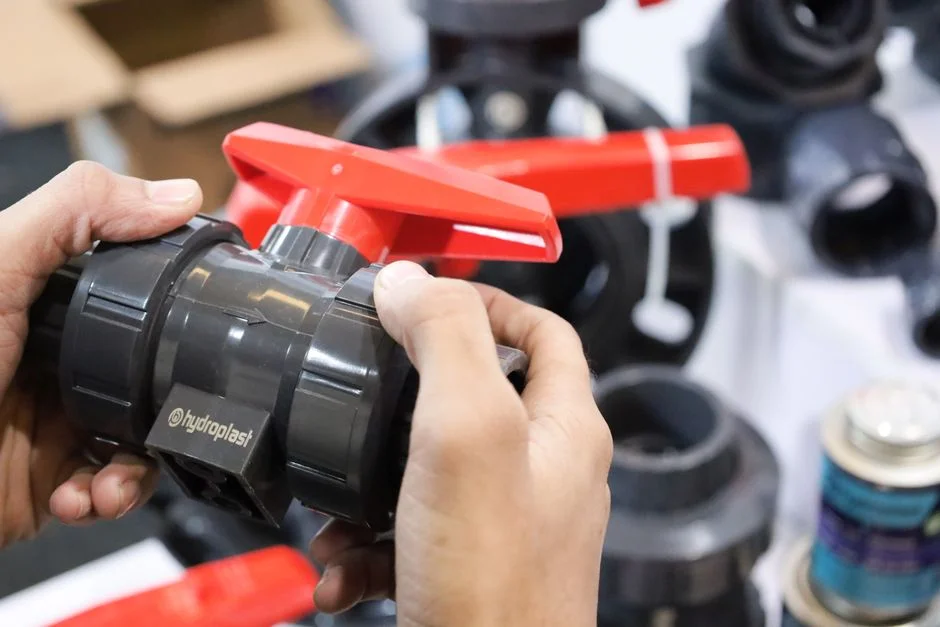
The MDPI 2026 CFD + autopsy study operated a pilot-scale UPW loop with both CPVC and PVDF piping under identical boundary conditions — 1.0 m³·h⁻¹ flow, 0.7 bar return-line pressure, 70 m hydraulic path length, six POU branches — and then performed endoscopic inspection of 17 sections after 8 months of operation, with leached samples taken at 60°C. The TOC results are the headline number: "CPVC exhibited yellow–brown discoloration and highly heterogeneous total organic carbon (TOC) release with hot spots of 16–18 mg·L⁻¹, whereas PVDF showed low, spatially uniform TOC (0.4–2.3 mg·L⁻¹) and minimal fouling" (MDPI 2026 CFD + autopsy study).
The differentiation is in the organics, not the metals. The same study reports "inorganic ions remained at sub-mg·L⁻¹ levels for both materials." That is an important finding for a buyer building a data request: if a supplier's data sheet leads with metals and under-reports organics, the organics are the dimension where the material choice is being made. CPVC is described in the MDPI 2-pass RO study as "designed to reduce extractables and organic leaching compared with conventional plastics, thereby minimizing background TOC contamination during second-pass RO permeate collection" — but the MDPI 2026 CFD + autopsy study makes clear that the field comparison still shows CPVC at a higher TOC baseline than PVDF in long-term service. Duong et al. and Park et al., both cited in the MDPI 2026 CFD + autopsy study, reinforce this direction: PVDF shows "lower organic carbon elution and reduced susceptibility to bacterial growth compared to CPVC in full-scale semiconductor facilities" (Duong et al., cited in MDPI 2026 CFD + autopsy study), and CPVC "released substantially higher amounts of TOC, metals and particles than PVDF in both batch and loop pilot tests, with CPVC showing a pronounced temperature dependence while PVDF rapidly reached a low, quasi-steady leaching level" (Park et al., cited in MDPI 2026 CFD + autopsy study). The comparison does not make CPVC unusable; it defines the test burden CPVC carries if a buyer still wants to qualify it.
| Parameter | CPVC (8-month pilot, 60°C leach) | PVDF (8-month pilot, 60°C leach) | Source |
|---|---|---|---|
| TOC release | Hot spots 16–18 mg/L, heterogeneous | 0.4–2.3 mg/L, spatially uniform | MDPI 2026 CFD + autopsy study |
| Inorganic ion release | Sub-mg/L | Sub-mg/L | MDPI 2026 CFD + autopsy study |
| Internal surface (8 months) | Yellow–brown discoloration | Minimal fouling | MDPI 2026 CFD + autopsy study |
| Temperature dependence of leaching | Pronounced | Low, quasi-steady | Park et al., cited in MDPI 2026 CFD + autopsy study |
| Biofilm susceptibility | Higher | Lower | Duong et al., cited in MDPI 2026 CFD + autopsy study |
The E&L Data Submittal Checklist: Endpoints, Methods, Conditions
The standards tell a buyer what the ceiling and the material floor are; they do not tell a buyer what to demand on the data sheet. The checklist below is the article's central deliverable. Endpoints: TOC, individual organic extractables (with compound identification and concentration), trace metals, inorganic anions, and sub-micrometer particle counts — drawn from the MDPI 2026 CFD + autopsy study's autopsy scope and the SEMI F57 material-performance frame. The Axeon monitoring list adds the analytical methods buyers should expect: ICP-MS for trace metals, ion chromatography for ionic species, laser particle counters for particles, and UV-persulfate oxidation for TOC (Axeon, 2026). Hydrochemix (2026-08) recommends "periodic grab-sample analysis using laboratory-grade instruments such as ICP-MS for trace metals, ion chromatography for ionic species, and scanning electron microscopy for particle identification" at least quarterly.
Test-condition disclosure is what turns a one-line data point into a comparable number. Required: leaching temperature (the MDPI 2026 protocol used 60°C — disclose whether the supplier's test used the same), contact time, surface-to-volume ratio, flush volume, and stabilization period. The MDPI 2-pass RO study is explicit that "TOC stabilization required a substantially longer period than the TDS stabilization, which is consistent with the time-dependent conditioning effects discussed in (e.g., depletion of leachables and/or adsorption–desorption interactions on wetted surfaces and the membrane)" and that "prolonged stabilization is necessary to obtain representative TOC performance" (MDPI 2026 2-pass RO study). A data sheet that reports only an early-time TOC number is not reporting the steady-state value.
Geometry context is non-negotiable. The same MDPI 2026 CFD + autopsy study identifies elbows and downstream tees as low-shear recirculation zones where particles and deposits can persist, and Lagrangian particle tracking (0.05 μm, no-sticking) showed that even particles with rapid breakthrough can persist in those zones. The E&L data sheet should specify whether test pieces were straight pipe, fittings, or loop sections. A straight-pipe coupon will not capture the recirculation behavior the autopsy work exposed. Reporting format must include each endpoint with detection limit, analytical method, uncertainty, and number of replicates — the same rigor the MDPI 2026 2-pass RO study applied, with "two independent samples … collected once the system reached steady state, and each sample was analyzed in triplicate."
Service-life context matters because short-term laboratory extraction does not equal long-term field behavior. The MDPI 2026 CFD + autopsy study makes the point: "long-term contamination behavior in UPW distribution loops is increasingly recognized as a coupled outcome of hydrodynamics, pipe material, and spatially heterogeneous stagnation phenomena." The 8-month field data set is the kind of long-term evidence that should be in the data package alongside the laboratory extractables, because the field numbers integrate geometry, hydrodynamics, and material aging in a way a short-term extraction cannot. A bundled extractables, leachables, and product-lifecycle framework (Wiley chapter on E&L through product approval) treats E&L data as a through-product-approval deliverable covering raw material, finished component, and in-service stages — a reminder that a single data point at one stage is not the package.
| Checklist item | What to demand on the data sheet | Why |
|---|---|---|
| Endpoints | TOC, individual organic extractables, trace metals, anions, particle counts | Matches F63/D5127 ceilings; covers organics-led differentiation |
| Leaching temperature | Disclose (e.g., 60°C per MDPI 2026 protocol) | CPVC leaching is temperature-dependent (Park et al.) |
| Contact time / stabilization | Disclose both; expect long stabilization for TOC | TOC stabilizes later than TDS (MDPI 2026 2-pass RO) |
| Surface-to-volume ratio | Disclose | Required to compare across data sets |
| Geometry of test piece | Straight pipe, fitting, or loop section | Elbows/tees are accumulation zones (MDPI 2026 CFD + autopsy) |
| Analytical method + detection limit | Per endpoint (ICP-MS, IC, TOC analyzer, particle counter) | Axeon 2026; Hydrochemix 2026-08 |
| Replicates + uncertainty | Triplicate analysis, two independent samples per condition | Matches MDPI 2026 2-pass RO rigor |
| Service-life data | Short-term extraction + long-term field (e.g., 8 months) | Field integrates geometry and aging (MDPI 2026 CFD + autopsy) |
| SEMI F57 clause cited | Specific clause and revision, not generic compliance | Required for audit trail |
From Test Data to Piping Specification: Decision Framework
The data package is only useful if it changes a procurement decision. The framework below translates the E&L evidence into a specification step. Step 1 — Set the E&L envelope. Write the POU water-quality target: 18.2 MΩ·cm at 25°C, TOC below 1 ppb per the SEMI F63 / ASTM D5127 industry specification, with sub-0.5 ppb as the internal target for 3 nm and 2 nm nodes (Axeon, 2026; Hydrochemix, 2026-08). Back-calculate the maximum allowable extractables contribution from the distribution loop by subtracting the expected polishing-stage and POU instrument contribution from the POU ceiling. Step 2 — Material shortlist. Require SEMI F57 data sheets for every candidate polymer and weight them by the 60°C TOC comparison: PVDF at 0.4–2.3 mg/L versus CPVC hot spots at 16–18 mg/L (MDPI 2026 CFD + autopsy study). A CPVC submittal carries the higher test burden and should not be excluded on chemistry alone, but the data request must be more demanding. Step 3 — Geometry and flow. Pair the E&L data with a turbulent-flow recirculation design (Reynolds number above 10,000 per Hydrochemix, 2026-08), sloped, orbital-welded routing, and no dead legs — the same hydrodynamic conditions the MDPI 2026 CFD + autopsy study used to map low-shear recirculation zones. A HydropureWater hollow-fiber UF polishing stage can be specified downstream to provide a final particle barrier ahead of the POU. Step 4 — Acceptance test. Require the supplier to demonstrate the data package against a defined stabilization period before POU sign-off; the MDPI 2026 2-pass RO study showed that premature shutdown or restart events trigger transient organic-quality deterioration, so the acceptance test should include a defined restabilization window after any system disturbance. Step 5 — In-service surveillance. Schedule quarterly laboratory grab samples including ICP-MS, ion chromatography, and particle identification per Hydrochemix (2026-08) and require the supplier to support failure-mode troubleshooting if a TOC excursion is traced to the loop. A HydropureWater industrial RO system upstream and a HydropureWater continuous electrodeionization stack ahead of the polymer loop are the typical anchor points in the treatment train whose performance the E&L data has to integrate with. For a broader engineering brief on adjacent fab-water treatment specifications, see the chip fab wastewater treatment supplier 2027 specs guide, and for simulation of loop hydraulics, see the digital twin for the UPW distribution loop reference.
Frequently Asked Questions
What specific E&L endpoints should a piping supplier's data sheet report for a UPW distribution loop?
The data sheet should report TOC, individual organic extractables (with compound identification and concentration), trace metals, inorganic anions, and sub-micrometer particle counts — the endpoint set the MDPI 2026 CFD + autopsy study applied to its 8-month pilot and the same set the SEMI F57 material-performance frame is built around. Each endpoint should be reported with its analytical method, detection limit, uncertainty, and number of replicates; the MDPI 2026 2-pass RO study used triplicate analysis on two independent samples per condition, which is the rigor a buyer should expect. A straight TOC number without detection limit or replicate count is not auditable.
How do the PVDF and CPVC extractables numbers compare under the same test conditions?
Under identical 8-month pilot-loop boundary conditions and 60°C leaching, PVDF released 0.4–2.3 mg/L TOC in a spatially uniform pattern with minimal fouling, while CPVC showed hot spots of 16–18 mg/L TOC with yellow–brown discoloration and heterogeneous release; inorganic ions were sub-mg/L for both materials (MDPI 2026 CFD + autopsy study). Park et al. (cited in the same study) report CPVC's TOC release has a pronounced temperature dependence while PVDF rapidly reaches a low, quasi-steady level — so the comparison is even more unfavorable to CPVC at sanitization temperatures.
What is the budget impact of inadequate E&L data on a UPW piping submittal?
The research does not provide a per-line-item price for an E&L data package or for a CPVC-versus-PVDF cost premium, so a buyer must request current quotations directly from the shortlisted suppliers rather than rely on an assumed range. What the evidence does support is the cost-of-failure framing: Axeon (2026) reports single fab investments of $1B–$4.6B and that "water-related issues contribut[e] to significant wafer failures in sub-7nm chip production." A failed E&L qualification that surfaces only at POU sign-off, or a TOC excursion in service traced to the distribution loop, carries the scrap and yield-loss exposure of that fab cost base, which is the risk envelope a procurement decision should be sized against.
How should a buyer select a polymer piping supplier against SEMI F57?
Require the supplier to cite the specific SEMI F57 clause and revision used for each E&L endpoint, and to provide the data sheet in the format described in the checklist above — endpoints, test conditions, geometry, replicates, and long-term field data. A generic "SEMI F57 compliant" statement is not auditable and is not the same as a clause-referenced data package. The supplier should also be able to support field failure-mode troubleshooting, because the MDPI 2026 CFD + autopsy study shows that loop-level contamination is a coupled outcome of hydrodynamics, material, and geometry that the laboratory data alone does not fully resolve. Buyers should request reference installations with comparable POU targets and confirm the supplier can deliver a turbulence-stabilized, orbital-welded routing design that the E&L data was generated against.