Start with a Real Kolkata Project, Not a Catalogue Page
Picture this: a 300-person labour camp in Rajarhat-New Town serving a metro-rail contractor through the 2026 monsoon. The site sits on a 600 m² irregular plot, water table is within 1.5 m of grade, and KMDA wants treated water reused for dust suppression and toilet flushing. The procurement manager asks for "a containerized MBR STP quote" by Friday, with a sizing calculation a reviewer can actually audit. That is the brief this article solves.
The same logic applies to a 200-flat residential block in Salt Lake, a school hostel in EM Bypass, or any small commercial development across the Kolkata Metropolitan Area. The calculation chain is identical: people served → per-capita flow → peaking factor → KLD → tank volumes → membrane area → container count. What changes between a camp and a housing society is the per-capita input and the local constraints — monsoon ingress, high groundwater, plot shape, and power reliability — that is, the variables a vendor's catalogue page never tells you how to handle.
Containerized membrane bioreactor (MBR) sewage treatment plants are pre-assembled in standard shipping containers, factory-tested, and require minimal on-site civil work to become operational (S2). That form factor is precisely why they win over conventional civil STPs for tight urban Kolkata plots and fast-moving construction camps where deep excavation is impossible and downtime is expensive.
Step 1 — Convert Population into Design Flow (KLD)
The single most error-prone step in any STP sizing is converting "300 people" or "200 flats" into a design flow in KLD. Get this wrong and every downstream unit — equalization, aeration, membrane, sludge — is mis-sized.
1. Define the served population. For residential blocks, count residents + domestic staff + realistic floating population (visitors, delivery, maintenance). For labour or construction camps, use peak occupancy, not average headcount — a 300-person camp is not 300 on the day the next shift rotates in.
2. Apply per-capita water use. The research does not supply a specific Kolkata per-capita figure, so this must be confirmed with the local municipal authority or the project hydraulic consultant. As a working assumption to be replaced by a project-specific number, residential developments typically plan around 135–150 Lpcd and labour or construction camps around 70–90 Lpcd, but treat these as placeholders, not as data.
3. Apply a sewage return factor. No Kolkata-specific return factor is supplied in the research, so confirm this with the utility or designer before locking the number. A working assumption of 0.80–1.00 is typical for domestic projects; lower values reflect camp conditions with evaporative cooling, gardening, or truck washwater losses.
4. Apply a peaking factor. Morning and evening peaks drive hydraulic surge through the plant. No peaking factor is supplied in the research, so request confirmation from the designer; a working range of 2.0–2.5 is typical for residential, and Kolkata monsoon inflow and infiltration during June–September can push the effective peak even higher. The equalization tank and screen channel must be sized for the wet-weather peak, not the dry-weather average.
The result is the design flow in KLD (m³/day), and that single number is what every downstream unit is sized against. The reference domestic MBR design in the research is anchored at 200 KLD for Stage 1 (S3) — a useful sanity check before you commit to membrane and container sizing.
Step 2 — Match Each Treatment Stage to the Flow
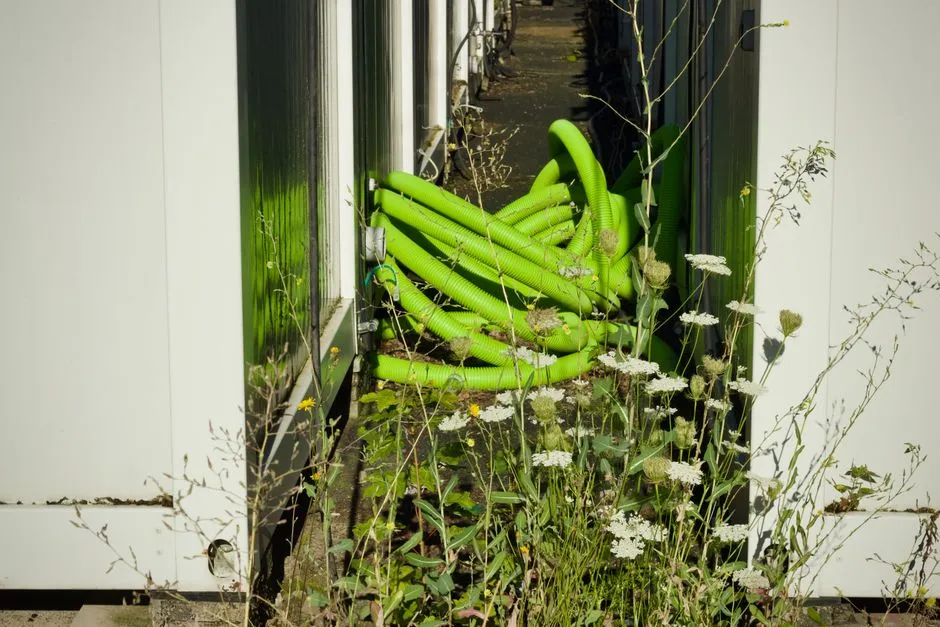
Once the KLD is fixed, every unit operation is sized against it. The reference MBR design at 200 KLD (S3) gives a defensible unit-process chain an engineer can lift directly into a datasheet. The headworks, biological stage, membrane stage, and sludge handling each carry a specific duty that the table below summarises.
| Stage | Equipment / Function | Design Parameter (S3) |
|---|---|---|
| Coarse screening | Bar screen, MS epoxy-painted, hand-raked | 8 mm and 6 mm openings (S3) |
| Fine screening | Mechanically cleaned SS bar screen | 2 mm pore size (S3) |
| Oil & grease removal | Civil O&G trap upstream of equalization | Handles kitchen waste (S3) |
| Equalization | Buffer + homogenize, coarse-bubble mixing | ~8 hr HRT (S3) |
| Aeration | Fine-bubble EPDM diffusers, twin-lobe blowers | MLSS 3,000–6,000 mg/L; O₂ demand 2 kg O₂ per kg BOD removed (S3) |
| MBR | Immersed PVDF modules in hopper-bottom tank, suction-side | 0.1 µm pore size; design flux 25 LMH; 100–300 mm Hg suction (S3) |
| Sludge handling | Holding tank with coarse-bubble diffuser + filter press | Filter press dewatering per S3 |
| Disinfection | Online UV or chlorination | Treated water polish (S3) |
Transfer pumps, MBR suction, MBR backwash, and MBR chemical-cleaning pumps are all specified 1 Working + 1 Standby in the reference design (S3). Blowers for equalization, aeration, sludge tank, and MBR air-scouring are specified 1W+1S with IP 55 enclosures and Class F insulation (S3). This 1W+1S redundancy is not optional on a Kolkata site where a single blower trip in the middle of a hot, humid night can crash MLSS and foul membranes within hours. For headworks screening, a GX series rotary mechanical bar screen handles the coarse-solids load ahead of the MBR cassettes, and a HydropureWater plate and frame filter press dewaters the sludge holding tank output to a manageable cake for off-site disposal.
Step 3 — Size the Membrane Area and Module Count
The membrane area calculation is the step that turns a flow number into a procurement line item. Use the design flux of 25 LMH (L/m²·h) as the operating point (S3). The reference module can run 15–70 LMH (S3), but 25 LMH is the documented design value and the figure an EPC reviewer will check you against.
Convert design flow from m³/day to m³/h, then divide by 25 LMH to get the required membrane area in m². The reference PVDF module has an effective area of 20 m² per module (S3), so the number of modules is simply total area divided by 20, rounded up to the next full cassette. Each reference MBR tank holds a cassette of modules grouped per plant design (S3); the vendor will quote cassettes rather than loose modules, so size to the nearest cassette.
The same container typically has to absorb the MBR suction pump set (1W+1S), the backwash pump set (1W+1S), and the chemical-cleaning pump, plus the membrane air-scouring blower duty and the chemical cleaning tank volume (S3). If the total envelope exceeds a single 20 ft or 40 ft container, split the cassettes and the permeate tank into a second container with common header pipework between them. A DF series PVDF flat-sheet MBR membrane module is one option to specify for this duty, and a HydropureWater integrated MBR membrane bioreactor system packages the cassette, suction side, and air-scour grid into a single skid that drops into a container slot.
Kolkata-Specific Sizing Adjustments
Generic MBR sizing pages stop at the membrane calc. The Kolkata project reality adds four constraints that change the answer, and a reviewer will ask about all four.
High water table. In much of the Kolkata Metropolitan Area the water table sits within 1.5 m of grade, which rules out deep civil tanks. This is precisely why containerized and skid-mounted MBR plants are specified — keep everything above grade, or in shallow buried vaults with buoyancy protection, and avoid the dewatering cost and risk of a deep civil excavation. Buried integrated units such as the WSZ underground integrated sewage treatment package can substitute for civil tanks only where the water table and buoyancy check have been formally addressed.
Monsoon ingress. June through September peak rainfall regularly saturates surrounding drains and pushes infiltration into the incoming sewer. The equalization tank and screen channel must be sized for the wet-weather peak, not the dry-weather average, and the headworks should include a bypass overflow with a documented discharge route.
Plot shape. Salt Lake, New Town, and Rajarhat plots are often narrow and irregular, which is hostile to a single large civil footprint. The modular scalability of containerized plants lets the buyer lay out two or three 20 ft containers in an L-shape, or a 40 ft + 20 ft combination, against a boundary wall — a layout that would be impossible for a conventional rectangular aeration tank.
Power reliability. Kolkata's grid is generally stable, but camp sites on the urban fringe frequently see multi-hour outages. The reference design already specifies 1W+1S redundancy for pumps and blowers (S3), so the standby unit covers a short trip. Confirm with the EPC contractor whether a UPS (for control and instrumentation) and a genset sized for at least the aeration blower and one transfer pump are needed to ride out longer outages.
How Many Containers Will You Need?
Containerized MBR plants are housed in standard 20 ft or 40 ft shipping containers, pre-assembled and factory-tested (S2), which is why the "how many containers" question is the deliverable a buyer actually wants at the end of the calc. A typical three-container layout puts equalization plus aeration in the first container, the MBR cassette plus permeate tank in the second, and sludge holding plus chemical cleaning plus the control panel in the third. The research does not supply a per-container KLD rating, so this layout and the resulting count must be confirmed with the vendor against the specific KLD you have calculated.
Capacity is increased by adding more containerized modules (S2), which means the skid interfaces and common header pipework should be specified from day one to allow a Stage-2 drop-in. A second benefit: containerized ETPs require significantly less space than conventional ETPs (S2), which is a decisive factor on a tight Kolkata urban plot where every square metre has a real-estate cost.
For comparison, the sister-guide for Accra residential and camp projects and the European equivalent for Hamburg projects both follow the same container-count logic; the inputs (per-capita flow, peak factor, plot constraints) shift, but the envelope per container does not.
Discharge, Reuse and Compliance Targets for West Bengal
The reference MBR design targets treated water at pH 7.0–8.0, TSS NIL, BOD5 <5 mg/L, COD <20 mg/L, and turbidity <2 mg/L (S3). Confirm these numbers against the latest WBPCB and KMDA norms applicable in 2026 before freezing the design envelope, because the regulatory bar can move between project conception and commissioning.
For residential reuse in flushing and gardening, or for camp reuse in dust suppression and toilet flushing, this effluent quality is suitable after UV or chlorination (S3) without further polishing. A HydropureWater UV sterilizer handles the final disinfection step and avoids the chlorine by-products that a chlorinator would introduce. For higher-end reuse such as cooling-tower make-up or vehicle washing, an ultrafiltration polish step is the next logical upgrade; this is a qualitative extension, not a parameter specified in the supplied research.
The SBM-U treated wastewater reuse push in Indian cities, documented in October 2026, and the ₹11,785 crore STP programme for small cities approved in October 2026, both signal a rising compliance and reuse bar in West Bengal over the next 12–24 months. Specify a plant that meets the 2026 effluent envelope today so it does not become a retrofit project in 2027.
Procurement Checklist Before You Sign the PO
Convert the sizing exercise into a buying checklist so you walk into vendor meetings with the right questions.
- Ask for a unit-process flow diagram and a guaranteed influent/effluent parameter table — match every line to the values in the reference design (S3).
- Ask for a container-by-container general arrangement drawing with overall dimensions, empty and operating weights, and certified lifting points — non-negotiable for Kolkata site logistics where cranes have to reach over narrow access lanes.
- Ask for the membrane module specification: PVDF, 0.1 µm pore size, design flux 25 LMH (S3), and the warranty terms on membrane replacement — a membrane replacement cycle of 5–7 years is the line item that drives lifecycle cost.
- Ask for the spare-parts list, the PLC/SCADA control philosophy, and the local service footprint in West Bengal — a vendor without a service engineer within 200 km of your site is a vendor you do not want to depend on.
- Request a site visit to an installed reference plant of similar KLD, not just a corporate brochure. Watch the plant run, look at the membrane cleaning logs, and talk to the operator.
Frequently Asked Questions
How many people can a single 20 ft containerized MBR STP serve?
It depends on the per-capita flow and peaking factor used in the Step 1 calculation, not on the container itself. The research does not supply a per-container KLD rating, so you must request a vendor-specific number against your project's KLD before signing the PO. As a sanity check, the reference MBR design is sized for 200 KLD domestic sewage (S3), which is the benchmark to compare a vendor's quoted capacity against.
What treated-water quality can I expect from a containerized MBR in Kolkata?
The reference MBR design targets BOD5 <5 mg/L, COD <20 mg/L, TSS NIL, turbidity <2 mg/L, and pH 7.0–8.0 (S3). Actual performance depends on influent quality, operating MLSS within the 3,000–6,000 mg/L band, and membrane maintenance discipline, so build a guaranteed-effluent clause into the PO rather than relying on catalogue numbers.
Is a containerized MBR STP cheaper than a civil STP for a Kolkata residential project?
Containerized ETPs reduce civil engineering work, installation time, and operational costs (S2), which typically shifts the cost case in their favour on tight urban plots and short-timeline camps. The research does not supply CAPEX or OPEX figures, so request a line-item comparison from the vendor covering civil works avoided, membrane replacement cost per year, and energy for the 1W+1S blower and pump sets.
How long does delivery and installation take, and can the plant be expanded later?
Containerized units are pre-assembled and factory-tested, so they can be set up and operational in a very short time with minimal on-site civil work (S2); the research does not supply a specific lead time, so request a current schedule in writing, including membrane delivery and any long-lead items. Capacity can be increased by adding more containerized modules (S2), so specify the skid interfaces and common header pipework from day one to allow a Stage-2 drop-in if the camp headcount or housing occupancy grows beyond the Stage-1 design.
Related Equipment
- HydropureWater integrated MBR membrane bioreactor system — specifications, capacity range, and technical data
- DF series PVDF flat-sheet MBR membrane module — specifications, capacity range, and technical data
- GX series rotary mechanical bar screen — specifications, capacity range, and technical data
- HydropureWater plate and frame filter press — specifications, capacity range, and technical data
- HydropureWater UV sterilizer — specifications, capacity range, and technical data