Why MBBR Fits Hotel and Resort Wastewater
MBBR is a documented biological stage for hotel and resort wastewater because three structural features of the technology map directly onto hospitality pain points: a compact footprint, no sludge recirculation, and modular biofilm carriers that retrofit into existing tanks. Genesis Water Tech lists "Decentralized Wastewater Treatment for Hotels/Facilities, Camps, Community Developments" as a primary application sector for the technology, confirming that the hospitality use case is established commercially, not experimental. For a basement plant room under a city-center hotel, a brownfield resort with no daily operator on site, or a property converting an existing aeration basin, those three features resolve the constraints that rule out conventional activated sludge at many hospitality sites.
General MBBR references describe the same advantages: biofilm processes need less space than activated sludge because the biomass is more concentrated, system efficiency is less dependent on final sludge separation, and MBBR systems do not need sludge recycling (Wikipedia, "Moving-bed biofilm reactor"). Each of those is a hospitality fit. The lack of sludge recycle removes the need for a dedicated return-activated-sludge pump and a skilled operator; the smaller basin footprint protects constrained urban and resort sites; the biofilm is self-regulating and tolerates the load swings that come with weekend occupancy peaks. The same source notes that "The MBBR system is often installed as a retrofit of existing activated-sludge tanks to increase the capacity of the existing system," which is the exact pattern a hotel developer faces when an existing STP is failing.
Hotel wastewater is not sanitary sewage alone. It is sanitary sewage blended with kitchen FOG, laundry surfactants and phosphate, and elevated ammonia from guest turnover. The two published MBBR studies most relevant to a hospitality buyer are the Aston hotel study (BOD 93.37%, TSS 89.74% removal at 7 days with Kaldnes K3 at 30% fill — Dhuhan et al. 2021) and the laundry study (COD 93.81%, surfactant 88.22% removal at 10 days with Kaldnes K1 at 20% fill — Kusuma et al. 2019). The hotel result is the primary dataset; the laundry study is the closest published analogue for the surfactant-bearing fraction that an on-site hotel laundry adds to the flow. Together they cover the bulk of what a hospitality STP receives. For turnkey packaged skid delivery on a small footprint, see a typical underground package sewage treatment plant configuration that wraps the biological stage in a buried civil envelope.
Hotel Wastewater Characteristics the MBBR Must Handle
The only published hotel-specific MBBR influent dataset is from the Aston hotel study reported by Dhuhan et al. 2021: BOD 109.81 mg/L, TSS 78 mg/L, with pH monitored but not quoted numerically in the source excerpt. That profile is a relatively dilute domestic sewage — not a high-strength industrial waste — and is consistent with what an engineering team would expect from a mid-size city hotel without significant food-processing effluent. Compliance was assessed against Indonesia's PERMEN LHK No. 68/2016 domestic wastewater quality standard, which is the regulatory lens the authors applied. Any buyer using this dataset as a proxy for their own site should pull their own recent influent sampling before scaling the published result.
In real operating conditions, a hotel MBBR will see more pollutant families than the Aston study measured. Kitchen drainage contributes fats, oils and grease; an on-site laundry contributes surfactants, COD, and phosphate; sanitary flow from guest rooms contributes ammonia and pathogens. The closest published analogue for the laundry fraction is Kusuma et al. 2019, which reported an influent of COD 910 mg/L, phosphate 38.24 mg/L, and surfactant 47.8 mg/L treated on Kaldnes K1 media. Those numbers are much higher than the Aston hotel influent and should be read as a worst-case surrogate for the laundry stream only — not as a hotel composite.
Why the upstream front-end matters: FOG and surfactants can shock an attached biofilm if they pass screening and reach the carriers, and the sources do not provide a numeric shock threshold a designer can apply. The practical engineering response is qualitative — install screening, grit removal, and FOG capture upstream of the MBBR, and route laundry discharge through an equalization or pretreatment step when flows are batch. The Dhuhan et al. 2021 study itself notes that the Aston hotel's existing suspended-growth biological plant "often does not meet" the PERMEN LHK No. 68/2016 standard, which is the compliance gap the MBBR retrofit is being evaluated against.
Core MBBR Design Parameters for a Hotel Plant

The defensible design envelope a hotel engineer can bring into a supplier conversation is built from two published operating points plus the documented general MBBR design range. The hotel study (Dhuhan et al. 2021) reports Kaldnes K3 carriers, a 30% fill fraction of reactor volume, 14 days of biofilm seeding (acclimation) on the adhesive media, and 7 days of treatment retention as the reported operating point. The laundry study (Kusuma et al. 2019) uses Kaldnes K1 carriers at 20% fill, 15 days of seeding, and tested 6, 8, and 10 days of retention with 10 days reported as best. Both use HDPE biofilm carrier media — the material identified by Wikipedia as the most preferable current carrier material due to plasticity, density, and durability.
For the upper design bound, Wikipedia documents that the free-floating biocarriers "can occupy as much as 70 percent of the tank" and lists the standard design components as a basin, free-floating carriers, an aeration grid, and an outlet sieve that retains the carriers inside the tank. The same source identifies three documented operating modes — continuous flow, intermittent aeration (cycles of aerobic and anoxic conditions), and sequencing batch reactor (SBR) in a single reactor. A hospitality buyer should ask any vendor to position their proposed design against these three points: which Kaldnes-family media, which fill fraction within the 20–70% envelope, and which operating mode matches the site's flow pattern.
The qualitative trade-off the table below summarizes is the one a designer must make: higher fill fraction puts more biomass and more protected surface area into the basin, but raises the aeration duty needed to keep the carriers in motion and supply oxygen to the biofilm; lower fill fraction is easier to mix and cheaper to aerate but provides less contact area per unit volume. The two published studies picked different points on that curve (30% K3 for hotel, 20% K1 for laundry) and both achieved above 88% removal on their target parameters. No source in the research provides a defensible air-flow rate per square meter or dissolved oxygen setpoint — those are items the supplier must demonstrate against the site-specific influent.
| Parameter | Hotel study (Dhuhan et al. 2021) | Laundry study (Kusuma et al. 2019) | General MBBR range (Wikipedia) |
|---|---|---|---|
| Carrier media | Kaldnes K3 | Kaldnes K1 | HDPE free-floating carriers, family includes K1 / K3 |
| Fill fraction | 30% of reactor volume | 20% of reactor volume | Up to ~70% of tank volume |
| Biofilm seeding (acclimation) | 14 days | 15 days | Not specified — vendor to confirm |
| Hydraulic retention time tested | 7 days (reported best) | 6, 8, 10 days (10 days best) | Continuous-flow, intermittent-aeration, or SBR modes available |
| Operating mode | Attached-growth (biofilm on carriers) | Attached-growth with aerator injection | Continuous flow, intermittent aeration, or SBR |
| Carrier retention | Mesh sieve on outlet (implied) | Mesh sieve on outlet (implied) | Sieve on outlet to keep carriers in basin |
Measured Removal Performance from Hotel and Laundry MBBR Studies
The two published datasets a hotel engineer can rely on are reproduced below with their original influent, effluent, and percentage values. The hotel result is from Dhuhan et al. 2021 (Aston hotel, Pontianak) using Kaldnes K3 at 30% fill and 7 days retention: BOD reduced from 109.81 mg/L to 7.28 mg/L (93.37% removal); TSS reduced from 78 mg/L to 8 mg/L (89.74% removal). The laundry result is from Kusuma et al. 2019 (FRESCO laundry) using Kaldnes K1 at 20% fill and 10 days retention: BOD 441 → 39.67 mg/L (91%), COD 910 → 56.3 mg/L (93.81%), phosphate 38.24 → 5.31 mg/L (86.10%), surfactant 47.8 → 5.62 mg/L (88.22%).
Reading the comparison qualitatively: the hotel MBBR result is achieved on a dilute domestic influent at shorter retention, while the laundry MBBR result is achieved on a much higher-strength, surfactant-rich influent at longer retention. Both exceed 88% on their headline parameters. The hotel dataset is the closer match for a hospitality buyer's expected performance envelope; the laundry dataset is the analogue to read for the on-site laundry fraction or for any hospitality waste stream with significant surfactant or phosphate loading. No source in the research provides ammonia, total nitrogen, or fecal coliform removal numbers for an MBBR on hotel wastewater — those are items a vendor must demonstrate on the site-specific influent.
The compliance framing in the hotel study is direct: Dhuhan et al. 2021 state that the existing Aston biological treatment "often does not meet" the PERMEN LHK No. 68/2016 domestic wastewater quality standard, and the MBBR retrofit is being evaluated specifically against that gap. Any hotel developer using this article as input should map their own jurisdiction's discharge standard onto the same kind of before/after comparison, rather than assume the 93.37% BOD figure transfers unmodified to a different regulatory limit.
| Parameter | Hotel influent (mg/L) | Hotel effluent (mg/L) | Hotel removal | Laundry influent (mg/L) | Laundry effluent (mg/L) | Laundry removal |
|---|---|---|---|---|---|---|
| BOD | 109.81 | 7.28 | 93.37% | 441 | 39.67 | 91% |
| COD | Not reported | Not reported | — | 910 | 56.3 | 93.81% |
| TSS | 78 | 8 | 89.74% | Not reported | Not reported | — |
| Phosphate | Not reported | Not reported | — | 38.24 | 5.31 | 86.10% |
| Surfactant | Not reported | Not reported | — | 47.8 | 5.62 | 88.22% |
Pretreatment and Retrofitting Considerations for Existing Hotel STPs
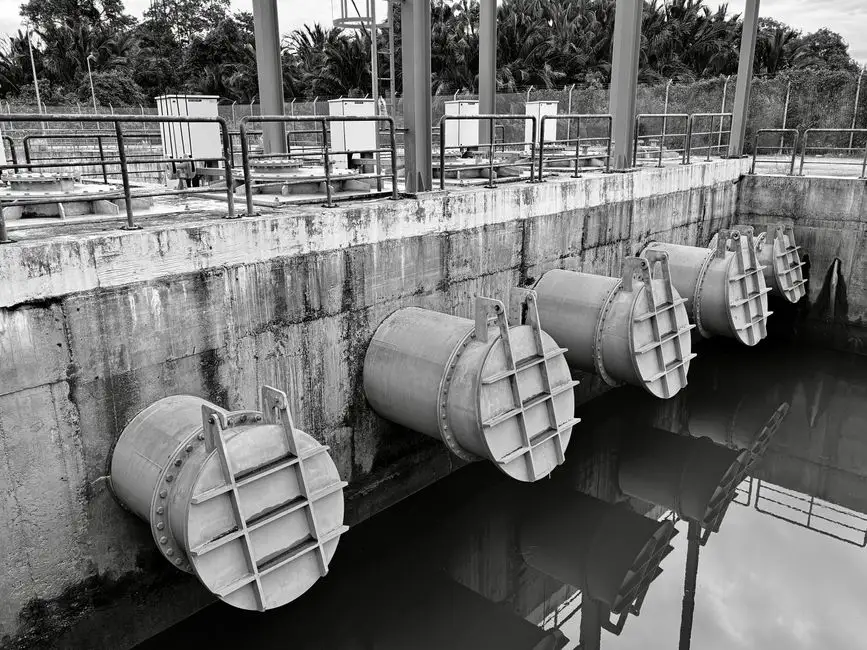
The retrofit case for a hotel STP is the exact one the Aston study describes: an existing suspended-growth biological plant that is not consistently meeting the discharge standard, in a basin envelope that cannot easily be expanded. Wikipedia's general statement that "The MBBR system is often installed as a retrofit of existing activated-sludge tanks to increase the capacity of the existing system" applies directly — the degree of filling of carriers can be adapted to the specific situation, and the existing tank can be re-used without expanding the footprint. For a hospitality buyer with a constrained basement plant room, that is the single most important structural argument for the technology.
Upstream of the MBBR, qualitative pretreatment is the part of the scope that decides whether the biofilm will survive. The research does not provide numeric sizing for screens, grit chambers, or FOG units, so a designer should plan for screening, grit removal, and FOG/oil removal ahead of the carriers as standard practice. FOG in particular is well known to coat biofilm and reduce oxygen transfer; a dissolved air flotation pretreatment step is the typical hospitality insertion point when kitchen flows are significant, paired with a rotary mechanical bar screen for solids capture. For greenfield sites with no existing basin, an underground package sewage treatment plant configuration consolidates the MBBR basin, screening, and clarification in a single buried envelope.
The turnkey MBBR scope itself is documented by Wikipedia as four components: a basin, free-floating carriers, an aeration grid, and a sieve on the outlet that retains the carriers. Anything outside those four — civil works, inlet screening, clarification, sludge handling, disinfection, reuse pumping — is the integrator's scope and should be priced separately. Genesis Water Tech adds two operational points that matter for hospitality: MBBR is "stable under large load variations and high flows" (a fit for weekend occupancy peaks at a resort) and the units are "modular" and "easy to retrofit" into an existing system. Neither source quantifies the cost or lead time of an MBBR retrofit — those are items to request from the supplier against the site-specific flow and influent.
Checklist Before You Specify an MBBR for a Hotel Project
Inputs to collect before talking to a supplier: design occupancy (rooms × guests), whether the hotel includes a kitchen and an on-site laundry, average and peak daily wastewater flow, recent influent sampling for BOD, COD, TSS, FOG, and surfactant, available footprint including any existing basin dimensions, and the discharge standard the project must meet (PERMEN LHK No. 68/2016 if applicable, or the local equivalent). The Dhuhan et al. 2021 and Kusuma et al. 2019 datasets are the published anchors for sizing the biological stage; the site-specific numbers govern everything around them.
Decisions to make up front: which Kaldnes-family media fits the influent (K1 family or K3 family), which fill fraction within the 20–70% envelope the design should sit at, the hydraulic retention time the supplier is asked to guarantee (the hotel study used 7 days, the laundry study 10 days), and whether the MBBR is a greenfield basin or a retrofit into an existing aeration tank. Operational constraints to flag: continuous aeration availability, access for media inspection and replacement, and the site's tolerance for periodic biofilm sloughing events. Specific HRT, F/M, or DO setpoints are items the supplier must demonstrate against the site-specific influent — none of the sources in the research provides defensible defaults.
Frequently Asked Questions
Does an MBBR reliably meet hotel wastewater discharge standards?
The only published hotel-specific MBBR dataset — Dhuhan et al. 2021 on Aston hotel wastewater using Kaldnes K3 at 30% fill and 7 days retention — reports 93.37% BOD removal and 89.74% TSS removal, and was evaluated against Indonesia's PERMEN LHK No. 68/2016 domestic wastewater standard. The standard the authors used is specific to that jurisdiction; any hotel developer should map the same kind of before/after comparison onto their own local discharge limit rather than assume the percentages transfer unmodified.
Can an MBBR be installed inside an existing hotel aeration tank?
Wikipedia states that MBBR is "often installed as a retrofit of existing activated-sludge tanks to increase the capacity of the existing system" and that the degree of filling of carriers can be adapted to the specific situation. The Aston hotel study itself is a retrofit case — the existing suspended-growth plant was not consistently meeting PERMEN LHK No. 68/2016, and the MBBR was evaluated as the upgrade path. Whether a specific basin can accept carriers, an aeration grid, and an outlet sieve is a structural check the supplier must confirm against the existing tank drawings.
What does an MBBR for a hotel typically cost?
None of the sources in the research — the two Tanjungpura studies, the Wikipedia entry, or the Genesis Water Tech commercial page — quotes a price, a price band, or a cost-per-cubic-meter for an MBBR system. The right input to request from a vendor is a budget indication priced against the inputs in the checklist above: design flow, influent concentrations, target effluent, and whether the scope is a retrofit or a greenfield basin. Any specific number offered before those inputs are fixed should be treated as a placeholder, not a quotation.
How do I select an MBBR supplier for a hospitality project?
The defensible selection check is to require each vendor to position their proposed design against the two published operating points in this article — Kaldnes K3 at 30% fill with 7 days retention (hotel, Dhuhan et al. 2021) and Kaldnes K1 at 20% fill with 10 days retention (laundry, Kusuma et al. 2019) — and to demonstrate aeration duty, sieve design, and media replacement access for the specific basin. Ask for at least one hospitality reference with influent characteristics similar to your site, and for a written compliance statement against the discharge standard that applies to your jurisdiction rather than a generic percentage guarantee.