Why Textile Wastewater Is a Hard Biological Stream
Textile effluent is one of the most variable and chemically aggressive industrial streams a biological plant will ever see. The 2026 Water Environment Research applied review (98(7):e70490) states that effluents from washing, bleaching, and dyeing contain dyes, heavy metals, surfactants, and other toxic compounds that threaten ecosystems and human health, and that conventional WWTPs face high costs, sludge generation, and limited removal of persistent contaminants (Water Environment Research, 2026-07). The same review frames physicochemical, biological, and hybrid technologies as the active research response because single-stage biological systems under-treat the persistent fraction.
The Kusuma et al. 2019 laundry study at Tanjungpura University, DOI 10.26418/jtllb.v7i1.31882, shows why a textile-adjacent stream is biologically aggressive: raw BOD 441 mg/L, COD 910 mg/L, phosphate 38.24 mg/L, and surfactant 47.8 mg/L on a FRESCO laundry feed (Kusuma, Fitria and Kadaria, 2019). Each of those parameters — not just the obvious color — has to be stripped before the effluent is safe to discharge, and the biofilm must hold its performance while a dye batch swings the load.
Because textile flows swing with batch cycles, published design loads should be treated as starting points only. A buyer should demand influent variability data (peak vs average, hourly profile across one dye cycle) from the vendor before signing off on tank volume.
What an MBBR Actually Does Inside a Textile Aeration Tank
Per Wikipedia's MBBR entry, a moving bed biofilm reactor is an aeration tank filled with free-floating plastic carriers on which a biofilm grows; the carriers are kept in motion by the aeration grid, and a sieve at the outlet retains them in the basin (Wikipedia, "Moving-bed biofilm reactor"). The technology was developed at NTNU by Prof. Hallvard Ødegaard in the late 1980s — first pilot in the early 1980s, first full-scale plant in Norway in 1985, commercialized by Kaldnes Miljöteknologi (now AnoxKaldnes, owned by Veolia Water Technologies), and now installed in 700+ plants across 50+ countries (Wikipedia).
HDPE is the dominant carrier material because of its plasticity, density, and durability; carrier fill can be tuned to the application and reach as much as 70% of tank volume in some installations (Wikipedia). For textile duty, the Kaldnes K1 family is the documented baseline (Kusuma et al. 2019). Documented MBBR applications include nitrification, denitrification, BOD/COD removal, and anammox — which together cover the pollutant set a textile plant actually needs to address (Wikipedia).
Biofilm processes require less space than activated-sludge systems because the biomass is more concentrated and the system is less dependent on final sludge separation (Wikipedia), which matters on cramped textile-mill sites. The same source notes MBBR does not need sludge recycle, an advantage over conventional activated sludge on streams that swing.
Documented MBBR Performance on Textile and Laundry Streams
The single most useful peer-reviewed textile-adjacent dataset is from Kusuma, Fitria, and Kadaria (2019), Tanjungpura University, DOI 10.26418/jtllb.v7i1.31882. The study used an MBBR with Kaldnes K1 HDPE carriers at 20% fill, a 15-day biofilm seeding, and HRTs of 6, 8, and 10 days on FRESCO laundry wastewater. The day-10 results are the best reported in the study.
| Parameter | Raw influent (mg/L) | Day-10 effluent (mg/L) | Removal (%) | Source |
|---|---|---|---|---|
| BOD | 441 | 39.67 | 91.00 | Kusuma et al. 2019 |
| COD | 910 | 56.3 | 93.81 | Kusuma et al. 2019 |
| Phosphate | 38.24 | 5.31 | 86.10 | Kusuma et al. 2019 |
| Surfactant | 47.8 | 5.62 | 88.22 | Kusuma et al. 2019 |
For textile dyeing specifically, the A2O moving-bed biofilm reactor configuration has been reported in the Korean Journal of Chemical Engineering (DOI 10.1007/s11814-010-0143-5), and a combined MBBR-MBR system has been investigated for textile wastewater in Heliyon (Europe PMC PMC11133930). These are the two configuration extensions a textile engineer should ask any MBBR bidder about, since they directly target dye and color removal beyond what an aerobic-only MBBR can deliver.
Configuring the MBBR Stage for a Textile Plant
A textile MBBR should not be specified as a generic municipal unit. The configuration choices that move the design from a copy-paste municipal bid to a textile-specific bid are: carrier type and fill, aerobic-only vs A2O vs anaerobic-aerobic vs MBBR-MBR, and the pre-treatment that has to sit in front of the basin. The published textile-adjacent baseline is Kaldnes K1 HDPE at 20% fill, 15-day biofilm seeding, and 10-day HRT on laundry effluent (Kusuma et al. 2019); carrier fill can in principle be raised toward 70% of tank volume in other applications (Wikipedia), but a vendor should justify any increase against the actual textile load.
| Configuration | Documented textile/dyeing evidence | What it delivers |
|---|---|---|
| Aerobic-only MBBR | Kusuma et al. 2019 (laundry, 20% Kaldnes K1, 10-day HRT) | BOD, COD, phosphate, surfactant removal |
| A2O-MBBR | Korean J. Chem. Eng. 2010, DOI 10.1007/s11814-010-0143-5 | Biological nutrient removal alongside organics on textile dyeing effluent |
| Anaerobic-aerobic MBBR | Wikipedia, municipal lab 2019 reference | Combined biogas production and aerobic polishing on industrial wastewater |
| MBBR-MBR hybrid | Heliyon, Europe PMC PMC11133930 | Reuse-grade suspended solids and turbidity finish that an MBBR alone cannot reach |
Hybrid biofilm + suspended biomass MBBRs, where attached and suspended biomass co-exist, raise the active biomass concentration and are worth specifying for high-strength textile influents (Wikipedia). On the upstream side, a rotary bar screen for textile headworks and DAF pre-treatment for textile wastewater are normally required to strip fibers, lint, colloidal dye, and oils before the biofilm sees the load; without this conditioning, the carriers foul and the published removal numbers are not repeatable.
Where the MBBR Sits in a Full Textile Treatment Train
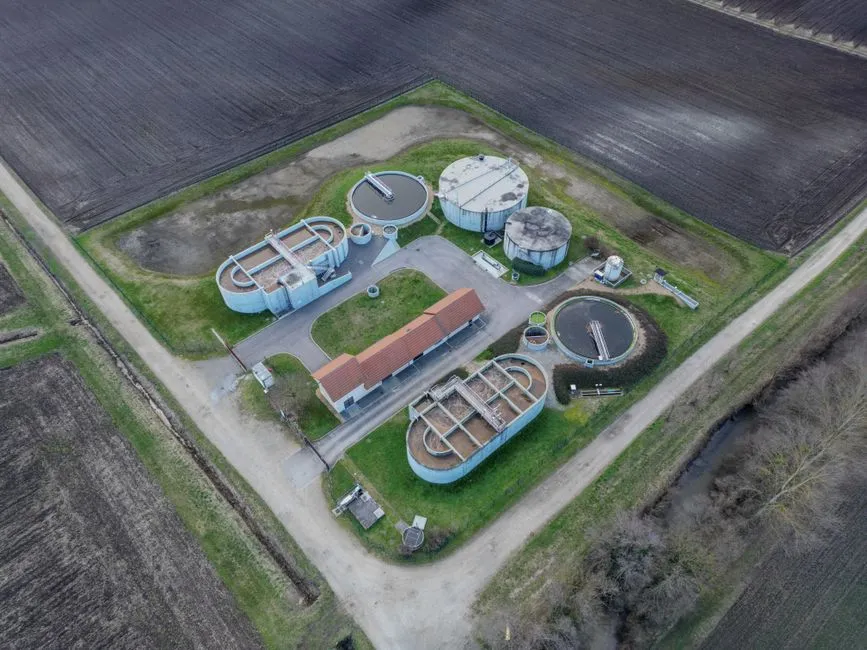
An MBBR is one stage in a treatment train, not a stand-alone cure. The WER 2026 review (98(7):e70490) frames biological treatment as one stage inside a hybrid system rather than a stand-alone solution, because textile streams carry persistent contaminants that single biological stages under-treat (Water Environment Research, 2026-07). A workable textile train runs: rotary bar screen → flow equalization → chemical conditioning and DAF for colloids, oils, and suspended dye → MBBR (or A2O-MBBR) for BOD/COD/surfactant/nutrient removal → optional MBR or sand filter for polish → disinfection if reuse is the target.
Sludge handling still has to be designed into the train. A biofilm reactor produces less waste-activated sludge than a comparable activated-sludge plant (Wikipedia), but the wasted biofilm plus any upstream DAF float still needs dewatering; the standard pairing is a sludge dewatering for the wasted biofilm stage on a plate-and-frame press. Where reuse is the target, the MBBR hands off to an MBR polishing stage after the MBBR; for further context on how a submerged MBR behaves on industrial loads, the submerged MBR design for industrial wastewater guide covers the same hardware on a different stream.
For a buyer, the right question is not "MBBR or not" but "where does the MBBR hand off to the next stage, and what does each stage guarantee on its own?" That framing forces every vendor to quote against a defined interface rather than a black box.
MBBR vs SBR vs Activated Sludge vs Submerged MBR for Textile Duty
The pre-purchase decision is not "which technology" but "which configuration of biological workhorse plus polish matches the discharge or reuse target." MBBR is strong on textile duty because the biofilm tolerates load swings, the footprint is small, and there is explicit textile/laundry removal data behind it (Kusuma et al. 2019). The weakness is that MBBR alone cannot deliver reuse-grade suspended solids or turbidity — it needs an MBR or filter downstream (Wikipedia; Heliyon, Europe PMC PMC11133930). Submerged MBR's strength is near-reuse effluent at sub-micron filtration in one integrated step, which matters if the plant wants reuse water for dyeing or washing rather than discharge.
Conventional activated sludge and SBR struggle on textile streams. The WER 2026 review (98(7):e70490) lists high sludge generation and limited persistent-contaminant removal as structural problems on textile flows (Water Environment Research, 2026-07), and SBR in particular is sensitive to toxic shock from dye batches. A selection rule of thumb from the source evidence: pick MBBR (or A2O-MBBR) as the biological workhorse and add an MBR only if reuse-quality water is the target; pick an MBR-only system if the textile load is moderate and reuse is mandatory; do not rely on a single biological stage for the persistent fraction flagged in WER 2026. For MBR sizing inputs, the MBR design criteria for industrial reuse guide is the relevant adjacent reference.
| Reactor type | Textile strength | Textile weakness | Source |
|---|---|---|---|
| MBBR (aerobic / A2O) | Small footprint, no sludge recycle, tolerates load swings, explicit textile/laundry data | Cannot on its own reach reuse-grade TSS/turbidity | Kusuma et al. 2019; Wikipedia |
| MBBR-MBR hybrid | Biological workhorse plus reuse-grade polish in one line | Higher membrane OPEX and footprint than MBBR alone | Heliyon, Europe PMC PMC11133930 |
| Submerged MBR (standalone) | Reuse-grade effluent, compact | Higher membrane cost; sensitive to toxic shock without upstream buffer | Wikipedia; WER 2026 |
| Conventional activated sludge / SBR | Well-understood, widely available | Large footprint, high sludge yield, weak on persistent textile contaminants, toxic-shock sensitive | Wikipedia; WER 2026 |
What a Textile Buyer Should Ask an MBBR Vendor

The fastest way to separate a textile-capable MBBR bid from a copy-paste municipal bid is to demand the configuration match and the reference match. The available peer-reviewed textile/laundry MBBR data sits on a 20% Kaldnes K1 fill, 15-day seeding, and 10-day HRT baseline (Kusuma et al. 2019), and a vendor should be able to defend a different number against that anchor. The four configuration families a textile plant should pin the vendor to are aerobic-only, A2O (Korean J. Chem. Eng. 2010, DOI 10.1007/s11814-010-0143-5), anaerobic-aerobic (Wikipedia), and MBBR-MBR (Heliyon, Europe PMC PMC11133930) — each is a different cost and footprint conversation.
The inputs a vendor must be asked to size against are peak and average COD/BOD/surfactant/salt/dye loads, temperature window, pH range, discharge limits versus reuse targets, and a carrier fill percentage justified against the specific load (Wikipedia notes fill can range toward 70% in some applications). Finally, the buyer should pin down what is outside the MBBR scope — screening, DAF, equalization, sludge dewatering, and final polishing/disinfection — so the vendor's price can be compared on a like-for-like basis; for the pH and nutrient side of that scope, an automatic chemical dosing for pH and nutrient control unit is the standard pairing. For pre-treatment sizing, the adjacent DAF applications and removal rates reference is the natural place to validate the upstream stage. For a plant-level rollout, the industrial park wastewater master planning guide covers how the MBBR stage slots into an EPC package.
Frequently Asked Questions
What MBBR removal rates are documented on textile or laundry effluent?
The strongest textile-adjacent numbers come from Kusuma, Fitria and Kadaria (2019, Tanjungpura University, DOI 10.26418/jtllb.v7i1.31882) on a Kaldnes K1 MBBR at 20% fill, 15-day seeding, and 10-day HRT on FRESCO laundry wastewater: BOD 91% (441 → 39.67 mg/L), COD 93.81% (910 → 56.3 mg/L), phosphate 86.10% (38.24 → 5.31 mg/L), and surfactant 88.22% (47.8 → 5.62 mg/L) on day 10. A2O-MBBR and MBBR-MBR configurations for textile dyeing are documented in Korean J. Chem. Eng. 2010 (DOI 10.1007/s11814-010-0143-5) and Heliyon (Europe PMC PMC11133930) respectively.
How much does an MBBR system for textile wastewater cost?
The research data set does not include a published equipment or EPC price for a textile MBBR, so a buyer should not accept a vendor number without an itemized quote. To make bids comparable, request a like-for-like split of: basin volume and carrier fill, aeration grid and blower sizing, carrier media cost, instrumentation, and what is explicitly excluded (screening, DAF pre-treatment for textile wastewater, equalization, sludge dewatering, polishing, and disinfection). Also ask the vendor to defend their proposed HRT and carrier fill against the Kusuma et al. 2019 baseline of 20% Kaldnes K1 fill at 10-day HRT.
How do I shortlist MBBR vs SBR vs submerged MBR for a textile plant?
Use a two-axis decision: discharge vs reuse on one axis, and influent variability on the other. For a discharge-only target with high load swings, MBBR or A2O-MBBR is the workhorse (Kusuma et al. 2019; Korean J. Chem. Eng. 2010). For a reuse target, an MBBR-MBR hybrid (Heliyon, Europe PMC PMC11133930) or a standalone submerged MBR is the right fit. For a moderate load with mandatory reuse, standalone submerged MBR is the simpler line. Avoid relying on a single biological stage — including SBR or conventional activated sludge — for the persistent-contaminant fraction flagged by the WER 2026 review (98(7):e70490).
What compliance and lead-time questions should I put to an MBBR supplier before signing?
Ask for the carrier type, fill percentage, HRT, and DO setpoint justified in writing against the specific influent profile, plus reference plants on textile or laundry duty (not municipal installs). Confirm the discharge or reuse guarantees the vendor is willing to put behind the bid, the membrane warranty and replacement interval if an MBBR-MBR is proposed, the carrier media lead time, and whether the proposed control narrative covers the dye-batch load swing. For the dewatering side of the line, a sludge dewatering for the wasted biofilm package is usually quoted separately and should be on the same comparison sheet.