How Food & Bev Plants Near Decatur Meet 2026 Pretreatment Limits Before Sewer Discharge
Food and beverage plants near Decatur, Illinois meet 2026 pretreatment limits by engineering against three overlapping layers: 40 CFR Part 403 (General Pretreatment Regulations), 40 CFR Parts 405–411 categorical effluent guidelines for the relevant sub-sector (grain mills under 406 for corn/wet-milling, dairy under 405, meat under 409, canned fruit/vegetable under 407, and 432 for meat products where applicable), and site-specific local limits written by the Decatur Sanitary District as the control authority. Federal categorical numbers are the floor; the local permit is the enforceable ceiling. The defensible 2026 train is screening → equalization → DAF → biological (MBR or CAS) → chemical precipitation for total phosphorus → disinfection/polishing, with PLC-controlled coagulant and pH trim to absorb CIP excursions. Electronic DMR submission and Significant Industrial User reporting through Illinois EPA's eReporting system are mandatory in 2026, and SIU re-determination at the receiving POTW is the gating step before any equipment PO.
The Three-Layer Compliance Stack for Decatur F&B Dischargers
Layer 1 is 40 CFR Part 403, the General Pretreatment Regulations, which delegate enforcement to local POTWs as control authorities — the same delegation pattern Illinois EPA uses to authorize the Decatur Sanitary District to administer pretreatment on its collection system (per the delegation pattern documented in the parallel Seward F&B pretreatment playbook on this site, 2025-09). Layer 2 is the F&B-specific categorical standards, and 40 CFR Part 406 (Grain Mills) is the most relevant for Decatur's corn/wet-milling cluster around Cargill and ADM-adjacent operations; 405 (Dairy), 407 (Canned and Preserved Fruits and Vegetables), 408 (Canned and Preserved Seafood), 409 (Meat Products), and 432 (Meat Products) are also potentially applicable, and 40 CFR Part 410 (Tanning) only applies where a plant runs co-located rendering. Layer 3 is the site-specific POTW discharge permit — 40 CFR 403.5(c) explicitly allows POTWs to set numeric or narrative local limits stricter than the federal categorical floor to protect against pass-through, interference, biosolids quality, and receiving-water standards, so the local limit is the enforceable ceiling. EPA currently regulates 59 industrial sub-categories with dedicated effluent limit tables, and food/beverage BOD routinely runs 10–20× higher than the domestic sewage baseline a POTW is designed around (Crystal Clean, 2025) — that gap is why a generic municipal checklist fails a Decatur F&B plant on its first audit. Reporting in 2026 is electronic: eDMR submission and electronic noncompliance notification are the default for any Significant Industrial User, and an unreported CIP excursion now carries the same enforcement weight as a chronic violation (Seward F&B pretreatment playbook, 2025-09).
Pollutants That Drive a Decatur F&B Design Basis

Six parameters govern almost every F&B pretreatment design basis: BOD/COD, TSS, FOG, total phosphorus, pH, and temperature (Integrated Water Services, 2025; Seward F&B pretreatment playbook, 2025-09). Raw dairy and meat wastewater runs 1,000–10,000 mg/L BOD against local permit limits that commonly sit at 250–500 mg/L BOD at the headworks, so a 10:1 reduction is the absolute floor for any train that will satisfy Decatur Sanitary District's local limits. The typical categorical ceiling for TSS is 100 mg/L, while an optimized DAF + biological train routinely achieves 25–50 mg/L. FOG concentrations reach several thousand mg/L in fryer, rendering, and stickwater streams, and DAF targets 25–50 mg/L in the underflow with proper coagulant conditioning. Total phosphorus in cereal, dairy, and meat wastewater commonly falls between 10 and 100 mg/L as P, well above the ~1 mg/L ceiling that most POTWs now apply at the headworks — chemical precipitation is unavoidable. The standard discharge pH window is 6.0–9.0, and CIP and lye-based cleaners routinely push excursions that must be neutralized in equalization before the biological stage. Temperature is the parameter most often missed in older plants: CIP and cooking operations routinely push above 40 °C, which can shut down downstream nitrification biology if not equalized.
| Parameter | Raw wastewater band | Permit ceiling (POTW/categorical) | Defensible design target | Unit operation |
|---|---|---|---|---|
| BOD/COD | 1,000–10,000 mg/L (dairy, meat) | 250–500 mg/L BOD (local limit varies) | < 30 mg/L effluent | Biological (activated sludge or MBR) |
| TSS | Hundreds to a few thousand mg/L | 100 mg/L typical; 25–50 mg/L achievable | 25–50 mg/L | DAF + biological uptake + chemical precipitation |
| FOG (O&G) | Several thousand mg/L in fryer / rendering / stickwater | ~100 mg/L ceiling; DAF routinely hits 25–50 mg/L in underflow | 25–50 mg/L underflow | industrial DAF system with coagulant conditioning |
| Total phosphorus | 10–100 mg/L as P (cereal, dairy, meat) | ~1 mg/L at headworks; 0.5–1 mg/L achievable | < 1 mg/L | Biological luxury uptake + chemical precipitation |
| pH | CIP/lye excursions outside 6.0–9.0 | 6.0–9.0 | 6.5–8.5 trim | Equalization with neutralization trim via PLC-controlled coagulant and pH dosing skid |
| Temperature | > 40 °C on CIP / cookout cycles | < ~40 °C to protect nitrification | < 38 °C to aeration basin | Equalization with cooling trim |
How Decatur Sanitary District and Illinois EPA Stack on Top of the Federal Floor
Illinois EPA administers NPDES delegation and the state pretreatment program, and the Decatur Sanitary District acts as the delegated control authority for industrial users discharging to its collection system (per the delegation pattern documented in the Seward F&B pretreatment playbook, 2025-09). Significant Industrial User status is triggered by flow (typically 25,000 gpd or more for categorical industries) and by pollutant strength; the practical effect is the full pretreatment monitoring stack — composite sampling for BOD, TSS, FOG, and TP at monthly-to-quarterly frequency plus continuous pH and flow monitoring. The categorical floor at 40 CFR 405.63 for existing dairy sources is 30 mg/L BOD₅ and 45 mg/L TSS as a 30-day average (Rainsville F&B pretreatment piece, 2025); the corresponding 40 CFR 432 floor for existing meat-product sources is 26 mg/L BOD₅ and 40 mg/L TSS as a 30-day average (Rainsville F&B pretreatment piece, 2025). Local limits can sit below the categorical floor; the engineering rule of thumb is to design to the strictest number in the stack rather than chase the federal minimum (Crystal Clean, 2025). The gating step before any equipment PO is the eReporting and SIU re-determination workflow at the delegated POTW, because permit modifications that require local-limits re-evaluation or SIU re-designation typically run longer than the equipment procurement window (Seward F&B pretreatment playbook, 2025-09).
The 2026 Pretreatment Train: Stage by Stage
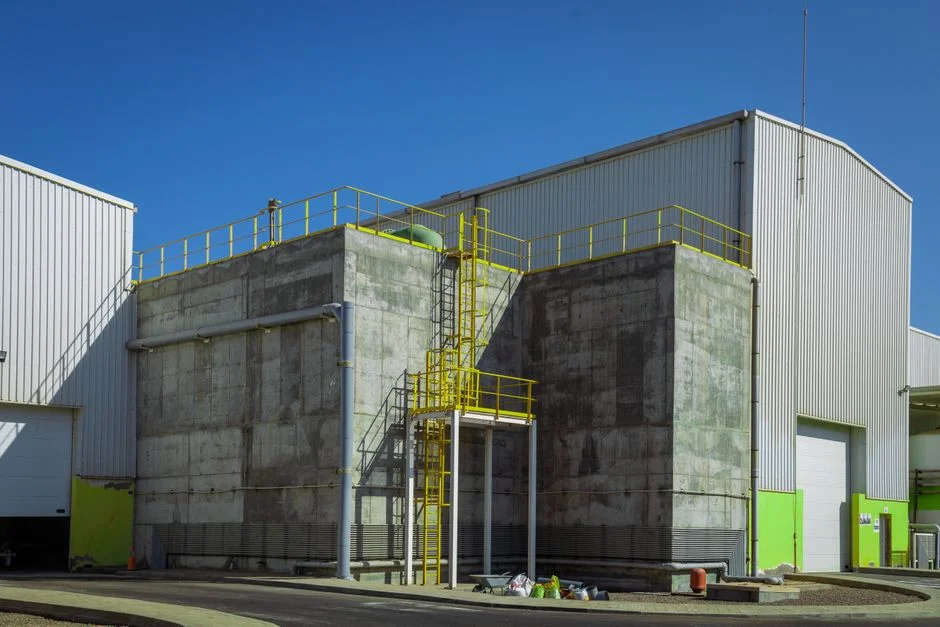
The defensible 2026 F&B pretreatment train runs screening → equalization → DAF → biological treatment → chemical precipitation → disinfection / final polishing in that order (Seward F&B pretreatment playbook, 2025-09). Each stage is justified by a specific pollutant and a measurable performance band, and an engineer can sketch the train on a P&ID with the bands below as sizing inputs. Stage 1 is a rotary mechanical bar screen (GX class) for rag, plastic, and bone fragment removal; bar spacing is typically 3–6 mm for food lines. Stage 2 is an equalization basin (6–24 h HRT) with aeration and pH trim, sized to 1.5–2× peak CIP flow because washdown surges run 3–5× the production average (Crystal Clean, 2025; Rainsville F&B pretreatment piece, 2025). Stage 3 is DAF at surface loading 4–25 m/h, air-to-solids 0.005–0.02, recycle 20–40%, targeting O&G 25–50 mg/L and TSS 50–100 mg/L in the underflow. Stage 4 is biological treatment — MBBR/CAS (HRT 8–24 h, MLSS 3,000–5,000 mg/L) or an MBR membrane bioreactor system (HRT 4–10 h, MLSS 8,000–12,000 mg/L); DO setpoint 1.5–2.5 mg/L where nitrification is required, and MBR effluent routinely runs BOD < 30 mg/L and TSS < 5 mg/L. Stage 5 is chemical precipitation with alum 50–250 mg/L or FeCl₃ 30–150 mg/L, with PLC-controlled trim on a flow-proportional load to avoid the 10–20% chemistry penalty of manual feed. Stage 6 is disinfection/polishing: ClO₂ residual 0.1–0.5 mg/L at pH 6.0–9.0, or a lamella clarifier running at 20–40 m/h surface loading as a quick polish step for older plants grandfathered on weaker permits. For plants in the 10–100 m³/h envelope typical of mid-size Decatur-area F&B operations, a package industrial DAF system spans 4–300 m³/h across 13 standard models and pairs with an automatic coagulant and polymer dosing skid (Rainsville F&B pretreatment piece, 2025).
| Stage | Unit operation | Design band | Performance target |
|---|---|---|---|
| 1 | Rotary mechanical bar screen (GX class) | 3–6 mm bar spacing | Rag, plastic, bone fragment removal; pump protection |
| 2 | Equalization basin | 6–24 h HRT; 1.5–2× peak CIP flow | Damps CIP slugs, pH, T > 40 °C excursions |
| 3 | DAF | Surface loading 4–25 m/h; A/S 0.005–0.02; recycle 20–40% | O&G 25–50 mg/L; TSS 50–100 mg/L in underflow |
| 4 | MBBR / CAS or MBR | HRT 8–24 h (CAS) or 4–10 h (MBR); MLSS 3,000–5,000 / 8,000–12,000; DO 1.5–2.5 mg/L | Effluent BOD < 30 mg/L; TSS < 5 mg/L (MBR) |
| 5 | Chemical precipitation | Alum 50–250 mg/L or FeCl₃ 30–150 mg/L; PLC-controlled | TP < 1 mg/L at headworks |
| 6 | Disinfection / polishing | ClO₂ 0.1–0.5 mg/L at pH 6.0–9.0; lamella 20–40 m/h | Discharge-ready effluent; polishing on weak permits |
DAF vs Lamella, MBR vs CAS: The Decisions That Move the Capex Number
The DAF vs lamella decision rule is well-defined: specify DAF when FOG or emulsified oils exceed ~200 mg/L or when the line is meat, dairy, or poultry; specify a high-efficiency sedimentation tank (lamella clarifier) when TSS is the dominant parameter and the plant's priority is minimizing coagulant and polymer OPEX (Rainsville F&B pretreatment piece, 2025). An industrial DAF system spans 4–300 m³/h across 13 standard models and removes FOG and colloidal matter via micro-bubble flotation with automatic skimming; a lamella clarifier achieves 20–40 m³/m²/h surface loading through inclined-plate settling and can cut coagulant consumption by up to 30% (Rainsville F&B pretreatment piece, 2025). The MBR vs conventional activated sludge decision is bigger: MBR delivers higher effluent quality on a 60% smaller footprint at the cost of membrane replacement and aeration energy, and the MBR-vs-CAS capex and opex delta is large enough that the procurement decision should be run as a 10-year ROI rather than a capex-only comparison (Integrated Water Services, 2025; Rainsville F&B pretreatment piece, 2025). Package DAF at the 10–100 m³/h scale typically runs in the low-to-mid five figures per m³/day of design flow; adding an MBR biological stage brings installed cost to roughly 1.4–1.8× the DAF cost (HydropureWater field data, 2026, as cited in the Rainsville F&B pretreatment piece, 2025). Sludge handling ties the train together: combined DAF skimmings and biological WAS dewater on a plate and frame filter press sized 1–500 m² to 22–28% dry matter, cutting disposal volume 75–80% versus lagooned float (Seward F&B pretreatment playbook, 2025-09; Rainsville F&B pretreatment piece, 2025).
| Decision | Specify DAF / MBR when | Specify lamella / CAS when | Key tradeoff |
|---|---|---|---|
| Primary FOG/solids | FOG or emulsified oils > ~200 mg/L; meat, dairy, poultry line | TSS-dominant, low-FOG, chemical-OPEX-sensitive | DAF chemical OPEX vs lamella 30% coagulant savings |
| Biological reactor | Reuse-quality polish needed; tight footprint; higher effluent quality required | Land available; reuse not on the table; lower membrane OPEX preferred | MBR 60% smaller footprint vs membrane replacement and aeration energy |
| Sludge handling | Hauling cost > 18–30 month payback threshold | Lagoon volume available; lower solids capture acceptable | Plate and frame 75–80% volume reduction vs lagoon footprint |
Surcharge Economics and Consent-Order Risk: The 10-Year ROI Frame

Documented sewer surcharge spikes from enforcement case files include a dairy that escalated past $30,000/month and a meatpacking plant whose surcharges were "approaching $40,000/month" (cited in the Seward F&B pretreatment playbook, 2025-09). A DAF retrofit has been documented to cut one dairy's wastewater costs by "over $20,000/month" after startup, and a failed dissolved-air-flotation alternative at a fluid milk / yogurt / juice plant ran opex at $14 per 1,000 gallons treated — a benchmark for what "do nothing" actually costs (Seward F&B pretreatment playbook, 2025-09). A consent order scenario is more expensive than an upgrade: the cited egg-processor case shows a 2016 consent order requiring BOD, TKN, and TSS reduction prior to discharge, which is a multi-year capex event triggered by one enforcement action (Seward F&B pretreatment playbook, 2025-09). Plate and frame dewatering usually pays back inside 18–30 months at hauling rates typical of north Alabama, and a comparable payback profile applies to high-disposal-cost Illinois sites (Rainsville F&B pretreatment piece, 2025). The defensible 2026 budget ask is to model surcharge avoidance, consent-order risk, and reuse-credit value side by side; any one of them alone usually justifies the DAF + biological upgrade for a 100,000+ gal/day Decatur-area plant, but the exact capex figure should be obtained from vendor quotes against the plant's actual flow, raw BOD, and raw FOG rather than estimated from generic industry ranges (Seward F&B pretreatment playbook, 2025-09).
Reject-Cause → Fix Map for the 2026 Operator
When the Decatur Sanitary District sends back a violation notice, the operator can pattern-match it to a process weakness and act on Monday morning using the map below. FOG pass-through at the headworks points to under-dosed DAF coagulant or hydraulic overload on the flotation cell; the fix is a jar-test-driven coagulant reset and recycle-rate check (Seward F&B pretreatment playbook, 2025-09). A pH excursion on a Saturday CIP drain points to inadequate equalization or a failed trim loop; the fix is an EQ volume review and PLC-controlled caustic/acid dosing trim via the PLC-controlled coagulant and pH dosing skid. Hydraulic overload during a 4-hour CIP cycle points to an undersized EQ basin relative to the actual CIP schedule; the fix is a flow-balance study against the actual CIP schedule, not the design peak. Poor flocculation control in chemical precipitation is corrected by a streaming current monitor on the clarifier and alum-dose trim against the TP analyzer. TSS breakthrough on the permit limit is corrected by a white-water probe check and saturator pressure verification on the DAF. The deeper process-fault signatures — foaming, bulking sludge, and turbid effluent — are catalogued in the wastewater troubleshooting field guide.
| Reject signature | Likely cause | Monday-morning fix |
|---|---|---|
| FOG pass-through at headworks | Under-dosed DAF coagulant or hydraulic overload on the flotation cell | Jar-test-driven coagulant reset and recycle-rate check |
| pH excursion on Saturday CIP drain | Inadequate equalization or failed trim loop | EQ volume review and PLC-controlled caustic/acid dosing trim |
| Hydraulic overload during 4-hour CIP cycle | Undersized EQ basin relative to actual CIP schedule | Flow-balance study against actual CIP schedule, not design peak |
| Poor flocculation control in chemical precipitation | Manual dose, no streaming-current feedback | Streaming current monitor on clarifier and alum-dose trim against TP analyzer |
| TSS breakthrough on permit limit | White-water carryover or saturator pressure drift | White-water probe check and saturator pressure verification on the DAF |
Frequently Asked Questions
How does a Decatur F&B plant size a DAF for a 3,000–10,000 mg/L FOG stream?
Four inputs drive the sizing: forward flow, peak-to-average ratio, raw BOD, and raw FOG. For a 3,000 mg/L FOG dairy stream the design sits at the conservative end of the recycle band; a meat rendering stream at 10,000+ mg/L FOG pushes toward the higher recycle rate and the longer retention model. Buyers should request a sized proposal with HRT, recycle rate, and chemical dose assumptions stated explicitly (Seward F&B pretreatment playbook, 2025-09).
What capex range should a Decatur F&B plant budget for a 100,000 gal/day DAF + biological train in 2026?
Package DAF at the 10–100 m³/h scale typically runs in the low-to-mid five figures per m³/day of design flow, and adding an MBR biological stage brings the installed cost to roughly 1.4–1.8× the DAF cost (Rainsville F&B pretreatment piece, 2025). The defensible move is to request vendor quotes against the plant's actual forward flow, peak-to-average ratio, raw BOD, and raw FOG, then run the technology choice through the DAF vs clarifier decision for F&B plants walkthrough before issuing a PO.
What triggers Significant Industrial User status and the full eDMR + electronic noncompliance stack at the Decatur Sanitary District?
SIU status is triggered by flow (typically 25,000 gpd or more for categorical industries) and by pollutant strength; the practical effect is the full pretreatment monitoring stack — composite sampling for BOD, TSS, FOG, and TP at monthly-to-quarterly frequency plus continuous pH and flow monitoring, with eDMR submission and electronic noncompliance notification as the 2026 default (Seward F&B pretreatment playbook, 2025-09; Rainsville F&B pretreatment piece, 2025).
What is the gating step before issuing an equipment PO — the Decatur Sanitary District permit modification or the equipment lead time?
The gating step is the eReporting and Significant Industrial User re-determination workflow at the delegated POTW, not the equipment lead time. Permit modifications that require local-limits re-evaluation or SIU re-designation typically run longer than the equipment procurement window, so the modification should be filed before the equipment PO so that approval and commissioning line up (Seward F&B pretreatment playbook, 2025-09).
Why doesn't a lamella clarifier replace a DAF on a high-FOG meat or dairy line?
The DAF vs lamella decision rule sets the cutoff at FOG or emulsified oils above ~200 mg/L — above that band, the inclined-plate settling in a lamella clarifier does not reliably capture emulsified FOG, and cross-flow risk rises. Specify DAF when FOG or emulsified oils exceed ~200 mg/L or when the line is meat, dairy, or poultry; specify a lamella when TSS is the dominant parameter and chemical OPEX reduction is the priority (Rainsville F&B pretreatment piece, 2025). For a parallel Seward F&B pretreatment playbook on a comparable three-layer stack, see the Nebraska piece on this site.