
Where a Sludge Thickener Tank Fits in a Wastewater Plant
A sludge thickener tank sits between upstream clarification/biology and downstream digestion or mechanical dewatering to raise the solids concentration of a dilute sludge stream while shedding free water. The AOSTS sludge-thickening overview states that thickening is the wastewater treatment step that "increases the solids concentration and decreases the free water" in waste sludge, and that this step "minimizes the load on the downstream processes, such as sludge dewatering and digestion." That positioning is visible in the mixed-wastewater process flow used in the Process Safety and Environmental Protection microalgae study, where the primary settling tank and the sludge thickener are the two upstream streams feeding downstream biology, and the thickener output continues to dewatering and digestion.
For a specifier, the practical consequence is hydraulic: every percentage point of solids gained in the thickener shrinks the volume that must be heated, mixed, or pressed downstream. The Routledge chapter "Sources of Sludge and Thickener Design" remains the standard academic reference for the design logic—feed concentration, target underflow solids, sludge blanket depth, and overflow clarity—that flows from this process position. A plant that skips or undersizes thickening pays for it twice: once as hauled water in the dewatering cake and again as oversized digester volume. The full process flow, including primary settling, thickening, and dewatering integration, is mapped in this sludge thickener working principle and process flow guide.
The Four Sludge Thickener Tank Technologies Compared
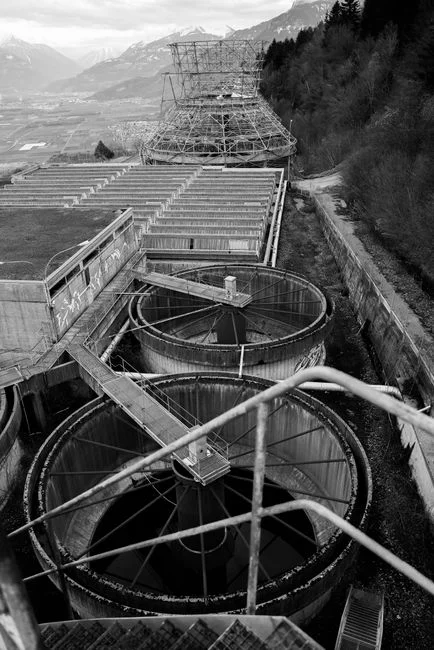
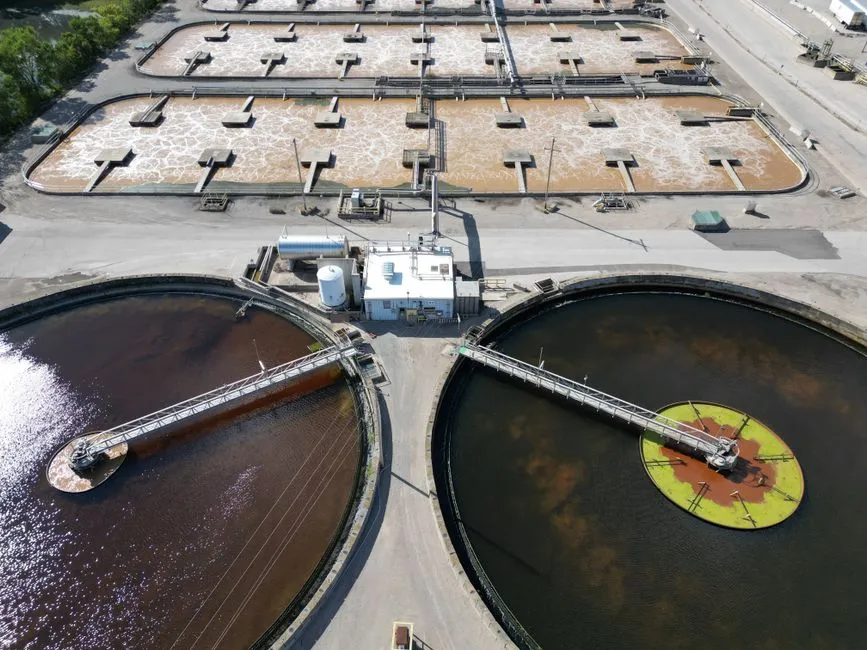
Gravity thickeners, DAF thickeners, rotary-drum thickeners, and centrifuge thickeners are competing solutions to the same problem rather than interchangeable equipment categories. The AOSTS article describes each as follows: a gravity thickener is a circular tank with slow-moving vertical paddles and a sloped base that concentrates thin sludge by letting solids settle; a DAF thickener attaches small air bubbles to suspended solids so they float to the surface as a removable blanket; a rotary-drum thickener is a stainless-steel drum with internal spirals and a flow system that mixes sludge and releases water; a centrifuge thickener uses centrifugal force to accelerate sedimentation. The same source notes that centrifuges "typically require less space than other sludge thickening methods, but generally… are not effective for primary sedimentation," which is why they are usually paired with biological sludges rather than primary clarifier underflow.
Specifiers must weigh footprint against polymer demand and achievable underflow. Gravity thickeners win on energy and polymer use but lose on footprint; DAF thickeners win on footprint and underflow density at the cost of polymer conditioning; rotary-drum units are compact and mechanically simple but limited to finer-particle sludges; centrifuges are the most compact and the most energy-intensive per unit of solids captured. The headline parameter table below condenses these four competing solutions into a single shortlisting view; quantitative underflow percentages were not given in the supplied research, so those cells are marked as inputs to request from vendors.
| Technology | Best-fit sludge | Footprint | Polymer demand | Underflow solids % |
|---|---|---|---|---|
| Gravity thickener | Primary, mixed primary + secondary | Large (circular tank) | Low to none | Request from supplier |
| DAF thickener | Waste activated sludge, high-FOG streams | Compact | Polymer-conditioned | Request from supplier |
| Rotary-drum thickener | Waste activated sludge | Compact (drum) | Polymer-conditioned | Request from supplier |
| Centrifuge thickener | Biological sludges (not primary) | Smallest | Polymer-conditioned | Request from supplier |
For a working definition of how the DAF variant fits into this shortlist, see the dissolved air flotation thickener system reference and the associated DAF retrofit and upgrade guide for capacity cases where an existing tank is being repurposed rather than replaced.
Key Sizing Parameters for a Sludge Thickener Tank in 2026
A defensible RFQ in 2026 starts with solids loading rate as the primary sizing envelope. The HydropureWater DAF thickener solids loading rate guide provides 24–48 lbs/ft²/day for a DAF thickener when polymer is dosed, which is the numeric anchor most specifiers use to scale a DAF unit to their solids inventory. For compact clarifier-thickener integrations, the same vendor's high-efficiency lamella sedimentation tank is rated at 20–40 m/h surface loading, per the HydropureWater product catalog entry; that figure is useful when a thickener is being co-located with a primary clarifier under a tight footprint.
For a gravity thickener, the design inputs that must be requested from the supplier are feed solids concentration, target underflow solids, sludge blanket depth, and paddle torque rating; the AOSTS overview does not publish numeric bands for these parameters, so the buyer should treat them as mandatory RFQ fields. For rotary-drum and centrifuge thickeners, the equivalent list is drum or bowl G-force, hydraulic residence time, polymer type and dose, and the feed-solids window the vendor guarantees. A sizing-envelope table that a procurement engineer can paste into an RFQ follows:
| Parameter | DAF thickener | Gravity thickener | Rotary-drum / centrifuge |
|---|---|---|---|
| Solids loading rate | 24–48 lbs/ft²/day with polymer (HydropureWater DAF guide) | Request from supplier | Request from supplier |
| Surface loading (clarifier-thickener) | 20–40 m/h (HydropureWater lamella clarifier) | N/A | N/A |
| Feed solids % | Request from supplier | Request from supplier | Request from supplier |
| Polymer demand | Polymer-conditioned (qualitative per AOSTS) | Low to none (qualitative per AOSTS) | Polymer-conditioned (qualitative per AOSTS) |
| Footprint | Compact | Large | Smallest (centrifuge per AOSTS) |
The lamella benchmark is detailed on the high-efficiency lamella sedimentation tank product page, including the 30% chemical-consumption reduction claim associated with the inclined-plate geometry.
Decision Framework: Which Thickener Tank for Your Sludge
Mapping sludge type to thickener type, then overlaying site constraints, provides the fastest route to a defensible shortlist. The AOSTS article is the basis for the sludge-type mapping: gravity thickeners handle primary and mixed sludge; DAF thickeners handle waste activated sludge and high-FOG streams; rotary-drum thickeners are dedicated thickening devices for waste activated sludge; and centrifuges accelerate sedimentation but are "not effective for primary sedimentation." Site footprint is the overlay: where land is available and polymer use is restricted, gravity remains the baseline; where footprint is the binding constraint, DAF or centrifuge pulls ahead, with the AOSTS note that centrifuges "require less space than other sludge thickening methods."
| If your sludge is… | First-choice thickener | Constraint-driven alternative |
|---|---|---|
| Primary or mixed primary + secondary | Gravity thickener | DAF thickener if footprint is tight |
| Waste activated sludge (WAS) | DAF thickener with polymer, or rotary-drum thickener | Centrifuge (less common as primary thickener per AOSTS) |
| High-FOG / food-and-beverage | DAF thickener | Rotary-drum thickener |
| Constrained site footprint | Centrifuge (per AOSTS) | DAF at 20–40 m/h lamella loading |
The "constrained site" row uses the 20–40 m/h figure from the HydropureWater high-efficiency lamella clarifier to allow a specifier to fit a thickener on a footprint that a conventional circular clarifier would not accommodate.
2026 Supplier Evaluation Checklist for Sludge Thickener Tanks
Procurement in 2026 requires distinguishing equipment vendors from resellers through specific technical and commercial questions. The first is tank and rotor material: the AOSTS article specifies that rotary-drum thickeners are "stainless-steel drums with spirals and a flow system," and the same construction logic applies to centrifuge rotors; gravity thickener shells are typically carbon steel with a corrosion-resistant coating, and material certificates (EN 10204 3.1) should be requested with the bid. The second is drive sizing: paddle torque rating for gravity units, gear-motor power for rotary drums, and G-force plus VFD capability for centrifuges are required inputs for the bid form. The third is instrumentation: sludge blanket level, underflow density meter, polymer feed flow, and a SCADA-ready I/O list are the minimum RFQ appendix requirements. The fourth is supplier diligence: a documented factory acceptance test plan, a performance test on simulated or actual site sludge, references on similar influent strength, and a post-commissioning service network in the buyer's region.
The economic case for thickening is realized in the downstream dewatering step. Request that the vendor quote expected underflow solids % under the buyer's feed conditions, then feed that number into a downstream dewatering mass balance to size a plate and frame sludge dewatering filter press and to model digester volume savings. A supplier who can provide a tested underflow number on simulated sludge is bidding on performance rather than hardware alone.
Frequently Asked Questions
What solids loading rate should I use to size a DAF thickener in 2026?
The HydropureWater DAF thickener solids loading rate guide provides 24–48 lbs/ft²/day with polymer conditioning, which serves as the band for RFQ anchoring until a vendor's bench test on the actual sludge narrows the range.
How do I choose between a gravity thickener and a DAF thickener for the same plant?
Match the technology to the sludge first: per the AOSTS sludge-thickening overview, gravity thickeners suit primary and mixed sludge with low polymer demand, while DAF thickeners suit waste activated sludge and high-FOG streams where polymer is acceptable and footprint is constrained.
What is a defensible 2026 supplier scorecard for a sludge thickener tank?
A defensible scorecard weights material certificates, drive sizing data, instrumentation lists, and supplier diligence items—FAT plan, performance tests, references, and service networks—equally, and rejects bids that omit expected underflow solids % under stated feed conditions.
How does thickener selection change downstream dewatering cost?
Thickener selection sets the underflow solids % that the downstream dewatering unit receives, and a higher underflow solids % directly reduces the hydraulic and polymer load on the downstream plate and frame sludge dewatering filter press; request that the thickener vendor quote the expected underflow % under your feed conditions to anchor the dewatering mass balance in test data.