
What Counts as a Small Community Wastewater System in Ecuador
A small community wastewater system in Ecuador is a decentralized treatment train sized for 200–5,000 people, typically delivering 80–200 L/person·day, and designed to meet Ecuador's TULSMA Libro VI Anexo 1 discharge limits. The dominant 2026 options are packaged MBR units (1–2,000 m³/day), underground A/O (WSZ) package plants (1–80 m³/h), and constructed-wetland trains combined with anaerobic pretreatment — chosen based on altitude, power reliability, and effluent reuse goals.
For sizing purposes, 200 people at 80 L/p·d gives 16 m³/day (lower bound for a rural school or small lodge), while 5,000 people at 200 L/p·d caps the envelope near 1,000 m³/day (upper bound for a parish capital or resort cluster). Inside that band, the design challenge is not novelty — it is keeping effluent compliant under Ecuador's Texto Unificado de Legislación Secundaria del Ministerio del Ambiente, Libro VI, Anexo 1, which sets the municipal-discharge envelope at BOD ≤100 mg/L and TSS ≤100 mg/L for surface-water and irrigation-reuse scenarios. Any system that misses those numbers is, for procurement-committee purposes, a non-starter regardless of capital cost. The public-health framing matters: a 2024 small-town water-quality study (PMID 39428701) linked the absence of community-scale treatment to measurable downstream contamination, which is the regulatory pressure that drives municipalities to fund decentralized plants in the first place. Engineers specifying in 2026 should treat the 100/100 mg/L pair as the floor — and design for BOD ≤30 mg/L and TSS ≤10 mg/L whenever reuse is on the table.
Ecuadorian Design Realities: Sierra, Costa, and Oriente Are Not the Same Job
Designing a small community wastewater system in Ecuador without separating the three geographic regions is the single most common specification error in 2026. Influent temperature swings 22 °C between the Andean Sierra and the Oriente, and the load profile follows. The table below summarizes the working envelope a design engineer should target before any equipment is quoted.
| Parameter | Sierra (Andean, 2,000–3,500 m) | Costa (Coastal, 0–500 m) | Oriente (Amazon, <500 m) |
|---|---|---|---|
| Influent temperature | 8–16 °C | 22–30 °C | 24–28 °C |
| Typical BOD | 150–250 mg/L | 200–400 mg/L | 180–300 mg/L |
| Typical TSS | 150–250 mg/L | 250–450 mg/L (rainy-season infiltration can double this) | 200–350 mg/L |
| Water table | Generally deep | High (≤1 m in rainy season) — favors above-grade or buoyant-resistant tanks | Variable; flooding common |
| Power reliability | Stable in towns, intermittent in rural parishes | Stable grid, salt-air corrosion risk | Intermittent single-phase in many cantons |
| Seismic zone (NEC-15) | High (V–VI) | Moderate (IV–V) | Moderate (III–IV) |
| Source-water chemistry risk | Hard water, occasional high Fe | Saline intrusion in coastal aquifers | Soft, acidic, high Fe/Mn in some aquifers |
Two non-obvious engineering consequences follow. First, in the Sierra, low influent temperature slows nitrification kinetics — design aerobic HRT around 6–8 h (not 4 h) or specify a submerged MBR running at MLSS 8,000–12,000 mg/L to compensate. Second, on the Costa, the high water table rules out standard buried WSZ tanks without buoyancy anchors and HDPE welding; specify a factory-welded, one-piece buried vessel or switch to a skid-mounted MBR. Across the Oriente, intermittent single-phase power pushes the design toward low-energy processes such as constructed wetlands or fully automated packaged systems with built-in ride-through.
Technology Options for 2026: MBR, WSZ A/O, and Constructed Wetlands

Three technology families dominate 2026 small community wastewater system proposals in Ecuador. They are not substitutes — each has a defensible niche defined by flow range, energy budget, and reuse intent. The matrix below lets a procurement committee read the trade-off in one page.
| Criterion | Packaged MBR | Underground WSZ A/O | Constructed Wetland (± anaerobic pretreatment) |
|---|---|---|---|
| Flow range | 1–2,000 m³/day | 1–80 m³/h (24–1,920 m³/day) | 5–500 m³/day typical |
| Effluent BOD | ≤5 mg/L (sub-1 μm membrane) | ≤20 mg/L | ≤20 mg/L (FWS) / ≤15 mg/L (SSF) |
| Effluent TSS | ≤1 mg/L | ≤20 mg/L | ≤15 mg/L |
| Effluent NH₃-N | ≤1 mg/L (with nitrification) | ≤15 mg/L | ≤10 mg/L (SSF); seasonal swing in FWS |
| Footprint | ~60% smaller than CAS at same load | Compact, fully buried | 5–10 m² per PE; large land area |
| Energy (kWh/m³) | 0.6–1.2 (submerged modules) | 0.4–0.7 | 0.05–0.15 (pumping only) |
| Operator skill | Trained (membrane CIP, SCADA) | Minimal (automated) | Minimal (vegetation, media) |
| CAPEX 2026 band | USD 80,000–250,000 (500–2,000 p) | USD 25,000–60,000 (~500 p) | USD 15,000–40,000/ha polishing |
| Best-fit Ecuadorian geography | Sierra towns, resorts, reuse intent | Hotels, hospitals, residential clusters | Rural Costa, Amazon, intermittent-power sites |
| TULSMA Anexo 1 headroom | Substantially tighter than limits (BOD ≤5 vs ≤100) | Comfortable margin | Comfortable margin; seasonal NH₃-N risk |
Three operational notes sharpen the choice. Packaged MBR units, such as a skid-delivered integrated MBR membrane bioreactor system, deliver near-reuse effluent with a footprint roughly 60% smaller than a comparable conventional activated-sludge plant, which matters in dense Sierra parishes where land is scarce and a parallel packaged MBR STP buyer's guide walks through hospitality-specific siting. Underground WSZ A/O units, including the WSZ underground A/O package sewage treatment plant, combine anoxic/aerobic zones, sedimentation, and disinfection in one buried vessel, run fully automated, and tolerate intermittent operators — a strong fit for hotels, hospitals, and residential clusters under 80 m³/h. Constructed wetlands remain the low-energy, low-capex option for rural Costa and Amazon communities, and the academic case is robust: the ASABE 2001 small-community constructed-wetland study (doi:10.13031/2013.6072) and the ASCE chapter on the same topic (doi:10.1061/9780784407417.ch11) both document reliable BOD, TSS, and nitrogen removal when the wetland is paired with anaerobic pretreatment. Current 2026 design philosophy frames these trains as nature-based solutions, supporting wetland + anaerobic pretreatment as a defensible process selection.
Recommended Process Flow: MBR Primary + Constructed Wetland Polishing
For a 1,000-person Sierra town targeting reuse, the defensible 2026 process train pairs a packaged MBR with a constructed-wetland polishing stage. The flow is linear, with one recycle loop for sludge return.
- Screening — A GX series rotary mechanical bar screen at 3–5 mm aperture protects downstream pumps and membrane fibers from rags, plastics, and fibrous debris common in combined or poorly-managed sewer laterals.
- Anaerobic pretreatment — A septic tank or upflow anaerobic sludge blanket (UASB) reactor removes 50–70% of influent BOD with no aeration energy. This is the energy-saving foundation highlighted in the ASABE 2001 study, and it stabilizes loading onto the downstream biological stage.
- MBR bioreactor — An anoxic zone followed by an aerated membrane tank using DF series PVDF flat-sheet MBR membrane modules (typical flux 10–20 LMH, MLSS 8,000–12,000 mg/L) delivers sub-1 μm filtered effluent at BOD ≤5 mg/L and TSS ≤1 mg/L. Submerged modules are 10–20× lower energy than external cross-flow systems — a meaningful OPEX lever.
- Disinfection — A pipeline UV-C sterilizer at 30–40 mJ/cm² dose provides chemical-free inactivation of bacteria, viruses, and chlorine-resistant protozoa such as Cryptosporidium and Giardia. Specify a UV unit with a quartz-sleeve wiper if the upstream water has iron or hardness above 0.3 mg/L Fe. UV sizing details for industrial use are covered in a 2026 industrial UV disinfection engineering spec guide; for sites that require a residual, a chlorine dioxide generator can be substituted.
- Wetland polishing — A subsurface-flow (SSF) constructed wetland (5–10 m² per person-equivalent, 0.5 m media depth) polishes residual TSS, performs further nitrification/denitrification, and acts as a hydraulic buffer for irrigation reuse. Nature-based-solution design guidance applies here.
- Sludge handling — A plate-and-frame filter press dewastes waste activated sludge to >22% dry solids for off-site disposal, with a return-water loop back to the head of the plant.
Sizing, Parameters, and 2026 Cost Bands
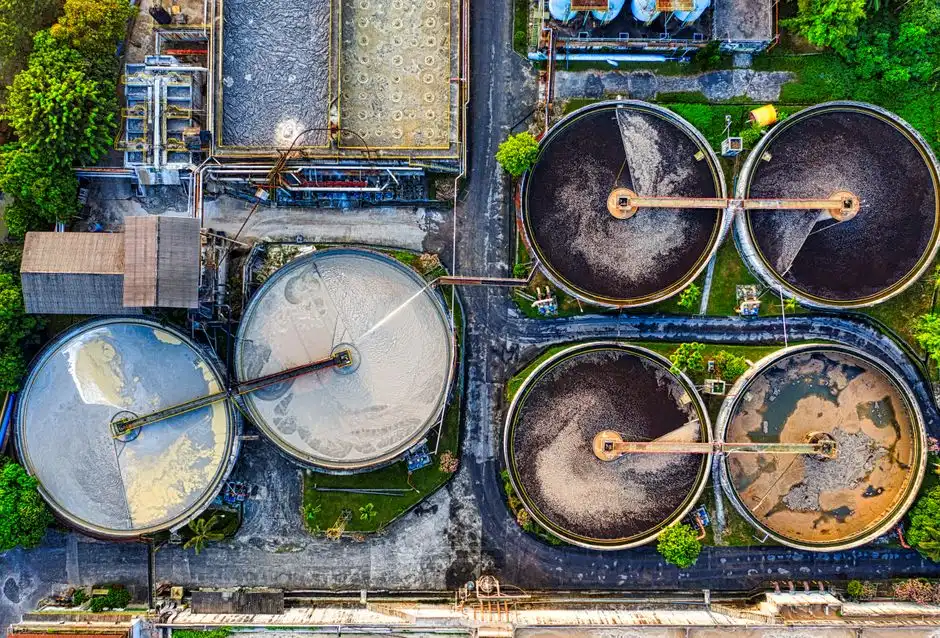
Translating the recommended train into a procurement-committee-ready envelope means three tables: a parameter table, a CAPEX band, and an OPEX band. The values below reflect 2026 market pricing for Latin American packaged systems and HydropureWater field data from comparable community installations.
| Parameter | Design value (MBR primary + wetland polish) |
|---|---|
| Design flow | 16–1,000 m³/day (200–5,000 p) |
| Per-capita BOD | 40–60 g/p·d |
| Per-capita TSS | 45–70 g/p·d |
| Per-capita NH₃-N | 6–10 g/p·d |
| Aerobic HRT (MBR) | 4–8 h (use 6–8 h in Sierra, 4–5 h in Costa/Oriente) |
| SRT | 15–30 days |
| MLSS | 8,000–12,000 mg/L |
| Membrane flux | 10–20 LMH (PVDF flat-sheet, submerged) |
| UV dose | 30–40 mJ/cm² |
| Wetland area | 5–10 m²/PE (SSF, 0.5 m media depth) |
CAPEX bands, 2026: USD 25,000–60,000 for a WSZ serving ~500 people; USD 80,000–250,000 for a packaged MBR serving 500–2,000 people; USD 15,000–40,000 per hectare for the constructed-wetland polishing stage. OPEX bands, 2026: USD 0.10–0.25/m³ for WSZ, USD 0.20–0.45/m³ for MBR (energy-dominated, 0.6–1.2 kWh/m³), and USD 0.03–0.08/m³ for the wetland stage (land-dominated). O&M staffing follows the same gradient — a single trained operator can run three or four WSZ sites, while a single MBR typically needs a dedicated technician following a documented containerized wastewater O&M protocol for membrane cleaning cycles, lamp replacement, and SCADA alarm review.
Compliance, Procurement, and Risk Checklist for Ecuadorian Projects
Four steps move a 2026 small community wastewater system from design to award in Ecuador without the usual permit-and-spare-part surprises. Treat them as a procurement-committee deliverable, not a wish list.
- Permitting baseline. Confirm TULSMA Libro VI Anexo 1 applicability for the receiving water body, secure the discharge permit from the Ministerio del Ambiente, Agua y Transición Ecológica (MAATE), and document a receiving-water baseline (BOD, TSS, NH₃-N, fecal coliforms, dissolved oxygen) so that compliance is provable on day one of operation.
- Pilot or factory acceptance test (FAT). For packaged MBR and WSZ units, require a witnessed FAT at the factory including a clean-water membrane integrity test, SCADA dry-run, and a 24-h leak test. For wetland trains, require a 2-week site pilot using site-specific influent, measured at start, day 7, and day 14, before awarding the full contract.
- Energy and redundancy. In single-phase Sierra and Oriente grids, specify a UPS or generator backup sized to ride through 30-minute outages without membrane scoured shutdown. Favor buried or shaded installations to limit UV degradation and thermal load on plastic components, and confirm NEC-15 seismic anchoring for any buried tank in seismic zone V or higher.
- Spare parts and O&M. Lock in a 5-year spare-parts supply agreement covering membranes, UV lamps, filter media, and solenoid valves, and train one local operator with documented competency sign-off. This is the single biggest determinant of whether a 2026 small community wastewater system in Ecuador is still operating in 2031.
Frequently Asked Questions
What is the typical per-capita flow used to size a small community wastewater system in Ecuador?
Design per-capita flow is 80–200 L/person·day depending on climate, fixture count, and infiltration. Sierra towns without sewerage infiltration typically design near 120–150 L/p·d; Costa communities with older laterals design near 150–200 L/p·d to absorb rainy-season infiltration (TULSMA design guidance, MAATE).
Which packaged wastewater technology fits a 1,000-person Andean town best?
A packaged MBR running submerged PVDF flat-sheet membranes (DF series) at MLSS 8,000–12,000 mg/L, paired with a 500–1,000 m² subsurface-flow constructed wetland for polishing and reuse buffering. This combination hits TULSMA BOD ≤100 mg/L / TSS ≤100 mg/L with substantial headroom and supports irrigation reuse.
What is the 2026 CAPEX range for a packaged sewage treatment plant serving ~500 people in Ecuador?
For a WSZ underground A/O unit, USD 25,000–60,000 installed. For a packaged MBR, USD 80,000–150,000 for the same population. Constructed-wetland polishing adds USD 15,000–40,000 per hectare, depending on media and liner specification (HydropureWater field data, 2026).
Do constructed wetlands in Ecuador actually meet TULSMA discharge limits?
Yes, when paired with anaerobic pretreatment and designed at 5–10 m² per person-equivalent, subsurface-flow wetlands reliably deliver BOD ≤20 mg/L, TSS ≤15 mg/L, and NH₃-N ≤10 mg/L — well inside the TULSMA Libro VI Anexo 1 municipal envelope. The ASABE 2001 study (doi:10.13031/2013.6072) and ASCE small-community wetland chapter (doi:10.1061/9780784407417.ch11) document this performance band for small-community service.
What UV dose is required for reuse-quality effluent in Ecuador?
30–40 mJ/cm² at peak flow, sized to a pipeline UV-C unit with a quartz-sleeve wiper if the upstream water carries iron above 0.3 mg/L. See the packaged MBR STP selection for hospitality guide for reuse-context sizing details.