Why Packaged MBR Is Now the Default for New York Hotels
Packaged membrane bioreactors (MBRs) have displaced cast-in-place activated-sludge plants as the default sewage treatment choice for New York hotel projects because the form factor directly resolves the three constraints that kill conventional designs in the state: site area, construction window, and reuse-grade effluent. The Pure Aqua MBR datasheet (2020) makes the case bluntly: by replacing the clarifier with a submerged membrane cassette, the process "eliminates the clarifier and allows high volumetric loading, resulting in a smaller footprint" — typically a 50-70% footprint reduction versus conventional activated sludge with secondary clarification (Pure Aqua, 2020). On a Manhattan infill lot, a brownfield redevelopment, or a Catskills resort with a tight leachfield envelope, that delta is the difference between a feasible project and a redesign.
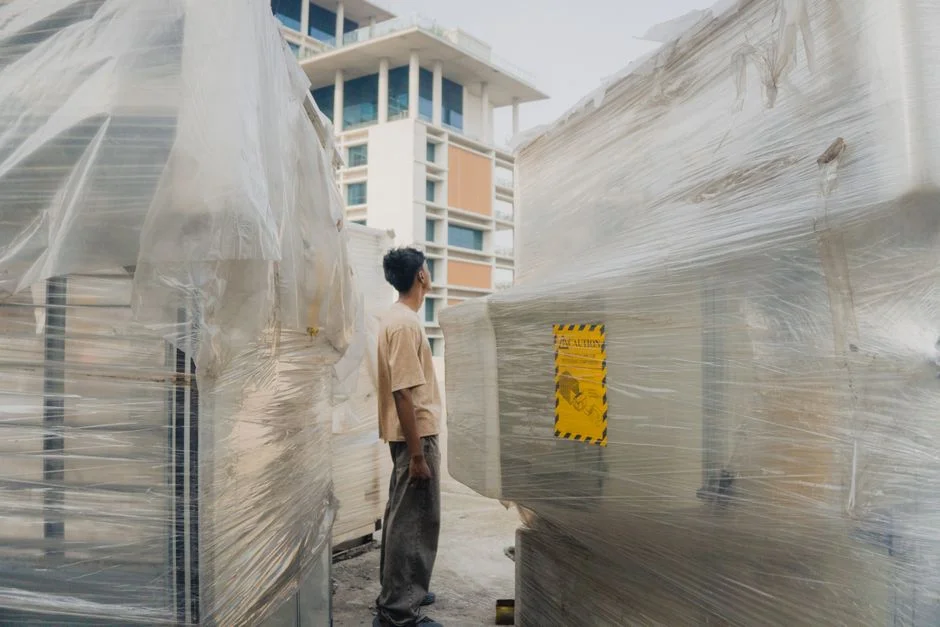
The Smith & Loveless TITAN MBR QUBE defines the canonical hotel format: a 40-ft ISO cube shipping container, factory-built, pre-plumbed, pre-wired, and delivered to site with "minimal assembly required" (Smith & Loveless, 2026). The 20- or 40-ft ISO form factor matters in New York specifically because containerized skids can be offloaded at a loading dock or crane-lifted into a vault, avoiding the months of excavation, rebar, and concrete pours that a cast-in-place aeration basin demands — pours that are repeatedly shut down by December-through-March freeze-thaw cycles and Department of Buildings concrete-pour restrictions. The QUBE is delivered with a built-in 3 mm automatic fine screen, a flat-plate membrane cassette, a lockable blower/control room, and remote monitoring as standard equipment, so the on-site construction scope collapses to piping, electrical tie-in, and the headworks interface.
For the engineer's RFQ narrative, the defensible claim is this: a containerized MBR cuts the on-site construction schedule from 6-9 months (conventional concrete) to roughly 6-10 weeks, and the modular design lets the owner add a second skid in parallel when a 200-key Phase 1 becomes a 350-key Phase 2.
Sizing the STP: Rooms, Flow, and Load
Size the plant at 1.0-1.5 m³ per occupied key per day, then apply a peaking factor of 1.5-2.0 for tourism peaks, holiday weekends, and conference blocks. The anchor case for the New York hotel sector is a 200-bed, 5-star reference plant running at 250 m³/d on hollow-fiber MBR (Imemflo, commercial data) — that is 1.25 m³/key/day at average occupancy, which is consistent with a high-amenity urban hotel that includes restaurants, spa, and back-of-house laundry.
For a quick lookup, the table below ties typical New York hotel programs to design flow and a matching Pure Aqua MBR model from the 6,250-75,000 GPD (24-284 m³/d) commercial series (Pure Aqua, 2020).
| Hotel size | Design flow (m³/d) | Suggested MBR model | Container format | Membrane count |
|---|---|---|---|---|
| 100-key, limited-service | 100-150 | MBR-12.5K-1 (47 m³/d base) | 40-ft × 1 | 1 |
| 200-key, full-service (5-star reference) | 200-280 | MBR-25.0K-2 (95 m³/d) or parallel pair | 40-ft × 2 | 2 |
| 300-key, conference/banquet | 300-450 | MBR-50.0K-4 (189 m³/d) | 40-ft × 2 | 4 |
Design envelope for raw hotel sewage entering the MBR: BOD 200-400 mg/L, TSS 200-350 mg/L, NH₃-N 20-40 mg/L, and FOG 50-150 mg/L from kitchen drains (Imemflo, commercial data, drawn from hotel wastewater characterization). New York hotels that operate on-premise laundries typically segregate that stream — a separate greywater plant or MBR sidestream is common (Imemflo) — and the engineer should confirm whether laundry is in or out of the main flow before locking the model number. If FOG is high, a pre-MBR grease interceptor sized for the kitchen peak (not just average) protects the membrane cassette from fouling and is required upstream of any NYCDEP connection regardless.
Regulatory Pathway in New York: NYSDEC, SPDES, and NYCDEP
Pick the discharge route before you pick the membrane, because the equipment specification follows the permit. New York State has three distinct pathways a hotel STP must clear, and the engineer of record will sign the design under one of them.
On-site discharge to groundwater or surface water. NYSDEC's State Pollutant Discharge Elimination System (SPDES) general permit GP-0-19-001 covers on-site wastewater treatment systems up to a defined design flow threshold and sets effluent limits for BOD, TSS, fecal coliform, and total nitrogen depending on the receiving water classification. Containerized MBRs routinely meet these limits because the membrane stage produces near-complete TSS removal and the anoxic + aerobic biological train can target NH₃-N below 5 mg/L with proper aeration control.
On-site subsurface disposal. If the discharge route is a leachfield or subsurface drip dispersal, design must follow the NYS Design Standards for Wastewater Treatment Works (2014, with design flow per Appendix A). The Standards set per-unit hydraulic loading rates based on soil percolation, and the design flow you commit to the MBR becomes the load the leachfield must accept — which is why conservative peaking factors matter in sizing.
Connection to NYC sewer. For sites inside the five boroughs, the discharge route is the NYCDEP trunk, and the plant must meet the limits in the NYCDEP Rules Governing Sewer Use (Title 15, Chapter 19) — typically 350 mg/L BOD, 400 mg/L TSS, and 100 mg/L FOG at the building connection, with pH 5-11. A packaged MBR meets BOD and TSS easily; the FOG limit is met by a properly sized grease interceptor upstream, which NYCDEP requires regardless of biological treatment. The local city or county DOH (or, in NYC, the Department of Buildings and NYCDEP) may add conditions on noise, odor control, truck routing for sludge haul-off, and visual screening — call these out early because they drive the enclosure design and the blower acoustic package, not the process itself.
Anatomy of a Containerized MBR: What You Are Actually Buying
Every packaged MBR is a sequence of five physical zones, and the engineer's job is to verify that each zone is sized and instrumented, not just named. The reference spec set is the HydropureWater integrated MBR membrane bioreactor system, which follows the same five-zone architecture used in the Smith & Loveless TITAN MBR QUBE and the Pure Aqua MBR series.
Pre-screening. A 3 mm automatic fine screen (Smith & Loveless QUBE) protects the membrane cassette from hair, lint, and food solids that would otherwise blind the flat-plate surface. Specify the screen with a brush-cleaning cycle and a bypass overflow rated to peak hourly flow.
Biological zones. Anoxic + aerobic zones, with optional sludge storage, deliver BOD removal and partial or full nitrification/denitrification when ammonia or total nitrogen limits apply (Smith & Loveless QUBE options). For New York SPDES permits with nitrogen limits, the engineer should confirm the anoxic zone volume and recirculation ratio — not just the presence of a labeled "anoxic" compartment.
Membrane zone. Flat-plate PVDF submerged cassettes, cleaned in place roughly once every six months on average, with no fiber breakage, no pressurized permeate pump skid, and no air integrity test on every cycle (Smith & Loveless, 2026). The Pure Aqua spec uses Toray flat-sheet elements with a 1.4 m² effective area per element, ABS supporting panel, PVDF and PET non-woven fabric membrane, and element dimensions of 515 × 1,608 × 13.5 mm (Pure Aqua, 2020) — that detail matters when you compare vendor cassettes on equal terms.
Blower room. Lockable, with the blower assembly sized for both biological aeration and membrane air scour. The QUBE delivers this as a single integrated room with the PLC and HMI controls, and supports remote monitoring (Smith & Loveless, 2026).
Control room. PLC + HMI with remote telemetry, data logging, and alarm forwarding. Specify the protocol (Modbus TCP, EtherNet/IP, or cellular MQTT) and confirm the SCADA handshake with the hotel's building automation system before the FAT, not after the SAT.
Flat-Plate vs Hollow-Fiber MBR for a Hotel
Flat-plate and hollow-fiber MBRs both deliver reuse-grade effluent; they differ on fouling tolerance, maintenance, and packing density. The Pure Aqua datasheet shows ~98% BOD5 removal and near-complete TSS removal for the Toray flat-sheet MBR (Pure Aqua, 2020), and Imemflo's hotel reference plant on hollow fiber meets the same reuse standard at 250 m³/d (Imemflo). The decision comes down to operating environment, not headline removal.
| Parameter | Flat-plate (e.g., Toray, S&L, HydropureWater DF series) | Hollow-fiber (Suez, Dow, DuPont, Mitsubishi) |
|---|---|---|
| Packing density | Moderate (e.g., 1.4 m²/element, Pure Aqua) | Higher — advantage at very large flows |
| Flow regime | Gravity-driven outside-in, simple hydraulics | Pressurized or suction-driven, pump skid required |
| Fouling tolerance | Tolerant of MLSS spikes and mixed-liquor variability | More sensitive to air-scour upsets and slugging |
| Failure mode | No fiber breakage, mechanical simplicity | Fibers can bundle or break under air-scour upset |
| In-place cleaning | Every ~6 months typical, no shutdown | More frequent chemical cleans, often requires drain-down |
| Operator skill required | Low — suited to unattended hotel duty | Moderate — better with a dedicated operator |
| Best-fit New York hotel scenario | 100-300 key, no full-time operator, mixed loading | 250+ m³/d plants where footprint is the binding constraint |
For most 100-300 key New York hotel plants, specify flat-plate: it survives a vacationing engineer's attention span, it cleans in place, and the documented ~98% BOD5 / near-complete TSS removal (Pure Aqua, 2020) clears NYSDEC and NYCDEP limits without process gymnastics.
MBR vs MBBR, SBR, and Conventional Activated Sludge for Hotels
The design-review question "why not MBBR or SBR" should be answered with a head-to-head table, not a paragraph. MBR wins on effluent quality and reuse enablement; MBBR and SBR win on first cost; conventional activated sludge rarely fits a New York hotel site at all.
| Criterion | MBR (flat-plate or hollow-fiber) | MBBR | SBR | Conventional ASP + clarifier |
|---|---|---|---|---|
| Effluent TSS | <1 NTU, near-zero TSS | 10-30 mg/L | 10-20 mg/L | 10-30 mg/L |
| Reuse-grade (toilet, irrigation, cooling tower) | Yes — standard | No — typically not reuse-grade | Marginal — polishing required | No — requires tertiary |
| Footprint | Small (clarifier eliminated) | Small to moderate | Moderate (single tank, large volume) | Large (separate clarifier, sludge handling) |
| Operator attention | Low (automated, CIP membranes) | Low to moderate | Moderate (timer/sequence logic) | High (clarifier, RAS, WAS) |
| On-site construction scope | Minimal (containerized skid) | Moderate (tankage) | Moderate (tankage) | High (multiple cast-in-place structures) |
| NYC site feasibility | High | High | Moderate | Low — rarely viable |
Use MBBR when the site can discharge to a sewer with non-reuse limits and the lowest capex is the priority. Use SBR when the hotel has the volume for a single batch tank and accepts higher operator involvement. Use MBR when the project needs reuse-grade effluent, a small footprint, and unattended operation in a confined urban site — which describes most New York hotel projects.
Cost, Payback, and Reuse Economics for a New York Hotel
For the capex conversation, anchor on a published academic pilot and a commercial performance band rather than a fabricated $/m³ number. Comas et al. (2017) piloted a hotel greywater MBR at 30 m³/d and reported a payback period of about 3 years at that scale, with 80-95% COD removal and effluent COD below 30 mg/L (Comas et al., 2017, Journal of Environmental Management). The commercial band for hotel MBR is 90-95% contaminant removal (Imemflo, commercial data) — the two data points bracket the same envelope.
| Cost / payback input | Value or range | Source |
|---|---|---|
| MBR COD removal (hotel greywater, pilot) | 80-95% | Comas et al., 2017 |
| MBR effluent COD | <30 mg/L average | Comas et al., 2017 |
| Payback period (30 m³/d pilot scale) | ~3 years | Comas et al., 2017 |
| Commercial MBR removal band (hotel) | 90-95% | Imemflo (commercial) |
| MBR BOD5 removal (flat-sheet) | ~98% | Pure Aqua, 2020 |
| Commercial sizing menu | 6,250-75,000 GPD (24-284 m³/d) | Pure Aqua MBR series (Pure Aqua, 2020) |
| Reuse end-uses | Toilet flushing, irrigation, cooling-tower makeup, laundry | Imemflo; NYC water/sewer rates |
Treat capex as order-of-magnitude tied to the Pure Aqua sizing menu (a 100-300 key hotel typically lands in the MBR-12.5K to MBR-50.0K range) and validate against three vendor quotes. The revenue levers are New York-specific: NYC combined water and sewer charges are among the highest in the United States, so every cubic meter of reuse displaces a high marginal cost. Comas's 3-year payback at 30 m³/d (Comas et al., 2017) is conservative for a New York site where the avoided water/sewer rate is higher than the Mediterranean pilot's baseline. For a parallel perspective on sizing and compliance in a different regulatory climate, see the India hotel/resort STP sizing and compliance guide.
Vendor Selection Checklist Before You Sign the PO
Turn the spec into a procurement tool with a checklist the engineer can paste into the RFQ. Each row is a line item a vendor should answer in writing.
| Checklist item | What to require (with acceptance criterion) |
|---|---|
| Documented hotel performance | 90-95% removal references on hotel wastewater, not just municipal (per Imemflo commercial band) |
| Membrane type and supplier | Named OEM — Toray, Suez, Dow, DuPont, Mitsubishi, or HydropureWater DF series — with replacement cost per m² and lead time |
| Factory build status | Pre-plumbed, pre-wired, factory-tested skid in 20- or 40-ft ISO container (per Smith & Loveless QUBE standard) |
| Remote monitoring | PLC + HMI with cellular/Ethernet telemetry; alarm forwarding to hotel BAS or third-party SCADA |
| Enclosure | Lockable blower room and control room; acoustic package for NYC noise code; freeze protection for winter operation |
| Reuse validation (if reuse in scope) | NSF/ANSI 350 or WERF/NSF protocol data; documented BOD <10 mg/L, TSS <1 mg/L, fecal coliform <14 CFU/100 mL |
| Component certification | UL-listed electrical, CE-marked panels where applicable, NSF-rated piping |
| Spare parts and service | Membrane cassette lead time, blower lead time, factory service dispatch within 48 h |
For projects where the loading dock or vault cannot accept a 40-ft cube, the WSZ underground integrated sewage treatment plant is a lower-profile alternative for the preliminary engineering layout — but the MBR remains the reuse-grade option.
Frequently Asked Questions
How do I size a packaged MBR for a New York hotel?
Size at 1.0-1.5 m³ per occupied key per day and apply a peaking factor of 1.5-2.0 for tourism peaks. A 200-key, 5-star reference plant runs at 250 m³/d (Imemflo, commercial data), which is 1.25 m³/key/day at average occupancy. Confirm whether on-premise laundry is in or out of the main flow before locking the model number.
Which permit applies to a packaged MBR STP in New York?
If the hotel discharges on-site to groundwater or surface water, the NYSDEC SPDES general permit GP-0-19-001 applies (with limits that a flat-plate MBR routinely meets). If the site connects to the NYC sewer, the discharge must comply with the NYCDEP Rules Governing Sewer Use (Title 15, Chapter 19) — typically 350 mg/L BOD, 400 mg/L TSS, 100 mg/L FOG, and pH 5-11 at the building connection. On-site subsurface disposal follows the NYS Design Standards for Wastewater Treatment Works (2014) with design flow per Appendix A.
Should I specify flat-plate or hollow-fiber MBR for a hotel?
Specify flat-plate PVDF for most 100-300 key New York hotel projects because it tolerates mixed-liquor variability, cleans in place roughly every six months (Smith & Loveless, 2026), and runs unattended without fiber-breakage risk. Specify hollow-fiber when the design flow exceeds 250 m³/d and packing density is the binding constraint, and when a qualified operator is available.
Can a packaged MBR produce reuse-grade water for a hotel?
Yes. MBR effluent typically runs sub-1 NTU turbidity, near-zero TSS, and COD below 30 mg/L — suitable for toilet flushing, landscape irrigation, cooling-tower makeup, and laundry (Comas et al., 2017; Pure Aqua, 2020). The reuse plumbing must be separated from the potable system by an air gap or backflow preventer, and NYC requires a cross-connection control plan on file.
How is a containerized MBR delivered to a New York jobsite?
Skids ship as 20- or 40-ft ISO shipping containers, delivered by standard flatbed or chassis to a loading dock, vault, or crane-lift location. The Smith & Loveless TITAN MBR QUBE is the canonical 40-ft cube format (Smith & Loveless, 2026); the Pure Aqua MBR series spans 20- and 40-ft formats from 24 m³/d to 284 m³/d (Pure Aqua, 2020). On-site work is limited to piping, electrical tie-in, and headworks — typically 2-4 weeks versus 6-9 months for a cast-in-place plant. For a parallel reference on a different urban context, see our Dubai hotel MBR buyer's guide.