
Why a Samsung Electronics acquisition in Germany re-opens the wastewater file
On 14 May 2025 Samsung Electronics signed an agreement to acquire FläktGroup from Triton for €1.5 billion, with closing expected within 2025; FläktGroup is headquartered in Herne, Germany and supplies HVAC systems to data centers, pharmaceutical and biotech plants, food and beverage sites, and gigafactories (source: news.samsung.com, 2025-05-14). That single press release triggers a permit cascade on every German site Samsung Electronics now controls, because German law attaches discharge rights to the permit holder rather than to the asset. A new operator must file a material-change notification under §16 BImSchG and re-apply for a water permit under §57 WHG for direct discharge or §58 WHG for indirect discharge, even when the physical plant, the production line and the trade effluent are unchanged (source: hydropurewater.com, 2026).
The water fingerprint on the Herne site is not a single stream. FläktGroup's portfolio — data-center cooling, hospital humidity control, food and beverage process air, and gigafactory dry rooms — means the inherited facility will host multiple tenants, multiple cooling-water loops, and multiple condensate streams, each with a different regulatory annex. Layered on top of the statutory minimum sits the corporate bar Samsung publicly commits to: the DX Division targets 100% water replenishment globally by 2030, the DS Division targets zero increase in water intake versus 2021 levels by 2030, and Samsung has committed over KRW 7 trillion to environmental management activities by 2030, including water resource preservation (source: Samsung Electronics 2024 Sustainability Report). For an EHS manager advising the deal team, those public commitments are the floor for what the German regulator will accept as a credible upgrade plan.
The four-layer legal stack a German site must satisfy
Before the deal team sizes a single tank, the permit engineer must read four overlapping layers in the order a Bezirksregierung case officer reads them. The first layer is European: the Industrial Emissions Directive 2010/75/EU sets the BAT-AEL benchmark through its BREF reviews, and Regulation (EU) 2023/1542 on batteries — in force since 17 August 2023 — adds producer-responsibility and recycling-efficiency duties that translate into separate effluent handling for end-of-life cells. The second layer is federal: the Bundes-Immissionsschutzgesetz (BImSchG) and the Wasserhaushaltsgesetz (WHG), where §57 governs direct discharge to a receiving water and §58 governs indirect discharge to a municipal Klärwerk through the Indirekteinleiter permit path. The third layer is the Abwasserverordnung (AbwV); Annex 31 applies specifically to the manufacture of primary cells, secondary cells and batteries and reaches into electrode coating, electrolyte filling, formation cycling, and module and pack assembly. The fourth layer is the state water authority and the municipal Entwässerungssatzung, which routinely tightens AbwV limits by 20–50% on heavy metals and AOX under the ATV/DVWK worksheet A 198 (source: hydropurewater.com, 2026).
Where the installation exceeds the IED Annex I capacity thresholds, the 2024 STM BREF (Surface Treatment Using Solvents) conclusions and the 2024 Waste Treatment BREF are the binding BAT-AEL benchmarks, and a permit engineer must benchmark against them even where the Annex I thresholds are not crossed, because the state authority will expect the gap analysis on file (source: hydropurewater.com, 2026).
| Layer | Instrument | What it controls | Issued by |
|---|---|---|---|
| 1 — EU | IED 2010/75/EU; Regulation (EU) 2023/1542 | BAT conclusions, producer responsibility | European Commission, transposed nationally |
| 2 — Federal | BImSchG, WHG §57 / §58 | Material-change notification, water permit | Federal legislature |
| 3 — Sector | AbwV Annex 31 | Cell and battery manufacture parameter band | Federal regulator (UBA) |
| 4 — State / municipal | Landeswassergesetz, Entwässerungssatzung, A 198 | Indirekteinleiter limits, hydraulic capacity | Bezirksregierung, Stadtwerke |
AbwV Annex 31 and the Indirekteinleiter envelope in numbers
AbwV Annex 31 sets the federal minimum band for cell and battery manufacture at pH 6.5–9, COD 150–300 mg/L at the discharge point, and a parameter list that includes sulfate, fluoride, zinc, copper, nickel, lead, lithium, total nitrogen, and AOX (adsorbable organically bound halogens). Where the site discharges indirectly, the Entwässerungssatzung and the A 198 worksheet routinely tighten the heavy-metal and AOX values by 20–50% on top of the AbwV band, and municipal surcharges for chloride or sulfate appear where the receiving Klärwerk biology or sewer corrosion profile is at risk; a sulfate cap of around 200 mg/L is common to limit sewer crown corrosion (source: hydropurewater.com, 2026).
Two caveats matter for a Samsung Electronics deal. First, Annex 31 is written for cell and battery manufacture, so a FläktGroup HVAC site or a semiconductor back-end site must argue analogous sector annexes with the state water authority — there is no automatic fit. Second, where lithium, NMP or electrolyte solvents are present, the parameter list expands beyond the standard Annex 31 table and the AOX line tends to be the binding constraint at commissioning.
| Parameter | AbwV Annex 31 federal minimum | Indirekteinleiter (A 198) typical envelope |
|---|---|---|
| pH | 6.5–9 | 6.5–9 (state guidance) |
| COD | 150–300 mg/L | 150–250 mg/L |
| Fluoride | Set per stream | ≤ 20–30 mg/L after precipitation |
| Sulfate | Site-specific | ≤ 200 mg/L (sewer-corrosion cap) |
| Zinc, copper, nickel, lead | Site-specific | 20–50% tighter than AbwV |
| Lithium | Site-specific | Increasingly benchmarked under STM BREF |
| AOX | Site-specific | 20–50% tighter than AbwV |
| Total nitrogen | Site-specific | Tightened to protect Klärwerk biology |
Direct discharge (§57 WHG) vs indirect discharge (§58 WHG) — the engineering decision
Direct discharge under §57 WHG sends treated effluent to a receiving water — a river, lake or canal — under a permit issued by the federal-state water authority, and the limit values are tied to low-flow dilution calculations and the full BAT-AEL envelope; the operator carries the entire treatment chain on site. Indirect discharge under §58 WHG sends pre-treated effluent to a municipal Klärwerk under an Indirekteinleiter permit and the local Entwässerungssatzung, and the Klärwerk provides the biological polishing that lets the operator avoid the full BAT-AEL envelope on site, at the cost of locking into municipal pre-treatment standards and Klärwerk hydraulic capacity (source: hydropurewater.com, 2026).
Most German gigafactory sites choose indirect discharge because it is faster to permit, the Klärwerk absorbs hydraulic and toxic shock loads, and the state water authority tends to view it as the preferred hierarchy under WHG. Direct discharge is preferred where municipal hydraulic capacity is constrained, where the operator wants to decouple from municipal enforcement risk, or where the process water is clean enough (FläktGroup data-center cooling blowdown is the obvious example) that polishing to BAT-AEL is cheaper than paying municipal surcharges. The capex delta is real: a direct-discharge site typically adds RO and AOX polish, while an indirect-discharge site stops at MBR plus carbon polish (source: hydropurewater.com, 2026).
| Decision factor | Direct (§57 WHG) | Indirect (§58 WHG) |
|---|---|---|
| Permit issuer | State water authority (Bezirksregierung) | State water authority + municipality |
| Receiving body | River / lake | Municipal Klärwerk |
| Treatment chain on site | Full BAT-AEL, often RO + AOX polish | Pre-treatment to municipal limits |
| On-site capex | Higher | Lower |
| Permit clock | Longer (low-flow, dilution, BAT) | Shorter, constrained by Klärwerk capacity |
| External dependency | Self-managed | Dependent on municipal bylaws and sewer |
Mapping floor chemistry to the wastewater train
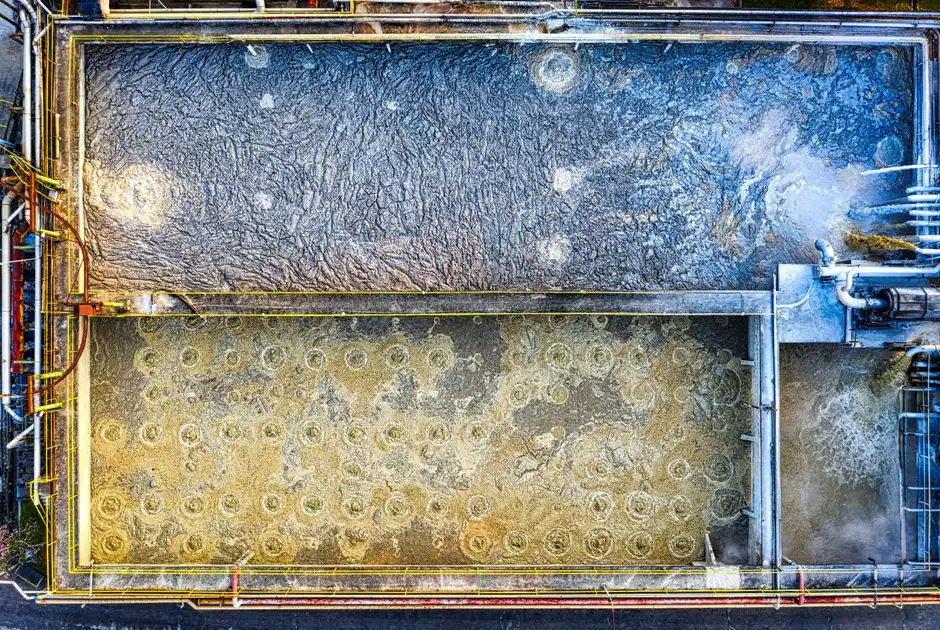
Each unit operation produces a different wastewater fingerprint, and the engineer must map floor chemistry to stream before sizing any unit operation. Electrode coating wastewater carries N-methyl-2-pyrrolidone (NMP) and PVDF binder, with high COD and poor biodegradability until NMP is recovered; the standard route is vacuum distillation of NMP followed by biological polishing. Electrolyte filling and formation wastewater contains LiPF6, carbonate solvents, fluoride and trace HF, with wide pH swings; fluoride is precipitated with calcium chloride after pH adjustment. Module and pack assembly wastewater is lower volume, mostly rinse water with trace metals and oil, and is amenable to a DAF system for suspended solids and metal-hydroxide removal followed by chemical precipitation using a PLC-controlled chemical dosing for fluoride precipitation and pH control. For the FläktGroup and data-center nexus, blowdown and humidification water are low-contamination and can be segregated for reuse when a Samsung Electronics site is co-located with a FläktGroup data center solution (source: hydropurewater.com, 2026).
Source segregation is the single most cost-effective decision in the train. Mixing fluoride-bearing and NMP-bearing streams forces tighter on-site removal, increases the calcium chloride dose, and pushes the operator out of the indirect-discharge comfort zone. Headworks protection with a rotary mechanical bar screen for headworks protection is the cheapest insurance against packaging debris and oversized solids disrupting the downstream DAF and MBR stages.
The treatment train, end to end
The train below translates AbwV Annex 31, the municipal A 198 envelope, and Samsung's RE100 water-stewardship posture into a process line the procurement team can size and install. Step 1 is headworks with a rotary mechanical bar screen to protect downstream units from solids and packaging debris. Step 2 is equalisation and pH neutralisation with PLC-controlled chemical dosing, where calcium chloride drives fluoride below the AbwV expectation. Step 3 is DAF or lamella clarification to remove suspended solids, oils and metal-hydroxide flocs. Step 4 is an MBR system for COD and ammonia reduction in a small footprint, producing near-reuse effluent and decoupling biology from hydraulics. Step 5 is activated-carbon polishing for AOX and trace organics, paired with a chlorine dioxide generator for reuse-loop disinfection for any reuse loop. Step 6 is optional RO polishing for process-water reuse, which is where RE100 and ISO 46001 water-stewardship targets become engineering deliverables. Sludge handling closes the loop with a plate and frame filter press for hydroxide sludge dewatering before licensed disposal as a metal-bearing waste (source: hydropurewater.com, 2026).
The operational rule for discharge-route selection is straightforward. If the site is connected to a municipal Klärwerk with sufficient hydraulic capacity, run for indirect discharge and stop at MBR plus carbon polish. If the site must hold a §57 WHG direct-discharge permit, add RO and tighten AOX polishing to meet the BAT-AEL envelope. Either way, NMP recovery by vacuum distillation should be designed upstream of the biological stage — it is cheaper to recover solvent than to destroy it, and it cuts the COD load on the MBR by an order of magnitude (source: hydropurewater.com, 2026).
Water balance and the corporate bar above statutory minimum
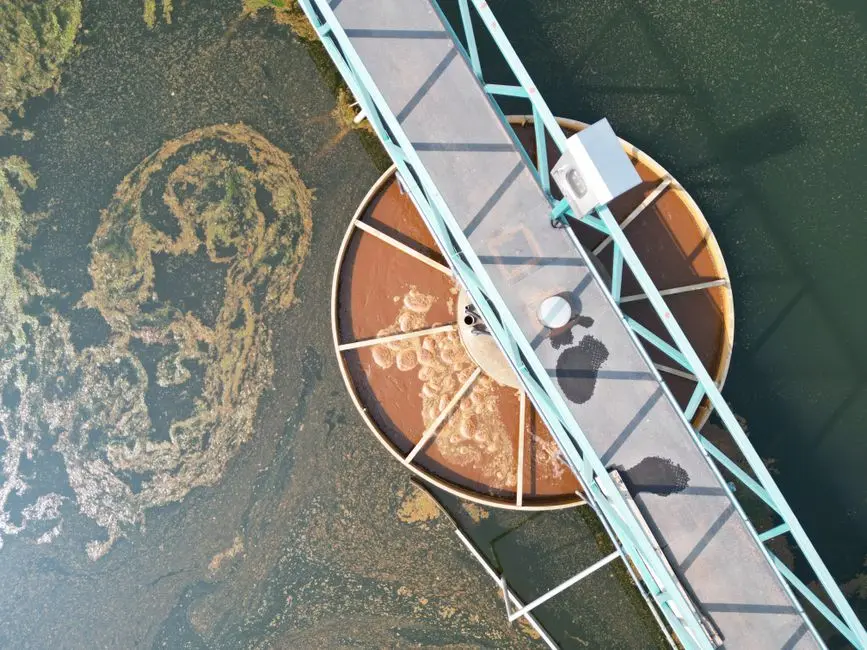
A typical German gigafactory water balance runs 1.2–1.6 m³ of process wastewater per kWh of cell capacity annually, plus 0.3–0.5 m³ of sanitary wastewater per employee per shift. A 10 GWh plant therefore generates roughly 15,000 m³/yr of process wastewater before sanitary load, and the engineer must plan for peak daily flows that are 3–5× the daily average when formation cycling is batched (source: hydropurewater.com, 2026).
Samsung publicly reports water reuse by category — sewage, wastewater, industrial water and ultrapure water — on a monthly basis through its N-EHS System, and each site enters its reuse data into that system (source: samsung.com, Water Management Process). On top of the statutory minimum, the DX Division has publicly committed to 100% water replenishment globally by 2030, and to Platinum-level Alliance for Water Stewardship (AWS) certification at 3 Korean and 3 Vietnamese manufacturing sites. Those public commitments are the corporate internal bar the EHS manager must design to, not the floor a regulator enforces (source: Samsung Electronics 2024 Sustainability Report). For a comparison perspective on the SDI path through the same German legal stack, see the Samsung SDI Germany compliance guide.
Permit and ESG timeline after signing
Permits and ESG reporting move on parallel tracks, not in series. The deal team needs a clock that plugs into a project plan and a Gantt chart from the day the share purchase agreement is signed. Pre-acquisition, the EHS manager runs a permit review of every BImSchG and WHG permit on file, files the operator-change notification under §16 BImSchG, and secures a clean statement of any outstanding enforcement orders. Months 0–6 are for filing a Vorbescheid on capacity or process change, notifying the state water authority of the operator change, and confirming the Indirekteinleiter contract with the local Klärwerk including hydraulic capacity. Months 6–18 cover detailed engineering, baseline monitoring, BAT-AEL gap analysis, and water-reuse design aligned to RE100 and ISO 46001. Ongoing obligations are annual wastewater reporting to the state authority, quarterly self-monitoring per the permit schedule, and integration of the site into Samsung's ISO 14001 EMS and ESG disclosures (source: hydropurewater.com, 2026). For the parallel M&A moment at a Hungarian site, see the Lonza Hungary acquisition compliance guide; for a semiconductor cooling-water angle, see the semiconductor and data-hall wastewater compliance guide.
| Phase | Permit and engineering action | ESG / disclosure action |
|---|---|---|
| Pre-acquisition | Permit file review; §16 BImSchG operator-change notification; clean statement on enforcement orders | Confirm ISO 14001 / ISO 50001 scope; identify AWS gap |
| Months 0–6 | Vorbescheid on capacity / process change; state water authority notification; Indirekteinleiter contract including Klärwerk hydraulic capacity | Integrate site into N-EHS System; baseline monitoring plan |
| Months 6–18 | Detailed engineering; BAT-AEL gap analysis; reuse-loop design | ISO 46001 water-stewardship alignment; RE100 disclosure prep |
| Ongoing | Annual wastewater reporting; quarterly self-monitoring | Quarterly ESG disclosure; AWS audit cycle |
Frequently Asked Questions
Does a Samsung Electronics acquisition in Germany automatically re-open the wastewater permit?
Yes. German law attaches discharge rights to the permit holder, so a new operator must file a material-change notification under §16 BImSchG and re-apply for a water permit under §57 WHG (direct) or §58 WHG (indirect), even when the physical plant and the trade effluent are unchanged (source: hydropurewater.com, 2026).
Which AbwV annex applies to a FläktGroup or data-center cooling site?
AbwV Annex 31 is written specifically for the manufacture of primary cells, secondary cells and batteries, so a non-battery Samsung Electronics site (HVAC, semiconductor back-end) must argue analogous sector annexes with the state water authority; there is no automatic fit, and the parameter band is negotiated case by case.
What are the typical indirect-discharger limits on top of AbwV Annex 31?
Indirekteinleiter permits under §58 WHG, the Entwässerungssatzung and ATV/DVWK worksheet A 198 routinely tighten heavy metals and AOX by 20–50% on top of the AbwV band, and municipal sulfate caps of around 200 mg/L are common to protect sewer corrosion profiles (source: hydropurewater.com, 2026).
How long does the permit re-issuance take after signing?
A Vorbescheid on capacity or process change typically takes 3–6 months, with detailed engineering, BAT-AEL gap analysis and reuse-loop design running through months 6–18, and full Indirekteinleiter contract closure including Klärwerk hydraulic capacity within the first 6 months (source: hydropurewater.com, 2026).