Why Meridian Petroleum Plants Cannot Use the Western 35 mg/L Carve-Out
Petroleum plants near Meridian, Mississippi sit east of the U.S. EPA's 98th meridian, which the agency uses as a tool to separate western and eastern discharge permitting (Jiang et al., 2022, NMSU). The western carve-out is the NPDES Agricultural and Wildlife Water Use Subcategory, which allows produced water and similar petroleum streams west of the line to be released for livestock, wildlife, or agricultural reuse if the discharge meets a 35 mg/L oil & grease floor and other parameters (Jiang et al., 2022, citing EPA). Mississippi is not in that group. Meridian, MS sits east of the line, so the 35 mg/L beneficial-use exemption does not apply, and a refinery, re-refinery, or terminal cannot route oily wastewater to irrigation or wildlife use under that federal shortcut.
The practical ceiling is therefore the receiving POTW's local limits letter, developed under EPA's Local Limits Guidance using the Maximum Allowable Headworks Loading (MAHL) method (per EPA Local Limits Development Guidance, 2004 reaffirmed 2021). Two legal hooks drive every compliance conversation: pass through, defined in 40 CFR 403.3(p) as a discharge that "exits the POTW into waters of the United States in quantities or concentrations that, alone or in conjunction with a discharge or discharges from other sources, is a cause of a violation of any requirement of the POTW's NPDES permit"; and interference, defined in 40 CFR 403.3(k) as a discharge that "inhibits or disrupts the POTW, its treatment processes or operations, or its sludge processes, use, or disposal" and therefore causes an NPDES or sludge violation. Any plant that triggers either definition is in violation, regardless of whether its specific number is below the local limit.
The 40 CFR Part 403 Framework That Drives the Local Limits Letter
40 CFR Part 403 layers four compliance obligations on top of each other, and an engineer at a Meridian petroleum site has to clear all four before discharge. The general prohibitions at 40 CFR 403.5(a) forbid any discharge that causes pass through or interference, as defined above. The specific prohibitions at 40 CFR 403.5(b) lay out eight categories of prohibited discharge; the ones that hit a refinery hardest are 403.5(b)(1) (closed-cup flashpoint below 140 °F / 60 °C per 40 CFR 261.21), 403.5(b)(2) (pH below 5.0, corrosion hazard), 403.5(b)(5) (influent temperature above 40 °C / 104 °F at the POTW headworks), and 403.5(b)(6) (petroleum oil, nonbiodegradable cutting oil, or products of mineral oil origin in amounts that cause pass through or interference). Categorical standards in 40 CFR Parts 400 through 499 set technology-based limits for specific industry sectors, and EPA's Local Limits Guidance sets site-specific local limits on top of all of that.
The local limits letter itself comes from the MAHL process, which has five steps (per EPA Local Limits Development Guidance, 2004 reaffirmed 2021): Step 1, identify Pollutants of Concern; Step 2, sample POTW influent, collection system, and significant industrial user flows; Step 3, calculate the Maximum Allowable Headworks Loading for each POC; Step 4, allocate to industrial users as Maximum Allowable Industrial Loading; Step 5, address collection system concerns. The Mississippi DEQ-approved control mechanism for a petroleum discharger converts that MAIL into daily-max and monthly-average concentration caps plus mass-based limits per shift.
The typical Pollutants of Concern a petroleum discharger must manage are oil & grease, total suspended solids, sulfides, ammonia, total phenols, BTEX (benzene, toluene, ethylbenzene, xylenes), and the eight RCRA priority metals (Pb, Cd, Cr, Cu, Ni, Zn, Hg, Ag). The POTW's local limits letter typically expresses each as a daily-maximum and a monthly-average concentration, then ties the cap to flow at the monitoring manhole so mass-based limits (lb/day) also apply.
A Pollutant-by-Pollutant Look at the 2026 Limits a Meridian Refinery Faces
Oil & grease is the headline number. Typical local-limits letters in the southeastern U.S. cap O&G at 50–100 mg/L daily max and 35–50 mg/L monthly average at the headworks, with a hard pump-out trigger on the upstream API/CPIS oil-water separator at 25% accumulation or 6 months, whichever comes first (per the Puyallup WA Appendix H pre-treatment policy, an industry-standard analogue). Sulfides usually run below 1 mg/L because of corrosion and odor pass-through risk; iron-based precipitation or oxidation is the standard control. Ammonia-N is commonly capped at 20–40 mg/L daily max depending on the receiving POTW's biological capacity, and many Meridian-area POTWs now require nitrification or denitrification upstream of discharge because of stricter NPDES ammonia limits.
Total phenols and BTEX are typically capped at 0.1–1 mg/L with a hard prohibition on any free-phase product reaching the sewer. Free-phase recovery in the API/CPIS unit plus GAC or advanced oxidation polishing is the typical path. Metals limits are site-specific but always present; document source control on the refinery side (heat-exchanger leaks, plating rinses, and storm water that picks up catalyst fines) because categorical standards continue to apply regardless of local limits. The pH floor is 5.0 under 40 CFR 403.5(b)(2) and the temperature cap at the POTW headworks is 40 °C / 104 °F under 40 CFR 403.5(b)(5) unless the POTW's approval authority has granted an alternate limit, which is rare in 2026.
The Unit-Operation Stack That Actually Clears Those Numbers
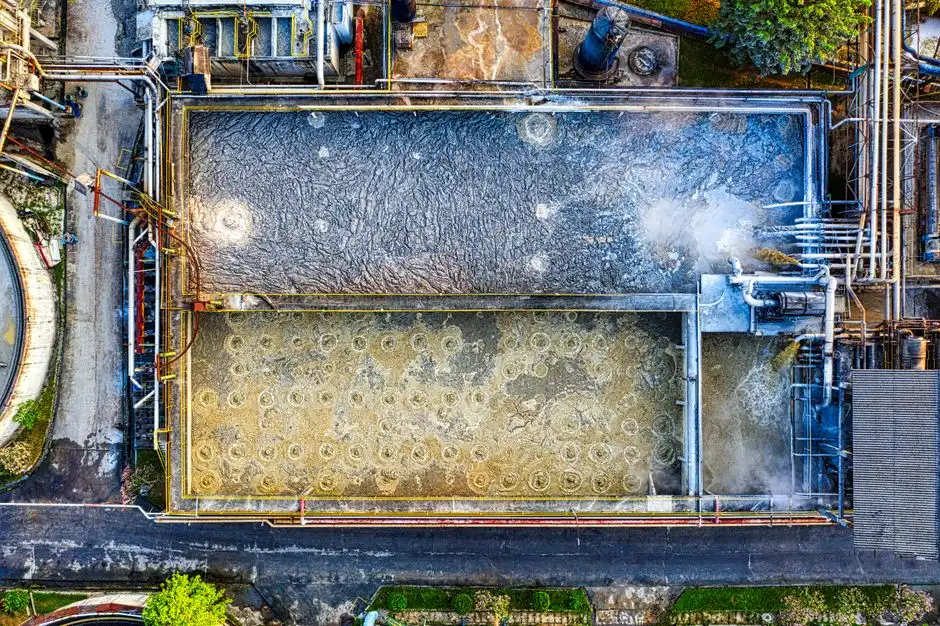
The 2026 working train for a petroleum discharger near Meridian runs in this order: rotary bar screen → corrugated plate oil-water separator (API 421 / CPIS) → equalization → dissolved air flotation → biological treatment (MBR or conventional activated sludge) → chemical polishing → sewer manhole, with sludge handled through a plate and frame filter press. Every step is anchored to a specific local-limits problem.
A GX series rotary bar screen at the headwork pulls rags, plastics, and fibrous debris before they foul the oil-water separator and DAF; dual overload protection and a self-cleaning brush discharge keep it running through slug loads. The corrugated plate oil-water separator removes free-phase product down to roughly 50–100 µm droplet size, with the 25% / 6-month pump-out rule enforced via a logged maintenance schedule. An equalization basin with mechanical mixing and aeration damps slug loads, which is critical for tank-farm operations and terminal truck receipts. The DAF system (4–300 m³/h, 13 standard models) handles emulsified oil and TSS, typically delivering 90–95% O&G removal to below 50 mg/L and 80–90% TSS removal in a single stage. The next step is biological treatment: an integrated MBR system is now preferred over conventional activated sludge for new builds because of a roughly 60% smaller footprint, near-reuse effluent quality, and tolerance of variable loads from upstream slugs (cross-reference: MBR vs conventional activated sludge for petroleum wastewater). A PLC-controlled chemical dosing skid handles pH adjustment, sulfide oxidation, and polymer conditioning before the sewer manhole. The OWS, DAF, and biological stages all generate sludge, which a plate and frame filter press dewaters to roughly 25% solids for offsite landfill.
| Step | Equipment | Target Pollutant | Expected Performance (2026) |
|---|---|---|---|
| 1 | Rotary bar screen (GX series) | Rags, plastics, fibrous debris | >90% capture of >3 mm solids; protects downstream OWS and DAF |
| 2 | API 421 / CPIS oil-water separator | Free-phase oil & grease | Down to ~100 mg/L; 25% / 6-month pump-out |
| 3 | Equalization basin | Slug loads, flow & concentration swings | ~4–8 h HRT; smooths upstream variability |
| 4 | DAF | Emulsified O&G, TSS | O&G <50 mg/L; TSS <30 mg/L; 90–95% O&G removal |
| 5 | MBR or CAS | Soluble COD/BOD, residual O&G | COD <50 mg/L; O&G <5 mg/L; TSS <1 mg/L on MBR |
| 6 | Chemical polishing (PLC dosing) | pH, sulfides, residual metals | pH 6.0–9.0; sulfides <1 mg/L |
| 7 | Plate and frame filter press | Sludge volume reduction | Cake to ~25% solids for landfill |
DAF and MBR Parameters a 2026 Engineer Should Pin Down Before Sizing
For a DAF unit, the design envelope is hydraulic loading 4–25 m³/m²·h depending on the model, recycle ratio 20–30%, air-to-solids ratio 0.005–0.015 kg/kg, and micro-bubble size 10–80 µm (industry-standard DAF design range, 2026). On refinery wastewater the expected single-stage removals are O&G below 50 mg/L and TSS below 30 mg/L, with surface skimming automated. For an MBR, the design envelope is MLSS 8,000–12,000 mg/L, HRT 6–12 h, SRT 20–40 d, PVDF membrane at 0.1–0.4 µm pore size, and flux 10–20 L/m²·h. Expected effluent on a properly sized MBR is COD below 50 mg/L, BOD below 5 mg/L, TSS below 1 mg/L, and O&G below 5 mg/L, which sits well below typical Meridian-area POTW local limits and gives real margin against slug loads. The decision point between MBR and conventional activated sludge usually comes down to footprint, variability tolerance, and whether the plant wants near-reuse quality in case future limits tighten (a working comparison is in our guide on MBR vs conventional activated sludge for petroleum wastewater).
| Parameter | DAF | MBR (integrated) |
|---|---|---|
| Hydraulic loading / flux | 4–25 m³/m²·h | 10–20 L/m²·h membrane flux |
| Recycle / air-to-solids | Recycle 20–30%; A/S 0.005–0.015 kg/kg | Aeration 0.3–0.6 kg O₂/kg COD removed |
| MLSS / HRT / SRT | n/a | MLSS 8,000–12,000 mg/L; HRT 6–12 h; SRT 20–40 d |
| Membrane / bubble spec | Micro-bubble 10–80 µm | PVDF 0.1–0.4 µm |
| Expected effluent | O&G <50 mg/L; TSS <30 mg/L | COD <50 mg/L; BOD <5 mg/L; TSS <1 mg/L; O&G <5 mg/L |
A Mississippi-Specific Compliance Checklist for 2026
Run this list against the plant this quarter. (1) Confirm the receiving POTW's control mechanism (industrial user permit or general permit) and re-read the local limits schedule against current production rates. (2) Sample the eight RCRA metals, BTEX, sulfides, and ammonia-N at least quarterly and submit through the POTW's self-monitoring report (SMR); Mississippi DEQ increasingly requires electronic submission in 2026. (3) Verify the oil-water separator pump-out log shows maintenance under the 25% / 6-month rule and that the 25% threshold was never exceeded. (4) Document slug-load prevention: secondary containment sized for the largest single tank, tank-farm spill kits staged at the manifold, and SOPs for switching process units. (5) Confirm closed-cup flashpoint screening of any waste streams entering the sewer is above 140 °F per 40 CFR 261.21 as referenced in 40 CFR 403.5(b)(1). (6) Maintain PLC logs from the PLC-controlled chemical dosing skid, DAF, and MBR; Mississippi DEQ inspectors now ask for electronic records first. (7) File the slug-load control plan and OWS maintenance log with the POTW before the next permit cycle, not after a notice of violation. For adjacent sectors in the same regulatory framework, see Pulp & paper pretreatment near Opelika.
Frequently Asked Questions
Why can't a Meridian, MS refinery use the 35 mg/L federal oil & grease carve-out?
The 35 mg/L floor is part of the NPDES Agricultural and Wildlife Water Use Subcategory, which under EPA's 98th-meridian split applies only to discharges west of that line for livestock, wildlife, or agricultural reuse (Jiang et al., 2022, NMSU). Meridian, Mississippi sits east of the 98th meridian, so the western carve-out does not apply, and the receiving POTW's local limits under 40 CFR Part 403 set the actual discharge ceiling instead.
MBR or conventional activated sludge for a 2026 petroleum plant — which is the right call?
For a new build or major upgrade, MBR is the default in 2026 because it delivers near-reuse effluent (COD below 50 mg/L, BOD below 5 mg/L, TSS below 1 mg/L, O&G below 5 mg/L) in roughly 60% of the footprint of conventional activated sludge, and it absorbs upstream slug loads without the biomass loss a CAS basin would suffer. CAS still wins on capex when footprint is not constrained and the local limits letter is generous; a working comparison is in our guide on MBR vs conventional activated sludge for petroleum wastewater.
What is the 25% / 6-month rule for an oil-water separator?
It is the standard local pretreatment maintenance trigger: the separator must be pumped out when the combined floating oil/solids layer and the settled solids reach 25% of the device's overall liquid depth, or every six months, whichever comes first (per the Puyallup WA Appendix H pre-treatment policy, the industry-standard analogue used by Mississippi POTWs). Exceeding the 25% threshold is treated as a violation, and the separator can be ordered cleaned on a tighter schedule at any time.
How do I document compliance with 40 CFR 403.5(b)(6) on petroleum oil?
Keep three records current: API/CPIS pump-out logs showing the 25% / 6-month trigger, daily composite samples at the monitoring manhole that show O&G below the daily-max and monthly-average limits, and continuous pH/temperature data confirming the discharge stays inside 40 CFR 403.5(b)(2) and 403.5(b)(5). Mississippi DEQ and the receiving POTW increasingly require these records in electronic form, not paper.
What is the smartest first move if our local-limits letter just got tighter?
Run a mass balance from the API/CPIS outlet to the monitoring manhole, identify which step in the train is now the bottleneck (usually the DAF or the biological stage), and stress-test the MBR or CAS basin against the new cap before sizing any new equipment. Slug-load control and OWS pump-out discipline usually buy more headroom than any single piece of hardware, and a tighter PLC log on the chemical dosing skid often satisfies the POTW while a DAF or MBR upgrade is being engineered and permitted.