Why combine hospital and textile effluent in one plant?
A hybrid hospital effluent treatment plant for textile industry operations handles a merged stream of roughly 30 m³/day from a 200-bed in-plant clinic and a 20 T/d fabric finishing line, with BOD of 150–500 mg/L, COD of 250–800 mg/L, TDS of 2,000–8,000 mg/L, residual colour of 200–1,500 Pt-Co units, and faecal coliforms at 10⁶–10⁸ MPN/100 mL from ward blackwater. Chemical processing — dyeing and finishing — accounts for ~70% of all textile pollution generated (S2, 2022), and roughly 60% of wastewater worldwide represents a documented public-health threat (PIOS 1999, cited in S2). Both numbers justify treating the two streams under a single compliance envelope rather than as separate problems.
The economics favour consolidation. A shared biological stage, a shared DAF, and a shared disinfection bank replace two parallel civil works. The WSZ underground integrated A/O treatment plant (1–80 m³/h) and the medical wastewater treatment system both fall inside the 10–500 m³/day envelope typical of integrated dye-house + hospital campuses, and they collapse preliminary, biological and disinfection stages into a single buried or skid footprint.
Two regulatory regimes apply simultaneously. A plant discharging in the United States must meet EPA 40 CFR Part 437 textile categorical pretreatment standards (BOD, TSS, sulphide, total metals, pH, colour). A plant in the EU, or supplying a European buyer, must satisfy the Urban Waste Water Treatment Directive 91/271/EEC for the hospital side, plus the Industrial Emissions Directive for the textile side. Designing for the tighter of the two up front avoids retrofit later.
Influent characterisation: hospital and textile streams side by side
Designing a hybrid ETP starts with placing the two streams on a common axis. Hospital effluent is the sum of blackwater (faeces, urine, food residue, toxic chemicals), greywater (bathing, washing, laboratory waste), and stormwater (S3). Its signature parameters are microbiological pathogens, radioactive isotopes from radiology, residual disinfectants, excreted drugs and metabolites, and pharmaceutical active compounds at high concentrations. Textile effluent is the inverse: high chemical content (reactive dyes, surfactants, Glauber salt, heavy-metal mordants), high BOD/COD, TDS from sodium chloride and sodium sulphate, and persistent colour (S4, 2024).
The table below places both signatures next to each other so a design engineer can confirm the envelope. All ranges are typical operating values drawn from S3, S4, and HydropureWater field data (2026).
| Parameter | Hospital effluent (typical) | Textile / dye-house effluent (typical) | Merged stream (design) |
|---|---|---|---|
| Flow | 5–20 m³/day per 100 beds | 1.0–1.5 m³ per kg fabric finished | 20–60 m³/day combined |
| pH | 6.5–8.5 | 6.0–10.0 (batch-dependent) | 6.5–9.0 |
| BOD₅ | 150–400 mg/L | 200–500 mg/L | 150–500 mg/L |
| COD | 300–600 mg/L | 400–800 mg/L | 250–800 mg/L |
| TSS | 100–350 mg/L | 100–500 mg/L | 100–500 mg/L |
| TDS | 300–900 mg/L | 2,000–8,000 mg/L | 2,000–8,000 mg/L |
| Colour | Negligible | 200–1,500 Pt-Co | 200–1,500 Pt-Co |
| Oil & grease | 20–50 mg/L | 10–60 mg/L | 15–60 mg/L |
| Temperature | 25–35 °C | 35–60 °C | 30–55 °C |
| Pathogens (faecal coliforms) | 10⁶–10⁸ MPN/100 mL | 10³–10⁵ MPN/100 mL | 10⁶–10⁸ MPN/100 mL |
| Heavy metals (Cu, Cr, Pb) | Trace | 0.5–10 mg/L Cu; trace Cr | 0.5–10 mg/L |
| Surfactants | 5–20 mg/L (laundry) | 10–50 mg/L (scouring) | 10–50 mg/L |
| Pharmaceutical residues | µg/L to mg/L range | Negligible | Hospital signal retained |
Read across the merged column and three design drivers emerge. Biodegradable organics are dominated by the cotton-sizing and starch BOD from the dye-house plus the soluble BOD from ward greywater — these load the biological stage. Recalcitrant colour and residual dye are textile-specific and demand coagulation plus membrane polishing. Dissolved salts are textile-specific and dictate whether reuse is feasible or whether RO/ZLD is required to meet discharge TDS limits.
Process train design for a 2026 hybrid ETP
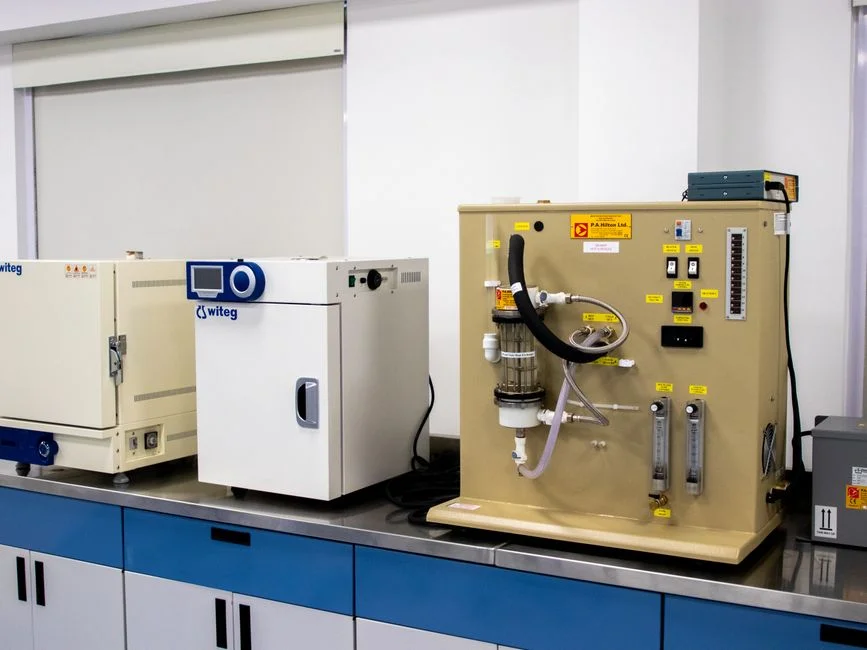
A defensible 2026 train runs in six stages. Each stage maps to a specific HydropureWater skid so procurement can issue a line-item RFQ rather than a generic performance spec.
Stage 1 — Preliminary. Rotary mechanical bar screens (GX series) at 3–6 mm aperture strip lint, yarn, fabric scraps, wipes, and other debris from both lines. An equalisation tank behind the screens smooths hospital diurnal peaks (morning wash, OR turnover) and textile batch discharges (dye-bath dumping). A 6–12 hour HRT typically brings the composite within ±15% of the mean on every parameter.
Stage 2 — Primary. A dissolved air flotation unit removes 60–80% of TSS, surfactants, oils, and floating solids. A chemical dosing skid ahead of the DAF injects alum/polyelectrolyte (or, for reactive dyes, a Fe³⁺ coagulant at 200–500 mg/L) to precipitate disperse dyes and most heavy metals. Physico-chemical DAF trains in comparable industries achieve 98% removal efficiency (S2).
Stage 3 — Secondary biological. Conventional activated sludge is the baseline, removing ~80% of BOD (S4). The 2026 default is the HydropureWater MBR membrane bioreactor with PVDF submerged membranes at <1 µm nominal pore size. MBR delivers mixed liquor suspended solids of 8,000–12,000 mg/L, effluent already below 10 mg/L TSS, and a 60% smaller aeration-tank footprint than CAS at equivalent loading — eliminating the secondary clarifier entirely (see the MBR vs CAS comparison for industrial wastewater).
Stage 4 — Tertiary. A multi-media filter (sand + anthracite + garnet) takes residual TSS to below 5 mg/L. Where reuse is targeted, a UF (1,000–40,000 L/h) followed by RO follows; RO achieves up to 95% recovery and removes >90% of dissolved copper (S2). For discharge-only flows, this stage is optional.
Stage 5 — Disinfection. A UV sterilizer at 30–40 mJ/cm² handles chlorine-resistant Cryptosporidium and Giardia with no disinfection by-products. Ozone is the alternative where colour polishing is also wanted (99%+ pathogen kill, no chemical dosing). A ClO₂ generator is the right choice when biofilm control in the reuse distribution loop is also a concern.
Stage 6 — Sludge. Wasted biological sludge and DAF float are thickened in a lamella clarifier and dewatered on a plate-and-frame filter press at 25–35% DS before disposal (S4). Filtrate returns to the head of the plant.
| Stage | Unit operation | HydropureWater skid | Typical removal / performance |
|---|---|---|---|
| 1 | Screening + equalisation | GX bar screen + EQ tank | >90% debris >3 mm |
| 2 | Coagulation + DAF | DAF + dosing skid | 60–80% TSS, 50–70% colour |
| 3 | Biological oxidation | MBR (PVDF) or CAS | ~80% BOD; <10 mg/L TSS in MBR permeate |
| 4 | Filtration / RO | MMF + UF + RO | >90% Cu, 95% recovery on RO |
| 5 | Disinfection | UV / ozone / ClO₂ | 99%+ pathogen kill, <1 NTU turbidity |
| 6 | Sludge handling | Lamella + plate press | 25–35% DS cake, S4-compliant disposal |
An MBR retrofit of existing activated sludge tanks is the lowest-capex path for facilities already running CAS and looking to gain reuse water and pathogen control without building new civil works.
MBR vs CAS + UF/RO vs ZLD: 2026 technology comparison
The 2026 default for a 10–500 m³/day hybrid plant is MBR; CAS + UF/RO is a cheaper alternative where reuse is not needed; ZLD is reserved for sites where discharge is banned or salt recovery is mandated. The table below captures the engineering trade-offs, drawing on HydropureWater catalog data and the 2026 process guide on RO process design for textile wastewater.
| Criterion | CAS + UF/RO | MBR (with optional RO) | ZLD (RO + MVR/crystalliser) |
|---|---|---|---|
| Footprint (per m³/day) | ~1.0–1.5 m² (CAS) + 0.2 m² (RO) | ~0.4–0.6 m² (60% smaller than CAS) | ~0.8–1.2 m² (RO + evaporator) |
| Effluent BOD / COD | ≤30 / ≤125 mg/L | ≤5 / ≤50 mg/L | ≤2 / ≤20 mg/L |
| Effluent TSS / turbidity | ≤10 mg/L / 1–2 NTU | ≤5 mg/L / <1 NTU | ≤1 mg/L / <0.5 NTU |
| Reuse suitability | None (CAS) or process water (with RO) | Toilet flush, irrigation, dye-rinse | Boiler feed, full recycle |
| Sludge yield | 0.4–0.6 kg DS/kg BOD removed | 0.25–0.4 kg DS/kg BOD | 0.3–0.5 kg DS/kg BOD (incl. brine) |
| Capex per m³/day (10–50 m³/day) | USD 30K–150K | USD 50K–250K | USD 500K–1,500K |
| Opex signal | Membrane replacement every 3–5 yr | Membrane cleaning every 6–12 mo | Thermal energy 0.1–0.3 kWh/kg (MVR) |
| 2026 compliance fit | EPA Part 437 (discharge to POTW) | EPA + EU UWWTD + reuse rules | Zero-discharge bylaws, salt recovery |
| Best fit | Discharge-only, lowest capex | Hybrid reuse, mid-range flow | Discharge ban, freshwater scarcity |
Decision rule: pick MBR when reuse water has any value (gardening, toilet flush, dye-rinse) or when site footprint is tight; pick CAS + UF/RO when the only requirement is to meet EPA Part 437 for discharge to a POTW; pick ZLD only when local bylaws require zero liquid discharge, when the receiving watershed is closed, or when salt recovery offsets the higher opex.
2026 compliance and discharge limits you must hit
Compliance is the artefact the engineer prints and pins up. For a hybrid plant, four sets of limits run in parallel; the design must clear the strictest of each parameter across all four.
- EPA 40 CFR Part 437 (textile categorical pretreatment): daily-max BOD 150 mg/L, TSS 100 mg/L, sulphide 1 mg/L, phenols 1 mg/L, total chromium 0.5 mg/L, total copper 1 mg/L, pH 6.0–9.0, colour 150 Pt-Co (visible). Verify against the current Federal Register version before submitting the design report.
- EU Urban Waste Water Treatment Directive 91/271/EEC: BOD₅ ≤25 mg/L, COD ≤125 mg/L, TSS ≤35 mg/L, total phosphorus ≤2 mg/L, total nitrogen ≤15 mg/L — referenced directly by the medical skid as the compliance basis for hospital discharges.
- WHO healthcare wastewater guidance (2026 update): ≥3-log (99.9%) reduction of faecal coliforms, with explicit targets for antibiotic-resistant organisms commonly found in hospital blackwater.
- Local bylaws on colour, TDS, and heavy metals: vary by state and by river basin; confirm with the regional pollution control board before finalising any design. In Tamil Nadu and Gujarat, for example, TDS limits of 2,100 mg/L and 1,000 mg/L respectively apply for land disposal, which can override the more permissive federal standards.
The 2026 tightening across all four regimes favours an MBR + RO finish over CAS alone, because CAS cannot reliably hit the ≤35 mg/L TSS target for EU hospital effluent, and cannot reach the colour/TDS limits some Indian state boards now enforce.
Frequently Asked Questions
Can hospital and textile wastewater really be treated in one plant?
Yes. After equalisation and DAF, a single MBR or CAS stage handles the merged BOD/COD load; UV or ozone disinfection takes care of hospital pathogens, while RO polishing addresses textile colour and TDS. The limiting parameters (TDS from dye-bath salts, pathogens from wards) are addressed in different unit operations within the same train, so no dedicated parallel plant is needed for flows up to 500 m³/day.
What is the typical removal efficiency?
Activated sludge removes ~80% of BOD on textile effluent (S4, 2024). An MBR pushes TSS below 10 mg/L and turbidity below 1 NTU. Coagulation/DAF removes 50–70% of residual colour. Membrane filtration (UF/RO) removes >90% of heavy metals such as copper (S2, 2022). Across the full train, the hybrid ETP typically delivers >95% BOD, >90% COD, and >99.9% pathogen reduction.
How much does a hybrid ETP cost in 2026?
For 10–50 m³/day, packaged MBR systems typically run USD 50K–250K CAPEX; CAS + UF/RO comes in slightly lower; ZLD starts near USD 500K for the same flow because of the evaporator/crystalliser. Civil works, equalisation tank, and PLC add another 30–60% on top. Reuse credits (avoided potable water purchase) typically pay back MBR in 2–4 years at industrial water tariffs above USD 1.5/m³.
Which equipment is most critical?
Screening (GX bar screen) and the biological stage (MBR or CAS) are non-negotiable; both protect every downstream asset. DAF, chemical dosing, and disinfection are configurable depending on reuse targets — but skipping any of them risks non-compliance on colour, heavy metals, or pathogens.
Can the treated water be reused?
With MBR + RO polishing, yes — typically for toilet flushing, garden irrigation, or process rinsing in the dye-house, subject to local reuse regulations. The permeate at <1 NTU and TDS <500 mg/L is suitable for most non-potable end uses, and the concentrate brine can be sent to a small evaporator or to crystallisation if ZLD is the long-term plan.