How DAF and Clarifiers Actually Treat Food & Beverage Wastewater
For a Fairfield food or beverage plant in 2026, the choice between Dissolved Air Flotation (DAF) and a clarifier is decided by what is floating versus what is settling. A DAF unit pressurizes a recycle stream — typically 20–40% of clarified effluent — to 4–6 bar, saturates it with air, and then releases the stream through a needle-valve manifold. The pressure drop generates 30–50 µm micro-bubbles that attach to FOG, oil, and flocculated solids and lift them to the surface (S3, S4). A clarifier family — conventional gravity, plate settler, or lamella (inclined-plate) — does the opposite job: it lets quiescent settling happen under a low upward velocity, and the inclined packs inside a lamella clarifier multiply the effective settling area inside a small footprint.
Both technologies depend on the same upstream chemical conditioning. Coagulants such as polyaluminum chloride (PAC) or ferric chloride neutralize surface charge, then an anionic polymer flocculant builds a 0.5–3 mm floc that the micro-bubbles or settling can capture (S1, S3, S4). A properly sized automatic chemical dosing system is what keeps either technology inside its design window.
Food and beverage flows are not steady. Across a single shift, hydraulic and organic loading at a dairy, sauce, or beverage line commonly swings 2–4×. An equalization basin upstream of either unit is what buffers those swings — Hahn's 2010 fundamentals paper lists equalization among the design variables that most directly affect DAF performance, and the same logic applies to gravity/lamella clarifiers (S3). Sizing the EQ tank correctly is often the difference between a clarifier that runs inside its 20–40 m/h surface loading band and one that scours solids over the weir on the second shift.
Removal Efficiency: FOG, TSS, BOD, and COD Side by Side
Removal efficiency is the first number a procurement officer will ask for, and it is the easiest place to mis-size a clarifier. The table below compares typical performance on a Fairfield food/bev influent — dairy 800–2,500 mg/L COD, meat processing 2,000–6,000 mg/L COD, beverage 400–1,500 mg/L COD. DAF numbers are anchored on the ~90% oil-removal benchmark from Hahn's 2010 fundamentals paper (S3) and the TSS/FOG/BOD/COD removal bands reported in commercial DAF literature (S1, S4). Lamella numbers reflect 20–40 m/h surface loading with polymer-conditioned feed, per the HydropureWater catalog.
| Parameter | DAF (COMPACT) | Gravity Clarifier | Lamella Clarifier |
|---|---|---|---|
| TSS removal | 85–95% | 40–60% | 50–80% |
| FOG removal | 90–98% (S3) | 20–40% (floatables escape) | 40–70% (emulsified FOG limited) |
| BOD removal | 60–80% | 25–45% | 35–60% |
| COD removal | 55–75% | 20–40% | 30–55% |
DAF underperforms when bubbles cannot attach — sub-30 µm emulsions stabilized by high surfactant loads, or streams with very high dissolved solids that crush the air-to-solids ratio. Gravity and lamella clarifiers fail in the opposite scenario: when FOG floats instead of settling, common in poultry rendering and edible-oil plants, the floatables ride over the weir and the FOG limit is missed on the first sample. On a meat or dairy stream with emulsified oils, lamella alone rarely hits FOG <100 mg/L without a downstream polish step.
Footprint, Hydraulic Loading, and Plant-Layout Reality in Fairfield
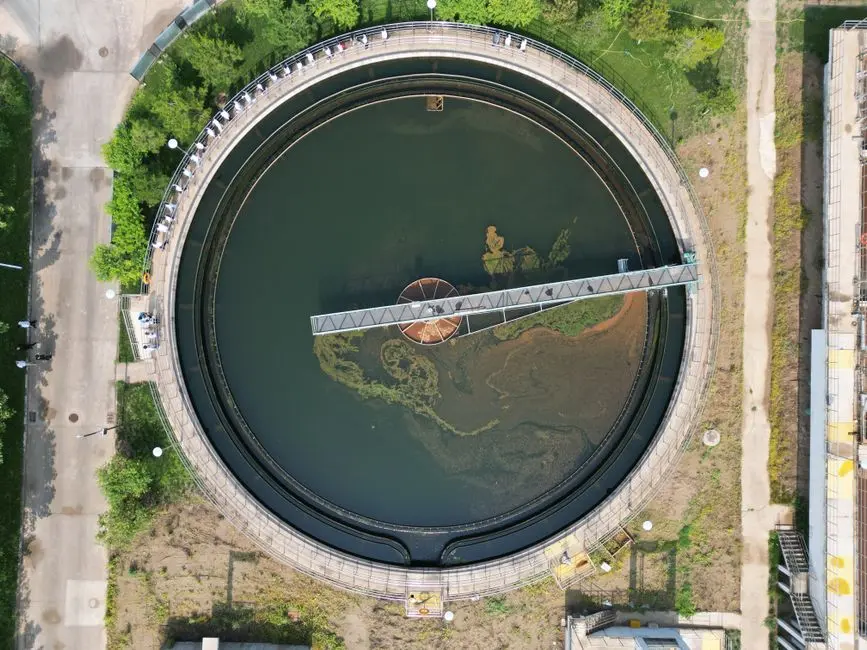
Efficiency numbers mean little if the equipment does not fit the available floor space. A DAF skid typically needs 0.3–0.6 m² per m³/h of flow, derived from the FPAC/FPBC/FPHF model geometry in commercial DAF literature (S1, S4). A lamella clarifier at 20–40 m/h surface loading needs 0.8–1.5 m² per m³/h because settling area scales with footprint, not height (HydropureWater catalog).
Standard DAF systems cover 4–300 m³/h across 13 catalog models, which fits most food/bev plants without custom engineering. A COMPACT DAF is a single skid at ≤66 GPM (~15 m³/h) and a two-skid modular layout above that, with chemical conditioning, sensors, and PLC controls pre-assembled (S1, S4). Headroom is another constraint: a DAF needs only 2.5–3.5 m of structural height, a lamella clarifier with packs at 55–60° sits under ~4–5 m, and a conventional gravity clarifier often needs 4–6 m. In an older Fairfield food plant with low headroom or a basement equipment room, that headroom difference alone can decide the project.
For retrofits, DAF skids are usually delivered pre-assembled and lifted into place, while lamella packs ship as modules that need on-site tank work. That install difference is typically 1–2 weeks of additional production downtime on a lamella retrofit — a cost line that rarely makes it into the capex comparison but always shows up in operations.
2026 OPEX and Sludge Handling: Polymer, Energy, and Downstream Dewatering
Sticker price is a small part of the 5-year cost picture. Sludge handling often dominates food/bev OPEX, and the choice of primary clarifier changes both sludge volume and dewaterability. The table below summarizes 2026 OPEX bands per m³ of treated flow, covering polymer and energy only (labor excluded, jar-test your site-specific number before budgeting).
| Cost line | DAF | Lamella Clarifier |
|---|---|---|
| Anionic polymer flocculant | 2–10 mg/L | 2–8 mg/L |
| Coagulant (PAC / ferric) | 50–200 mg/L | 35–140 mg/L (up to 30% lower, per HydropureWater catalog) |
| Energy | 0.05–0.12 kWh/m³ (recycle pump + saturator) | 0.01–0.03 kWh/m³ (sludge recirculation only) |
| Float / underflow dryness | 2–6% DS | 0.5–2% DS |
| 2026 OPEX band (polymer + energy) | $0.04–0.09/m³ | $0.02–0.05/m³ |
Polymer and energy costs above are typical 2026 Fairfield-region ranges derived from S3, S4 and HydropureWater field data; actual dose and tariff will swing these bands 20–40% either way. The offsetting cost is downstream dewatering. A DAF float at 2–6% dry solids dewateres readily on a plate and frame filter press sized at 1–500 m² filtration area (HydropureWater catalog). A lamella underflow at 0.5–2% DS is much wetter, which often forces a thicker polymer dose or a larger press to reach the same cake dryness. On a meat or dairy line, the dewatering offset typically closes — and often reverses — the OPEX gap between the two technologies.
Chemical conditioning is the lever that drives every line above. A jar-tested automatic chemical dosing system is what keeps the polymer and coagulant numbers honest as the influent shifts across a production week.
Fairfield, US Compliance: 40 CFR Part 408 and Local Pretreatment
The technology choice in Fairfield is shaped as much by the local sewer-use ordinance as by the influent chemistry. Federal categorical pretreatment standards divide the food and beverage sector into separate 40 CFR parts: canned fruits and vegetables fall under 40 CFR Part 408, meat and poultry products under 40 CFR Part 432, and dairy products under 40 CFR Part 405. Each part sets its own BOD, TSS, FOG, and pH limits that drive the design (per EPA categorical pretreatment framework, S5). The 2024 EPA Multi-Sector General Permit (MSGP) renewal is the current baseline for stormwater and process-water interfaces at food/bev sites, and PFAS in food processing effluent has been a visible 2025–2026 enforcement priority — confirm the latest state agency position before final design.
Local limits often run tighter than federal categorical limits. The City of Fairfield (California) and Fairfield, Ohio each operate POTW pretreatment programs with their own FOG, BOD, and TSS caps, frequently with daily-maximum and instantaneous-maximum values that a single shift excursion can violate. Engineers should request the current local limits from the POTW before sizing anything. The compliance logic is straightforward: if the local daily-max is FOG <100 mg/L and TSS <250 mg/L on a meat or dairy stream, a lamella clarifier alone will not reliably hit both numbers — a DAF, or a lamella primary with a DAF polish, becomes the right answer regardless of OPEX preference.
For a related compliance picture in a different US food/bev corridor, see the Food and beverage pretreatment compliance near Delhi, US guide. Industrial pretreatment at POTWs is enforced through a categorical-standard-plus-local-limits stack that rarely loosens in a 5-year planning window.
Decision Tree: Which One Should Your Fairfield Plant Choose?
The five-branch table below maps the most common Fairfield food/bev influent profiles to the right primary clarifier. It is the rule an engineer can defend in a project meeting and that a procurement officer can score against.
| Influent / Site Branch | Recommended Primary | Why |
|---|---|---|
| High FOG or free oil (dairy, meat, poultry, edible oil, sauce) | DAF system | Micro-bubbles capture floatables that a clarifier would let escape over the weir. |
| High TSS, low FOG (fruit/veg washing, beverage bottling, grain) | HydropureWater high-efficiency sedimentation tank (lamella clarifier) | Inclined packs settle bulk TSS cheaply; add DAF only if FOG spikes seasonally. |
| Variable hydraulic and organic load (most food/bev plants) | DAF + equalization basin | DAF recovers faster from hydraulic surges than a quiescent clarifier. |
| Tight footprint, indoor / skid-mount installation | DAF or COMPACT DAF | 0.3–0.6 m² per m³/h footprint and pre-assembled skid (S1, S4). |
| Strict capex, low FOG, large site footprint available | Lamella clarifier | Lowest 2026 OPEX band ($0.02–0.05/m³) when conditions fit. |
A sixth pattern shows up at larger Fairfield beverage and dairy plants: lamella primary for bulk TSS removal, followed by a DAF polish for residual FOG. The hybrid trains the two technologies to the part of the job each does best, and it keeps the downstream plate and frame filter press feed in the 2–6% DS range that dewateres cleanly. For a contrasting sector view, see DAF vs clarifier for petroleum wastewater in Shreveport and DAF vs clarifier for mining and metals wastewater in Naselle.
Frequently Asked Questions
When should a Fairfield food or beverage plant choose a DAF over a clarifier in 2026?
Choose a DAF when the influent carries free or emulsified FOG above ~100 mg/L, when flows vary 2–4× across a shift, or when local POTW daily-max FOG limits are tight. On meat, dairy, poultry, sauce, and edible-oil streams, the DAF system typically achieves 90–98% FOG removal and recovers from hydraulic surges faster than a quiescent clarifier.
What 2026 OPEX should a Fairfield plant budget per m³ of treated flow?
Budget 2026 polymer-plus-energy OPEX at $0.04–0.09/m³ for DAF and $0.02–0.05/m³ for a lamella clarifier, before labor. Lamella is cheaper to run, but its wetter underflow (0.5–2% DS) usually raises downstream dewatering cost on a plate and frame filter press, narrowing the gap on meat and dairy lines.
Which 40 CFR category governs a typical Fairfield food or beverage plant?
Canned fruits and vegetables fall under 40 CFR Part 408, meat and poultry products under 40 CFR Part 432, and dairy products under 40 CFR Part 405. Each sets categorical BOD, TSS, FOG, and pH limits, and the local POTW pretreatment limits in Fairfield (both California and Ohio) are often stricter — request the current local limits before sizing any primary clarifier.