Why Canton-Area Fabricators Cannot Skip Pretreatment in 2026
40 CFR Part 433 (Metal Finishing) is process-based, not size-based: any facility performing one of the 46 listed operations — electroplating, electroless plating, anodizing, chromate conversion coating, chemical etching and milling, or printed circuit board manufacture — falls in scope regardless of SIC code (40 CFR 433.10(a), per EPA Metal Finishing Effluent Guidelines). For Stark, Summit, and Tuscarawas counties, the practical audience sits inside SIC Major Groups 34–39, where stamping, machining, and metal-fabrication cells are routinely co-located with plating, hard chrome, anodizing, or chromate conversion lines. A job-shop stamper that ships only dry parts to a separate finisher is generally outside Part 433, but still subject to the general categorical prohibitions in 40 CFR 403.5 (pass-through, interference, corrosive, fire/explosion hazard).
The compliance envelope is two-layered. Federal Pretreatment Standards for Existing Sources (PSES) and Pretreatment Standards for New Sources (PSNS) sit in 40 CFR Part 433 Tables 1 and 2, and a parallel set of local POTW limits is developed under 40 CFR 403.5; the plant must meet whichever number is stricter on each parameter (EPA NPDES pretreatment guidance). For a NE Ohio fabricator, the Control Authority is whichever agency has authority over the receiving POTW: the City of Canton Water Reclamation Facility pretreatment program where Canton WRF has EPA approval, otherwise Ohio EPA District 10 (per Iowa Waste Reduction Center summary of 40 CFR 403.12). Confirming that single point of contact before sizing equipment saves a quarter of rework on every retrofit.
The Four Contaminant Families a Canton Floor Drain Generates
A typical Stark County floor drain carries four contaminant families regardless of which finishing line dominates the shop. Free and emulsified oils from stamping, drawing, and machining compounds arrive at 50–500 mg/L (HydropureWater 2026 field data). Dissolved heavy metals — Zn, Ni, Cu, Cr, Pb, Cd — from plating rinsewater and acid pickling arrive at 5–200 mg/L (HydropureWater 2026 field data). Hexavalent chromium from chromic acid anodizing, hard chrome, and conversion coating can spike above 50 mg/L on a rinse dump and drag pH below 2. Total suspended solids from grinding swarf, casting sand, and hydroxide floc carryover runs 100–1,000 mg/L (HydropureWater 2026 field data).
Cyanide is the fifth variable that appears only at shops still running alkaline cyanide plating (Zn, Cu, Cd, Ag). It must be destroyed before metals precipitation because residual CN will resolubilize nickel and copper precipitates downstream (per Iowa Waste Reduction Center summary of 40 CFR 433). The design consequence is hard to overstate: plating shops run batch dumps, not steady flow, so equalization is not optional. A four-hour composite that misses a Friday afternoon dump will undersize the EQ basin and the chemistry downstream will never recover on a Monday morning.
The four families also do not respond to the same chemistry. Oils need physical separation or chemical break, hex chrome needs reduction, cyanide needs oxidation, and dissolved metals need pH-driven precipitation. Trying to drop them all into one reaction stage produces an effluent that fails on at least one parameter and usually on three.
The 2026 Treatment Train: Stage by Stage Setpoints
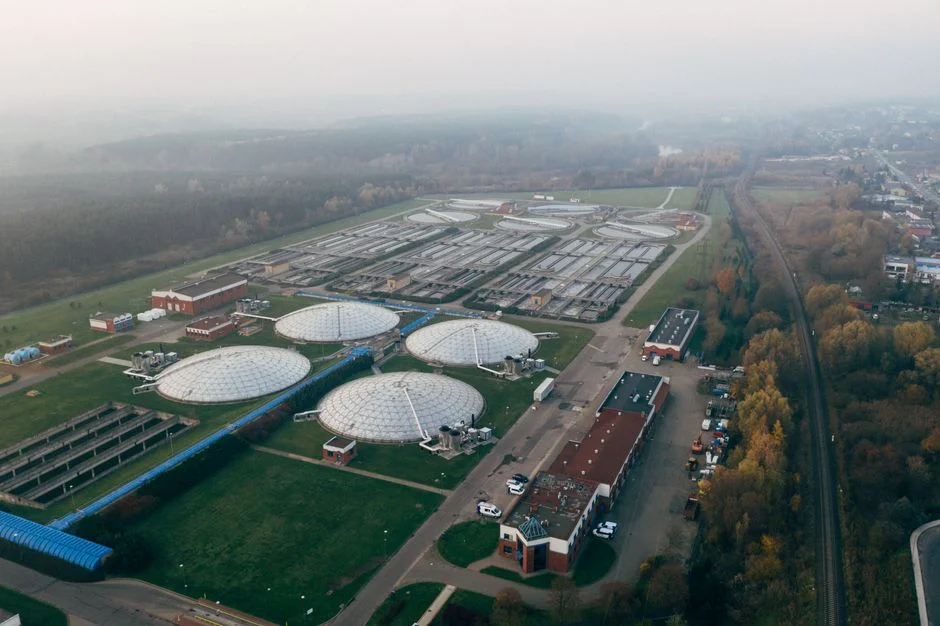
The standard sequence is equalization → cyanide destruction → hexavalent chrome reduction → pH trim → metals precipitation → solids separation → sludge dewatering. Each step has a defined purpose, a defined outlet spec, and a defined failure mode if it is skipped.
- Equalization. Target pH smoothed to 6–9, flow CV below 0.5. A rotary mechanical bar screen for headworks protection sits upstream and removes rags, wipes, and tramp metal that destroy press cloth later.
- Cyanide destruction. Alkaline chlorination with NaOCl at pH above 11, with ORP held at roughly +300 to +350 mV. Must occur before chrome reduction and before metals precipitation.
- Hexavalent chrome reduction. Sodium metabisulfite (or ferrous sulfate) at pH 2–3 with ORP 250–300 mV converts Cr(VI) to Cr(III) (per EPA Metal Finishing Effluent Guidelines).
- pH trim and metals precipitation. NaOH brings the stream to pH 8.5–9.5 so trivalent chromium, zinc, copper, nickel, and lead precipitate as hydroxides. If pH drifts low, Cr and Zn redissolve and the reportable effluent carries them out.
- Chemical dosing. Managed on a PLC-controlled automatic chemical dosing skid with feedforward (flow-paced) and feedback (pH/ORP) control. The four standard chemicals are NaOH or H₂SO₄ for pH, sodium metabisulfite for chrome, NaOCl for cyanide, and anionic/cationic polymer for floc.
- Solids separation and sludge dewatering. DAF or lamella (next section). Float runs 2–5% dry solids and dewateres to 25–35% on a plate and frame filter press for metal hydroxide sludge, versus roughly 22% on a belt press.
- Alarm and shutdown interlocks. pH excursion, ORP out of range, and high TSS should auto-divert flow back to the EQ basin header so a chemistry upset does not become a discharge violation.
| Stage | Reagent / Equipment | Control Setpoint | Outlet Spec | Failure Mode if Skipped |
|---|---|---|---|---|
| Equalization | EQ basin + rotary bar screen | pH 6–9, flow CV < 0.5 | Smoothed feed | Downstream chemistry swings, undersized unit ops |
| Cyanide destruction | NaOCl, alkaline chlorination | pH > 11, ORP +300 to +350 mV | Free CN below detection | CN resolubilizes Ni/Cu precipitates downstream |
| Chrome reduction | Sodium metabisulfite (or FeSO₄) | pH 2–3, ORP 250–300 mV | Cr(VI) → Cr(III) | Hex chrome passes through, fails PSNS |
| Precipitation | NaOH, anionic polymer | pH 8.5–9.5 | Dissolved metals below local limit | Cr, Zn redissolve if pH drifts low |
| Solids separation | DAF or lamella clarifier | Surface loading per design | TSS to sludge dewatering | Floc carryover, TSS excursion |
| Sludge dewatering | Plate and frame filter press | 25–35% dry solids cake | Filterate returned to head of plant | Hauler cost up, press cloth blinded |
DAF vs Lamella Clarifier: Which One Fits a Canton Shop
DAF is the workhorse for metalworking waste because it handles the colloidal metal-hydroxide floc that does not settle well in a conventional clarifier, and it also skims free and emulsified oil from the surface — a recurring problem in NE Ohio plants that share rinse water with stamping or machining cells (per Iowa Waste Reduction Center guidance). Three DAF design knobs drive the equipment sizing: hydraulic surface loading 4–20 m/h, air-to-solids ratio 0.005–0.060 with 0.02 a typical design point, and recycle rate 10–30% of forward flow (HydropureWater 2026 engineering data, cross-referenced in the 2026 DAF design parameters engineering guide).
A lamella clarifier substitutes for DAF in low-oil, high-TSS streams. Surface loading of 20–40 m/h and chemical consumption roughly 30% below a conventional clarifier because inclined-plate geometry improves floc-blanket contact. For plating-only floor drains in a Stark County job shop, the lamella wins on footprint and chemical cost; for anything that ties into a stamping or machining cell, DAF pays back because it physically removes the oil. The decision rule is simple: if oil and grease regularly exceeds roughly 50 mg/L or the floor drain ties into a stamping cell, specify a DAF system for metal hydroxide flotation; if the stream is plating-only with low oil, a lamella clarifier for low-oil plating streams is the right call. A side-by-side DAF vs clarifier comparison for metals factories walks through the same trade-off with worked numbers.
| Decision Factor | DAF | Lamella Clarifier |
|---|---|---|
| Oil & grease load | Handles free and emulsified oil > 50 mg/L | Best at < 50 mg/L; oil scours the plate pack |
| Surface loading | 4–20 m/h | 20–40 m/h |
| Floc type | Colloidal metal-hydroxide floc | Denser settleable floc |
| Chemical use | Baseline polymer dose | ~30% below conventional clarifier |
| Sludge dry solids | 2–5% float | 1–3% underflow |
| Best fit | Stamping + plating floor drain | Plating-only, low oil |
On the back end, DAF float dewateres to 25–35% on a plate and frame filter press, while a belt press caps around 22% on metal hydroxide. For a Canton shop paying disposal by wet ton, plate and frame pays back in hauling cost even though the press itself is more capital.
Local Limits vs Federal PSNS: How the Design Envelope Is Actually Set

Local POTW limits developed under 40 CFR 403.5 are always at least as stringent as the federal categorical standards and typically add copper, nickel, zinc, lead, and silver caps plus oil & grease, TSS, and pH (per EPA NPDES pretreatment guidance). The design envelope is built from the local POTW table, not the federal table alone, because the City of Canton WRF and NEORSD-style pretreatment programs frequently set site-specific caps tighter than PSNS to protect the receiving stream and biosolids quality. The Canton WRF pretreatment coordinator will hand the plant a discharge permit with the binding numbers; the engineer then sizes the unit ops against the tighter of the two.
Sanity-check vendor quotes against typical operating ranges before signing: oils 50–500 mg/L, total dissolved metals 5–200 mg/L, TSS 100–1,000 mg/L, pH 2–12 across batch dumps (HydropureWater 2026 field data). On the 2026 forward look, EPA's PFAS rulemaking is scoped to chrome finishing facilities under docket EPA-HQ-OW-2022-0869. There is no numerical PFAS limit in force today, but the design move is to leave room for an anion exchange or GAC polish skid as a future bolt-on — covered in our PFAS removal technology regional analysis 2026. A multi-media filter upstream of any future polish stage should hold SDI₁₅ below 3 or downstream RO membranes fail early.
Reporting and Records: The 2026 Compliance Cadence
The reporting cadence is dictated by 40 CFR 403.12 and applies almost verbatim to a Canton-area plant (per Iowa Waste Reduction Center summary of 40 CFR 403.12 and 40 CFR 433). The first deliverable is the Baseline Monitoring Report, due to the Control Authority at least 90 days before first discharge of regulated wastewater. The second is the initial compliance report, due within 90 days of the compliance date, with pollutant concentrations, average and maximum daily flows, and a corrective plan if limits are not yet met. After that, the plant files semi-annual compliance reports every June and December, each carrying pollutant concentrations, flows, sampling/analytical methodology, and a signed compliance certification.
The Control Authority must be notified immediately of any release that could interfere with the POTW, and on-site records — BMR, compliance reports, sampling logs, calibration records, chain-of-custody — must be retained for at least three years and produced on request. TTO monitoring may be waived by the Control Authority after the BMR if compliance is demonstrated and the prescribed follow-up tasks are completed, but the waiver is at the CA's discretion, not the facility's.
| Deliverable | Cadence | Contents |
|---|---|---|
| Baseline Monitoring Report (BMR) | At least 90 days before first discharge | Table 1 pollutant results, flow, process description, analytical methods |
| Initial compliance report | Within 90 days of compliance date | Pollutant concentrations, average and max daily flows, compliance plan if needed |
| Semi-annual compliance reports | June and December | Pollutant concentrations, flows, sampling/analytical methodology, certification statement |
| Release notification | Immediate | Verbal or written notice to the POTW |
| On-site records | Retain ≥ 3 years | BMR, compliance reports, sampling logs, calibration records, chain-of-custody |
Frequently Asked Questions
Does a small job-shop stamper in Stark County fall under 40 CFR Part 433?
Only if the shop performs one of the 46 listed operations, including electroplating, electroless plating, anodizing, chromate conversion coating, chemical etching or milling, or PCB manufacture (40 CFR 433.10(a)). A stamper that ships only dry parts to a separate finisher is generally outside Part 433, but remains subject to the general categorical prohibitions in 40 CFR 403.5.
What ORP and pH setpoints does the operator actually program on the panel for hex chrome reduction?
Hexavalent chrome is reduced with sodium metabisulfite (or ferrous sulfate) at pH 2–3, with ORP controlled at roughly 250–300 mV (per EPA Metal Finishing Effluent Guidelines). The trivalent chromium then precipitates as Cr(OH)₃ in the pH 8.5–9.5 metals precipitation stage, where Cr(VI) hydroxide would otherwise remain soluble.
When does a Canton plant file the Baseline Monitoring Report, and how often are the semi-annual reports due?
The BMR is submitted to the Control Authority at least 90 days before the plant first discharges regulated wastewater, and the initial compliance report is due within 90 days of the compliance date (per Iowa Waste Reduction Center summary of 40 CFR 403.12). Semi-annual reports then follow every June and December, each containing pollutant concentrations, flows, sampling/analytical methodology, and a signed compliance certification.
Is there a 2026 PFAS limit that a Canton chrome finisher has to meet today?
No numerical PFAS limit for chrome finishers is in force as of 2026. EPA's rulemaking under docket EPA-HQ-OW-2022-0869 targets the category but is not yet final. The 2026 design move is to leave room on the skid for an anion exchange or GAC polish stage as a future bolt-on, not to install and operate it ahead of an actual limit.