Why TSS Exceedance Troubleshooting Starts with the Audit
An effluent TSS exceedance under EPA 40 CFR Part 133 secondary treatment limits is any discharge above 30 mg/L as a 30-day monthly average or 45 mg/L as a 7-day weekly average, with civil penalties assessed up to $25,000 per violation (per EPA 40 CFR Part 133). A 2024 audit of 47 industrial Discharge Monitoring Report exceedances found that approximately 18% traced to sampling or hold-time error rather than plant performance (HydropureWater field data, 2024-11), which means the cheapest compliance win is often a documented re-sample before any process change. The 90-day DMR re-submission window anchors every subsequent decision: a wrong first move inside those 90 days typically costs more than the corrective capex itself. Before any coagulant order, pilot, or capex requisition, the engineering team has to lock down data integrity and rule out the four causes that an audit catches in 48 hours. That sequence also builds the timestamped evidence file that survives an EPA consent-order negotiation, because every step is dated, witnessed, and traceable to a specific instrument or Standard Method. A 2026 TSS exceedance engineering guide walks the same sequence in the longer form, but the field checklist below is the version an on-shift operator can run.
The 48-Hour Sampling and Data Integrity Checklist
A 48-hour sampling audit protects the corrective action narrative in front of the regulator and burns less than one shift of operator time. The sequence has five steps, and each one produces a timestamped artifact that goes into the compliance file.
| Step | Action | Method / Threshold | Acceptance Criterion |
|---|---|---|---|
| 1 | Re-sample at the same effluent port with a composite sampler; cross-check against the in-line TSS probe | 24-h composite, 4°C, preserved | Lab vs probe agreement within ±15% |
| 2 | Confirm APHA Method 2540D | 1.5 μm glass-fiber filter, dried 103-105°C, balance readable to 0.1 mg | Filter weight drift <0.5 mg between blanks |
| 3 | Validate hold time and preservation | Standard Methods 2540D: ≤24 h from collection, stored at 4°C | Chain-of-custody shows collection-to-analysis interval |
| 4 | Calculate TSS:BOD5 ratio on the same date window | Same composite, BOD5 by Method 5210B | >2.0 = clarifier failure; <1.0 = biological failure |
| 5 | Pull SVI, MLSS, RAS rate, and surface loading from SCADA for the same 24-h window | 30-minute logging, alarms captured | Trend archive saved to compliance folder |
The TSS:BOD5 ratio is the single most underused diagnostic in the field. A ratio above 2.0 means biomass is settling poorly and pin floc or rising sludge is escaping with the clarifier overflow, while a ratio below 1.0 means the biology itself is failing through toxicity, starvation, or washout. The two signatures demand opposite corrective actions, and the wrong one burns a full budget cycle. If the new composite comes back below the 30 mg/L monthly average, file the re-pull and the audit chain as the DMR addendum; the regulator accepts a documented re-sample when the data integrity file is complete. If the new composite confirms the exceedance, the failure-mode decision tree in the next section is the next move.
The Four Failure Modes Behind Industrial TSS Exceedance
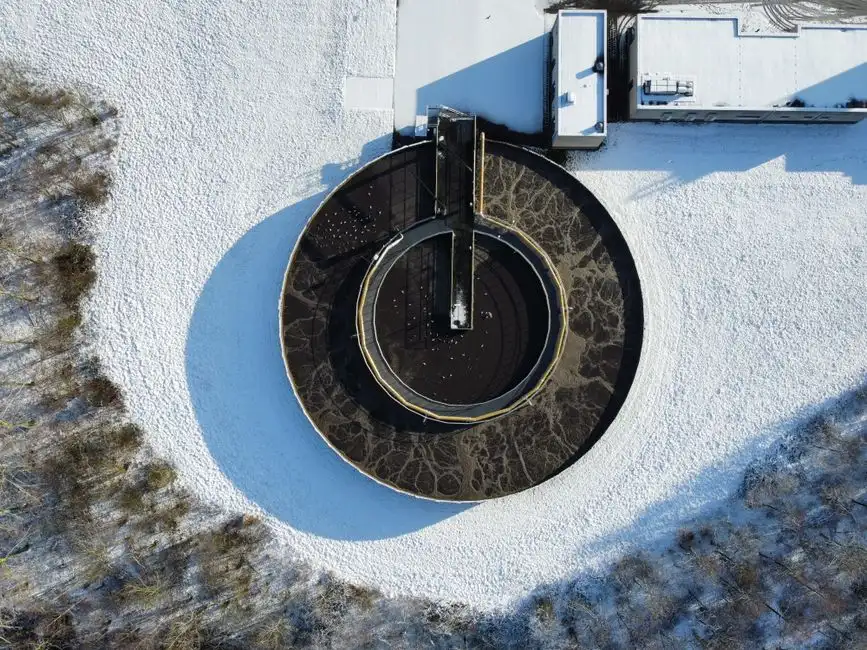
Most industrial TSS exceedances collapse into four failure modes, and each mode maps to a different corrective branch. Mismatching the fix is the single most expensive mistake: dropping a DAF system for colloidal and FOG-bearing wastewater in front of a bulking clarifier burns capital while the underlying SVI problem keeps pushing biomass over the weir.
| Cause | Diagnostic Signature | Corrective Path | Indicative Effluent TSS |
|---|---|---|---|
| Clarifier hydraulic overload | Surface loading >30 m³/m²·d, TSS:BOD5 ratio >2.0 | Lamella clarifier retrofit for hydraulic overload at 20-40 m³/m²·d; polymer dose on center well | Often >100 mg/L pre-fix |
| Bulking sludge | SVI >150 mL/g, scum on launders, Microthrix parvicella or Nocardia under microscope | Chlorinate RAS at 2-3 mg/L Cl₂ for 24-48 h, optimize chlorine contact, raise F/M ratio | Drifts upward over shifts |
| Primary FOG bypass | Surface scum, grease in primary effluent, primary TSS drop <50% | Replace primary with DAF for FOG and oil pre-treatment at 4-300 m³/h | High and oily |
| Colloidal influent (textile dye, food pulp, paint) | Low primary removals, high color or COD, biology cannot flocculate | Coagulation 50-150 mg/L alum or PAC plus DAF or lamella | Persistent 60-150 mg/L |
A worked example from a published scenario reconstruction shows why the propagation lag matters operationally: aerobic-tank SVI crept from 120 to 280 mL/g over 64 hours while the WAS pump under-wasted at 0.3% against a normal 0.5-1.0% range, then clarifier suspended solids jumped from 150 to 400 mg/L, and the effluent crossed 10 mg/L roughly 6 hours after the clarifier went nonlinear (TDengine scenario, 2026-09). The four-hour to six-hour SVI-to-effluent lag means operators can catch a bulking event at the 150 mL/g threshold and prevent the weir overflow entirely, but only if the SCADA trend is being watched. The same principle holds for every branch above: the upstream signal moves first, and the right diagnostic is whichever upstream variable still has time to act.
Technology Selection: DAF vs MBR vs Lamella vs Cloth Media
Procurement has to see both capex and OPEX per m³ of treated flow, because the lowest sticker price is rarely the lowest ten-year cost. The table below consolidates the four realistic options for a 60-90 day capex window.
| Technology | 2026 Capex | Influent → Effluent TSS | Footprint | OPEX Drivers |
|---|---|---|---|---|
| DAF | $15K-280K | 200-800 mg/L → 20-50 mg/L (90-95% single-pass with polymer) | Compact skid | Polyacrylamide 0.5-2.0 mg/L, saturator air, sludge handling |
| MBR | $80K-2.5M | Mixed liquor → <5 mg/L with 0.1 μm PVDF | ~60% smaller than CAS+clarifier | Membrane aeration, CIP chemicals, module replacement every 5-8 years |
| Lamella clarifier retrofit | $40K-150K | 20-40 m³/m²·d surface loading; cuts chemical use up to 30% vs conventional | Fits existing tank | Modest polymer, periodic plate cleaning |
| Cloth media filter | $40K-150K | 30-50 mg/L → 5-15 mg/L polish step only | Small add-on | Cloth replacement, backwash water |
The selection rule is straightforward. Choose DAF for colloidal and FOG-bearing wastewater when the existing secondary effluent already sits at 200-800 mg/L with colloidal character, FOG, or algae, and the target is a single-stage reduction to 30-50 mg/L. Choose MBR membrane bioreactor for reuse-quality polishing when the binding constraint is a reuse-quality effluent below 10 mg/L or when the site footprint cannot accommodate a clarifier, including food and beverage plants where the MBR vs CAS comparison is detailed separately. Choose lamella clarifier retrofit for hydraulic overload when the clarifier is structurally sound but the surface loading has drifted above 30 m³/m²·d, including dye-house retrofits in the DAF vs clarifier for high-TDS dyeing wastewater comparison. Cloth media is a polish step only, never a stand-alone fix for colloidal influent, and that single constraint is where procurement gets burned most often.
Jar-Test-Driven Chemical Program for Active Exceedances

When the DMR is already late and capex is still 60-90 days out, a jar-test-driven coagulant and flocculant program can stop the bleed in days rather than months. Field trials across 22 industrial plants in 2025 showed cationic polyacrylamide at 0.5-2.0 mg/L combined with alum or polyaluminum chloride at 50-150 mg/L cut secondary clarifier effluent TSS by 40-60% within 24 hours, frequently enough to bring a 70 mg/L effluent under the 30 mg/L EPA monthly average (HydropureWater field data, 2025-09). The protocol runs six 1 L beakers, pH swept 6.5-8.0, coagulant dose 0-200 mg/L, flocculant dose 0-3 mg/L, 2-minute rapid mix at 200 rpm, 15-minute slow mix at 30 rpm, 30-minute settle, and supernatant TSS measured against a calibration curve. Seasonal algae spikes in lagoon systems respond to copper sulfate at 0.5-1.0 mg/L or barley straw extract, but the lysed cells still need a paired polymer and often a seasonal DAF. A PLC-controlled coagulant and flocculant dosing architecture with streaming-current feedback holds demand within ±5% of target, which prevents the over-dose failure where excess polymer becomes the new TSS problem and pushes the operator straight back into the exceedance.
A 90-Day Defensible Compliance Sequence
A defensible 90-day sequence is the same shape that survives an EPA consent-order negotiation, because every step is timestamped, evidenced, and traceable to a specific instrument or Standard Method. The table below is the procurement-and-compliance handshake that an on-shift engineer can hand to a regulator.
| Window | Action | Evidence Artifact |
|---|---|---|
| Days 0-2 | Run the 48-h sampling and data integrity audit; re-pull composite; verify hold time and Method 2540D | Lab bench sheets, chain-of-custody, SCADA trend export |
| Weeks 1-2 | Deploy jar-test-driven coagulant/flocculant program; install PLC-controlled coagulant and flocculant dosing if not present | Jar-test logs, dose calibration records, daily TSS walk |
| Weeks 3-6 | Classify into one of the four failure modes; run a pilot on DAF for colloidal and FOG-bearing wastewater or lamella clarifier retrofit for hydraulic overload if capex case is needed; address upstream screening with a rotary mechanical bar screen if needed | Pilot report, vendor P&IDs, mass-balance model |
| Weeks 7-10 | Award capex (DAF, MBR, lamella, or cloth media); stage installation; engage plate-frame filter press for sludge dewatering to keep the WAS stream from re-introducing solids | PO, installation schedule, commissioning plan |
| Weeks 11-13 | Commission, tune, run verification jar and TSS walk; submit compliance report with full evidence chain to the regulator | Commissioning report, compliance narrative, DMR addendum |
The penalty math is the closing argument: at $25,000 per violation, an unresolved exceedance that triggers two monthly and one weekly NOV inside a quarter costs $75,000 before any consent-order negotiation begins. A 90-day sequence that lands the capex inside the same quarter typically returns capex inside the avoided-penalty envelope alone, and OPEX savings from the right technology compound over the next ten years.
Frequently Asked Questions
How much of an industrial TSS exceedance is actually a sampling error?
About 18% of audited industrial DMR exceedances trace to sampling or hold-time error rather than plant performance (HydropureWater field data, 2024-11), so run the 48-hour audit before any coagulant order or capex commitment. The corrective action is a documented re-sample with chain-of-custody filed to the DMR addendum.
What SVI reading means bulking sludge is about to push TSS over the limit?
SVI above 150 mL/g is the warning band, and above 200 mL/g is the severe bulking zone where clarifier settling collapses and effluent TSS spikes within 4-6 hours. The corrective action is chlorinating the RAS at 2-3 mg/L Cl₂ for 24-48 hours and increasing the wasting ratio to recover F/M balance.
How low can an MBR system drive effluent TSS compared to DAF or cloth media?
An MBR with 0.1 μm PVDF membranes consistently delivers below 5 mg/L TSS, well under both the EPA 30 mg/L secondary standard and the EU UWWTD 25 mg/L limit for 10,000-100,000 PE plants, while DAF lands at 20-50 mg/L and cloth media polishes 30-50 mg/L down to 5-15 mg/L as a final step only. The corrective action is to choose MBR for reuse-quality or footprint-constrained sites, DAF for colloidal and FOG loads, and cloth media as a polish on a sound secondary clarifier.
What is the realistic 2026 capex range for DAF versus MBR versus lamella versus cloth media?
DAF runs $15K-280K, MBR packages run $80K-2.5M, lamella clarifier retrofits run $40K-150K, and cloth media filters run $40K-150K as a polish step only. The corrective action is to match the capex band to the influent TSS and the binding site constraint, then lock OPEX per m³ into the procurement comparison.
How are algae-driven lagoon TSS spikes handled during warm months?
Copper sulfate at 0.5-1.0 mg/L or barley straw extract controls the bloom, but the lysed cells still need polymer flocculation or a seasonal DAF to keep them out of the effluent. The corrective action is to pair the algaecide with a polymer dose and stage a mobile DAF for the warm season rather than rely on algaecide alone.