
Why coking wastewater needs an activated carbon polishing stage
Biological treatment alone cannot meet effluent limits for coking wastewater: post-biotreated effluent from a typical coke plant carries COD 200-800 mg/L, phenol 20-200 mg/L, thiocyanate 20-100 mg/L, and color 200-500 Pt-Co, plus refractory BTEX, polycyclic aromatics, and metal-cyanide complexes. A/O, A2O, and SBR trains typically remove 80-90% of influent COD but leave a recalcitrant fraction that receiving-WWTP operators or direct-discharge regulators will not accept (HydropureWater field data, 2026). Granular activated carbon is a proven option for removing organic chemicals; it is less effective on dissolved minerals, which suits coking polishing where the load is organic-dominant (S3, S4). The two compliance drivers an engineer should reference are China GB 8978-1996 Class I/II for coking discharge (COD ≤100 mg/L, phenol ≤0.3 mg/L for Class I) and the EU IED BAT-AELs for coke ovens, which set comparable thresholds for total phenols, COD, and TOC. A polishing GAC adsorber is the most defensible single-unit step to bridge that gap without expanding the biological train.
GAC vs PAC: choosing the right activated carbon form for coke plant duty
Powdered activated carbon (PAC) adsorbs more than 100 times faster than GAC at the same feedstock because particles are roughly 100 times smaller, but the same size that speeds kinetics makes PAC impossible to pack in a column—pressure drop across a powdered bed would be thousands of psi (S4). GAC packed-bed columns are the default for continuous high-flow coking duty. While full PAC capacity needs roughly 16 hours in a batch tank, GAC continuous columns can work at under three minutes; however, that figure applies to drinking-water organics, not coking refractories. Coking polishing needs empty bed contact time (EBCT) of 30-90 minutes to drive residual phenol and color below the discharge limit. Specify GAC for steady-state polishing, keep a PAC dosing system for emergency phenol spikes, and run both in parallel at plants that see upset loads from batch coke pushing. Coking operations are inherently batch—pushing cycles, gas-main drainage, and tar-decanter swings all generate phenol shocks that PAC can absorb in 2-6 hours while the GAC bed keeps producing stable water.
| Parameter | GAC (packed-bed adsorber) | PAC (slurry dosing) |
|---|---|---|
| Particle size | 0.6-2.4 mm (8x30 to 12x40 mesh) | <45 µm (passes 325 mesh) |
| Adsorption rate relative to GAC | 1× (baseline) | >100× |
| Effective contact time | 30-90 min (coking polish) | ~16 h in batch tank |
| Operating mode | Continuous, fixed-bed | Batch, single-pass slurry |
| Regeneration | Thermal, on-site or off-site | Single-use, spent to disposal |
| Best fit for coking | Steady-state polishing | Upset/shock load, emergency |
Carbon specification: which feedstock, iodine number and particle size work for coking duty
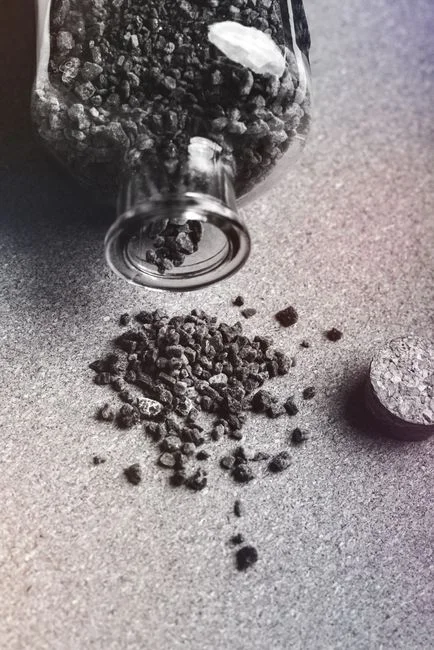
Coal-based bituminous GAC is the coking-industry default because its broad pore-size distribution matches the wide molecular-weight range of coking effluent organics (S4). Coconut-shell GAC develops finer micropores and is well suited to low-MW phenol and color bodies, but it saturates faster on the high-MW fraction; a common layout is a coal-based primary bed followed by a coconut-shell polish layer. The key acceptance spec is iodine number: well-activated carbons run 800-1,000 mg/g or higher, and any carbon below 600 mg/g should be rejected for coking duty (S4). Mesh size 8x30 or 12x40 is standard for coking columns; finer 20x50 grades raise pressure drop without proportional capacity gain on clarified effluent. Procurement should also require the manufacturer's BET surface area certificate, with a working range of 400-675 m²/g for coking-grade GAC, plus a washable fines limit below 1% by weight to protect the underdrain nozzles during the first backwash cycle. Source specification from a supplier that stocks bulk activated carbon and filter media with batch-level certificates.
| Spec parameter | Coking-duty target | Reject if |
|---|---|---|
| Iodine number | 800-1,000 mg/g | < 600 mg/g |
| BET surface area | 400-675 m²/g | < 400 m²/g |
| Mesh size | 8x30 or 12x40 | Finer than 20x50 without vendor justification |
| Feedstock | Bituminous coal (primary), coconut shell (polish layer) | Wood-based for primary bed |
| Washable fines | < 1% by weight | > 2% by weight |
Sizing the GAC adsorber: EBCT, bed depth and hydraulic loading for coke plant effluent
Empty bed contact time is bed volume divided by flow rate; coking polishing runs 30-90 minutes because the residual phenol, thiocyanate, and refractory COD are at low concentration but kinetically slow to adsorb. Bed depth is typically 1.5-3.0 m, paired with hydraulic loading of 5-12 m³/m²·h on clarified post-bio effluent to avoid channeling and excessive pressure drop (HydropureWater field data, 2026). A lead-lag two-vessel configuration is standard practice so the first bed runs to breakthrough while the second acts as a guard; on breakthrough, the lag bed becomes the lead and the exhausted bed is taken offline for regeneration. Backwash and air-scour capability must be built in because coking effluent carries 30-80 mg/L residual suspended solids even after secondary clarification, and the bed will blind without periodic fluidization. A 100 m³/h coking plant at 60-min EBCT and 2.0 m bed depth needs two vessels of roughly 3.0 m diameter operating in lead-lag. Pair the adsorber with a JY-integrated water purification skid for turnkey delivery of the carbon stage, and a multi-media pre-filter for coking effluent polishing if upstream TSS is >50 mg/L.
| Design parameter | Typical coking range | Notes |
|---|---|---|
| EBCT | 30-90 min | Use ≥60 min when residual phenol > 50 mg/L |
| Bed depth | 1.5-3.0 m | Min 1.5 m to limit channeling |
| Hydraulic loading | 5-12 m³/m²·h | Hold ≤10 on clarified bio-effluent |
| Vessel configuration | Lead-lag, 2 vessels minimum | 3 vessels for >150 m³/h plants |
| Backwash flow | 30-45 m³/m²·h with air-scour | Daily on first 7 days, weekly after |
| Bed life (phenol breakthrough 1 mg/L) | 5-20 m³ effluent per kg GAC | Function of influent loading |
Where GAC fits in a coking wastewater treatment train

The standard coking train runs: oil removal → ammonia stripping → phenol solvent extraction and/or biological detox → A/O or A2O biotreatment → coagulation/sedimentation → GAC polishing → final discharge or reuse. If biotreated effluent COD still exceeds 150-200 mg/L, GAC polishing is more economical than expanding biological capacity—a 50 m³/h polishing train at 60-min EBCT has a footprint of roughly 60 m² versus the basin volume required to push biological COD down another 30%. When the residual load is dominated by total dissolved salts, ammonia, or thiocyanate, GAC is a poor choice; the engineer should consider breakpoint chlorination for ammonia, ion exchange for thiocyanate, or AOP for the most refractory fraction. Spent GAC is fed to a regeneration furnace: the 350°C low-temperature route in open air recovers around 97% of fresh capacity, while the 900°C inert route pushes surface area into the 400-675 m²/g range at about 35% higher energy cost (S4). Position the GAC stage downstream of a DAF pre-treatment for coking wastewater to strip residual oils and tars, and ahead of a lamella clarifier upstream of the GAC adsorber only when an intermediate TSS polish is needed.
Operating costs and regeneration economics for a coking-plant GAC system
Low-temperature regeneration at 350°C for 1 hour in open air restores spent carbon to near-virgin characteristics, with reported energy cost under €1 per batch; high-temperature regeneration at 900°C in an oxygen-free atmosphere costs about 35% more but boosts surface area into the 400-675 m²/g range (S4). Bed-life benchmark: 1 kg of activated carbon treats 5-20 m³ of coking effluent to a phenol breakthrough of 1 mg/L, depending on influent loading—for a 100 m³/h plant at 10 m³/kg and 8,000 operating hours per year, that implies roughly 80-160 tonnes of GAC in service at steady state, with annual make-up of 2-5% per cycle. The OPEX line items are: carbon make-up, regeneration furnace gas and electricity, backwash water, labor, and spent-carbon disposal—coking carbon is typically classified as hazardous waste due to adsorbed cyanides and PAHs and must be incinerated or sent to a licensed facility. At sustained high flows, GAC with on-site regeneration is 30-50% cheaper than equivalent PAC dosing over a 5-year horizon, even after capitalizing the regeneration furnace. Procurement can defend the capital ask with the bed-life benchmark plus an avoided-disposal cost line for PAC substitution. Use the same PAC dosing system for emergency phenol spikes as the surge-protection capex line so the GAC bed life is preserved.
| Cost line | GAC + on-site regeneration | PAC continuous dosing |
|---|---|---|
| Carbon consumption (100 m³/h plant) | 80-160 t in service; 2-5% make-up/cycle | 5-20 kg/h, single-use |
| Regeneration energy | < €1/batch at 350°C; +35% at 900°C | None (spent to disposal) |
| Spent-carbon handling | Hazardous waste, ~10-30 €/t disposal | Hazardous waste, full volume |
| 5-year OPEX index (relative) | 1.0 (baseline) | 1.3-1.5× higher at sustained flow |
| Surge / shock capability | Limited by EBCT | Fast response, 2-6 h to clear spike |
Frequently Asked Questions
What EBCT should I specify for a GAC adsorber polishing coking biotreated effluent?
Empty bed contact time (EBCT) is bed volume divided by volumetric flow rate. For coking polishing on effluent with residual COD 200-800 mg/L and phenol 20-200 mg/L, specify 30-90 minutes; use 60 minutes as the working value when phenol exceeds 50 mg/L (HydropureWater field data, 2026).
How often does spent GAC from a c
Frequently Asked Questions
What concentration of phenol can activated carbon remove from coking wastewater?
Activated carbon is highly effective at reducing phenol concentrations in coking wastewater, typically achieving removal efficiencies of 90% to 99%. In tertiary treatment stages, it can reduce influent phenol concentrations from 5–20 mg/L down to less than 0.5 mg/L, consistently meeting stringent discharge standards such as the Chinese GB 16171-2012 limit for coking chemical industry effluent.
How long does activated carbon last in a coking wastewater treatment system?
The operational lifespan of activated carbon in coking wastewater applications typically ranges from 3 to 6 months depending on the organic loading rate and the presence of competing compounds. Factors such as high chemical oxygen demand (COD) and the accumulation of polycyclic aromatic hydrocarbons (PAHs) lead to pore blockage, necessitating regeneration once the adsorption capacity reaches a breakthrough point, often defined as a 20-30% reduction in removal efficiency.
Is GAC or PAC better for coke plant wastewater?
Granular Activated Carbon (GAC) is generally preferred for coking wastewater treatment because it facilitates continuous operation in fixed-bed or fluidized-bed reactors, which are more efficient for large-scale industrial flows. Powdered Activated Carbon (PAC) is typically reserved for short-term operational upsets or as a secondary additive in activated sludge processes (PACT systems) to improve settleability and mitigate toxicity, but GAC is more cost-effective for long-term, high-volume contaminant removal.
What is the typical empty bed contact time for a coking wastewater GAC filter?
The typical empty bed contact time (EBCT) for GAC filters treating coking wastewater ranges from 15 to 45 minutes. This duration is critical for the kinetics of complex aromatic adsorption; shorter contact times often lead to premature breakthrough of persistent refractory organics, while longer times increase the footprint and capital expenditure of the treatment facility.
How is spent activated carbon from coking plants regenerated or disposed of?
Spent activated carbon is most commonly regenerated via thermal reactivation in a rotary kiln or multiple hearth furnace at temperatures between 800°C and 950°C in a controlled, oxygen-limited atmosphere. This process oxidizes the adsorbed organic pollutants, restoring the carbon's pore structure and surface area. If thermal regeneration is not feasible due to the nature of the adsorbed hazardous waste, the spent carbon must be disposed of as hazardous waste in accordance with local environmental regulations, typically through incineration in a licensed hazardous waste facility.