Why Tampa pulp and paper mills are re-evaluating primary solids removal in 2026
Tampa's surface-water intake sits between 25-30 °C for most of the year, and that single fact reshapes primary clarification design. Stokes-law settling velocity drops as water viscosity falls, which means a conventional clarifier that performs at 1.0 m/s settling in February underperforms by roughly 15-20% in July (HydropureWater field data, 2026). For a pulp mill that already pushes TSS loads of 1,500-3,000 mg/L with wood fiber, starch, calcium carbonate filler, and deinking FOG, that thermal penalty is the difference between meeting a 100 mg/L overflow target and missing it on the hottest weeks of the year.
The influent itself is the second pressure point. Per Ecologix, pulp and paper wastewater carries high TSS, BOD, COD, color, and entrained wood fibers and fillers — a stream where many particles are close to neutral buoyancy and resist gravity settling on principle, not just on warm-water kinetics. The practical effect in Tampa is that overflow TSS drifts to 120-180 mg/L on a hot afternoon and a fiber-laden clarifier surface needs to be hosed down twice a shift.
The third driver is the regulatory and commercial frame around 2026. FDEP industrial pretreatment permitting continues to tighten discharge limits on TSS, BOD, and color for categorical industries in the Hillsborough basin, and water-reuse initiatives under the Tampa Bay Water renewal plan make the recovery of reusable fiber, filler, and process water financially attractive rather than just environmentally responsible. For a procurement lead in 2026, the real buyer question is no longer "DAF or clarifier" in the abstract — it is whether to keep a 1970s concrete clarifier and bolt on polymers, or install a packaged DAF skid that delivers usable overflow at 20-30 mg/L TSS in a footprint that fits the mill's existing pad.
How a DAF system works on pulp and paper wastewater
A dissolved air flotation system clarifies by attaching micro-bubbles to suspended particles so they rise, instead of waiting for them to sink. In practice, a side stream of clarified effluent (typically 20-30% of forward flow) is pressurized to 60-80 psig in a saturator and then released at atmospheric pressure inside a flotation tank, generating a cloud of 10-100 µm bubbles that nucleate on floc particles (per Seven Seas Water, 2024). The bubbles lower the effective density of the floc, so fibers, fillers, and emulsified FOG that would have taken hours to settle float to the surface in roughly 3 minutes (per Lenox Institute, 2022, citing USEPA).
That bubble-floc attachment is not free. Fine wood fiber and colloidal filler will not float reliably without a chemical program, so a typical pulp-mill DAF includes a coagulant dose (alum, PAC, or a ferric-based product at 20-80 mg/L) followed by a flocculant dose of 2-10 mg/L (Lenox Institute, 2022, citing USEPA). The floc grows, the bubbles attach, and the resulting mat is skimmed by a traveling or spiral scoop at the top of the tank. Clarified water exits below the floating mat through an underflow baffle, and a portion is recycled to the saturator to close the loop (Seven Seas Water, 2024).
The performance envelope is well documented. USEPA data summarized by Lenox Institute (2022) puts optimized DAF effluent TSS at 20-30 mg/L, with thickened sludge consistency of 2-3% — meaning the floated material goes straight to a filter press or hauling tank without a thickener in between. Hydraulic loading rates of 4-5 GPM per square foot of effective flotation area, and water-filled floor loads below 150 lb/sqft, allow a packaged DAF to sit on a slab or even a structural mezzanine (Lenox Institute, 2022).
How a conventional clarifier performs on the same stream
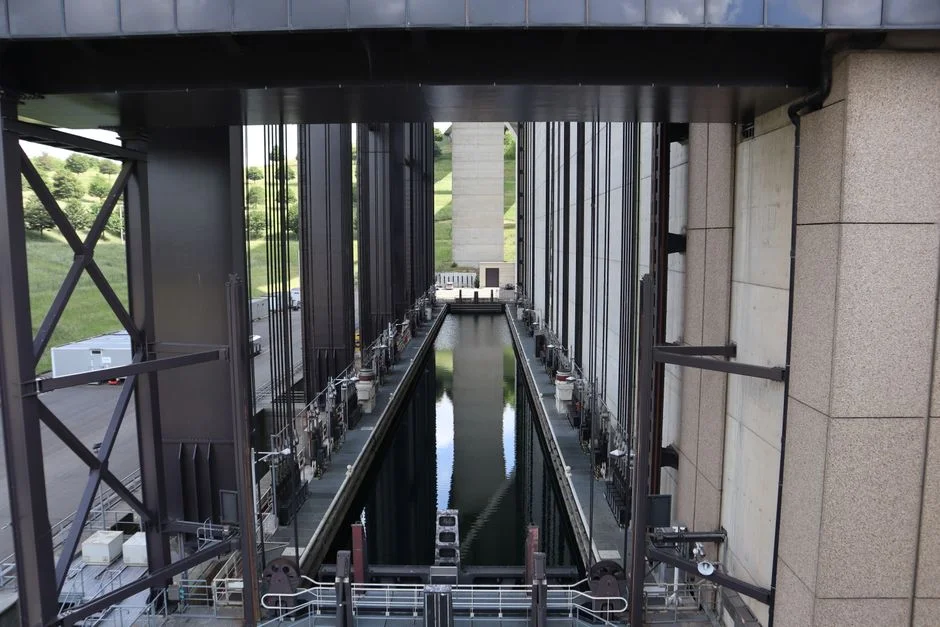
A conventional gravity clarifier removes suspended solids by waiting for them to settle under quiescent conditions. In its favor, the technology is well understood, capital parts are commodity, and on heavy inorganic streams (grit, lime softening, metal hydroxides) it delivers steady, low-effort performance (per Ecologix, 2025). On a pulp mill feed, three structural problems show up immediately.
First, wood fiber and many papermaking fillers are near neutral buoyancy, with specific gravities of 1.0-1.1 — close enough to water that gravity settling is slow even in ideal conditions (Ecologix, 2025). Second, clarifier retention time is 2-4 hours for primary duty, which on a 2 MGD pulp-mill forward flow means a 170,000-330,000 gallon concrete basin. Third, that long retention time acts as a low-pass filter on hydraulic performance: a 20% flow spike from a batch pulping dump turns into 4 hours of elevated overflow TSS, and overflow commonly drifts to 80-150 mg/L on a typical pulp feed without aggressive polymer assist.
The sludge side of the ledger is also weaker. Gravity clarifier underflow on a fiber stream exits at well under 1% solids, so the mill must install and operate either a separate gravity thickener, a DAF thickener, or a gravity belt thickener before the material is dry enough to send to a filter press or land disposal. The clarifier is the cheapest single piece of equipment on the P&ID, but the system around it — thickener, larger basin, larger polymer day tank — typically closes the capex gap with a packaged DAF and leaves the clarifier holding the operational penalty.
DAF vs clarifier for pulp and paper: head-to-head parameter table
Procurement engineers are usually handed a one-page comparison in the first project meeting. The table below puts the two technologies on the same axes for a Tampa pulp and paper primary duty, drawing on Lenox Institute (2022, citing USEPA) for the DAF numbers and Ecologix (2025) for clarifier behavior on fiber streams.
| Metric | DAF (packed skid) | Conventional Clarifier | Advantage |
|---|---|---|---|
| Effluent TSS (chemical-optimized) | 20-30 mg/L | 80-150 mg/L without thick polymer; higher on warm-water spikes | DAF |
| Retention time | ~3 min | 2-4 h | DAF |
| Hydraulic loading | 4-5 GPM/sqft | 0.3-0.8 GPM/sqft | DAF |
| Sludge dryness (out of unit) | 2-3% | <1% | DAF |
| Footprint | Compact skid; no heavy foundation (load <150 lb/sqft water-filled) | Large concrete basin, 170k-330k gal at 2 MGD | DAF |
| Fiber / filler recovery | Yes — float captures reusable solids | Limited — most neutrally buoyant fiber stays in overflow | DAF |
| Sensitivity to flow / temperature spikes | Low — short retention damps spikes | High — long retention propagates upset | DAF |
| Capex on equal primary duty | Lower for packaged DAF (Lenox, 2022) | Lower for the basin alone, but system cost (basin + thickener) closes the gap | DAF |
For pulp and paper primary duty in Tampa, DAF wins on 7 of 8 parameters; the one row where a clarifier competes on sticker price disappears once a thickener is added to make the clarifier sludge handleable.
Which Tampa mills should still choose a clarifier in 2026
There is a narrow but real set of conditions where a clarifier is still the right call, and an honest engineering review has to spell them out.
The first is low-TSS secondary polishing. After a primary DAF or a well-functioning aerated lagoon, influent to a secondary clarifier is often below 300 mg/L TSS and the duty is settling residual biological floc, not floating wood fiber. In that envelope, a lamella plate clarifier multiplies the effective settling area inside a small footprint, and a properly designed lamella clarifier can deliver 30-50 mg/L secondary overflow at a fraction of the capex of a second DAF.
The second is very small mills under 1 MGD with abundant land, no fiber-recovery value, and an influent dominated by heavy inorganics. A lined earthen clarifier with a simple sludge pump can outprice any mechanical system in pure capex terms, and the operator is not trying to recover furnish. The third is a deinking or recycled-paper line where most usable fiber is already screened out before the wastewater reaches primary treatment, leaving a stream heavy in ash and stickies that does settle.
Outside these three niches, the engineering case for keeping a conventional clarifier on a Tampa pulp mill's primary duty in 2026 is weak. The remaining clarifier applications in this segment are retrofit projects where a mill is adding polishing capacity, not primary treatment.
Sizing a DAF system for a Tampa pulp and paper factory
Sanity-checking a vendor quote starts with three numbers: hydraulic loading rate, air-to-solids ratio, and the saturator's pressure envelope.
For the hydraulic basis, USEPA-derived practice (via Lenox Institute, 2022) sets DAF design at 4-5 GPM per square foot of effective flotation area. A 500 GPM peak flow therefore needs 100-125 sqft of effective area, which is well within the envelope of a packaged skid. A mill that wants to size against a packaged DAF skid can map average and peak flow into the catalog's 4-300 m³/h range across 13 standard model sizes and pick a unit with 20-30% hydraulic headroom to absorb batch discharges from pulping or broke handling.
For the air side, start with an air-to-solids (A/S) ratio of 0.005-0.01 lb air per lb solids (Seven Seas Water, 2024). That is wide enough to cover most pulp-mill primary streams without optimization, and jar tests should be used to trim the dose to the lower end of the range when influent TSS is variable. A reasonable starting chemical program is 2-10 mg/L of an anionic or cationic flocculant matched to the furnish, plus coagulant as needed for color and colloidal filler. Plan the recycle pump at 20-30% of forward flow, and the saturator at 60-80 psig, so the P&ID matches the operating envelope vendors actually run (HydropureWater engineering specification, 2026).
Finally, leave room for the polymer system. A DAF that is starved of chemical feed underperforms a well-tuned clarifier, and the easiest way to lose the 20-30 mg/L effluent advantage is to under-design the polymer makeup unit or share it with another process.
2026 cost and ROI snapshot for Tampa mills
Capex for a packaged DAF in this duty class is typically lower than a comparably rated concrete clarifier once the supporting infrastructure is added (Lenox Institute, 2022). The skid arrives prefabricated, sets on a slab with floor loads under 150 lb/sqft water-filled, and skips the heavy foundation work a 200,000-gallon basin demands. Install timelines on Tampa projects typically run 4-8 weeks for a DAF skid versus 6-12 months for a basin, which carries its own working-capital and disruption cost.
OPEX savings come from three places. First, DAF sludge exits at 2-3% dry solids, so a separate gravity or DAF thickener can be deleted from the flow sheet (Lenox Institute, 2022, citing USEPA). Second, polymer consumption per pound of TSS removed is lower at 3-minute retention than at 2-4 hours, because floc does not have time to break. Third, recovered fiber and filler can be returned to the furnish or sold, which on a deinking or recycling line can offset several percent of virgin furnish cost — a real line item on a 2026 P&L.
For the 2026 dollar view, treat the comparison in ranges rather than point estimates, since utility and labor rates shift between Tampa, Hillsborough, and adjacent counties:
| Cost driver | DAF (low / mid / high) | Clarifier + thickener (low / mid / high) |
|---|---|---|
| Equipment + install capex | Low | High (basin dominates) |
| Civil / foundation work | Low | High |
| Polymer consumption | Low to mid | Mid to high |
| Sludge handling OPEX | Low (no separate thickener) | High (thickener + press duty) |
| Fiber / filler revenue | Recoverable | Lost in overflow |
| Schedule to operate | Weeks | Months |
For a one-page business case, walk the reader through the same comparison frame used in the 2026 TCO breakdown for wastewater plants and plug in site-specific utility, labor, and polymer unit costs. Comparable sizing logic for adjacent segments is laid out in our DAF vs clarifier guide for mining and metals and the DAF vs clarifier guide for Batesville mining; the per-ton economics move with influent character, but the capex-vs-system-cost pattern holds across segments.
Frequently Asked Questions
What effluent TSS should a Tampa pulp and paper mill expect from a DAF in 2026?
USEPA data summarized by Lenox Institute (2022) puts optimized DAF effluent TSS at 20-30 mg/L on pulp and paper primary duty with a tuned coagulant and flocculant program. Tampa's 25-30 °C raw-water envelope does not materially change that target, because DAF clarifies by buoyancy rather than settling kinetics. Run a jar test before signing a guarantee so the polymer program is matched to the actual furnish and FOG load.
When is a conventional clarifier still the right choice for a pulp or paper mill?
Three cases. First, low-TSS secondary polishing (under 300 mg/L) downstream of a primary DAF or aerated lagoon, where a lamella clarifier is the cost-effective choice. Second, very small mills under 1 MGD with abundant land and no fiber-recovery value, where a lined earthen clarifier wins on capex. Third, deinking or recycling lines where most usable fiber is screened out upstream and the remaining stream is heavy inorganics that actually settle (per Ecologix, 2025).
How do you size a DAF for a Tampa pulp and paper factory?
Size at 4-5 GPM per square foot of effective flotation area (Lenox Institute, 2022, citing USEPA), set the air-to-solids ratio between 0.005 and 0.01 lb air per lb solids, and run the saturator at 60-80 psig with a 20-30% recycle stream. Map average and peak flow into a standard packaged range of 4-300 m³/h and add 20-30% hydraulic headroom to absorb batch discharges from pulping or broke handling.
How does Tampa's warm influent change the DAF vs clarifier decision?
Warm water (25-30 °C) cuts clarifier settling efficiency by an estimated 15-20% versus winter baseline, because lower viscosity slows Stokes-law settling on already near-neutral wood fibers and fillers. DAF clarifies by flotation, which is largely insensitive to temperature, so the DAF advantage widens in Tampa summers. The practical symptom is overflow TSS drift on a hot July afternoon — exactly the failure mode a 2026 capex decision is meant to remove.
What FDEP permitting considerations apply to a DAF installation in 2026?
Industrial pretreatment permits in the Hillsborough basin are tied to categorical effluent limits for TSS, BOD, and color, and a DAF that delivers 20-30 mg/L TSS leaves comfortable margin for compliance reporting (per FDEP industrial pretreatment program). Early coordination with the local FDEP district on sampling points, recycle-stream accounting, and any water-reuse permitting is worthwhile because the 2-3% dry sludge and the recovered fiber stream both touch solid-waste and product-recovery regulations.