
How Regina Treats Domestic Sewage Today
The City of Regina's collection network is gravity-fed, but Regina's flat prairie topography means gravity alone is not enough to push wastewater across roughly 80 km of sewer mains to the treatment plant. The City relies on neighbourhood lift stations that lift flows to the McCarthy Boulevard Pumping Station, the main interceptor that delivers sewage to the City-owned Regina Wastewater Treatment Plant located just west of the city (regina.ca WWTP page). At the plant, screening and biological treatment remove pollutants before the treated effluent is discharged to Wascana Creek under a Permit to Operate held by the City. The City owns the asset, but EPCOR holds the operating contract — a structure that determines who to call when something goes wrong: Service Regina at 306-777-7000 for billing, backups, flooding or water-quality complaints, and EPCOR for matters tied to the operation or construction of the plant itself (regina.ca WWTP page). For any parcel inside city limits with a sewer main within reach, the connection application is the cheapest, lowest-risk disposal path. The following sections address options for properties where that path is not available.
What Goes Down the Drain in Regina (and What Must Not)
The City of Regina's sewer-use rules exist because blockages caused by misuse generate the majority of avoidable maintenance cost in the collection system (regina.ca Sewer page). The headline rule is the "3Ps only" standard: pee, poo, and toilet paper. Even products labelled "flushable" — wipes, hygiene products, paper towel — are not safe to flush, because they do not break down like toilet paper and accumulate in the network. The second rule, FOG (fats, oils, grease), is the most common cause of residential sewage backups in the city. Warm FOG cools and hardens on the inside of pipe walls; over months, the deposit constricts the pipe and eventually blocks it (regina.ca Sewer page). Many property managers miss that FOG is not just a meat-eater's problem; vegan and vegetarian kitchens generate coconut oil, nut butters, and creamy dressings that behave the same way once they hit a cool pipe. Pool and hot-tub water is the third category the City explicitly regulates. Chlorinated and brominated water discharging to a storm drain ends up in Wascana Creek via the storm channel network; the City requires that it be siphoned or pumped into an indoor basement drain so it reaches the treatment plant (regina.ca Sewer page). Finally, the City recommends that garburators not be used at all: ground food particles accumulate along pipe walls and form blockages over time, even when rinsed with hot water.
| Substance | Allowed down the drain? | Disposal route | Source |
|---|---|---|---|
| Toilet paper (3P) | Yes | Toilet | regina.ca Sewer |
| "Flushable" wipes | No | Garbage | regina.ca Sewer |
| Cooking fats, oils, grease (any source) | No | Wipe into Green Cart when cooled | regina.ca Sewer |
| Ground food via garburator | Not recommended | Green Cart | regina.ca Sewer |
| Chlorinated pool/hot-tub water | Only to indoor drain via siphon | Never to storm drain | regina.ca Sewer |
| Stormwater from yard or roof | Storm sewer only | Never into sanitary sewer | regina.ca Sewer |
When a Packaged Plant Is the Right Answer
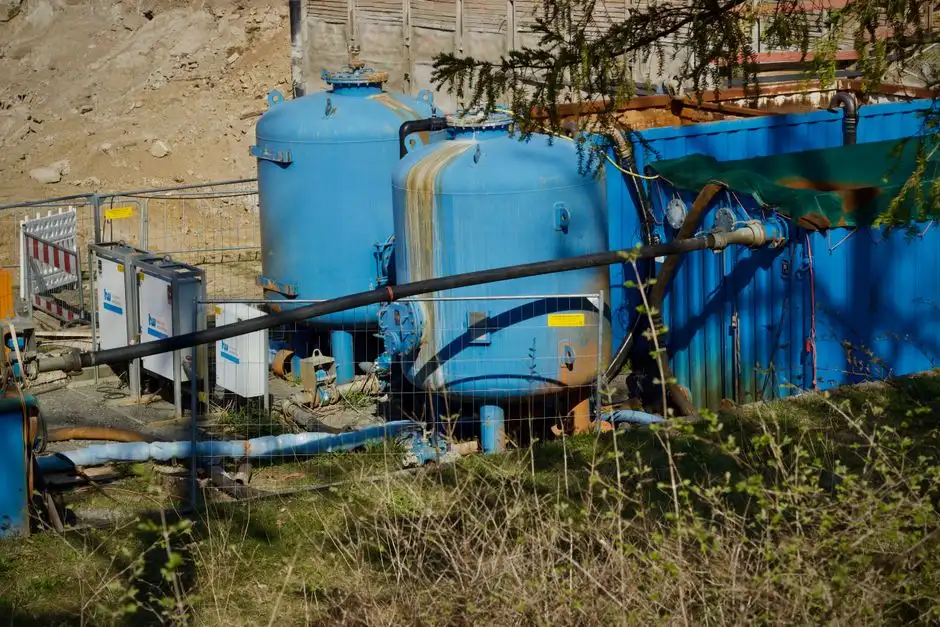
Properties outside the McCarthy-fed trunk network require on-site treatment solutions. The academic literature on small-scale domestic plants explicitly catalogues the use cases that recur in the Regina-area RFPs: individual residential houses, small schools, roadside cafes and restaurants, small railway stations, and camping sites without centralised sewerage (Kyriienko et al., 2018). The Regina context confirms this list is not theoretical. The City's own Sewer page maintains a directory of existing sewage disposal dump sites in operation near Regina, including Kings Acres Campground 2000, White City Comfort Plus Campground, River Park Campground in Lumsden, and Craven World Campground — all of which operate outside the City sewer and rely on packaged or on-site systems (regina.ca Sewer page). The decision rule is simple: if the lot is inside city limits and a sewer main is reachable, a tie-in is the lowest total-cost option. If the lot is not, or if the project is a campground, rural school, small commercial site, or any facility whose seasonal load does not justify a connection, evaluate a buried packaged plant or a skid-mounted membrane bioreactor. The WSZ underground A/O package plant is the typical first option for flows in the 1–80 m³/h band.
Process Options for Cold-Climate Canadian Sites
A Regina-area project requires selecting from three process trains based on flow band, effluent target, and footprint. The first option is a septic tank plus drainage well or subsurface field, which the academic literature describes as gravity-driven, electricity-free, and viable where soil percolation and lot size allow (Kyriienko et al., 2018). On tight Regina urban lots, in high groundwater, or in heavy clay with poor percolation, this option is generally ruled out by site conditions. The second option is the WSZ underground integrated plant, which combines anoxic and aerobic (A/O) biological contact oxidation with sedimentation and disinfection in a single buried unit, handles 1–80 m³/h, and is fully automated (per the HydropureWater WSZ product page). The third option is an MBR membrane bioreactor, which uses submerged PVDF membranes with a nominal pore size under 1 μm to produce near-reuse effluent; the equipment footprint is roughly 60% smaller than a conventional activated-sludge plant at equivalent flow, and the MBR product range covers 10–2,000 m³/day (per the HydropureWater MBR product page). For Regina's winter design temperatures, buried or fully insulated installations are standard practice to maintain biological activity in the mesophilic range even when ambient air drops below −30 °C. The discharge target depends entirely on the receiving environment: a sewer tie-in must meet the City of Regina's sewer-use rules, while any direct surface or subsurface discharge must be designed to the standards set by the Saskatchewan Ministry of Environment for the specific receiving water or land application.
| Process train | Flow range | Footprint | Effluent quality | Power / operator | Best fit |
|---|---|---|---|---|---|
| Septic tank + drainage field | Residential scale | Large subsurface area | Primary + soil treatment | None | Rural lots with good percolation (Kyriienko et al., 2018) |
| WSZ A/O (buried package) | 1–80 m³/h | Buried; near-zero surface | Secondary, disinfected | PLC automated; no operator | Communities, campgrounds, schools (WSZ product page) |
| MBR membrane bioreactor | 10–2,000 m³/day | ~60% smaller than CAS | Near-reuse, low TSS/turbidity | PLC; periodic membrane checks | Reuse goals, footprint-constrained sites (MBR product page) |
WSZ vs MBR: Matching Technology to the Site
Procurement requires evaluating a WSZ-versus-MBR decision based on specific flow, footprint, and effluent targets. The flow bands frame the upper question: WSZ covers 1–80 m³/h (≈24–1,920 m³/day), which spans small communities and most campgrounds; MBR covers 10–2,000 m³/day, which is the small-to-mid community band where footprint and reuse quality start to dominate. Effluent quality is the differentiator. The MBR's submerged PVDF membranes at less than 1 μm deliver water that can be reused for irrigation or toilet flushing without further polishing, while the WSZ A/O train produces standard secondary effluent that suits a sewer tie-in or controlled surface discharge under a Saskatchewan permit. Footprint is also distinct: the WSZ is fully buried, so the above-grade surface footprint is essentially zero and the site can be landscaped or paved; the MBR sits in an above-grade skid or container, but claims roughly 60% less area than an equivalent conventional activated-sludge plant (per the HydropureWater MBR product page). Both systems are PLC-automated; the WSZ requires no operator, while the MBR's membrane aeration system and periodic chemical cleaning need a small amount of scheduled attention. Use-case rule of thumb: choose the WSZ underground A/O package plant for buried residential and community-cluster applications and for campgrounds; choose the MBR membrane bioreactor system when water reuse is a project goal or when the available footprint is the binding constraint.
| Decision criterion | WSZ A/O package | MBR membrane bioreactor |
|---|---|---|
| Flow range | 1–80 m³/h | 10–2,000 m³/day |
| Surface footprint | Buried; ~0 m² above grade | Above-grade skid; ~60% smaller than CAS |
| Effluent quality | Secondary, disinfected | Near-reuse (PVDF <1 μm) |
| Reuse potential | Limited without polishing | Irrigation, toilet flushing |
| Operator requirement | None (PLC) | Periodic membrane checks |
| Best-fit site | Buried community / campground clusters | Reuse-driven, footprint-constrained sites |
Pre-Design Checklist for a Regina Domestic Sewage Plant
- Confirm whether the parcel sits inside Regina city limits and within a workable distance of a sanitary sewer main. If yes, submit a sewer connection application through Service Regina (306-777-7000) — tie-in is almost always cheaper than a packaged plant once construction, permit, and lifecycle costs are added up.
- If the site is off-network, build a flow profile: average and peak daily flow in m³/day, BOD/COD loading, and any seasonal swings (campgrounds peak in July–August; schools are term-driven; restaurants peak weekends).
- Define the discharge point — municipal sewer, surface water, or land application — and secure the matching permit from the City of Regina or the Saskatchewan Ministry of Environment before equipment is ordered.
- Specify winter provisions: bury the unit or specify an insulated enclosure, design for an ambient minimum of −35 °C, and detail snow-load-rated access covers and vehicular loadings where the unit sits under a driveway or yard.
- Plan sludge handling from day one. Settled and waste-activated sludge has to be dewatered; route it to a plate-and-frame sludge dewatering press sized to the plant's solids yield, and budget for cake haul-off.
- For a side-by-side view of how packaged MBR and WSZ A/O systems spec out against other Canadian projects, the domestic sewage treatment in Victoria guide runs the same framework under different winter and discharge conditions, and the packaged wastewater treatment plant supplier checklist covers the procurement-side questions to put to any vendor.
Frequently Asked Questions
Who operates the Regina Wastewater Treatment Plant and who do I call about a backup?
The City of Regina owns the plant and holds the Permit to Operate; EPCOR runs and maintains it under contract (regina.ca WWTP page). For billing, sewage backups, flooding, or water-quality complaints, contact Service Regina at 306-777-7000. For matters tied to the plant's construction or operation, EPCOR is the contact.
Where does the treated effluent from the Regina WWTP go?
Treated effluent is discharged into Wascana Creek after screening and biological treatment at the City-owned plant located just west of Regina (regina.ca WWTP page). The discharge is governed by the Permit to Operate held by the City of Regina.
What can I legally flush or pour down the drain in Regina?
Only the 3Ps — pee, poo, and toilet paper. Fats, oils, and grease (including plant-based sources such as coconut oil and nut butters) must go into the Green Cart; chlorinated pool or hot-tub water must be siphoned to an indoor drain rather than a storm drain (regina.ca Sewer page). Flushing "flush