Why Wood-Plant Sludge Is Not a Generic Biosolids Problem
Wood processing wastewater sludge treatment in 2026 is a three-stage train: DAF or rotary-drum thickening to 3-6% dry solids, plate-and-frame or screw-press dewatering to 22-35% cake, and an end-of-pipe outlet chosen by cake volume — landfill for low-volume MDF/sawmill plants under 200 kg DS/day, co-firing pelletization for 200-2,000 kg DS/day streams where 50/50 sludge/wood pellets meet ISO 18125 at 14.45-19.01 MJ/kg. Cake solids above 22% and polymer dose 3-6 kg per dry tonne are the operating targets that make the train economic.
Wood-water influent carries 800-3,500 mg/L TSS, 1,200-4,500 mg/L BOD, and 2,000-8,000 mg/L COD with resin acids (abietic, dehydroabietic, pimaric) sitting in a 50-200 mg/L band (HydropureWater field data, 2026). The solids leaving the bioreactor are therefore not municipal floc. They are loaded with cellulose fragments, bark fines, and resin-acid residue that change dewatering chemistry and lower the cake-solids ceiling a generic design assumes. Waste-activated sludge yield from a wood-water MBBR is 0.15-0.25 kg TSS per kg COD removed (HydropureWater field data, 2026) — about half the municipal figure — because attached growth retains biomass on HDPE carriers. The WAS that does waste out is stickier than the municipal equivalent, driven by extracellular polymeric substances that the biomass produces as a stress response to resin-acid excursions.
Pitch droplets, tall-oil residues, and bark polyphenols form a floatable fraction that DAF captures upstream. If that float is recycled back to the bioreactor or blended into the same thickening step as the WAS, it re-attaches to the floc and pulls cake solids down by 2-4 percentage points. The float-sludge versus waste-activated-sludge split is the single most important decision before any thickener is sized. Field data from 2026 wood-plant MBBR trains confirms the upstream DAF as the non-optional first separation step, with 80-95% TSS removal and 50-70% FOG removal (HydropureWater field data, 2026), and the Zanini et al. 2026 pellet study (Environ Sci Pollut Res Int, vol. 33 issue 19) confirms that the inorganic fraction of the sludge — exactly what the float carries in concentrated form — is what sets the ash ceiling on the downstream thermal outlet (Zanini et al., 2026).
Sludge Mass Balance for a 100-1,000 m³/day Wood Plant
A working mass balance is what separates a defensible equipment list from a vendor guess. The numbers below use the 2026 HydropureWater wood-MBBR field data: WAS yield 0.15-0.25 kg TSS per kg COD removed, upstream DAF removing 80-95% of raw TSS, and a typical wood influent at 2,000-8,000 mg/L COD. Build it per day at your actual flow, then compare the dry-solids-per-day figure against the outlet decision thresholds in the table.
| Parameter | 100 m³/day sawmill | 350 m³/day sawmill / plywood | 1,000 m³/day MDF / integrated panel |
|---|---|---|---|
| Influent COD (mg/L) | 3,000-5,000 | 3,500-5,500 | 4,000-8,000 |
| COD load (kg/day) | 300-500 | 1,225-1,925 | 4,000-8,000 |
| MBBR COD removal (%) | 85-90 | 85-92 | 85-95 |
| WAS produced (kg DS/day) at 0.20 kg TSS/kg COD | 51-90 | 208-354 | 680-1,520 |
| DS after DAF (80-95% removal) and clarifier loss | ~40-80 | ~150-300 | ~500-1,200 |
| Outlet band | Landfill | Landfill to mono-incineration boundary | Mono-incineration or SS/wood pelletization |
A 350 m³/day sawmill at 4,000 mg/L COD with a working DAF ahead of the MBBR typically produces 150-300 kg DS/day to the dewatering press. That is the band where the landfill economics start to slip and the engineer should price a thermal outlet. The MBBR CAPEX envelope for 100-500 m³/day wood plants sits at 120-420 USD per m³/day turnkey in 2026 (HydropureWater field data, 2026) and the downstream dewatering line must fit inside that envelope — typically 15-25% of the total installed cost for a plate-press train, polymer skids, and a small cake bunker.
Two streams leave the bioreactor train: float sludge from the DAF (3-6% DS, easy to dewater) and waste-activated sludge from the clarifier (0.8-1.5% DS, polymer-dependent). Treat them as separate. Blending the float back into the WAS thickener is a common 2026 retrofit mistake that costs 2-4 points of cake solids and over-specifies the polymer pump.
Thickening: DAF, Gravity, and Rotary Drum on Wood Sludge
DAF is already present at 80-95% of wood-plant headworks as a TSS/FOG step (HydropureWater field data, 2026), so it doubles as the float-sludge thickener at 3-6% DS with no extra civil work. The dissolved air flotation system sized for the raw-water TSS load will produce a float thick enough to feed a plate press directly when the float is scraped to a small sludge hopper rather than diluted back into the WAS line. Where the headworks DAF is shared with raw influent, a dedicated sludge-only DAF unit on the WAS line keeps the float chemistry stable and prevents re-aerating the float back into mixed liquor.
Gravity thickening works for wood WAS only when resin acids are below 50 mg/L in the feed. Above that band, rising sludge and gas binding collapse the blanket, and the thickener turns into an unmixed digester with rising solids over the weir. The failure mode is temperature-sensitive as well: below 12 °C, the WAS blanket compresses poorly and overflow suspended solids climb past 300 mg/L. In plants where winter basin temperature drops to 8-10 °C, gravity thickening needs a polymer dose to hold performance, and that pushes the design toward a rotary-drum thickener instead.
Rotary-drum thickeners with polymer fit mid-size wood plants where footprint matters. A reasonable starting dose on wood WAS is 8-15 g active polymer per kg DS — drawn from operating envelopes, not vendor cutsheets. Dose to overflow clarity and to filtrate solids, not to a fixed number, and expect the dose to climb 30-50% during a resin-acid spike. Where the upstream DAF is the only thickener and a rotary-drum is added on the WAS line, the two streams stay separate and the dewatering device sees consistent feed.
Dewatering: Plate Press, Screw Press, and Decanter Centrifuge Targets
Plate-and-frame filter presses are the canonical 2026 default for 100-500 m³/day wood plants. On wood WAS they consistently deliver 22-28% DS at 8-12 cycles per day with 3-6 kg polymer per dry tonne (HydropureWater field data, 2026). The HydropureWater plate-and-frame filter press sized to 200 m³/day of waste sludge sits inside the MBBR CAPEX envelope without distorting the project budget. The plate press is the only dewatering option that reliably hits the 25% DS threshold that makes downstream mono-incineration autogenous; if the project thermal-outlet plan is even a possibility, the plate press is the safest specification.
| Parameter | Plate-and-frame filter press | Screw press | Decanter centrifuge |
|---|---|---|---|
| Cake DS on wood WAS (%) | 22-28 | 18-24 | 20-26 |
| Polymer dose (kg/tonne DS) | 3-6 | 4-8 | 5-10 |
| Throughput driver | Batch, 8-12 cycles/day | Continuous, low pressure | Continuous, high G |
| Power use | Low (hydraulic pack) | Low | 20-40 kWh per m³ of feed |
| Operator skill | Low-medium | Low | Medium-high |
| Best fit | 100-500 m³/day, landfill or thermal outlet | Below 200 m³/day, landfill only | Above 1,000 m³/day MDF or pulp-side plant |
| Cake solids → thermal outlet impact | Holds autogenous threshold (≥25% DS) | Usually below autogenous, needs support fuel | Borderline; check cake moisture per batch |
Screw presses are cheaper and continuous but plateau at 18-24% DS on wood WAS. The decision is a labor-versus-cake-solids trade. Every extra 2 percentage points of DS past 20% materially cuts haul cost for landfill and pushes a borderline cake over the autogenous line for mono-incineration. For a 100 m³/day sawmill with a 1-hour haul to a lined landfill, the screw press is defensible. For anything that may grow into a thermal outlet, the plate press is the safer anchor.
Decanter centrifuges fit high-volume MDF and pulp-side plants above 1,000 m³/day. They reach 20-26% DS but consume 20-40 kWh per m³ of feed and need a skilled operator to keep the bowl speed and differential tuned to the resin-acid swings. The energy premium pays back when the cake volume justifies continuous operation and the plant has a 24/7 operator. For the MBBR design context, the upstream reactor sizing guide covered in the wood-plant MBBR design guide sets the dewatering feed rate the engineer should pin to.
End-of-Pipe Outlet: Landfill, Mono-Incineration, or SS/Wood Pellets
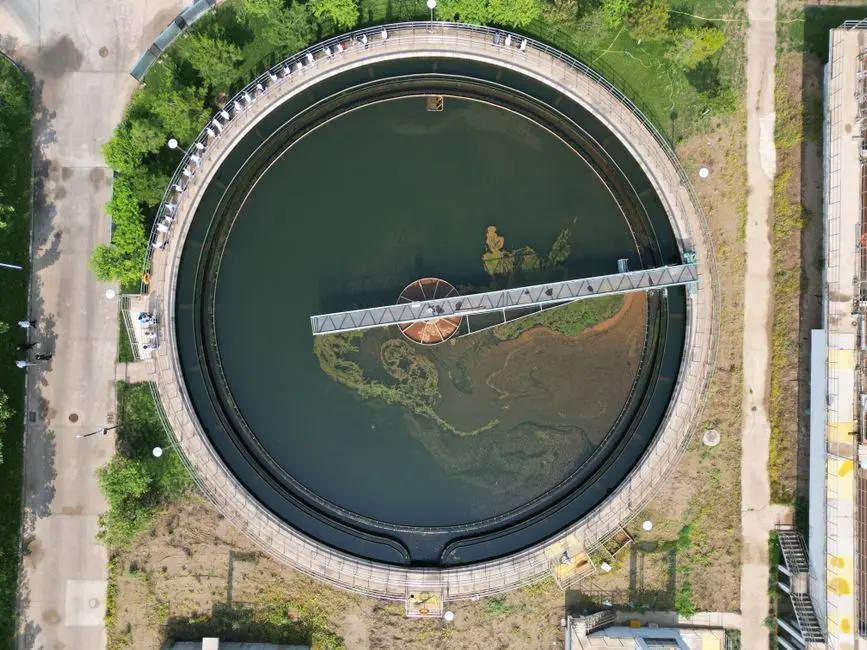
The 2026 outlet decision is driven by three numbers: cake volume in kg DS/day, cake moisture, and whether a wood-fuels buyer or nearby utility boiler exists. The three options below are the realistic set for a wood plant in the 100-1,000 m³/day band.
| Outlet | Cake DS / quality requirement | Typical plant scale (kg DS/day) | 2026 engineering note |
|---|---|---|---|
| Lined landfill | ≥22% DS; leachate resin-acid concern | < 200 | Default for low-volume MDF and sawmill; tipping-floor cost sensitive to haul distance |
| Mono-incineration (fluidized bed) | ≥25% DS for autogenous combustion | 200-1,000 | Pure SS LHV ≈4.8 MJ/kg vs wood sawdust 16.31 MJ/kg; co-firing with wood supports flame stability (Elbl et al., 2023) |
| SS/wood pellets to co-firing buyer | Pellet HHV ≥16.56 MJ/kg per ISO 18125; moisture per ISO 18134-2 | > 1,000 | 50% SS / 50% Pinus powder pellets: HHV 14.45-19.01 MJ/kg, moisture 1.89-6.76%, ash 0.85-29.96% (Zanini et al., 2026); 25 kW grate test holds CO < 50 mg/Nm³ at 80-90% wood (Elbl et al., 2023) |
Landfill is the default for plants under 200 kg DS/day. The tipping-floor cost is sensitive to haul distance, and the resin-acid leachate concern is real — some jurisdictions now require lined cells only, which moves the cost from a flat tipping fee to a per-tonne lined-cell surcharge. The decision rule is simple: if the haul exceeds 50 km or the lined-cell surcharge is above the per-tonne mono-incineration gate fee, mono-incineration wins even at 200 kg DS/day.
Mono-incineration on a fluidized bed is autogenous above approximately 25% DS cake solids. Below that, the furnace needs support fuel. Pure dried sewage sludge LHV sits at 4.8 MJ/kg versus wood sawdust at 16.31 MJ/kg (Xiao et al., as cited in Elbl et al., 2023) — a 3.4× swing that explains why sludge alone struggles to stay lit and why the co-firing pathway is the more common 2026 retrofit. NOx, SO₂, and PCDD/F are regulated under EU IED 2010/75/EU, and the 2014/687/EU BAT conclusions for pulp, paper and board remain the operative sector reference as of 2026 (per the wood-plant MBBR design guide).
Pelletization is the outlet for plants above 1,000 kg DS/day with a wood-fuels buyer. The Zanini et al. 2026 study (Environ Sci Pollut Res Int) tested a 1,500 kg/h pilot pellet mill at 0%, 25%, 50%, 75%, and 100% sewage-sludge substitution for Pinus powder. At 50/50, the pellets meet ISO 18125 (HHV ≥16.56 MJ/kg) with a measured 14.45-19.01 MJ/kg range; moisture 1.89-6.76% per ISO 18134-2; and ash 0.85-29.96% rising linearly with sludge content. Co-firing such pellets on a 25 kW grate at 80-90% wood holds CO below 50 mg/Nm³, with NOx and SO₂ scaling with sludge share (Elbl et al., 2023). The ash ceiling is the binding constraint — above 50% sludge, ash approaches 30% and most grate boilers start to slag.
Operating Risks and 2026 Compliance Watch-outs
Resin-acid spikes above the 50-200 mg/L influent band shut down nitrification and bleed into the WAS, where they raise polymer demand by 30-50% within hours. A winter composite matters as much as a summer one — winter basin temperatures of 8-10 °C lower dewatering throughput by 20-30%, and the polymer make-up unit must be sized for the cold-month viscosity, not the design-point summer. On the thermal side, PCDD/F, NOx, and SO₂ are regulated under EU IED 2010/75/EU and the 2014/687/EU BAT conclusions for pulp, paper and board remain operative in 2026. Plants firing SS/wood pellets above 50% sludge should budget for continuous emissions monitoring and a slag-tap schedule on the grate, since the ash ceiling approaches 30% (Zanini et al., 2026).
Frequently Asked Questions
What cake dry solids do I need to make mono-incineration autogenous on a wood-plant biosolids stream?
Approximately 25% DS at the press outlet. Pure dried sewage sludge LHV is around 4.8 MJ/kg versus wood sawdust at 16.31 MJ/kg, so a plate-and-frame press hitting 22-28% DS (HydropureWater field data, 2026) is the realistic specification for autogenous combustion.
What SS/wood pellet ratio meets ISO 18125 for HHV?
Up to 50% sewage sludge blended with Pinus powder. The Zanini et al. 2026 study measured HHV 14.45-19.01 MJ/kg, moisture 1.89-6.76% per ISO 18134-2, and confirmed the 50/50 blend meets the ISO 18125 threshold of ≥16.56 MJ/kg.
How much dry solids does a 350 m³/day sawmill actually send to the dewatering press?
Typically 150-300 kg DS/day when the upstream DAF removes 80-95% of raw TSS and the MBBR runs at 0.15-0.25 kg TSS per kg COD removed (HydropureWater field data, 2026). That band sits across the landfill-to-mono-incineration decision boundary, so the thermal-outlet economics should be priced from day one.
What polymer dose should I budget for a plate-and-frame press on wood WAS?
3-6 kg active polymer per dry tonne of sludge for a plate press running 8-12 cycles per day (HydropureWater field data, 2026). Expect the dose to climb 30-50% during a resin-acid spike, and oversize the polymer make-up unit for winter viscosity at 8-10 °C.
Related Equipment
- Dissolved air flotation system — specifications, capacity range, and technical data
- HydropureWater plate-and-frame filter press — specifications, capacity range, and technical data
- GX rotary bar screen — specifications, capacity range, and technical data