
Why Oakwood Fabricated Metals Plants Need a 2026 Pretreatment Refresh
A Friday-afternoon batch dump will break an undersized equalization basin faster than any other single failure mode on a fabricated metals floor near Oakwood, OH. Field data from mixed stamping, machining, and plating operations show dissolved metals swinging 5–200 mg/L and pH swinging 2–12 across the week, with the worst excursions landing on the same shift the production manager wants to release (HydropureWater field data, 2026). When that dump hits a basin sized from a 4-hour composite, the downstream chrome reduction stage sees pH 12, ORP crashes, residual Cr(VI) breaks through, and the discharge sampler logs a violation that the local POTW will not negotiate down.
The typical Oakwood-area shop mixes stamping cells, CNC machining, hard chrome or zinc plating lines, anodizing, and conversion coating on a single site. Once any of those plating or anodizing operations sits on the same parcel, 40 CFR Part 433 (Metal Finishing) applies, and the facility becomes a Categorical Industrial User (CIU) under 40 CFR Part 403. The contaminant families that drive design are free and emulsified oils from stamping and drawing compounds (typically 50–500 mg/L), dissolved Zn, Ni, Cu, Cr, Pb, Cd from plating rinsewater (5–200 mg/L combined), Cr(VI) from chromic acid anodizing, cyanide where alkaline cyanide plating still runs, and TSS from grinding swarf and casting sand (100–1,000 mg/L). On top of that, EPA has a live 2026 PFAS rulemaking scoped to chrome finishing facilities; no numerical limit exists yet, but the design envelope has to leave room for it (per the EPA Metal Finishing Effluent Guidelines page, epa.gov/eg/metal-finishing-effluent-guidelines). The existing equalization-and-clarifier setup that worked in 2018 is not the setup that survives a 2026 audit.
The 2026 Regulatory Envelope: 40 CFR Part 433 Plus Your POTW Table
40 CFR Part 433 covers the Metal Finishing point source category, including forming, finishing, forging, foundry, metal spraying, and machining wash operations co-located with plating or anodizing lines; a stamping shop that ships only dry parts to a separate finisher is generally outside the category (per EPA categorical pretreatment framework, 40 CFR Part 403.6). The rule splits limits into Pretreatment Standards for Existing Sources (PSES) and Pretreatment Standards for New Sources (PSNS), with PSNS tighter because they apply to sources constructed after the rule's promulgation date. Most POTW pretreatment programs enforce PSNS-equivalent local limits on all industrial users as a conservative baseline, so an existing plant should still design to PSNS numbers.
Local POTW limits, developed under 40 CFR 403.5, are always at least as stringent as categorical standards and in practice add the pollutants the categorical rule underweights: copper, nickel, zinc, lead, and silver caps, plus oil and grease, TSS, and pH (per EPA Local Limits guidance, epa.gov/npdes/pretreatment-standards-and-requirements-local-limits). The operational rule the plant must follow is simple: meet whichever limit is stricter on each parameter, which is why the design envelope is built from the POTW table, not from the federal table alone. The design also has to pass the 40 CFR 403.5 pass-through and interference tests so a discharge does not cause the POTW to violate its own NPDES permit or its sludge management program. The table below converts the federal PSES/PSNS numbers for the 40 CFR Part 433 metal pollutants into a daily-max and monthly-average reference, with the local-limit columns the plant should expect to see in the POTW discharge permit.
| Pollutant | PSES Daily Max (mg/L) | PSES Monthly Avg (mg/L) | PSNS Daily Max (mg/L) | PSNS Monthly Avg (mg/L) | Typical POTW Local Limit (mg/L) |
|---|---|---|---|---|---|
| Cadmium (Cd) | 0.69 | 0.26 | 0.11 | 0.07 | 0.05–0.10 |
| Chromium (Total) | 2.77 | 1.71 | 0.86 | 0.55 | 0.50–1.00 |
| Copper (Cu) | 3.38 | 2.07 | 0.86 | 0.43 | 0.50–1.00 |
| Lead (Pb) | 0.69 | 0.43 | 0.43 | 0.28 | 0.20–0.50 |
| Nickel (Ni) | 3.98 | 2.38 | 0.86 | 0.55 | 0.30–0.80 |
| Silver (Ag) | 0.43 | 0.24 | 0.24 | 0.13 | 0.10–0.20 |
| Zinc (Zn) | 2.61 | 1.48 | 0.86 | 0.55 | 1.00–2.00 |
| Total Toxic Organics | 2.13 | — | 2.13 | — | Per permit |
Federal PSES/PSNS values are taken from 40 CFR Part 433 Table 1; local-limit ranges reflect what Oakwood-area POTWs typically publish in their industrial user discharge permits and should be confirmed against the current permit. Note that Cr(VI) is often called out separately by the POTW even though the federal table reports total chromium.
The Standard 2026 Treatment Train for Fabricated Metals Wastewater
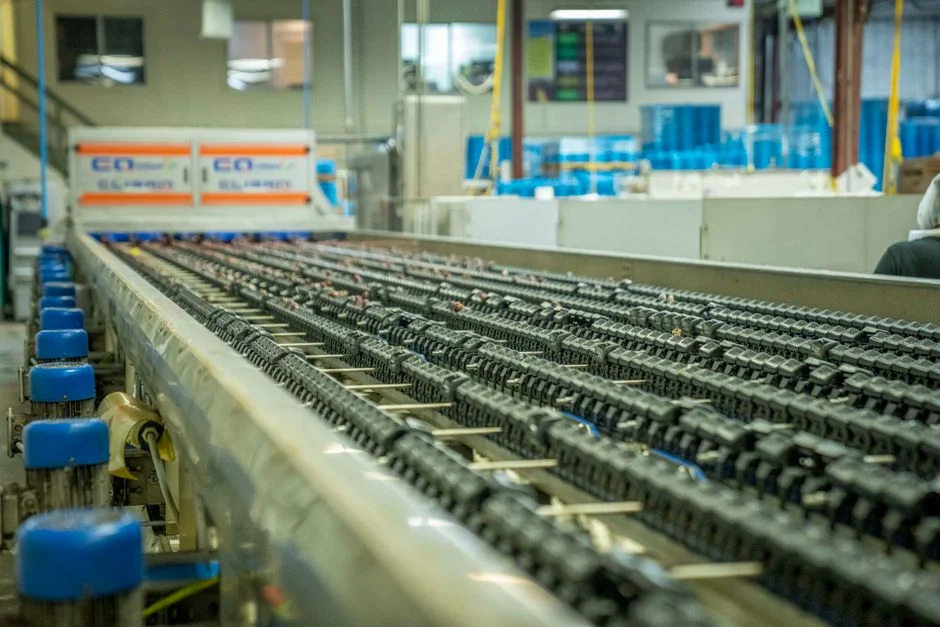
The treatment train has to be sequenced so each unit operation hands the next one a stream it can actually treat. Equalization comes first, sized to smooth pH 6–9 and flow CV below 0.5, because a 4-hour composite that misses the Friday afternoon dump will undersize the basin and every stage downstream (HydropureWater field data, 2026). From there the chemistry dictates the order: oil and grease removal, hexavalent chrome reduction, cyanide oxidation, hydroxide precipitation, solids–liquid separation, and pH trim before discharge. Skipping a stage or reordering them is the most common reason a plant fails a self-audit on a Monday morning.
Oil and grease removal sits upstream of DAF and addresses the 50–500 mg/L emulsified oil range from stamping and machining compounds using either physical coalescing or a chemical break with polymer. Hexavalent chrome reduction uses sodium metabisulfite (or ferrous sulfate) at pH 2–3, with ORP controlled at roughly 250–300 mV; the trivalent form then precipitates as Cr(OH)3 in the pH 8.5–9.5 metals precipitation stage (per the EPA Metal Finishing Effluent Guidelines framework). Cyanide oxidation with NaOCl has to run before metals precipitation, because residual cyanide will resolubilize the metal hydroxides downstream and turn a clean clarifier overflow into a Cd, Cu, or Ni spike. Hydroxide precipitation of dissolved Zn, Ni, Cu, Pb, Cd runs at pH 8.5–9.5 with anionic or cationic polymer flocculant. Solids–liquid separation is handled by a DAF system for metal hydroxide floc removal, with a lamella clarifier alternative to DAF as the high-TSS backup option. pH trim to 6–9 runs on the discharge line, and a PLC-controlled chemical dosing skid for pH, ORP and polymer feed handles NaOH/H2SO4, sodium metabisulfite, NaOCl, and polymer in one locked-out panel. For an apples-to-apples look at the solids step, the DAF vs clarifier sizing trade-offs for metals wastewater factory guide walks through the same loading-rate decision.
Sizing the DAF and Controlling Chemistry in 2026
DAF is governed by three knobs: hydraulic surface loading (4–20 m/h depending on floc density and model), air-to-solids ratio (A/S, 0.005–0.060 with 0.02 as a typical design point), and recycle rate (10–30% of forward flow). Pushing A/S higher produces a drier float but costs blower power and can shatter fragile floc, while pushing recycle rate higher improves TSS removal but dilutes the chemistry and inflates equalization demand (HydropureWater field data, 2026). For a broader sense of how lamella stacks up against DAF on high-TSS streams, the lamella surface loading benchmark of 20–40 m/h is the right place to start when influent TSS sits above 500 mg/L on a regular basis.
Chemical control lives on a single skid with feedforward (flow-paced) and feedback (pH/ORP) loops. The four chemicals are NaOH or H2SO4 for pH trim, sodium metabisulfite for chrome reduction, NaOCl for cyanide destruction, and anionic/cationic polymer for floc. Each pump needs a calibration column and a stroke-count totalizer so the operator is never dosing blind, and the skid should ship with alarm and shutdown interlocks on pH excursion, ORP out of range, and high TSS that automatically divert flow back to the equalization basin header before a chemistry upset becomes a discharge violation. A consolidated reference for the controls lives below.
| Control Point | Setpoint Window | Sensor | Interlock Action on Fault |
|---|---|---|---|
| Equalization pH | 6.0–9.0 | pH probe | Divert to slug basin; stop forward feed |
| Chrome reduction ORP | 250–300 mV | ORP probe | Hold downstream valves; alarm Na2S2O5 pump |
| Chrome reduction pH | 2.0–3.0 | pH probe | Block flow to precipitation; alarm H2SO4 pump |
| Cyanide oxidation ORP | > 650 mV at pH > 10 | ORP/pH probes | Block flow to precipitation; alarm NaOCl pump |
| Precipitation pH | 8.5–9.5 | pH probe | Divert to re-treatment; alarm NaOH pump |
| DAF surface loading | 4–20 m/h | Flow meter | Throttle forward flow; alarm operator |
| Discharge pH | 6.0–9.0 | pH probe | Divert off-spec to re-treatment |
Skid-mounting the whole package on a PLC-controlled chemical dosing skid for pH, ORP and polymer feed cuts field install time, forces the integrator to bench-test the interlocks before shipment, and gives the operator one panel to lock out instead of five loose pumps. For a plant that is replacing an existing clarifier with a DAF retrofit, the DAF sits downstream of a lamella clarifier alternative to DAF only when the influent TSS regularly exceeds the DAF's comfort zone.
Sludge Dewatering and the Forward Look to the 2026 PFAS Rule
DAF float sludge typically runs 2–5% dry solids and dewateres to 25–35% with a plate and frame filter press for metal hydroxide sludge; a belt press is cheaper and continuous but caps out around 22% dry solids on metal hydroxide, so the hauler's pricing model decides the payback (per wet ton versus dry ton). A rotary mechanical bar screen ahead of equalization keeps rags, wipes, and tramp metal out of the sludge train, which is the single most common cause of premature press-cloth failure on fabricated metals floors.
Most plants hit sewer limits with the core train and never need a polishing step. The cases that do are predictable: the POTW tightens local limits below PSNS, the plant wants to reuse rinsewater and needs RO-quality feed, or the 2026 PFAS rulemaking lands and forces a polish stage. For BOD/COD tightening or water reuse, a submerged PVDF MBR system delivers sub-micron filtration and stable effluent for cooling tower makeup or rinsewater reclaim; for a head-to-head look at MBR against conventional activated sludge on this exact stream, the MBR vs activated sludge for fabricated metals wastewater guide is the right reference. For sub-ppm TDS or specific metal caps like Ni <0.1 mg/L, an RO system is required and the upstream multi-media filter must hold SDI15 below 3 or the RO membranes fail early. For the PFAS question, anion exchange or GAC is the proven polish step for the long-chain PFAS species tied to chrome plating, and the right 2026 move is to design the train so a polish skid can be bolted on later, not to install it now and pay to operate it ahead of any actual limit. Plants designing a new train in 2026 should also be reading the Skiatook mining and metals pretreatment guide for 2026 for the parallel rule landscape that EPA has in motion.
Frequently Asked Questions
Does 40 CFR Part 433 apply to a stamping shop that ships parts out for plating?
No. A stamping shop that ships only dry parts to a separate finisher is generally outside the Metal Finishing category. Once the facility runs its own zinc, nickel, chromic acid, or alkaline cyanide tank, or co-locates machining wash with plating rinsewater, 40 CFR Part 433 applies and the facility becomes a Categorical Industrial User (CIU) under 40 CFR Part 403.
What ORP and pH window actually drives hexavalent chrome reduction?
Sodium metabisulfite (or ferrous sulfate) reduction runs at pH 2.0–3.0 with ORP held around 250–300 mV. The trivalent chrome produced then precipitates as Cr(OH)3 in the pH 8.5–9.5 metals precipitation stage; if reduction is incomplete, residual Cr(VI) stays soluble through the clarifier and shows up in the discharge sample.
Why does cyanide oxidation have to run before metals precipitation?
Residual cyanide resolubilizes the metal hydroxides formed at pH 8.5–9.5, which turns a clean clarifier overflow into a Cd, Cu, Ni, or Zn spike. NaOCl oxidation to pH > 10 with ORP > 650 mV must finish upstream of the precipitation reactor, with an interlock that blocks forward flow if the oxidation ORP setpoint is missed.
When does a fabricated metals plant actually need a polishing step?
Three predictable cases: the POTW sets local limits tighter than PSNS, the plant reuses rinsewater or cooling tower makeup and needs RO-quality feed, or the 2026 EPA PFAS rulemaking for chrome finishing facilities forces a polish stage. MBR handles BOD/COD and reuse, RO handles sub-ppm TDS or specific metal caps like Ni <0.1 mg/L, and anion exchange or GAC is the proven PFAS polish for long-chain species.