
What a Containerized MBR STP Actually Is
A containerized membrane bioreactor (MBR) sewage treatment plant (STP) is a fully shop-fabricated wastewater treatment unit that combines activated-sludge biology with submerged ultrafiltration (UF) membranes inside a single ISO 20- or 40-ft intermodal shipping container. The UF stage replaces the secondary clarifier used in conventional activated sludge, retaining all biomass and suspended solids on the membrane surface and producing a clarified, low-turbidity permeate in a single step. Hollow-fiber UF modules used in packaged MBRs carry a nominal pore size of 0.04 µm (Pure Aqua MBR-C datasheet, 2025), with field units demonstrating 0.01 µm solids rejection on domestic sewage (RODI Systems 2,500 gpd project sheet, 2024-04).
For Freetown, containerization matters because the unit ships as a standard ISO box on the same vessels that already call at Queen Elizabeth II Quay. On-site civil works shrink to a concrete equipment pad, an inlet sewer drop, and a permeate or soakaway discharge line — no reactor casting, no clarifier, no large excavations. Vendors offer two layouts: the I-version, where aeration, buffer, and membrane tanks all sit inside the container for full mobility, and the U-version, where underground buffer and aeration tanks are buried outside and the container houses only the MBR cassettes and blowers (MENA-Water MBR plant page, 2025). For most Freetown estate or camp work, the I-version is simpler to permit and to relocate. A properly selected integrated MBR membrane bioreactor system is delivered with the container, blowers, control panel, and membrane modules pre-piped and factory-tested.
Freetown-Specific Design Basis You Cannot Skip
Per-capita domestic water use in Sierra Leone runs 60–80 L/person/day, with 70 L/p/d a defensible working value for residential estates and work camps around the Western Area peninsula. A Western 50 gpd (≈ 190 L/p/d) default does not apply; using it will underdesign flow capacity by 30–60% against observed consumption (HydropureWater field data, 2026).
Wet-season inflow and infiltration (I&I) must be carried in the peak factor. Camps with informal drainage, unpaved yards, and shallow soakaways see PWWF rise to 2.0–2.5× the average dry-weather flow during July–September rains. Use 2.25 unless the layout is fully sealed and roof-drained. Raw domestic BOD in Freetown residential sewers typically measures 250–400 mg/L; catering-heavy camps run 500–700 mg/L BOD and 80–150 mg/L oil & grease, which has to be removed upstream of the membranes. Ambient temperature of 24–32°C is favourable for biological kinetics — design at 25–28°C, well inside the 20–30°C operating window quoted for the Pure Aqua MBR-C (Pure Aqua datasheet, 2025).
Power is the single most operationally fragile input. Grid supply in the Western Area is intermittent, so specify 460 V/3-phase electrical panels (the standard Pure Aqua ships) and a standby genset sized to the two largest loads: the duty blower(s) and the permeate pump. Under-sizing standby power is the most common cause of biological crashes on tropical MBR plants.
Step 1 — Calculate Average and Peak Daily Flow
The first calculation is average dry weather flow (ADWF):
ADWF (L/day) = Population × per-capita flow (L/p/d)
For 250 residents at 70 L/p/d: 250 × 70 = 17,500 L/day = 17.5 m³/day. This figure is the basis for every downstream sizing decision.
Peak wet weather flow (PWWF) applies the peak factor to ADWF:
PWWF (m³/day) = ADWF × peak factor
Using 2.25: 17.5 × 2.25 = 39.4 m³/day. The bioreactor, equalization tank, and screen chamber must all be able to accept PWWF without overflow. For a 100-personnel work camp with catering, lift per-capita flow to 100 L/p/d: 100 × 100 = 10 m³/day ADWF, 22.5 m³/day PWWF. Schools with kitchens or guesthouses should carry an additional 10–15% industrial safety margin on top of ADWF before rounding up to the nearest standard packaged size (10, 25, 50, 100 m³/day).
Step 2 — Convert Flow to BOD, Nitrogen and FOG Loads
Flow alone does not size the biology — load does. The BOD mass loading rate is:
BOD load (kg/day) = ADWF (m³/day) × BOD concentration (g/m³)
For 17.5 m³/day at 300 g/m³: 17.5 × 0.300 = 5.25 kg BOD/day. This is the number the aeration basin and MLSS setpoint must absorb.
Target MLSS of 8,000–12,000 mg/L — higher than the 3,000–5,000 mg/L used in conventional activated sludge — gives the F/M ratio of 0.05–0.15 kg BOD/kg MLSS·day that defines a well-loaded MBR (HydropureWater field data, 2026). Hold sludge retention time (SRT) at 20–30 days for full nitrification in the tropical temperature window; hydraulic retention time (HRT) typically lands at 6–10 hours depending on influent strength. For camps, add FOG (fat/oil/grease) loading of 30–60 mg/L in raw influent and remove it with a dissolved air flotation unit or a simple grease trap upstream of the equalization tank — FOG that reaches the membrane surface halves flux within weeks. Design membrane flux at 15–25 L/m²·h for submerged hollow-fiber UF operating at 20–30°C.
Step 3 — Size the Bioreactor, Membrane Tank and Aeration
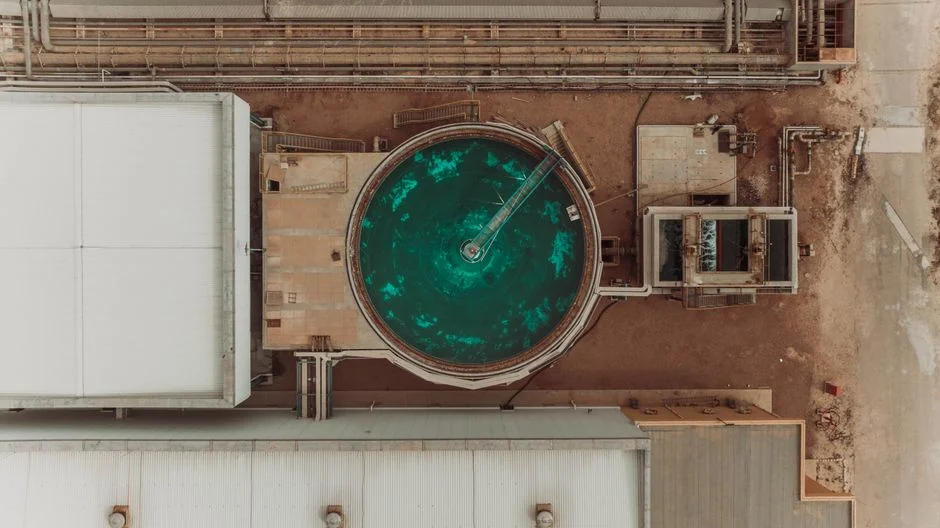
Bioreactor volume is set by HRT:
Reactor volume (m³) = ADWF (m³/day) × HRT (days)
For the 250-resident case at 8 hours HRT: 17.5 × (8/24) = 5.8 m³ — small enough to fit inside a 20-ft container alongside the membrane cassette. The membrane tank is sized to hold the submerged modules with 0.3–0.5 m water depth above the top of the cassette; a 50 m³/day plant typically uses a 4–6 m³ membrane compartment (HydropureWater DF-series datasheet, 2025).
Membrane area is the more important figure for procurement:
Membrane area (m²) = design flow (L/h) ÷ design flux (L/m²·h)
At 20 L/m²·h: 17,500 L/day ÷ 24 h = 729 L/h; 729 ÷ 20 = ≈ 36 m² of PVDF hollow-fiber area. Aeration is sized at 0.4–0.6 kW of blower power per m³/day of design flow, split between coarse-bubble membrane scour and fine-bubble biology aeration. For higher-fouling or camp applications where individual element replacement matters, DF-series flat-sheet MBR membrane modules (0.1 µm PVDF, 32–135 m³/day per module) are a useful alternative to hollow-fiber.
Step 4 — Pick the Container, Power and Auxiliaries
Match the container to the design flow. Plants ≤25 m³/day fit a single 20-ft ISO container (the RODI 2,500 gpd ≈ 9.5 m³/day benchmark is a useful lower-end reference, 2024-04). Plants from 25–200 m³/day need a 40-ft ISO box; MENA-Water packs up to 1,200 m³/day in a single 40-ft by staging modules (MENA-Water, 2025). For the 17.5 m³/day worked example, a 20-ft container is correct.
Specify 460 V/3-phase/60 Hz electrical panel with IP54 enclosure, and add 2.5-inch rigid foam insulation under a white-painted exterior to reject tropical heat (RODI reference, 2024-04). Include a drum screen pre-treatment with 1.5 mm perforation to protect the membranes from rags and grit common in camp sewage (Pure Aqua standard scope, 2025). A PLC with remote monitoring is worth the incremental cost on Freetown sites where skilled operators are scarce. Add a chlorination or UV polishing step only if reuse demands it — MBR UF permeate alone typically meets <10 mg/L TSS and <1 NTU turbidity, which is acceptable for soakaway discharge but not for unrestricted irrigation. A packaged UV sterilizer is the simplest polishing add-on for non-potable reuse.
Freetown Sizing Reference Table
Inputs used: 70 L/p/d, peak factor 2.25, MLSS 10,000 mg/L, flux 20 L/m²·h, HRT 8 h. Substitute the reader's own values for site-specific design.
| Population equivalent (PE) | ADWF (m³/d) | PWWF (m³/d) | Reactor volume (m³) | Membrane area (m²) | Container size |
|---|---|---|---|---|---|
| 50 | 3.5 | 7.9 | 1.2 | 8 | 20-ft ISO |
| 100 | 7.0 | 15.8 | 2.3 | 15 | 20-ft ISO |
| 250 | 17.5 | 39.4 | 5.8 | 36 | 20-ft ISO |
| 500 | 35.0 | 78.8 | 11.7 | 73 | 40-ft ISO |
| 1,000 | 70.0 | 157.5 | 23.3 | 146 | 40-ft ISO |
| 2,000 | 140.0 | 315.0 | 46.7 | 292 | 40-ft ISO (dual) |
Common Freetown Sizing Mistakes to Avoid
Five errors account for the majority of underperforming containerized MBRs in the Western Area. First, using 50 gpd per capita — that underdesigns flow by 30–60% versus Sierra Leone field data (HydropureWater, 2026) and produces a chronically overloaded membrane. Second, skipping the grease trap on catering camps; FOG coats the membrane surface and flux drops by half within weeks. Third, designing at ADWF instead of PWWF — once August rains arrive, the bioreactor turns anaerobic. Fourth, forgetting sludge storage: a 17.5 m³/day MBR wastes 30–50 L/day of waste activated sludge at ~1% solids that must be trucked off-site, typically via a small plate-and-frame filter press for dewatering. Fifth, omitting standby power — even a 4-hour grid outage stops aeration and the biomass crashes; specify a genset with auto-changeover sized to blowers plus permeate pump. Engineers cross-checking against the Freetown hotel packaged MBR STP guide will note the same risk list applies to hospitality loads.
Frequently Asked Questions
What flow per person should I use in Freetown?
Use 60–80 L/p/d for residential and estate projects, with 70 L/p/d as the working middle value. Apply a peak factor of 2.0–2.5 on top of that figure to carry wet-season inflow and infiltration.
How big a container for 50 m³/day?
A single 40-ft ISO container is sufficient for 50 m³/day plants, fitted with a 460 V/3-phase electrical panel, a drum screen, and a PLC with remote monitoring. The membrane cassette alone typically needs 100–110 m² of PVDF area at 20 L/m²·h flux.
Does an MBR STP need a disinfection step?
Not for discharge to a soakaway — the UF permeate already meets <10 mg/L TSS and <1 NTU turbidity. Add UV or chlorination only when the effluent is intended for unrestricted landscape irrigation or toilet flushing reuse.
What is the power consumption of a 25 m³/day containerized MBR?
Expect 10–15 kW total connected load, dominated by the duty/standby blowers (0.4–0.6 kW per m³/day of flow). Permeate pumps, mixers, and the control panel add a small parasitic load. Size the standby genset at the same kW rating with auto-changeover.
How often is sludge wasted?
For residential flows, waste 1% of reactor volume per day to keep SRT in the 20–30 day nitrification window. For work camps with intermittent loading, wasting every 2–3 days at the same volumetric rate is acceptable, provided MLSS stays inside the 8,000–12,000 mg/L operating band. For related tropical applications outside Sierra Leone, the methodology scales identically — see the comparable Thiès packaged MBR STP buyer's guide.
Related Equipment
- WSZ underground package STP — specifications, capacity range, and technical data