Why Ball Ground Fabricated Metals Plants Struggle With Conventional Activated Sludge
Fabricated metals job shops in Cherokee County generate a wastewater profile that punishes conventional activated sludge (CAS): stamping lubricants, machining coolants, drawing compounds, and plating rinses combine into a stream carrying free and emulsified oil at 50–500 mg/L, TSS frequently above 200 mg/L, and dissolved metals that must be reduced to single-digit mg/L before discharge. EPA Metal Finishing categorical standards at 40 CFR Part 433 set daily maximum limits at 2.13 mg/L total chromium, 3.98 mg/L nickel, 4.98 mg/L zinc, 1.85 mg/L copper, 1.10 mg/L lead, and 52 mg/L oil & grease (per 40 CFR Part 433). Cherokee County Water & Sewerage Authority local limits ride on top of 40 CFR 403 general pretreatment rules, and the receiving stream is the Etowah River, so accidental pass-through carries real regulatory weight.
CAS handles this poorly for three concrete reasons. First, free oil sheens destroy floc; even a 20 mg/L oil slug will float a clarifier blanket. Second, filamentous organisms like Nocardia and Microthrix parvicella bloom on long-chain coolants and trigger persistent foaming that strips solids over the weir. Third, final clarifier overflow routinely lands at 15–30 mg/L TSS, which fails the 30 mg/L monthly average limit at most Georgia POTWs and forces a polish step (sand filter or cartridge) that adds capex the original CAS design never budgeted for. Ardern and Lockett's 1914 activated sludge discovery (S2) was a breakthrough for municipal sewage, but a 100-year-old floc-and-settle architecture is the wrong tool for an oily, chelated-metal job-shop stream.
How an MBR Replaces the Clarifier — and Why That Matters for Metals Streams
A membrane bioreactor (MBR) collapses two unit operations into one tank. Submerged PVDF flat-sheet membranes with a nominal 0.1 μm pore size sit directly in the aeration basin, and coarse-bubble aeration beneath the modules provides both oxygen and continuous scouring of the membrane surface. The gravity clarifier disappears entirely. In an integrated MBR system for fabricated metals wastewater, the DF series PVDF flat sheet membrane module physically rejects biomass and particulates, so mixed liquor suspended solids (MLSS) can be pushed to 8,000–12,000 mg/L versus 2,000–4,000 mg/L in CAS (Mannina et al., S3). That 3–4× higher biomass concentration is the mechanism behind every downstream benefit.
Higher MLSS enables a longer solids retention time (SRT) at the same hydraulic retention time, which is the single most important variable for degrading chelated metal complexes carried in plating rinse water. Chelating agents like EDTA and gluconate hold nickel and zinc in solution; slow-growing heterotrophs and SRTs in the 30–60 day range break those complexes more completely than the 5–10 day SRT typical of CAS. MBR also runs with low observed yield (Yobs), producing 0.2–0.4 kg TSS per kg COD removed versus 0.4–0.6 for CAS (engineering reference). For a 50 m³/day Ball Ground job shop already paying $200–$400 per wet ton for metals hydroxide sludge disposal, that 30–50% sludge reduction is a real line item. The academic literature stresses membrane fouling: extracellular polymeric substances (EPS) raise transmembrane pressure and force chemical clean-in-place cycles, increasing energy demand and consumables versus CAS (S3, S5).
MBR vs CAS Process Parameters for Fabricated Metals Wastewater
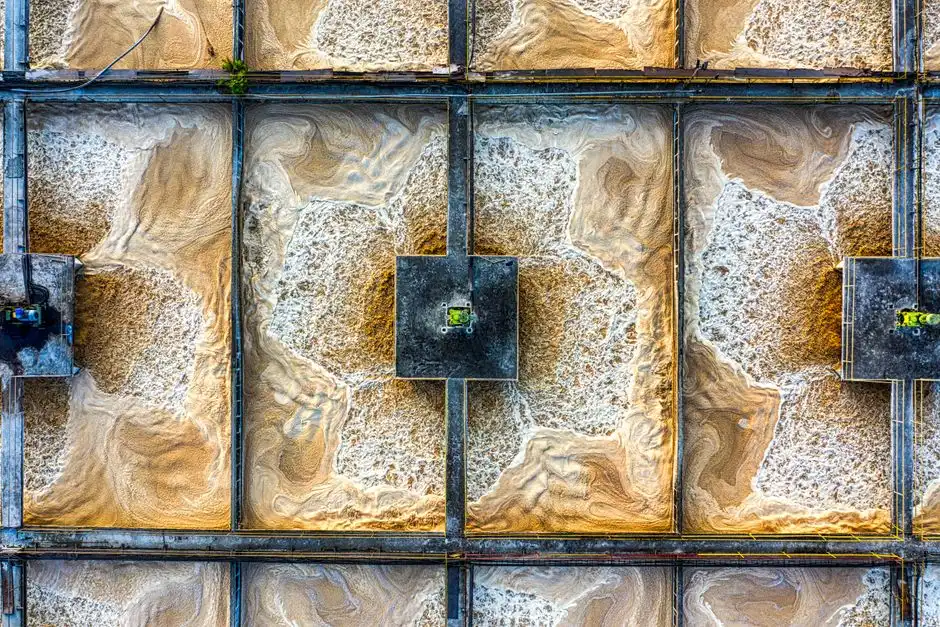
The parameter differences below explain why MBR keeps winning metals bids. The table uses ranges drawn from Mannina et al. (S3), engineering references for MLSS and sludge yield, and 40 CFR 433 for discharge limits.
| Parameter | MBR (submerged PVDF) | CAS (conventional) | 40 CFR 433 daily max |
|---|---|---|---|
| MLSS, mg/L | 8,000–12,000 | 2,000–4,000 | — |
| SRT, days | 30–60 | 5–10 | — |
| FOG influent tolerance, mg/L | Up to ~200 with DAF pre-treatment | Upset above ~50 emulsified | 52 |
| Effluent TSS, mg/L | < 5 (typically < 2) | 10–30 | 30 (monthly avg) |
| Effluent turbidity, NTU | < 1 | 5–15 | — |
| Sludge yield, kg TSS/kg COD | 0.2–0.4 | 0.4–0.6 | — |
| Footprint index (50 m³/day) | ~40 m² basin | ~100 m² basin + clarifier | — |
| Total Cr after precipitation, mg/L | 0.05–0.5 | 0.1–1.0 | 2.13 |
| Ni after precipitation, mg/L | 0.1–0.5 | 0.2–1.5 | 3.98 |
| Zn after precipitation, mg/L | 0.2–1.0 | 0.5–2.5 | 4.98 |
The footprint and effluent columns carry the argument. MBR delivers sub-1 μm filtered water with a TSS below 5 mg/L, which means chemical precipitation for Cr/Ni/Zn can run at slightly higher residual solids without violating local limits, and clarifier carryover no longer threatens a monthly average. CAS can hit 40 CFR 433 daily maxes on a good day, but the monthly average penalty at 30 mg/L TSS, plus the chronic 0.5–2.5 mg/L zinc bleed-through from clarifier solids, is where Ball Ground plants get consent-agreement letters.
Compliance, Fouling, and Operator Reality in a Cherokee County Job Shop
One operator typically runs the floor, the press, the washer, and the wastewater system in a small job shop. MBR technology is mechanically denser but operationally simpler once running. The pain point is fouling, not compliance. Extracellular polymeric substances are the principal foulant in aerobic MBRs (S5), and Chang and Lee demonstrated that a 40% reduction in EPS translated to an equivalent reduction in cake-layer hydraulic resistance (S5). For a metals stream rich in emulsified coolants, EPS load runs high. Clogging is the more dramatic failure mode: a 2008 survey of 15 European MBR plants found 8 had experienced clogging events, often from agglomerated fibrous solids forming "rags" up to a meter long (S5). A rotary bar screen upstream of the bioreactor with 2–3 mm openings is the cheapest insurance a job shop can buy, and pairing it with automatic chemical dosing for pH and coagulant control keeps the mixed liquor in a fouling-resistant range.
Budget for chemical cleaning frequency 20–30% higher than municipal MBR duty: a monthly maintenance day with sodium hypochlorite and citric acid CIP is normal on a metals stream. CAS operators in Cherokee County plants often run with one person who must simultaneously manage SVI, return activated sludge ratios, and Nocardia foam events, and the lack of membrane experience is the main reason a plant manager might still pick CAS. On greenhouse gas, the Mannina et al. plant-wide model found 0.91 kgCO2eq/m³ for MBR versus 0.85 kgCO2eq/m³ for CAS, a 7% premium that matters only for plants under mandatory ESG reporting.
Cost and Footprint: When MBR Pays for Itself in Ball Ground
Capex delta between CAS and MBR for a 50 m³/day job shop typically runs $80,000–$180,000 in 2026 dollars, driven by the membrane modules, cassette frames, and larger blowers for scouring. Footprint, however, drops roughly 60% (HydropureWater verified product data, 2026), and on a 1–2 acre industrial parcel in Cherokee County that 60% is often the binding constraint. Karim and Mark (2017, via S3) found MBR wins long-term beyond 67 years; that horizon is academic for a private fabricator, so the practical industrial payback window is 8–12 years for a job shop where the avoided sludge hauling, avoided clarifier retrofit, and tighter effluent reduce consent-agreement risk.
| Cost line (50 m³/day metals stream, 10-yr horizon) | CAS | MBR | Notes |
|---|---|---|---|
| Capex (tankage + equipment) | Baseline | +25–40% | Membrane modules and blower upgrade |
| Annual sludge hauling | Baseline | −30 to −50% | Lower Yobs |
| Annual energy | Baseline | +10–20% | Scour aeration and recirculation |
| Annual CIP chemicals | Minimal | +$3,000–$6,000 | Hypochlorite + citric acid |
| Footprint (m²) | ~100 | ~40 | Site constraint driver |
| 10-yr NPV delta | — | −5% to +10% | Sludge hauling tips the scale |
The single most leveraged cost line is sludge disposal. Coupling the MBR to a plate and frame filter press for metals hydroxide sludge drives cake solids above 25% and cuts hauling tonnage by another 50% beyond the yield benefit. For CFO conversations, frame it as: lower capex on a CAS system, but MBR's lower OPEX, smaller land requirement, and lower compliance risk converge on net present value parity around year 8, with MBR pulling ahead from there.
Choosing Between MBR and CAS: A 5-Step Decision Framework
- Quantify FOG and chelated-metal load. Sample your washer and plating rinses separately. If FOG exceeds 50 mg/L after DAF pre-treatment or chelated Ni/Zn are routine, MBR earns its place.
- Check site footprint. A 50 m³/day flow needs roughly 100 m² of CAS basin plus clarifier. If your available parcel is under 250 m² total for the treatment area, MBR's ~40 m² footprint is decisive.
- Check the discharge target. 40 CFR 433 daily maxes plus Cherokee County WSA local limits must be met on every monthly average, not just best-effort. MBR's < 5 mg/L TSS effluent gives the margin that CAS plus sand-filter polish struggles to maintain.
- Check operator skill. One operator with no membrane experience, no CIP skid, and no budget for training is a CAS scenario, with polish filtration if monthly TSS is borderline. This same trade-off is detailed in a parallel DAF vs clarifier for fabricated metals wastewater selection guide.
- Run a 10-year NPV. Include sludge hauling at $250/wet ton, energy at $0.10/kWh, and CIP chemicals. If the NPV delta is under 15%, choose the simpler CAS; if MBR wins by more than 15% on NPV or on footprint, pick MBR.
Frequently Asked Questions
Does an MBR actually meet 40 CFR Part 433 metal finishing limits?
Yes, when paired with chemical precipitation for Cr, Ni, Zn, and Cu upstream of the membrane. Typical MBR effluent after hydroxide precipitation lands at 0.05–0.5 mg/L total Cr, 0.1–0.5 mg/L Ni
Frequently Asked Questions
Which is better for fabricated metals wastewater, MBR or conventional activated sludge?
Membrane Bioreactors (MBR) are generally superior for fabricated metals wastewater due to their ability to achieve complete solids separation, which is critical when dealing with the variable influent quality typical of metal finishing. While Conventional Activated Sludge (CAS) relies on gravity settling that is susceptible to sludge bulking and dispersed growth, MBR utilizes microfiltration or ultrafiltration membranes to provide a physical barrier, ensuring high-quality effluent regardless of settling characteristics.
Does an MBR meet EPA Metal Finishing categorical limits under 40 CFR 433?
Yes, an MBR system is highly effective at meeting 40 CFR 433 standards, particularly for Total Suspended Solids (TSS) and Oil and Grease (O&G), which often serve as carriers for regulated heavy metals like chromium, nickel, and zinc. By maintaining a high Mixed Liquor Suspended Solids (MLSS) concentration, usually between 8,000 and 15,000 mg/L, MBRs provide superior removal of particulate-bound metals compared to conventional clarifiers, often allowing facilities to meet stringent local discharge limits in Ball Ground with minimal downstream polishing.
How much smaller is the footprint of an MBR compared to a CAS system?
An MBR system typically requires 50% to 70% less footprint than a conventional activated sludge plant. Because MBRs eliminate the need for large secondary clarifiers and operate at significantly higher biomass concentrations, the hydraulic retention time is reduced, allowing for compact, modular tank configurations that are ideal for space-constrained industrial sites.
Can an MBR handle oil and grease from a metal stamping or machining plant?
MBRs can handle industrial oil and grease, but they require robust pretreatment, such as Dissolved Air Flotation (DAF) or oil-water separators, to keep concentrations below 50-100 mg/L. Excessive free-floating oil can coat membrane surfaces and cause irreversible fouling, so while the biological process can degrade emulsified oils, pre-screening and primary oil removal are mandatory to maintain flux rates and membrane integrity.
What is the main disadvantage of using an MBR for industrial wastewater?
The primary disadvantage of an MBR is the high operational cost associated with membrane fouling and energy consumption. Maintaining a sustainable flux rate requires periodic chemical clean-in-place (CIP) procedures, typically performed with sodium hypochlorite or citric acid, and the constant air scouring required to keep membrane surfaces clean consumes significantly more electricity than the mechanical surface aeration used in conventional activated sludge systems.