
Why Lower Burrell Mining and Metals Plants Are Re-evaluating CAS
Heavy-metal spikes crashing a clarifier at 2 a.m. is the daily reality for wastewater leads in the Allegheny-Kiski Valley. Influent arriving at Lower Burrell plants carries a punishing mix: high TSS from coal-prep thickener overflow, spent pickling acid (HCl, H₂SO₄) and rinse water from steel finishing, fluoride and fine suspended solids from aluminum smelter scrubbers, plus cyanide/thiocyanate-bearing ammonia from coke plant contact. Across a single shift pH can swing from 2 to 11, and instantaneous metal loads (Cr, Ni, Cu, Zn) routinely exceed 50 mg/L total during process upsets. A conventional activated sludge (CAS) train handles the average and loses the peak — metal-hydroxide flocs do not compact, the sludge blanket collapses, and pin floc carries over the weir. Bulking driven by filamentous growth on coke-plant organics is chronic; operators chase it with chlorination and never quite catch up.
CAS also carries an EPA-flagged structural weakness for this duty: the EPA membrane bioreactor fact sheet notes that conventional systems depend on growing "the right types of microorganisms" and require a large footprint, both of which are hard to secure on tight brownfield sites in Westmoreland and Allegheny counties. The 2026 regulatory picture tightens the screws. PA DEP Chapter 92 NPDES effluent limits, the Allegheny County Sanitary Authority (ALCOSAN) pretreatment program for indirect discharges, and the metals TMDLs on the Allegheny River mean a TSS excursion or a single Cr over-limit now triggers a Notice of Violation rather than a warning letter. That is why the CAS-vs-MBR question is back on the table in Lower Burrell, not as a greenfield design exercise but as a retrofit decision under real permit pressure.
How a Membrane Bioreactor Differs from Conventional Activated Sludge
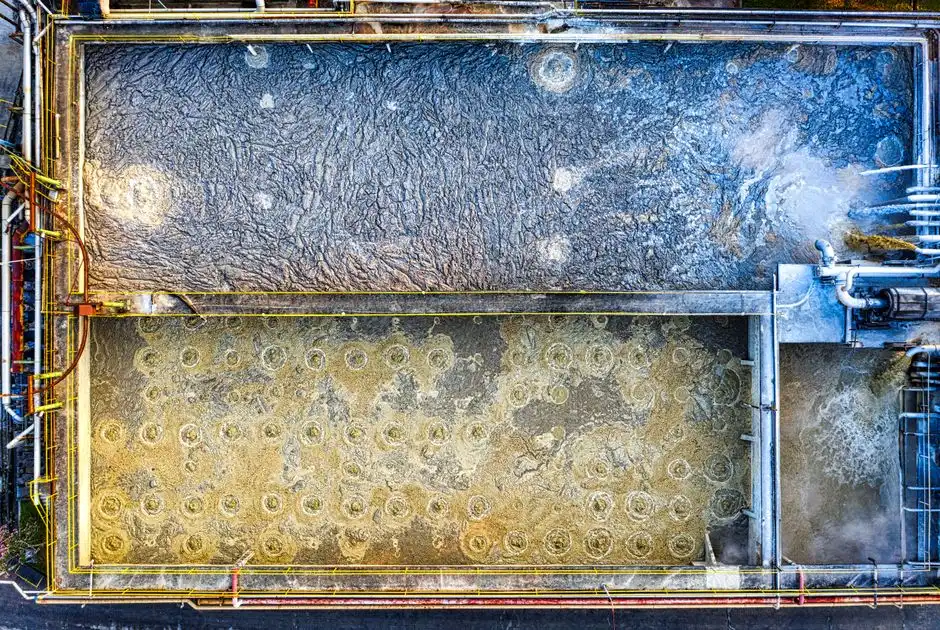
CAS is a two-stage train: an aeration tank where biomass oxidizes organics and nitrifies ammonia, followed by a gravity secondary clarifier that separates the mixed liquor from the clarified effluent. Return activated sludge (RAS) is pumped back to the front of the aeration tank; waste activated sludge (WAS) is sent to thickening/dewatering. The clarifier is the weak point in metal service — it depends on the sludge settling well, which it rarely does when metal-hydroxide floc dominates the mixed liquor.
An MBR replaces the clarifier (and usually the downstream sand filter) with submerged microfiltration membranes. Per the EPA membrane bioreactor fact sheet, MBRs couple a suspended-growth biological reactor to membranes typically rated at 0.1–0.4 µm pore size, most commonly PVDF hollow fiber or flat-sheet elements immersed directly in the aeration basin or in a separate membrane tank. Solids stay in the system, biomass concentration rises to 8,000–12,000 mg/L MLSS, and SRT is decoupled from hydraulic retention time (HRT). The EPA fact sheet specifically notes that MBRs are "often operated with longer solids residence times (SRTs), which results in lower sludge production," while Crawford et al. (2000) cited in the same fact sheet confirms that MBRs are not required to run long SRT but commonly do. The result for the engineer: a compact integrated MBR system for mining and metals duty that fits inside a basin footprint 60% smaller than the equivalent CAS train, with the separation step no longer dependent on floc settleability.
Membrane configuration matters in mining service. Immersed (vacuum-driven) hollow-fiber and flat-plate designs dominate because they avoid the high pump pressures and abrasion risk of sidestream tubular configurations. Hollow-fiber elements typically need 1–2 mm upstream screening; flat-plate elements tolerate 2–3 mm (EPA fact sheet, citing Wallis-Lage et al. 2006). For an influent carrying coal fines, mill scale, and grit, this screening difference has real OPEX consequences: finer screens blind faster, and the cleaning frequency lands on the operations crew.
MBR vs CAS for Mining and Metals: Performance Comparison
The numbers below summarize how the two trains compare on the metrics that drive a Lower Burrell permit. The MBR column reflects both published municipal/industrial data and product specification; the CAS column reflects typical industrial activated-sludge operation. Mining-specific metal-removal percentages depend on influent speciation and the precipitation chemistry upstream, so the table describes the mechanism rather than a single guaranteed value.
| Parameter | MBR (submerged PVDF) | CAS (secondary clarifier) |
|---|---|---|
| Effluent BOD | <5 mg/L, often near detection limit (EPA Calls Creek, Table 1) | 10–30 mg/L typical industrial |
| Effluent TSS | <1–5 mg/L, near detection limit (EPA Calls Creek) | 10–30 mg/L; spikes to >50 mg/L on metal upset |
| Effluent NH₃-N | <1 mg/L achievable at long SRT (EPA Calls Creek: 0.10–0.72 mg/L) | 2–10 mg/L; nitrification inhibited by metals and low SRT |
| Total phosphorus | 0.1–0.5 mg/L with chemical precipitation (EPA Calls Creek) | 1–3 mg/L without tertiary polish |
| Heavy metals (Cr, Ni, Cu, Zn) | Removed by upstream precipitation; MBR retains metal-bearing floc in system, preventing washout | Removed by precipitation; metal-hydroxide floc often rises in clarifier (SVI > 150 mL/g bulking), causing effluent spikes |
| MLSS | 8,000–12,000 mg/L | 2,000–4,000 mg/L |
| SRT | 20–60 days common (decoupled from HRT) | 5–15 days |
| HRT | 4–8 hours (lower due to high MLSS) | 6–12 hours |
| Footprint | ~40% of equivalent CAS basin (HydropureWater product spec: 60% smaller) | Larger aeration + clarifier + sand filter |
| Reuse suitability | RO feed quality with low SDI; cooling-tower and rinse reuse | Requires tertiary polish (DAF/sand filter/UF) before reuse |
The mechanism behind the MBR advantage on metal shock loading is straightforward: with the clarifier eliminated, biomass cannot wash out. Even at 2× design metal load, the membranes retain MLSS, and the long SRT lets the mixed culture adapt. CAS on the same upset loses solids over the weir, SVI climbs, and the clarifier takes days to recover. For ammonia — a chronic issue with coke and pickling rinse water — the same long SRT that protects the biomass also sustains the slow-growing nitrifiers that convert NH₃-N to nitrate. The PVDF flat-sheet MBR module spec is what makes this realistic on a constrained Lower Burrell site.
Footprint, Cost, and Lifecycle: The 2026 Numbers
CAPEX, OPEX, and footprint rarely all point the same direction, and this decision is no exception. The EPA fact sheet is direct: "The primary disadvantage of MBR systems is the typically higher capital and operating costs than conventional systems for the same throughput." Energy sits on top of that because air-scour blowers run continuously to keep biofilm off the membranes, and mining mixed liquor runs at higher TDS than municipal sewage, so blower demand climbs further. For engineering-judgement ranges at industrial scale, MBR CAPEX lands at roughly 1.3–1.8× a comparable CAS train, and OPEX runs 10–25% higher once air-scour energy (commonly 0.3–0.6 kWh/m³ for immersed designs) and membrane replacement are folded in. Treat these as planning estimates, not vendor quotes, because the source research does not publish mining-specific cost figures.
The life-cycle view is more favorable to MBR. The 2026 LCA in Membranes (Basel) found that a low-cost decentralized MBR showed 8% lower human-health impact and 60% lower resource-depletion impact than a centralized extended-aeration activated sludge plant. Footprint is the line that often decides the project on a Lower Burrell brownfield: per the HydropureWater integrated MBR specification, the system delivers a 60% smaller footprint than an equivalent conventional train. For a plant with no spare basin real estate, that delta can be the difference between a feasible retrofit and a civil works package that breaks the budget.
| Cost/lifecycle line | MBR (immersed PVDF) | CAS (clarifier + sand filter) |
|---|---|---|
| CAPEX multiplier (same duty) | ~1.3–1.8× (engineering judgement) | 1.0× (baseline) |
| OPEX delta | +10–25% (air scour, chemical cleaning, membrane replacement) | Baseline |
| Air-scour energy | 0.3–0.6 kWh/m³ | Aeration only, no scour |
| Membrane replacement | Every 3–10 years (EPA fact sheet: Zenon 10-yr guarantee, others 3–5 yr) | N/A |
| Footprint | ~40% of CAS (60% reduction per product spec) | 1.0× (baseline) |
| Lifecycle impact (LCA, 2026) | 8% lower human-health; 60% lower resource depletion vs centralized EA-ASP | Baseline |
Pretreatment, Scaling, and Membrane Care in Mining Service
Most failed MBR retrofits in mining service trace back to one cause: inadequate upstream conditioning. The EPA fact sheet is explicit that all MBR systems require 1–3 mm fine screens immediately before the membranes, with frequent cleaning, and that high-level debris removal is required to prevent physical damage. A rotary bar screen for MBR headworks is the typical first line; a second stage of finer screening (2 mm for hollow fiber, 3 mm for flat plate) goes immediately before the cassette bank.
Mining duty needs more than screening. Equalization is non-negotiable for pH and flow swings of 2–11; lime or soda-ash softening cuts calcium hardness to prevent CaCO₃ scaling on the membrane surface, which is the single most common cause of irreversible flux loss in mining MBRs. Sulfide or hydroxide precipitation ahead of the bioreactor drops dissolved Cr, Ni, Cu, and Zn to the range the biomass can tolerate, and an automatic chemical dosing system for pH and precipitation keeps reagent stoichiometry on target through shift changes. Air-scour energy rises with mixed-liquor TDS, so blower sizing and energy recovery (blower heat, permeate back-pulse) belong in the OPEX model rather than the fine print. Membrane life is the line that determines whether the project pencils: the EPA fact sheet cites Zenon's 10-year guarantee against 3–5 years for most other manufacturers, and the standard cleaning regime (sodium hypochlorite for organic fouling, citric acid for inorganic scale) needs to be scheduled, not improvised. For a deeper dive on solids handling downstream of either train, the sludge dewatering specification guide covers the WAS and metal-hydroxide sludge characteristics that drive centrifuge vs belt-press selection.
Decision Framework: When to Pick MBR or CAS in Lower Burrell
The "right" technology is a function of site constraints, discharge targets, and reuse intent rather than a universal answer. The matrix below distills the decision into triggers an engineer can defend in front of a plant manager.
| Trigger / site condition | Pick MBR | Stay with CAS (or hybrid) |
|---|---|---|
| Footprint | Brownfield site with no spare basin area (60% footprint reduction) | Open land available for new clarifier and sand filter |
| Discharge TSS limit | <10 mg/L TSS, near-detection BOD required | 30 mg/L TSS acceptable under current permit |
| Heavy-metal shock loading | Chronic Cr/Ni/Cu/Zn spikes that crash clarifier SVI | Metal load is steady and low (<5 mg/L total) |
| Flow variability | Peak flow ≤ 2× average (EPA fact sheet design limit) | Peak flow > 2× average; equalization is impractical |
| Water reuse | RO make-up, cooling-tower makeup, or rinse reuse planned | No reuse; surface discharge only |
| First cost | Lifecycle OPEX, footprint, and reuse ROI justify higher CAPEX | First cost dominates; CAPEX ceiling is fixed |
| Hybrid retrofit option | — | Keep existing CAS, add membrane stage downstream to upgrade effluent to reuse quality |
One practical note that does not fit in the table: a 30–90 day MBR pilot on site wastewater is cheap insurance before committing CAPEX. Mining influent chemistry shifts with ore body, blending ratio, and shift pattern, and a pilot generates the MLSS, SVI, and fouling-rate data the design needs to be honest. Plants that have already made the DAF-vs-clarifier decision upstream will find useful context in the parallel DAF vs clarifier for mining and metals wastewater comparison, and for a municipal/pharma framing of the same MBR-vs-CAS question the MBR vs conventional activated sludge for pharma wastewater guide covers the footprint math in more detail.
Frequently Asked Questions
How much better is MBR effluent than CAS for TSS and BOD in mining service?
MBR permeate typically runs BOD and TSS at or below 5 mg/L, with the EPA Calls Creek data showing BOD and TSS at the analytical detection limit. A conventional activated sludge clarifier on the same duty more commonly lands at 10–30 mg/L TSS and is vulnerable to excursions above 50 mg/L during metal or hydraulic upsets.
Does MBR really handle heavy-metal shock loading better than CAS?
Yes, by mechanism rather than by chemistry. MBRs run 8,000–12,000 mg/L MLSS at 20–60 day SRT, and the submerged membranes prevent the sludge blanket collapse and pin-floc carryover that take a clarifier offline after a metal spike. CAS at 2,000–4,000 mg/L MLSS and 5–15 day SRT loses biomass over the weir on the same upset, and SVI bulking above 150 mL/g becomes chronic.
What is the realistic CAPEX premium for MBR over CAS?
For the same throughput, an immersed MBR typically lands at 1.3–1.8× the CAS capital cost, with OPEX 10–25% higher once air-scour energy (0.3–0.6 kWh/m³) and membrane replacement (3–10 year life per EPA fact sheet) are included. Treat these as engineering-judgement planning ranges; mining-specific numbers should be confirmed by a 30–90 day on-site pilot.
Can an existing CAS basin be retrofit with MBR instead of replaced?
Yes. The hybrid path — keeping the existing aeration basin and adding a downstream membrane stage fed by the existing clarifier effluent — converts a CAS plant into MBR-grade effluent without abandoning the existing civil works. It is a common retrofit route for legacy Lower Burrell plants where greenfield CAPEX is not an option but reuse quality is now in scope.