
Why Shippensburg Food & Beverage Plants Are Asking the DAF-vs-Clarifier Question in 2026
For most Shippensburg food and beverage plants, a DAF system is the better primary clarifier in 2026 because F&B effluent is dominated by FOG, emulsified oils, and light suspended solids that float rather than settle. A lamella clarifier only wins when the stream is high in settleable TSS and low in FOG. DAF typically achieves >90% removal on suspended solids, oils, and grease (per SIGMADAF performance data) and handles 4–300 m³/h in compact skidded units like the HydropureWater dissolved air flotation system.
Food and beverage processors in the Shippensburg area — dairy, bakery, prepared foods, beverage bottling — generate wastewater that looks fundamentally different from municipal sewage. Per Ecologix industry framing, F&B streams carry high concentrations of fats, oils, and grease (FOG), total suspended solids (TSS), and biochemical oxygen demand (BOD) drawn from processing lines, cleaning-in-place (CIP) operations, and production changeovers. These plants typically discharge to the local POTW serving the Shippensburg Borough area and must satisfy 40 CFR 432 categorical standards — the Meat and Poultry Products point source category — with effluent limits on BOD, TSS, FOG, and total nitrogen applied to many subcategories even when the plant is not strictly a slaughterhouse.
That compliance layer is what turns the question from "which clarifier is cheaper" into "which clarifier will reliably hit our FOG and TSS limits under variable production loads." In 2026, the realistic choice for most F&B head-of-house applications is between two compact primary-clarification technologies: dissolved air flotation (DAF) and the lamella, or inclined-plate, clarifier. The right answer is influent-specific, and the rest of this guide walks through why.
How a DAF System Actually Works on F&B Wastewater
A dissolved air flotation unit clarifies wastewater by attaching microscopic air bubbles to suspended particles and floating them to the surface, where a skimmer removes the concentrated layer (per Shanley Pump / EDUR technical description). On an F&B stream, the process train runs in four stages.
First, raw effluent passes through a coagulation/flocculation stage where coagulant (typically a ferric or aluminum salt) and a polymer flocculant are dosed to aggregate colloids, emulsified oil droplets, and fine TSS into settleable or floatable flocs. Second, a side-stream of clarified effluent is pressurized to approximately 6 bar and saturated with air in a saturation vessel. Third, that saturated water is released at atmospheric pressure inside the DAF tank, generating micro-bubbles in the 30–50 micron range (per SIGMADAF and Clearwater/SigmaDAF engineering data). Those bubbles attach to flocs and lift them to the surface. Fourth, an adjustable paddle skimmer scrapes the float layer into a sludge trough; heavier settleable solids drop to the bottom auger and discharge as a secondary underflow.
Removal performance on F&B streams is the reason DAF is the default in this sector: SIGMADAF reports >90% removal of suspended solids, oils, and grease, with substantial BOD and COD reduction as a side effect of pulling organic particulates out of the stream. For Shippensburg plants with fat-bearing CIP effluent, bakery dough washwater, or dairy processing streams, that single-pass removal is what closes the gap to 40 CFR 432 compliance without resorting to massive equalization tanks.
Material and configuration options matter in a food-grade mechanical room. 304 stainless is standard; 316SS or polypropylene are specified when the plant runs aggressive CIP chemicals (caustic, nitric acid, peroxyacetic acid). Skimmer speed, recycle ratio, and chemical dose are PLC-controlled in modern units, and a pre-assembled skid such as the HydropureWater dissolved air flotation system covers 4–300 m³/h across 13 standard models. The companion HydropureWater automatic chemical dosing system integrates coagulant, flocculant, and pH adjustment on one skid so chemical feed tracks flow in real time.
How a Lamella Clarifier Handles Food & Beverage Effluent
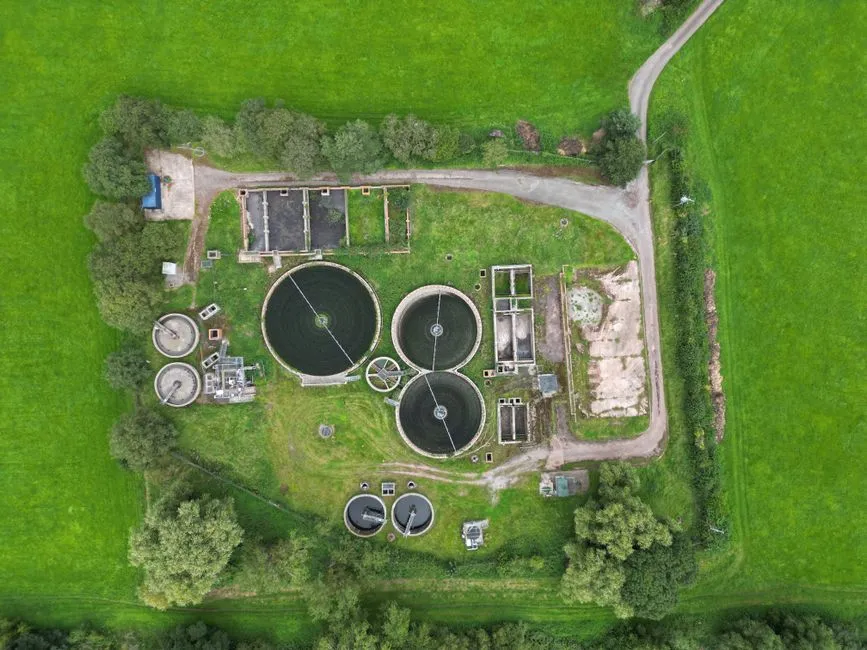
A lamella clarifier — also called an inclined-plate or high-rate sedimentation tank — separates suspended solids by letting them settle against a stack of inclined plates, then slide down into a sludge hopper. Coagulant is dosed upstream to build a dense floc, and clarified water rises through the plate pack at surface loading rates typically between 20 and 40 m/h, roughly an order of magnitude higher than a conventional clarifier (per HydropureWater high-efficiency sedimentation tank specifications). The result is a very compact plan-area unit that handles high flow with a small footprint.
For F&B streams, the lamella is genuinely good in three specific scenarios. First, where the TSS is heavy and settleable — think fruit pulp, grain washwater, or bakery crumb streams that readily drop out of suspension. Second, where FOG is low to moderate, say below 50 mg/L, because the lamella cannot float emulsified oil. Third, where the goal is polishing after a DAF or after a biotreatment step, where the lamella catches the carryover solids and the biological flocs.
Where the lamella falls short is exactly where DAF excels: emulsified FOG, light colloidal solids, and oil-in-water emulsions from meat rendering, dairy separation, or fryer cleaning. Those particles do not readily coagulate into a heavy floc and tend to pass through the plate pack or coat the plates, raising wash-water frequency. A plant that tries to run a lamella alone on a high-FOG stream will typically see floatable oil pass downstream, fail the FOG limit, and pay surcharges. HydropureWater's lamella clarifier is best deployed either upstream of a DAF (as grit/screens-residue removal) or downstream as a polish step, not as a sole primary clarifier on a fat-bearing F&B stream.
Side-by-Side: DAF vs Lamella Clarifier for Shippensburg F&B Plants
The table below summarizes the operating envelope of each technology on a typical Shippensburg F&B effluent. Numbers are drawn from SIGMADAF, Clearwater/SigmaDAF, and HydropureWater product specifications and are appropriate for screening, not for final design.
| Parameter | DAF | Lamella Clarifier |
|---|---|---|
| FOG removal | >90% on emulsified and free oil (SIGMADAF) | Poor; 20–40% unless heavily coagulated; unreliable on emulsions |
| TSS removal | 80–95% on light and colloidal TSS | 70–90% on settleable TSS; weaker on colloids |
| BOD reduction | Substantial, tied to TSS and FOG removal | Moderate; tied to settleable fraction only |
| Hydraulic loading | 5–30 m/h typical, design-dependent | 20–40 m/h on plate surface area |
| Flow range | 4–300 m³/h in 13 standard DAF models | Wide range, very compact plan area |
| Footprint | Compact, but taller profile | Smallest plan area of either option |
| Chemical demand | Coagulant + flocculant + pH adjustment | Coagulant only; up to ~30% lower chemical consumption |
| Sludge consistency | Float 2–5% DS; needs dewatering (belt press, screw press) | Denser underflow (3–6% DS); easier to thicken, sometimes higher volume |
| Sensitivity to influent swings | Moderate; PLC dose tracking helps | Higher; lamella does not float oil spikes well |
| CAPEX direction | Higher unit cost, lower civil cost | Lower unit cost, more civil/site work possible |
| OPEX direction | Higher chemical use, lower sludge disposal | Lower chemical use, higher sludge volume |
| Typical placement | Primary clarifier, often post-screen, pre-bio | Primary on low-FOG streams, or polish after DAF/bio |
For a Shippensburg plant whose stream carries >100 mg/L FOG, the FOG row alone settles the question: a lamella alone will not consistently hit the FOG limits in 40 CFR 432. The DAF win on FOG is decisive; the trade-off is chemical cost and a float sludge that has to be dewatered. A full design comparison, including the HydropureWater dissolved air flotation system and the HydropureWater lamella clarifier, belongs in the bid package, not the screening decision.
40 CFR 432 and the Compliance Side of the Decision
40 CFR Part 432 is the U.S. EPA categorical effluent standards for the Meat and Poultry Products point source category, and it sets the compliance floor for many F&B processors in the Shippensburg area. Daily maximum limits across common subcategories typically include BOD₅ around 200 mg/L, TSS around 370 mg/L, and FOG (often reported as oil and grease) around 150 mg/L, with monthly-average limits running tighter and additional limits on total nitrogen and ammonia depending on subcategory and discharge point (per 40 CFR 432). Plants that discharge to a POTW still see these categorical limits enforced through the local sewer use ordinance, and the controlling authority is whichever limit — categorical, state, or local pretreatment — is the most stringent.
On a slaughterhouse, rendering, dairy, or high-fat processing stream, a DAF's >90% FOG and TSS removal is typically the only single-step technology that reliably hits the 40 CFR 432 FOG limit. A lamella clarifier alone rarely meets FOG limits without downstream polishing, and downstream polishing usually means a second DAF or an oil-water separator that brings the same float step back into the train. This is the practical reason Shippensburg plants default to DAF as the primary clarifier and consider lamella only when the stream is low in FOG or when lamella is added as a polish step after a DAF or biotreatment.
Decision Framework: Which One Should Your Plant Pick in 2026?
For a Shippensburg F&B plant in 2026, the equipment choice collapses to four decision rules driven by influent character, not by vendor marketing.
- Choose DAF when FOG or emulsified oils are >100 mg/L, when TSS is light or colloidal, or when the available floor space is limited and a skid-mounted unit will shorten the installation window. This covers most dairy, meat, bakery, and prepared-foods plants in the area.
- Choose a lamella clarifier when FOG is low (<50 mg/L), TSS is heavy and settleable, and flow is very high — for example a beverage bottling plant with high TSS and minimal oil. The lamella delivers the smallest plan area and the lowest chemical bill.
- Choose a DAF + lamella train when a plant has both heavy settleable grit/screens residue and emulsified FOG — typical of a meat processor with rendering, where the lamella first pulls out settleable solids and the DAF polishes FOG. The two units in series also gives a denser underflow to the dewatering press.
- When in doubt, run a jar test with and without coagulant/flocculant to compare float-versus-settle behavior. This is the lowest-cost 2026 de-risking step a Shippensburg plant can take before signing a purchase order, and most vendors including HydropureWater, Ecologix, and SigmaDAF offer a free wastewater characterization and treatability study as the first deliverable.
For plants that match rule 1, the HydropureWater dissolved air flotation system paired with the HydropureWater automatic chemical dosing system is a defensible primary train. For plants that match rule 2, the HydropureWater lamella clarifier is the right starting point.
2026 Sourcing Checklist: Vendors, Lead Time, and Risk Reduction
Procurement at a Shippensburg F&B plant should normalize every bid to the same spec sheet rows: flow range, FOG/TSS/BOD removal guarantee, materials of construction, skimmer and auger drive type, controls platform, chemical dosing integration, and the sludge dewatering interface. Two relevant reference points for 2026 bid comparisons: the HydropureWater DAF (13 standard models, 4–300 m³/h, skid delivery) and the SIGMADAF/Clearwater USA approach (304SS standard, optional 316SS and polypropylene, lamella-plate DAF variants such as the FPBC and FPHF, with more than 800 projects globally per Clearwater/SigmaDAF).
For a tight food-grade mechanical room, a pre-assembled DAF on one or two skids — single-skid at flows ≤66 GPM, two-skid above — typically cuts installation time from weeks to days. Bundle the chemical dosing skid with the DAF so coagulant, flocculant, and pH adjustment are PLC-integrated and track flow in real time. Finally, insist on a free wastewater characterization and treatability study as the first vendor deliverable; the same logic applies whether the plant ends up selecting a HydropureWater dissolved air flotation system with the HydropureWater automatic chemical dosing system, or a lamella-led train. For an apples-to-apples regional read, the Camp Hill food and beverage DAF-vs-clarifier guide covers a parallel central-PA F&B case, and the Italy DAF system engineering guide gives a 2026 cost-and-compliance view useful for cross-checking U.S. bids.
Frequently Asked Questions
What is the best primary clarifier for a Shippensburg food and beverage plant in 2026?
For most Shippensburg F&B plants, a DAF is the better primary clarifier in 2026 because F&B effluent carries FOG, emulsified oils, and light suspended solids that float rather than settle. DAF systems typically achieve >90% removal of suspended solids, oils, and grease per SIGMADAF performance data, which is the level needed to hit 40 CFR 432 FOG limits on dairy, meat, bakery, and prepared-foods streams.
When does a lamella clarifier make more sense than a DAF for food and beverage wastewater?
A lamella clarifier makes more sense when the stream is low in FOG (<50 mg/L), the TSS is heavy and settleable, and the flow is very high — for example beverage bottling or fruit processing. Surface loading rates of 20–40 m/h on the inclined plates give the smallest plan area of either option, and chemical consumption can be roughly 30% lower than a DAF train.
What 40 CFR 432 effluent limits apply to a Shippensburg F&B plant discharging to a POTW?
40 CFR 432 (Meat and Poultry Products) sets categorical daily maximum effluent limits that commonly include BOD₅ around 200 mg/L, TSS around 370 mg/L, and oil and grease around 150 mg/L, with monthly-average limits tighter and additional limits on total nitrogen and ammonia depending on subcategory. Indirect dischargers must also satisfy the local sewer use ordinance, which is often the more stringent of the two.
How large a DAF does a typical Shippensburg F&B plant need?
Flow-driven sizing puts most Shippensburg F&B plants in the 10–150 m³/h range, well inside the 4–300 m³/h envelope from HydropureWater DAF's 13 standard models. Single-skid delivery covers flows up to about 66 GPM (≈15 m³/h); larger plants use a two-skid modular DAF with PLC-integrated chemical dosing.
Can a DAF and a lamella clarifier be used together?
Yes, and for some Shippensburg meat and rendering plants a DAF + lamella train is the right 2026 call. A lamella first pulls out heavy settleable grit and screens residue, then a DAF polishes emulsified FOG and colloidal TSS, producing a denser underflow for downstream dewatering. The two-unit train typically reduces chemical demand on the DAF stage and improves sludge consistency to the press.