Why the DAF-vs-Clarifier Question Matters for Largo Transportation Equipment Plants in 2026
Dissolved air flotation (DAF) is the correct primary unit for almost every stream at Largo, FL transportation equipment factories in 2026 because parts-washer and E-coat wastewater is dominated by free oil (200–2,000 mg/L), emulsified machining lubricant (500–5,000 mg/L O&G), and oil-coated TSS — the exact particle classes the EPA Oil/Water Separation State-of-the-Art matrix (EPA-600/2-78-069) rates DAF "XXX — excellent" for. A lamella clarifier belongs downstream as a polish or sludge-thickener, not as the primary oil-removal unit, and both must meet 40 CFR Part 432 daily-maximum O&G and metals limits enforced through FDEP and the Pinellas County POTW pretreatment program.
Largo sits inside Pinellas County, which routes industrial discharges through a POTW pretreatment program backed by FDEP and 40 CFR Part 403 — meaning a Largo transportation equipment plant is regulated twice: by federal 40 CFR 432 categorical limits and by local POTW discharge limits. Transportation equipment manufacturing (NAICS 336xxx) in the Tampa Bay area spans automotive stamping, aerospace component machining, marine hardware passivation, and rail/heavy-truck sub-tier parts washing — each producing a characteristic oily wastewater envelope. Parts-washer overflow runs 200–2,000 mg/L free oil plus tramp greases; machining coolant dumps contribute 500–5,000 mg/L emulsified oil stabilized by surfactants; E-coat and phosphate conversion-coating rinse water adds 200–1,000 mg/L TSS and trace Zn, Ni, Cr. Paint-booth water contributes polymeric overspray and floatable solvents — confirming the composite stream is oily, turbid, and high in TSS, the exact envelope that the 1978 EPA Oil/Water Separation matrix was built to classify. The same framing logic appears in the Milton transportation equipment DAF vs clarifier guide; the Largo difference is the local FDEP/Pinellas compliance overlay.
How a DAF and a Lamella Clarifier Actually Treat an Oil Droplet
A DAF saturates a pressurized side-stream (typically 5–8 bar) with air, then releases it at atmospheric pressure at the bottom of the flotation tank; the pressure drop generates 10–80 µm micro-bubbles that attach to oil droplets and oil-coated solids and lift them in 15–40 minutes of HRT, where a surface skimmer removes the float (HydropureWater DAF field data, 2026). Surface loading on a DAF runs 5–25 m/h, which is why a packaged DAF handles a high oil load in a compact footprint — a single HydropureWater DAF system can process 4–300 m³/h across 13 standard models.
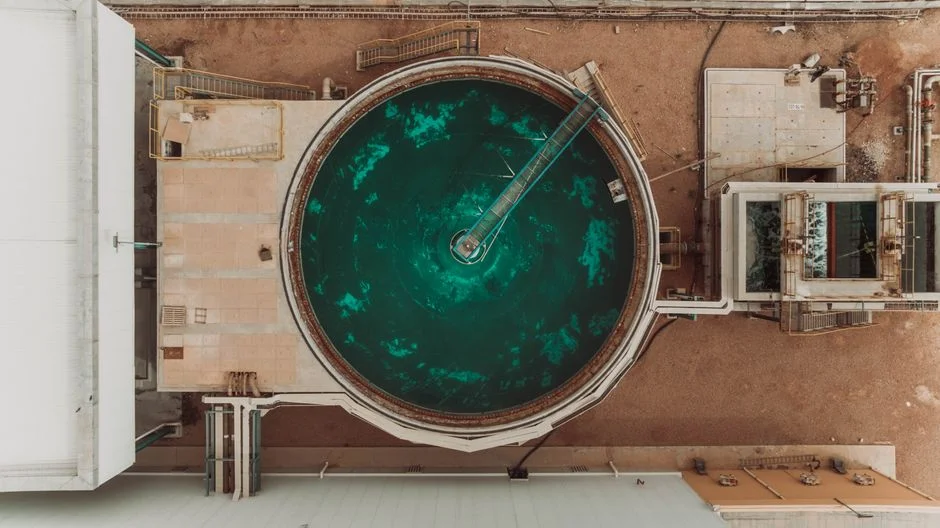
A lamella clarifier is a gravity settler where wastewater flows upward through inclined plates set at 55–60°, settleable solids drop onto the plate and slide into a sludge hopper, HRT 30–90 minutes; the HydropureWater high-efficiency sedimentation tank rates 20–40 m³/m²·h surface loading. Because the lamella mechanism is purely gravitational, free oil by definition floats and passes through the plate pack — a lamella needs a separate top-mounted oil skimmer plus a chemical demulsifier feed to remove free or emulsified oil. EPA-600/2-78-069 (April 1978) Table 1, still cited in 2026 fact sheets, concludes that "a modern oil wastewater treatment system may include an API gravity separator and dissolved air flotation for removing free oil" — meaning EPA itself pairs the units, with DAF doing the oil-removal work.
The same Table 1 rates DAF "XXX — excellent" for free oil, unstabilized dispersions, and oil-coated solids; a conventional gravity clarifier is rated only "XXX" for free oil and "X–XX" for the dispersed classes. The codes are a 1978 reference standard, not a 2026 benchmark, but the underlying physics — buoyancy, surface tension, bubble attachment — has not changed. Florida Water Resources Journal pilot work (May 2000) confirmed DAF loading rates of 3–30 gpm/ft², consistent with the 5–25 m/h band used for oily industrial sizing today.
The 2026 Regulatory Frame: 40 CFR 432 and Florida Pretreatment in Pinellas County
The binding federal standard is 40 CFR Part 432 (Transportation Equipment Cleaning Point Source Category), not the generic 40 CFR 433 Metal Finishing that most vendor pages cite — Subpart A covers aircraft and aerospace parts cleaning, Subpart B covers metal-finishing of transportation equipment. The 2024–2025 EPA effluent-guideline revision cycle tightened daily-maximum limits on O&G and several metals and increased the frequency of narrative self-monitoring reports; Largo environmental managers should expect FDEP and Pinellas County POTW inspectors to reference that direction of tightening in 2026. Confirming the current numeric limits with the state NPDES authority before sizing any unit is non-negotiable — the regulation, not vendor marketing, sets the bar.
EPA has moved toward narrative self-monitoring reports and weekly DMR submissions for 40 CFR 432 facilities, and inspectors are reading the narrative for cause rather than just checking numbers — a DAF-primary + lamella-polish train is easier to narrate defensibly because each unit has a single, well-documented job. Pinellas County's local limits typically sit below the federal categorical floor for O&G and TSS, and FOG limits along the Tampa Bay coastal discharge corridor are particularly tight because of the downstream surface-water quality context. That double layer is what makes the 2026 self-monitoring narrative a true compliance document, not paperwork.
Head-to-Head Comparison: DAF vs Lamella Clarifier for Largo Transportation Equipment Wastewater
The following table is anchored to the 10–80 m³/h flow band typical of single- and two-shift Largo plants and to specific HydropureWater product data. A Largo procurement reader can paste the rows into a memo without re-reading the article.
| Parameter | DAF (Primary) | Lamella Clarifier (Primary) |
|---|---|---|
| Target contaminant | Free oil, emulsified oil, oil-coated TSS | Settleable TSS only; free oil passes through without skimmer + demulsifier |
| Removal performance | 80–95% O&G; 60–90% TSS (with polymer) | 50–80% TSS; <30% free oil alone |
| Footprint | Larger tank volume (~1.5–2×), but single integrated unit | Smaller tank, but adds oil skimmer, plate pack, chemical feed skid |
| Chemistry | Coagulant + flocculant (polymer 2–10 mg/L) | Flocculant only (polymer 2–10 mg/L) |
| OPEX driver | Saturated-water recycle pump energy + polymer | Polymer + sludge pumping (thinner sludge) |
| Surge tolerance | Tolerant (rapid float-up kinetics) | Sensitive (residence-time limited) |
| Sludge | 3–6% DS float; easy to dewater | 1–2% DS underflow; higher hauling cost |
| CAPEX shape | Higher bare unit; lower total installed for oily streams | Lower bare unit; rises sharply when oil-skimmer and chemistry added |
| Capacity envelope | 4–300 m³/h, 13 standard models | 20–40 m³/m²·h surface loading; up to 30% chemical reduction vs conventional clarifier |
The 95% DAF vs 70% clarifier O&G removal figure in the Ecologix food-processing case study is one of the few vendor-published head-to-head numbers, and the gap holds in practice for oily transportation equipment streams. The HydropureWater lamella's "up to 30% chemical consumption reduction" claim is real, but it is a clarifier-vs-clarifier data point, not a clarifier-vs-DAF claim.
Sizing a DAF or Lamella for a Largo Plant: Flow, Surge, and Daily-Maximum Sampling
The first sizing question is flow: a single-shift Largo parts washer and E-coat line typically combines to 10–25 m³/h, a two-shift high-mix plant 40–80 m³/h — both bands fit inside the DAF 4–300 m³/h range. The second sizing question is peak vs. average: 40 CFR 432 uses a daily-maximum vs. monthly-average sampling regime; sizing to average flow will fail the daily-max on the first surge day, so treat the daily-max as binding and the monthly-average as the design margin.
For a 25 m³/h single-shift Largo plant, size for at least 30–35 m³/h peak and select a DAF model with documented headroom at that flow; a lamella at the same flow needs design flow (m³/h) divided by the 20–40 m³/m²·h surface loading rate, which yields roughly 0.6–1.25 m² of plate area before adding skimmer and chemical skid. A HydropureWater automatic chemical dosing system paired with the DAF tightens polymer consumption and stabilizes performance through flow swings. The same flow-surge logic is documented for adjacent Florida peer plants in the Bradenton EV and auto parts DAF vs lamella clarifier guide and the broader EV/auto plant 2026 pretreatment compliance walkthrough.
Cost, OPEX, and the 2026 Enforcement Reality in Largo
Capital cost: a bare lamella clarifier is cheaper on the nameplate, but the honest comparison adds the oil skimmer, demulsifier feed, larger plate area needed to chase 40 CFR 432 daily-max O&G, and sludge-hauling uplift — once tallied, total installed cost for an oily Largo stream usually favors DAF. OPEX: DAF is dominated by the saturated-water recycle pump (1–3% of throughput energy) and polymer dose (2–10 mg/L); a lamella has no recycle pump but burns more on sludge hauling because its underflow runs 1–2% DS versus the 3–6% DS float a DAF produces. Sludge handling: a HydropureWater plate and frame filter press downstream of the DAF handles the float sludge without sending water-rich cake to disposal.
Enforcement: in 2026, FDEP and Pinellas County POTW inspectors are reading the narrative self-monitoring report for cause; a DAF-primary + lamella-polish train with an automatic chemical dosing system gives a clean, auditable operating story. Each unit has a single, well-documented job, the polymer dose is logged, the float sludge tonnage is metered, and the daily-max O&G result is reproducible run-to-run — the kind of narrative an inspector accepts on the first pass.
Frequently Asked Questions
For a 25 m³/h single-shift Largo parts washer and E-coat line, which HydropureWater unit is the right primary in 2026?
Size for at least 30–35 m³/h peak and select a DAF model inside the 4–300 m³/h, 13-model envelope with documented headroom at that flow; the lamella is a polish or sludge-thickener, not the primary. A lamella at 25 m³/h needs roughly 0.6–1.25 m
Frequently Asked Questions
Should a Largo, FL transportation equipment factory choose a DAF or a clarifier in 2026?
In 2026, the selection depends on the concentration of emulsified oils and suspended solids typical of transportation equipment cleaning. A Dissolved Air Flotation (DAF) unit is generally superior for facilities handling high concentrations of free and emulsified oils, as it achieves 90-95% removal efficiency for oil and grease. Clarifiers are more effective for heavy, inorganic sediment and grit but require chemical de-emulsifiers to handle the high surfactant loads common in transportation wash bays.
For Largo facilities, DAF systems are increasingly preferred due to their smaller physical footprint, which helps maximize floor space in constrained industrial zones, and their ability to handle the variable hydraulic loading common in multi-stage parts washing processes.
What are the 40 CFR 432 oil and grease limits for transportation equipment cleaning?
While 40 CFR 432 primarily governs meat and poultry products, transportation equipment cleaning facilities must typically comply with local categorical pretreatment standards or 40 CFR 433 (Metal Finishing) if E-coat or painting is involved. Under common industrial pretreatment programs, Oil and Grease (O&G) limits are frequently capped at 100 mg/L for monthly average concentrations and 200 mg/L for daily maximums.
Facilities in Largo must verify their specific discharge permit, as local Pinellas County limits may be more stringent than federal guidelines to protect the regional wastewater treatment infrastructure. Exceeding these limits often triggers automatic surcharges or enforcement actions.
Can a lamella clarifier remove free oil and emulsified coolant without a DAF?
A lamella clarifier alone cannot effectively remove emulsified coolant or free oil to meet stringent discharge standards. While the inclined plates increase the effective settling area for heavy solids, they lack the bubble-attachment mechanism required to float lighter-than-water oils to the surface for skimming.
To achieve compliance using a clarifier, you must implement a robust chemical pretreatment stage involving acidification and polymer flocculation to break the emulsion. Even with optimal chemistry, a clarifier typically leaves residual emulsified oils in the effluent that would be effectively captured by the micro-bubble aeration process of a DAF.
What size DAF does a single-shift parts washer and E-coat line in Largo need?
Sizing a DAF for a single-shift operation requires calculating the total daily discharge volume divided by the effective operating hours, typically including a 20-30% safety factor for surge capacity. For a standard transportation equipment plant, a unit rated for 10-25 gallons per minute (GPM) is usually sufficient to handle wash-down cycles and E-coat rinse water overflow.
You must also account for the hydraulic loading rate, which should ideally be between 1.5 and 3.0 GPM per square foot of flotation area. A properly sized system for a single-shift facility should be able to process the total daily volume within 6 to 8 hours to allow for necessary maintenance and chemical dosing adjustments.
How does FDEP and Pinellas County POTW pretreatment enforcement work for transportation equipment plants in 2026?
In 2026, FDEP maintains oversight of state-wide water quality, while Pinellas County operates the Publicly Owned Treatment Works (POTW) pretreatment program through delegated authority. Enforcement is driven by mandatory self-monitoring reports, typically submitted on a quarterly or semi-annual basis, which document effluent pH, O&G, and heavy metal concentrations.
Pinellas County inspectors conduct unannounced site visits and independent sampling to ensure compliance with local limits. Facilities failing to maintain operational logs or exceeding discharge parameters face tiered enforcement ranging from formal notices of violation and increased sampling frequency to significant monetary penalties and potential revocation of discharge permits.