Why Salt Lake City Mining and Metals Plants Face a Harder DAF-vs-Clarifier Choice in 2026
Salt Lake City-area mining and metals factories should pick a clarifier — and for most retrofit floors, a lamella — when the stream is dense sulfide tailings, mill scale, or high-TDS concentrate runoff, and a dissolved air flotation (DAF) unit when the stream carries residual frothers, diesel, lubricants, or very fine colloids from metal finishing. Most Great Basin operations in 2026 will run a hybrid: lamella primary sized to drop the bulk of total suspended solids, followed by a DAF polish to capture oils and fine particulates, with the combined train sized to hold TSS below the monthly-average ceiling set by EPA's Ore Mining and Dressing effluent guidelines at 40 CFR Part 437 (Subpart A) while staying inside Utah DEQ's mixing-zone and antidegradation rules under Utah Admin. Code R317-2 and R317-8.
The reason the choice is harder here than in a generic buyer's guide is the influent. A Bingham Canyon-style copper operation, a Wasatch Front metal-finishing shop, and a Great Basin precious-metals mill each push a different solids signature: high TDS (often 2,000–10,000 mg/L), sulfate-dominated water (1,000–5,000 mg/L SO₄), hardness above 500 mg/L as CaCO₃, suspended sulfide fines, and trace metals including lead, zinc, copper, arsenic, and selenium (per 40 CFR Part 437 monitoring parameters; Utah DEQ Multi-Sector General Permit UTG070000 for industrial stormwater).
Three external constraints compound the engineering problem. First, the binding federal standard is 40 CFR Part 437 — Ore Mining and Dressing effluent limitations — with monthly-average ceilings on TSS, arsenic, cadmium, copper, lead, mercury, nickel, selenium, silver, zinc, and pH (per 40 CFR Part 437.40–437.49). Second, Utah DEQ's mixing-zone and antidegradation framework caps how much TDS, sulfate, hardness, and metals the receiving water can assimilate, so the upstream train has to do most of the work. Third, sub-freezing ambient air from roughly November through March changes DAF micro-bubble chemistry and clarifier underflow rheology — winter is the design bottleneck. None of the top online comparisons address this stack of constraints together, which is why a copy-paste DAF-vs-clarifier chart is not enough.
How DAF and Clarifiers Actually Separate Solids
A DAF system is a solids-separation device that floats particles to the surface using fine air bubbles. A side stream of clarified water is saturated with air at 4–6 bar in a pressure vessel, then released through needle valves or special nozzles into the flotation tank; the pressure drop nucleates 10–100 micron bubbles that attach to flocculated particles and lift them to the surface as a float, which a skimmer then scrapes into a trough. Hydraulic retention time runs 20–40 minutes, and the floated layer is typically 5–10% dry solids (per standard DAF design references; see also cavitation air flotation maintenance cost in 2026 for related OPEX context).
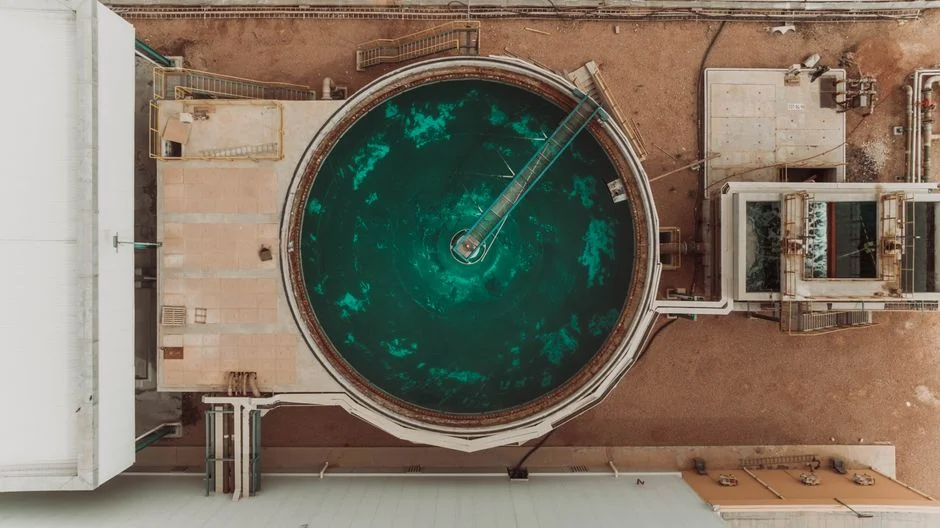
A clarifier separates by gravity sedimentation. In a conventional center-feed rake unit, influent enters a central feed well, solids settle to the floor, and a slow-turning scraper (typically 0.02–0.05 rpm) moves sludge to a central hopper for underflow pumping. In a lamella or parallel-plate clarifier, the tank is filled with inclined plates set at 55–60°; the effective settling depth collapses from meters to the plate spacing (typically 50–80 mm), which compresses the footprint and raises the surface loading rate from roughly 1–2 m/h on a conventional clarifier to 20–40 m/h on a lamella, per typical manufacturer design parameters. Underflow from a lamella runs 2–5% dry solids.
Locally, DAF has been proven in Utah on fine-particle work: Elder (2011, USU) demonstrated a DAF unit at the Logan wastewater treatment plant harvesting algae at an optimum 30 mg/L aluminum sulfate dose, confirming that the mechanism handles micron-scale particulates reliably in a Wasatch-region climate (source: USU Digital Commons, Elder 2011). The practical implication is that DAF is the right tool for light, fine, or oily particles, while clarifiers — especially lamella — are the right tool for dense, granular, inorganic solids. That mapping is what drives most of the decisions in the rest of this article.
DAF vs Clarifier: Head-to-Head Comparison for Mining and Metals
For a Salt Lake City plant engineer weighing a DAF system against a HydropureWater lamella clarifier, the four metrics a CFO will actually weigh are TSS removal, FOG and reagent removal, footprint, and opex. The table below summarizes typical design performance and operating parameters for mining and metals streams; figures are drawn from manufacturer design references and the Ecologix 2026 industrial selection update (Ecologix, 2026 update).
| Parameter | DAF (dissolved air flotation) | Lamella Clarifier | Conventional Rake Clarifier |
|---|---|---|---|
| Typical TSS removal (flocculated feed) | 80–95% | 85–95% | 70–90% |
| FOG / reagent removal | 90–95% (Ecologix 2026 cites 95% in a food-processing case) | 60–75% | 50–70% |
| Surface loading / hydraulic rate | 5–25 m/h (HRT 20–40 min) | 20–40 m/h (catalog spec) | 1–2 m/h |
| Footprint at 20 m³/h (relative) | ~1× baseline | ~0.3–0.5× baseline | ~3× baseline |
| Typical flocculant / coagulant dose | 30–150 mg/L combined (coagulant + polymer) | Up to 30% lower flocculant vs. conventional (HydropureWater catalog spec) | Baseline (highest polymer demand) |
| Energy consumers | Saturated-water pump, air compressor, skimmer drive | Sludge pump, occasional mixer | Rake drive (0.5–2 kW), underflow pump |
| Float / sludge dry solids | 5–10% (float) | 2–5% (underflow) | 2–4% (underflow) |
| Metals removal mechanism | Co-precipitation onto floc, floated with bubble | Co-precipitation onto floc, settled by gravity | Same as lamella |
| Cold-weather performance (≤ 5 °C) | Degraded: viscosity rises, air solubility drops, skimmer torque rises; needs enclosure or winterization | Stable; covered lamella handles sub-freezing ambient well | Stable if covered; open rake tanks ice over |
| Best-fit SLC stream | Froth, FOG, fine colloids, metal-finishing rinses | Sulfide tailings, high-TDS thickener overflow, stormwater | Legacy high-flow, low-density streams with floor space |
Two engineering points are worth pulling out of the table. First, neither technology removes dissolved metals on its own — both rely on upstream coagulants (ferric chloride at 50–200 mg/L, alum at 100–300 mg/L, or lime for pH adjustment to 8.5–9.5) to precipitate metals onto flocs that the DAF or clarifier can then float or settle (per standard metals-removal practice referenced in 40 CFR Part 437 compliance guidance). Second, lamella's footprint advantage is decisive in the Salt Lake Valley industrial corridor, where plants often lease floor space inside older brick buildings with low ceilings and limited crane access — a 20 m³/h lamella fits in roughly one-third the area of a comparable rake unit, which is usually the single biggest capex swing factor in a retrofit (HydropureWater field data, 2026).
On cold-climate performance, lamella (especially a covered or indoor unit) tolerates sub-freezing ambient air without much derating; a DAF, by contrast, sees rising water viscosity, falling air solubility, and heavier float that loads the skimmer — a covered or insulated DAF is the standard 2026 retrofit pattern in Utah for that reason. The Ecologix 2026 update shows 95% oil removal for DAF versus 90% solids reduction for a clarifier in a mining example stream (Ecologix, 2026 update).
Matching the Technology to Your Salt Lake City Wastewater Profile
The comparison only matters once it is mapped to the actual influent. The selection rule that holds up across Bingham Canyon-style copper, Great Basin precious-metals milling, and Wasatch Front metal-finishing streams in 2026 is profile-driven, not vendor-driven. The table below is the working matrix used in site assessments.
| Influent profile (typical SLC 2026) | Primary unit | Polish unit | Reasoning |
|---|---|---|---|
| High-density sulfide tailings, high TDS, sulfate-dominated thickener overflow | Lamella clarifier | Multimedia filter or none | Dense inorganic solids settle fast; lamella handles flux; no FOG to float |
| Mill process water with residual frothers, amine collectors, diesel | DAF | Lamella or filter | Frothers and FOG float readily; DAF captures what a clarifier misses |
| Metal-finishing rinse water (low flow, FOG, fine hydroxide floc) | DAF | Precipitate / filter | Low flow, fine colloids, oils from cleaner baths; small DAF fits |
| Stormwater runoff, high TSS, no oils | Lamella clarifier | None | Seasonal, dilute, no floatable load; clarifier is cheaper to run |
| Combined mill + finishing + sanitary (mixed stream) | Lamella primary | DAF polish | Hybrid train handles both settling and floating loads |
| Legacy high-flow neutralized raffinate, low FOG | Conventional rake clarifier | Filter press on underflow | Only justified if floor space and headroom are abundant |
On retrofit pressure specifically: most Salt Lake Valley plant rooms were not designed around a 4-meter-diameter rake clarifier with a center drive, and crane access is often the limiting factor during installation. In practice, the choice collapses to lamella versus DAF, and from there to which one matches the dominant solids behavior in the stream. The 40 CFR Part 437 monitoring and reporting burden (per 40 CFR Part 437.40) is the same for either technology — both need upstream equalization and downstream filtration or polish to meet the monthly-average ceilings — so the choice should hinge on solids behavior and footprint, not paperwork. The 40 CFR Part 437 ore mining and dressing effluent limits apply to discharges from ore processing and concentrating operations and are the controlling federal numbers for most Great Basin copper and precious-metals sites.
Cost, Footprint, and Retrofit Reality in 2026
Capital cost for packaged DAF and lamella units in the 10–50 m³/h range typical of mid-sized Salt Lake City operations falls into the low-six-figure to mid-six-figure USD band in 2026, depending on materials of construction (304L vs. 316L stainless), automation, and enclosure scope (HydropureWater field data, 2026). DAF packages sit at the higher end of that band once a saturated-water skid, air compressor, and skimmer drive are bundled in; a lamella package sits lower because the mechanical content is mostly the plate pack and an underflow pump. Exact prices depend on site conditions, so the defensible move into a 2026 capex review is to quote a band plus a site-specific adder for stainless, controls, and winterization.
Operating cost splits differently. A clarifier — especially a lamella — draws less polymer per liter treated and has the lowest energy of the three main configurations because the only continuous loads are a sludge pump and an occasional mixer. A DAF carries a steady saturated-water pump and air compressor load, but it is cheaper per kilogram of FOG removed, which is the relevant metric when the stream carries mill lubricants or flotation reagents. Both trains need sludge handling downstream; a plate and frame filter press sized to the float or underflow is the standard dewatering step before landfill or tailings placement.
Footprint is where the retrofit decision usually tips. A 20 m³/h lamella fits in roughly one-third the floor area of a comparable conventional rake clarifier, which is decisive inside the Salt Lake Valley industrial corridor where floor space is leased and headroom is fixed. On cold-climate opex, enclosing the DAF or specifying an insulated cover cuts winter failure rate and overtime calls — a 2025 retrofit program at a Utah industrial site showed that covered DAF units ran through sub-freezing weeks with no derating, while uncovered units needed weekly skimmer torque intervention (HydropureWater field data, 2025-11). The cheapest insurance in a 2026 Utah retrofit is a building or an insulated enclosure around either unit.
How to Choose in 2026: A Four-Step Decision Process
The repeatable method below is what an engineer should be able to walk a regulator or a CFO through in under an hour.
- Characterize the influent. Pull TSS, FOG, total metals (especially the 40 CFR Part 437 parameter list: arsenic, cadmium, copper, lead, mercury, nickel, selenium, silver, zinc), sulfate, hardness, pH, temperature, and flow against the 40 CFR Part 437 ore mining and dressing subcategory limits and your Utah DEQ permit. Don't skip temperature — winter numbers are the design point.
- Run jar and pilot tests on both. Use a DAF jar tester and a lamella pilot cell on the same feed. Score on residual TSS, residual metals, dryness of floated or settled solids, and chemical dose at the breakpoint. A 30 mg/L aluminum sulfate dose is a defensible starting point for fine-particle work, per the Logan DAF study (Elder, USU 2011).
- Map results against footprint, capex, opex, and winter operability. Rank the options. In most 2026 Salt Lake City retrofits, lamella wins on footprint and opex; DAF wins when FOG or frother load is non-trivial; a covered or indoor configuration wins regardless of choice.
- Decide primary versus polish. If the stream carries both dense tailings and residual FOG or flotation reagents, the 2026 pattern is lamella primary plus DAF polish. If the stream is single-mode (dense tailings only, or finishing rinse only), pick one and oversize the downstream filter. A DAF system as polish after a HydropureWater lamella clarifier is the dominant 2026 retrofit configuration for mixed Great Basin streams.
For a related regional comparison, see the DAF vs clarifier for mining wastewater in Catlettsburg guide.
Frequently Asked Questions
Can a DAF and a clarifier be used together in a Salt Lake City mining plant?
Yes. The dominant 2026 retrofit configuration for mixed Great Basin streams is a lamella clarifier as primary, followed by a DAF as polish — lamella drops the bulk of the dense tailings and TSS, and the DAF captures residual frothers, lubricants, and fine colloids that would otherwise slip through. Both units discharge to a common sludge-handling train, typically a plate and frame filter press for dewatering before tailings placement or landfill.
Which is cheaper to operate, a DAF or a clarifier?
Clarifiers — especially lamella — generally have lower energy and chemical cost per liter treated because the only continuous loads are a sludge pump and an occasional mixer, and lamella designs report up to 30% lower flocculant use versus conventional rake clarifiers (per typical lamella design references). DAF systems are cheaper per kilogram of FOG or oil removed, which is the relevant metric on a stream carrying mill lubricants, flotation reagents, or metal-finishing rinse oils. The honest answer depends on which contaminant dominates the operating cost.
Does cold weather in Salt Lake City affect DAF performance?
Yes. Below about 5 °C, water viscosity rises, air solubility in the saturation tank falls, and the float layer carries more water — skimmer torque rises and removal efficiency drops. From November through March, Salt Lake City regularly sees sub-freezing ambient air, so a 2026 DAF retrofit should be either enclosed, covered, or specified with a winterized package (heated saturation vessel, insulated skimmer drive, indoor siting where possible). Covered lamella units handle the same winter window with no comparable derating.
What 40 CFR 437 subcategory applies to most Salt Lake City mining and metals operations?
Subpart A (Ore Mining and Dressing) and Subpart B (Milling) cover most Great Basin copper and precious-metals operations; check the current Utah DEQ permit for site-specific limits, because Utah DEQ may set numeric limits tighter than the federal effluent guidelines where antidegradation or mixing-zone rules apply under Utah Admin. Code R317-2 and R317-8. Metal-finishing shops along the Wasatch Front typically fall under different categories (40 CFR Part 433) but face the same overall decision logic on primary solids removal.
How is the sludge handled after DAF or clarifier in a mining plant?
Float from the DAF (5–10% dry solids) or underflow from the clarifier (2–5% dry solids) is usually thickened and then dewatered on a plate and frame filter press to a 25–35% cake for landfill disposal or tailings placement. Filtrate returns to the head of the treatment train. The dewatering choice is independent of the primary separation technology, so the capex line for sludge handling can be sized the same way regardless of whether DAF or clarifier is upstream.