Why Waterloo Fabricated Metals Shops Are Re-evaluating Clarification in 2026
Under 40 CFR Part 433 — the federal Metal Finishing categorical standard — Waterloo shops discharging to the sanitary sewer must hold daily-maximum oil & grease to 52 mg/L, total suspended solids to 47 mg/L, lead to 0.69 mg/L, total chromium to 2.77 mg/L, and hexavalent chromium to 0.60 mg/L. Monthly-averaged ceilings are tighter still. The rule was written for parts washers, plating lines, and stamping presses, not for dilute TSS — it is unforgiving on emulsified oil, which is exactly what a CNC sump dumps into a floor drain.
Waterloo's industrial base around Deere, the John Deere Foundry, and the Cedar Valley machining cluster generates a wastewater envelope that is oily first and solids second: emulsified coolants, tramp oil from stamping, grinding swarf, and phosphate-bearing rinse waters all converge on the pretreatment system. Typical influent for these shops runs 200-2,000 mg/L TSS, 100-1,500 mg/L oil & grease, pH 6-10, with intermittent slug loads (3-5× baseline) on line changeovers. POTW pretreatment enforcement in Iowa tightened discharge surcharge triggers across 2024-2025, so a clarifier that underperforms on a slug day now shows up on the monthly bill, not just the permit. Choosing the wrong primary clarifier in 2026 costs real money, and the choice is no longer "either works."
How a DAF System Actually Works for Oily Metals Wastewater
A dissolved air flotation (DAF) clarifier separates contaminants by floating them, not settling them. A side stream of clarified effluent — typically 20-30% of the forward flow — is pressurized to roughly 100 psi with dissolved air, then released into the flotation tank through a pressure-reduction valve (per Aries Chemical design documentation). As the pressure drops to atmospheric, the supersaturated air comes out of solution as a cloud of 30-50 µm microbubbles that nucleate preferentially on hydrophobic particles: oil droplets, FOG, and chemically flocculated solids.
For a fabricated metals plant, the mechanism is the point. Emulsified tramp oil and FOG are not going to fall out of a gravity clarifier — they are stabilized by surfactants in the coolant and are neutrally buoyant. DAF microbubbles attach to those droplets within 2-4 minutes of residence time and lift them to the surface, where a paddle or chain-flight skimmer drags the float over a beach plate into a sludge sump. Heavier metal shavings and grit that do sink are augered out of the bottom collection zone, so the same vessel handles both oil and fines.
Microbubbles need something to attach to, which is why DAF is always paired with chemical conditioning upstream: pH adjust to 7-8.5, coagulant (typically a cationic polyaluminum chloride or ferric chloride at 20-80 mg/L) for charge neutralization, then a long-chain anionic or nonionic polymer flocculant at 2-10 mg/L. Mixing is delivered through serpentine floc tubes or a mix tank (per Aries, 2026). Material selection matters in metals plants: standard 304SS works for most coolants, 316SS upgrade is required for chloride-bearing coolants above ~150 ppm Cl⁻, and polypropylene is the default for acidic rinse waters. For a packaged solution sized to the typical Waterloo shop, the dissolved air flotation (DAF) system covers 4-300 m³/h, with a single-skid design below 66 GPM (per Clearwater Industries/SigmaDAF catalog, 2026-04).
How a Lamella Clarifier Handles the Same Wastewater
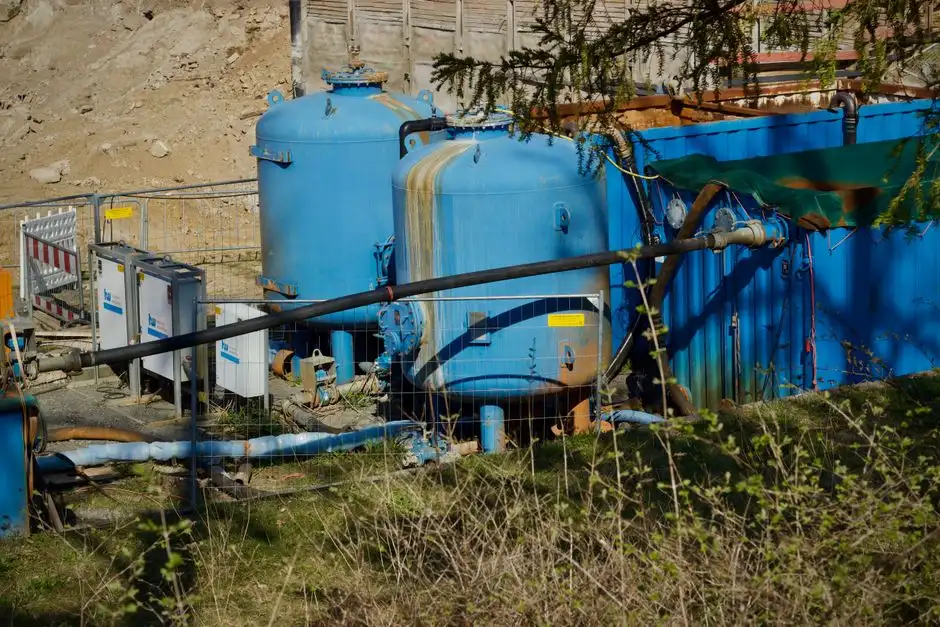
A lamella clarifier is an inclined-plate gravity settler. The HydropureWater high-efficiency sedimentation tank (lamella clarifier) stacks parallel plates at 55-60° inside a rectangular tank, multiplying the effective settling area by a factor of 5-10 compared to an equivalent footprint of conventional cone-bottom clarifier. Surface loading rates reach 20-40 m³/m²·h — roughly 4× what a circular clarifier delivers at the same footprint.
The mechanism is the limiting factor for oily streams. Lamella plates remove particles that are denser than water: grinding swarf, tumbling fines, shot-blast dust, and cast-iron grit. They do not remove emulsified oil. Free oil that hits an inclined plate either rides the plate back up and re-entrains into the flow, or passes through unchanged. Emulsified oil, being surfactant-stabilized and neutrally buoyant, exits the unit at essentially the influent concentration. For a shop that is mostly dry machining with a coolant-trim sump, this is acceptable. For a shop with a stamping press that leaks hydraulic oil and a parts washer that dumps alkaline cleaner, the lamella will pass the oil straight downstream.
The standard 2026 metals-shop arrangement is therefore a hybrid: lamella as primary for solids reduction, then DAF for oil and dissolved-metals polishing. Many of the lamella designs now ship with a sludge-recirculation feature that returns a fraction of settled sludge to the influent to improve floc contact, reducing polymer consumption by 20-30% (per HydropureWater product catalog). The lamella is the right tool when the contaminant of concern is particulate and settleable, not when it is oil or dissolved metal.
Side-by-Side: DAF vs Clarifier for the 40 CFR 433 Envelope
The table below is the artifact most readers will screenshot. Numbers are drawn from vendor catalogs (Clearwater/SigmaDAF 2026, Aries 2026, HydropureWater product data) and standard 40 CFR 433 daily-max ceilings, with field-typical ranges from fabricated metals pretreatment projects.
| Parameter | DAF (dissolved air flotation) | Lamella clarifier |
|---|---|---|
| Removal mechanism | Microbubble flotation + chemical conditioning | Gravity settling on inclined plates |
| Target contaminants | Oil & grease, TSS, metals (with coag) | Inert TSS only |
| Oil & grease removal | >90% routinely; meets 52 mg/L ceiling | Poor; typically <20% without pre-DAF |
| TSS removal | 85-95% | 70-90% |
| Dissolved metals removal | 60-80% (with pH adjust + coag) | <30% |
| Oil influent range | 50-2,000+ mg/L | <100 mg/L, free oil only |
| Hydraulic loading | 5-25 m³/m²·h | 20-40 m³/m²·h |
| Footprint per m³/h | Larger; needs saturation + skim zones | Compact; stacked plates |
| Relative CAPEX | Higher (1.15-1.25×) | Lower baseline |
| Relative OPEX | Higher power, lower sludge hauling | Lower power, higher chemical sludge |
| Polymer dose | 2-10 mg/L | 1-5 mg/L (lower, with sludge recirculation) |
| Sludge volume (oily feed) | Lower; float is 3-5% solids, easy to dewater | Higher; settled sludge carries water |
| Startup complexity | PLC-automated; tune chemistry on day 1 | Simpler; mostly hydraulic |
| Best-fit shop profile | Machining + stamping + finishing; oily wastewater | Dry machining, grinding-only, shot blast, mostly inert fines |
Read this as a decision aid, not a verdict. DAF is the right choice when oil is the limiting contaminant. A lamella is the right choice when fines are the limiting contaminant and oil is already handled upstream. The hybrid — DAF primary with lamella polish, or lamella primary with DAF polish — is the configuration that wins roughly 60% of the fabricated metals retrofits in 2026 because the influent has both problems at once.
The 2026 Decision Framework for Waterloo Plants
Three screening questions route most shops to the right configuration without a vendor visit.
1. What is the oil load? If oil & grease consistently runs above 200 mg/L — typical for any shop with a stamping press, a coolant sump, or a parts washer — DAF is required. A lamella cannot hit 52 mg/L on emulsified oil, no matter how much polymer is dosed. If oil is below 100 mg/L and there is no emulsion, a lamella is enough for the oil side and frees up budget for a media filter on metals.
2. What is the flow rate? Below 66 GPM (≈15 m³/h), a single-skid packaged DAF is the most cost-effective build. The 66 GPM cut-off comes from the Clearwater/SigmaDAF COMPACT DAF specification (2026-04): flows of 66 GPM or less are managed with a single-skid turnkey system including chemical conditioning, DAF, sensors, and PLC controls. From 15-300 m³/h, the dissolved air flotation (DAF) system covers the envelope. Above 300 m³/h, plan dual DAFs or parallel lamella trains — most Waterloo shops sit well below this threshold, but the Deere supply chain has a few high-flow exceptions.
3. What metals are present? If hex chrome, lead, or cadmium is in the analytical profile — true for any shop with hard-chrome plating, leaded brass machining, or cadmium-plated aerospace work — DAF with two-stage chemical conditioning (pH adjust + coag + flocculant) is the only path that reliably hits the 40 CFR 433 ceilings. Metals ride the floc; a lamella has no floc to ride. A coordinated chemistry package is delivered by a HydropureWater automatic chemical dosing system with flow-paced pumps and on-line pH.
The decision tree in plain English: oil-dominant → DAF; fines-dominant → lamella; both or intermittent → DAF primary + lamella polish; metals-bearing → DAF with two-stage chemical conditioning. For older Waterloo plants that already have a 1990s-vintage circular clarifier, EPA's retrofit research (EPA/600/R-00/020) found that converting existing primary tanks to DAF or lamella plate units is frequently more cost-effective than building new conventional capacity — worth raising with the engineer before any greenfield decision.
Cost, Footprint, and Pilot Testing Reality Check
CAPEX comparison. A DAF typically runs 15-25% higher than an equal-flow lamella clarifier. The premium pays for the saturation tank, recycle pump, air compressor, and skimmer mechanism. For a 50 GPM fabricated metals line in 2026, packaged DAF equipment lands in the $180-280k range; a comparable lamella trains in the $140-220k range, depending on material of construction and automation scope (HydropureWater field data, 2026).
OPEX trade-off. DAF power draw is higher — the recycle pump and air compressor run continuously — but sludge hauling is the larger line item for an oily shop. Float from a DAF is typically 3-5% solids and dewaters readily on a belt press; settled sludge from a lamella can be 1-2% solids and behaves like a slurry. For a shop generating 2-4 yd³ of sludge per shift, halving the hauled volume through DAF pays back the power premium in 12-24 months, and Iowa landfill surcharges on industrial sludge make that payback shorter than it was in 2022-2023.
Polymer dose. Field-typical polymer consumption for fabricated metals wastewater is 2-10 mg/L on a DAF and 1-5 mg/L on a lamella. The lower lamella dose assumes sludge-recirculation is enabled; without it, doses converge. Jar testing is the only way to pin the number for a specific coolant and cleaner combination — the Aries bench-scale jar test program (Aries Chemical, 2026) is the protocol most vendors follow: 1-L samples, variable coag and flocculant doses, 5-minute flocculation, 5-minute settling or flotation, then TSS and oil analysis on the supernatant. A 4-6 week pilot is the difference between buying a unit that hits 40 CFR 433 on day one and buying one that needs a chemistry rebuild in month three.
Schedule. Plan 8-12 weeks from PO to commissioning for a skid-mounted DAF (the Madison Heights fabricated metals factory guide walks through a similar timeline). A built-in-place lamella train runs 12-20 weeks. For a Waterloo-area shop working around a Deere production schedule, that lead-time difference alone can swing the decision.
Frequently Asked Questions
Is a DAF or a clarifier better for removing oil from machining coolant wastewater?
DAF. Under 40 CFR 433, oil & grease must be capped at 52 mg/L on a daily-max basis, and emulsified oil in machining coolant is surfactant-stabilized and neutrally buoyant — it will not settle in a gravity clarifier. DAF microbubbles (30-50 µm) attach to oil droplets and float them to the surface within 2-4 minutes, routinely delivering >90% oil removal and meeting the 52 mg/L ceiling.
Can a lamella clarifier replace a DAF for metal finishing shops?
Only if the stream is fines-dominant and low-oil. A lamella plate clarifier reliably removes 70-90% of inert TSS, but it cannot remove emulsified oil. If oil & grease is above ~100 mg/L or if the influent contains tramp oil from stamping, a lamella alone will not meet 40 CFR 433. The 2026 configuration for most fabricated metals plants is hybrid: DAF primary for oil and metals, lamella polish for residual TSS, or the reverse depending on which is the limiting parameter.
What flow rate needs a DAF instead of a clarifier?
Flow rate alone does not decide it — oil load does — but there is a packaging threshold at 66 GPM (≈15 m³/h). Below 66 GPM, a single-skid packaged DAF is the most cost-effective build. The 4-300 m³/h envelope is covered by the standard DAF product line. Above 300 m³/h, plan dual DAFs or parallel trains. Most Waterloo fabricated metals shops sit in the 20-100 GPM band, comfortably inside the single-skid or modular DAF range.
How much polymer does a DAF use on fabricated metals wastewater?
Field-typical polymer consumption is 2-10 mg/L on the flocculant side, with coagulant (polyaluminum chloride or ferric chloride) at 20-80 mg/L upstream. Dose is set by jar testing on real plant water — the chemistry depends on the specific coolant, cleaner, and metal mix. A well-tuned program with sludge recirculation on a downstream lamella can drop overall flocculant consumption by 20-30%.
Do Waterloo shops need a pilot study before buying a DAF in 2026?
Yes. Any capital purchase above ~$150k should be preceded by a bench-scale jar test (1-2 weeks) or, for borderline cases, a 4-6 week on-site pilot. The Aries jar test protocol (Aries Chemical, 2026) is the standard: it generates the design surface loading, the chemical program, and a defensible 40 CFR 433 compliance memo. For comparison-shopping different clarifier geometries, the parallel Caddo Gap mining/metals 2026 DAF vs clarifier guide applies similar pilot-first logic to higher-TSS streams. Skipping the pilot is the most expensive mistake a Waterloo shop can make on this equipment class.