Why San Antonio Fabricated Metals Plants Need a City-Specific Pretreatment Playbook
Fabricated metals plants near San Antonio meet sewer pretreatment limits by routing wastewater through an engineered train — flow equalization, oil/grease removal, hexavalent chrome reduction at pH 2–3 (ORP 250–300 mV), cyanide oxidation, hydroxide precipitation at pH 8.5–9.5, dissolved air flotation, and pH trim — then verifying compliance against 40 CFR Part 433 PSES/PSNS limits overlaid with SAWS local limits under 40 CFR 403.5 before discharge to the San Antonio Water System sewer.
Generic national guidance stops at the federal categorical standard, but Bexar County sits inside the Edwards Aquifer Recharge Zone and SAWS runs one of the more active pretreatment programs in Texas. The San Antonio Water System's Resource Compliance division administers both the storm water (MS4) and pretreatment programs under the Texas Pollutant Discharge Elimination System (TPDES), with permitting, monitoring, and enforcement authority over industrial users discharging to the sanitary sewer (per the SAWS Industrial Compliance page). SAWS's 2023 enforcement summary lists Total Heavy Metals (e.g., Lead) among the Top 5 Cited Pollutants, with Metal Finishing and Battery Manufacturing as the dominant source categories (HydropureWater 2026 San Antonio industrial wastewater guide). A categorical-standard-only design misses both the local overlay and the fact that any spill or unpermitted discharge on a recharge-zone site is a groundwater incident, not just a sewer violation. The rest of this article bridges that gap: SAWS program facts up front, then the full chemistry and unit-operation detail for a 2026 design envelope.
Does 40 CFR Part 433 Apply to Your Plant?
40 CFR Part 433 covers any facility whose operations fall in the Metal Finishing point source category, including forming, finishing, forging, foundry, metal spraying, and machining wash co-located with plating or anodizing lines. The regulation draws the cut line at wet chemistry on site: a stamping shop that ships only dry parts to a separate finisher is generally outside the category; a facility that runs its own zinc, nickel, or chromic acid tank is inside it (HydropureWater 2026 US fabricated metals guide).
The regulation splits its limits into Pretreatment Standards for Existing Sources (PSES) and Pretreatment Standards for New Sources (PSNS), with PSNS tighter because it applies to sources constructed after the rule's promulgation date. Most POTW pretreatment programs — SAWS included — enforce PSNS-equivalent local limits on all industrial users as a conservative baseline, so even an existing plant should design to the PSNS column. Self-classification before equipment purchase is the single highest-value hour a design engineer can spend on this project.
| Operation on Site | Inside 40 CFR Part 433? | Design Implication |
|---|---|---|
| Zinc, nickel, or chromic acid plating tank | Yes | Full categorical treatment train required |
| Hard chrome or chromic acid anodizing line | Yes | Cr(VI) reduction stage mandatory |
| Alkaline cyanide plating (Zn, Cu, Cd, Ag) | Yes | Cyanide oxidation stage mandatory |
| Stamping/machining co-located with plating rinse | Yes | Oil/grease removal plus metals train |
| Pure stamping shop shipping dry parts | Generally no | SAWS permit still likely; chemistry lighter |
PSES vs PSNS: The Federal Limits That Set the Floor
40 CFR Part 433 sets daily-maximum and monthly-average limits for eight regulated pollutants: cadmium, total chromium, copper, lead, nickel, silver, zinc, and total toxic organics. The PSES column applies to existing sources, the PSNS column to new sources, and PSNS is the tighter of the two on every metal parameter. SAWS local limits, developed under 40 CFR 403.5, are always at least as stringent as the categorical standards and frequently cap parameters the federal rule underweights (HydropureWater 2026 US fabricated metals guide).
The compliance rule is parameter-by-parameter: the plant must meet the strictest of the three numbers — PSES, PSNS, or the SAWS local limit — for each pollutant. Building the design envelope from the federal table alone is the most common engineering mistake on this category, because it ignores both the new-source tightening and the POTW overlay.
| Pollutant | PSES Daily Max (mg/L) | PSES Monthly Avg (mg/L) | PSNS Daily Max (mg/L) | PSNS Monthly Avg (mg/L) |
|---|---|---|---|---|
| Cadmium | 0.69 | 0.26 | 0.11 | 0.07 |
| Total Chromium | 2.77 | 1.71 | 0.86 | 0.62 |
| Copper | 3.38 | 2.07 | 1.04 | 0.63 |
| Lead | 0.69 | 0.43 | 0.20 | 0.14 |
| Nickel | 3.98 | 2.38 | 1.12 | 0.77 |
| Silver | 0.43 | 0.24 | 0.13 | 0.09 |
| Zinc | 2.61 | 1.48 | 0.92 | 0.55 |
| Total Toxic Organics | 2.13 | — | 0.56 | — |
Limits reproduced from 40 CFR Part 433, Tables 1 and 2. Verify against the current eCFR text before specifying equipment.
The SAWS Local-Limit Overlay: Where San Antonio Goes Stricter
Under 40 CFR 403.5, every POTW with an approved pretreatment program develops local limits that are at least as stringent as the categorical standards. The reason is straightforward: categorical limits protect the POTW's biological treatment and receiving stream, but they do not protect the POTW's sludge, its reuse program, or local water-quality standards. SAWS adds caps for oil & grease, total suspended solids, and pH, and tightens several metals below the PSNS column based on local loading and Edwards Aquifer receiving-water concerns (HydropureWater 2026 San Antonio industrial wastewater guide).
The compliance rule does not change — the plant must meet whichever limit is stricter on each parameter — but the design envelope does. A plant that designs to PSNS copper of 1.04 mg/L and discovers SAWS enforces 0.5 mg/L has a non-compliant system on day one. San Antonio EHS managers should pull the current SAWS industrial user permit and the SAWS local-limit letter before locking in equipment sizing.
| Parameter | 40 CFR 433 PSNS Daily Max (mg/L) | Typical SAWS Local Limit (mg/L) | Design Driver |
|---|---|---|---|
| Copper | 1.04 | 0.5–1.0 | SAWS or PSNS, whichever stricter |
| Nickel | 1.12 | 0.5–1.0 | SAWS or PSNS, whichever stricter |
| Zinc | 0.92 | 1.0–2.0 | PSNS typically binding |
| Lead | 0.20 | 0.1–0.2 | SAWS or PSNS, whichever stricter |
| Silver | 0.13 | 0.05–0.1 | SAWS typically binding |
| Oil & Grease | Not in 433 | 30 (HydropureWater 2026 SAWS guide) | SAWS |
| TSS | Not in 433 | 30–50 | SAWS |
| pH | Not in 433 | 6.0–9.0 standard units | SAWS |
SAWS values are typical operating ranges; confirm against the current permit letter before specifying equipment.
The Four Contaminant Families Coming Off a San Antonio Floor
Most fabricated metals floors generate the same four contaminant families regardless of the process mix: free and emulsified oils from stamping, machining, and drawing compounds; dissolved heavy metals (Zn, Ni, Cu, Cr, Pb, Cd) from plating rinsewater and acid pickling; hexavalent chromium from chromic acid anodizing, hard chrome, and conversion coating; and total suspended solids from grinding swarf, casting sand, and hydroxide floc carryover. Cyanide appears as a fifth where alkaline cyanide plating is still in use, and it must be destroyed before metals precipitation or it will resolubilize the precipitates downstream (HydropureWater 2026 US fabricated metals guide).
HydropureWater field data (2026) for a mixed floor drain entering pretreatment show oils at 50–500 mg/L, total dissolved metals at 5–200 mg/L, TSS at 100–1,000 mg/L, and pH swinging between 2 and 12 across batch dumps. A hard chrome line is the worst-case example: it will spike Cr(VI) to 50+ mg/L and drop pH below 2 on a single rinse dump. Because plating shops run batch dumps and not steady flow, equalization is not optional — it is the unit operation that makes every stage downstream work. The four families also do not all respond to the same chemistry, so collapsing them into one reaction stage produces an effluent that fails on at least one parameter and usually on three.
The Standard Pretreatment Train for a Fabricated Metals Plant
The treatment train below is the standard sequence a fabricated metals plant uses to hit PSNS-equivalent POTW limits. Each step has a defined purpose, a defined outlet spec, and a defined failure mode if it is skipped.
- Flow equalization — Target a smoothed pH of 6–9 and a flow coefficient of variation below 0.5. Require a full week of composite sampling before sizing, because a 4-hour composite that misses the Friday afternoon dump will undersize the basin. Failure mode: shock loading overwhelms the chemistry stages and pushes spikes past the permit.
- Oil/grease removal — A skimmer or DAF pre-stage handles stamping and machining compounds. A HydropureWater DAF system sized to the equalized flow will drop oils below the 30 mg/L SAWS target in a single pass. Failure mode: emulsified oil carries over into the precipitation stage, coats metal-hydroxide floc, and breaks settleability.
- Hexavalent chrome reduction — Sodium metabisulfite (or ferrous sulfate) at pH 2–3, with ORP controlled at 250–300 mV. The trivalent form then precipitates as Cr(OH)₃ in the pH 8.5–9.5 stage. Failure mode: low ORP leaves Cr(VI) in solution, and Cr(VI) hydroxide is soluble at any pH the plant can discharge.
- Cyanide oxidation — NaOCl at high pH (typically 10–11) before metals precipitation, to prevent downstream resolubilization. Failure mode: residual CN⁻ complexes with zinc, cadmium, and silver and strips them back into solution in the clarifier.
- Hydroxide precipitation — Dissolved metals precipitate at pH 8.5–9.5 with anionic/cationic polymer floc. Dosing is governed by feedforward (flow-paced) and feedback (pH/ORP) control on a PLC-controlled automatic chemical dosing skid. Failure mode: pH excursion outside the 8.5–9.5 band re-dissolves amphoteric metals (Zn, Pb, Cr³⁺, Al).
- Clarification and pH trim — DAF or lamella clarification, then pH trim to 6–9, then final compliance sampling before discharge. Failure mode: carryover of floc drives TSS above the SAWS cap and metals with the floc.
Sizing the DAF and the Sludge Train for SAWS Effluent Targets
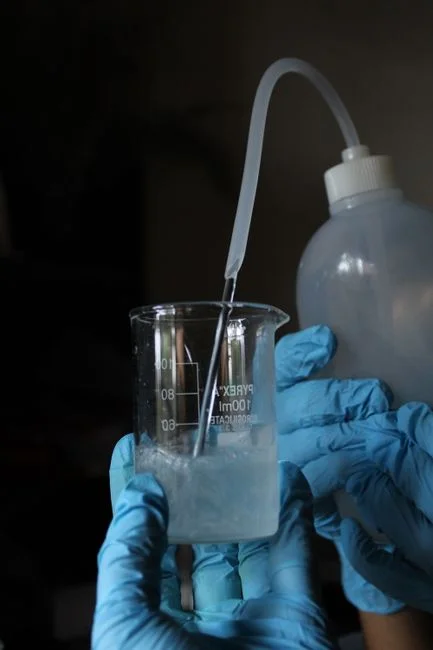
DAF sizing is governed by three knobs: hydraulic surface loading (4–20 m/h depending on floc density), air-to-solids ratio (0.005–0.060 with 0.02 a typical design point), and recycle rate (10–30% of forward flow). Pushing A/S higher produces a drier float but costs blower power and can shatter fragile floc; pushing recycle rate higher improves TSS removal but dilutes the chemistry and inflates equalization demand (HydropureWater 2026 US fabricated metals guide).
Floated metal-hydroxide sludge typically runs 2–5% dry solids out of the DAF and dewaters to 25–35% with a plate and frame filter press. A belt press is cheaper and continuous but caps out around 22% dry solids on metal hydroxide — if the hauler bills by wet ton, plate and frame pays back inside two years. A rotary mechanical bar screen upstream of the equalization basin keeps rags, wipes, and tramp metal out of the sludge train, which is the single most common cause of premature press-cloth failure. Alarm and shutdown interlocks on pH excursion, ORP out of range, and high TSS should auto-divert flow back to the equalization basin header so a chemistry upset does not become a discharge violation. For a plating-adjacent stream like rack wash, our DAF configuration for passivation chrome rinse walkthrough applies the same three knobs to a tighter influent envelope.
| DAF Sizing Knob | Typical Range | Design Point | Trade-off |
|---|---|---|---|
| Hydraulic surface loading | 4–20 m/h | 10–15 m/h | Higher loading = smaller tank, risk of floc washout |
| Air-to-solids ratio (A/S) | 0.005–0.060 | 0.02 | Higher A/S = drier float, more blower power, fragile floc |
| Recycle rate (% of forward flow) | 10–30% | 20% | Higher recycle = better TSS, larger equalization basin |
| Float solids (metal hydroxide) | 2–5% DS | 3% DS | Feeds sludge dewatering stage |
When Polishing Is Required: MBR, RO, and the 2026 PFAS Watch Item
Most fabricated metals plants hit sewer limits with the train above and never need a polishing step. The cases that do are predictable: SAWS tightens local limits below PSNS, the plant wants to reuse rinsewater and needs RO-quality feed, or a new rule forces a polish stage. EPA has a live PFAS rulemaking scoped to chrome finishing facilities in 2026 per the EPA Metal Finishing Effluent Guidelines page — there is no current numerical PFAS limit, but any 2026 design should treat anion exchange or GAC polish as a future bolt-on rather than a retrofit (HydropureWater 2026 US fabricated metals guide). The right move is to lay out the pretreatment train so a polish skid can be added later without re-plumbing the equalization basin.
The technology map is straightforward. For BOD/COD tightening or water reuse, a submerged PVDF MBR system delivers <1 μm filtration and stable effluent that can be sent to cooling tower makeup or rinsewater reclaim. For sub-ppm TDS or specific metal caps like nickel <0.1 mg/L, an industrial RO system is required, and the multi-media filter upstream must hold SDI15 below 3 or the RO membranes fail early. For the PFAS question, anion exchange or granular activated carbon is the proven polish step for the long-chain PFAS species tied to chrome plating. Closed-loop zero liquid discharge is rarely economic for a fabricated metals plant unless water scarcity or a specific reuse-economics case supports the capital. For a broader San Antonio cost and compliance framing, see our San Antonio industrial wastewater treatment cost and compliance guide.
| Trigger | Polish Technology | Effluent Target | Design Note |
|---|---|---|---|
| SAWS local limit tighter than PSNS | MBR or RO | Parameter-specific cap | Confirm against current permit letter |
| Rinsewater reuse | RO (after MBR polish) | <0.1 mg/L Ni, sub-ppm TDS | Multi-media filter SDI15 < 3 |
| 2026 PFAS rulemaking (chrome finishing) | Anion exchange or GAC | Future PFAS cap, no number today | Design for skid bolt-on, not retrofit |
| BOD/COD tightening for discharge | Submerged PVDF MBR | <1 μm filtration, stable BOD | Reuse-ready effluent |
Frequently Asked Questions
What is the difference between PSES and PSNS for a fabricated metals plant near San Antonio?
PSES (Pretreatment Standards for Existing Sources) applies to sources constructed before the 40 CFR Part 433 promulgation date; PSNS (Pretreatment Standards for New Sources) applies to sources built after that date and is the tighter of the two. Most POTW pretreatment programs, SAWS included, enforce PSNS-equivalent local limits on all industrial users as a conservative baseline, so even an existing plant should design to the PSNS column (per 40 CFR Part 433 Tables 1 and 2).
How does a fabricated metals plant remove hexavalent chromium before sewer discharge in San Antonio?
Hexavalent chrome is reduced to trivalent chrome using sodium metabisulfite (or ferrous sulfate) at pH 2–3, with ORP controlled at roughly 250–300 mV. The trivalent form then precipitates as Cr(OH)₃ in the pH 8.5–9.5 precipitation stage, where Cr(VI) hydroxide would otherwise remain soluble. Skipping the reduction step guarantees a Cr(VI) failure at the compliance sample.
When does a fabricated metals plant near San Antonio need an MBR or RO polish stage?
Polishing is needed when the POTW sets limits tighter than PSNS, when the plant reuses process water, or when a future rule forces it. MBR handles BOD/COD tightening and water reuse, RO handles sub-ppm TDS or specific metal caps like nickel <0.1 mg/L, and anion exchange or GAC handles the PFAS rulemaking EPA has in motion for chrome finishing facilities in 2026. The 2026 design move is to lay out the pretreatment train so a polish skid can be bolted on later.