
Why Phoenix Petroleum Operators Are Re-evaluating DAF vs. Clarifier in 2026
For Phoenix-metro petroleum bulk terminals, refineries, and tank-cleaning facilities, the DAF vs. clarifier decision has tightened sharply in 2026. Three local pressures converged: ambient wastewater temperatures routinely above 100 °F in summer, monsoonal storm surges that can triple influent flow over a six-hour window, and Arizona Department of Environmental Quality (ADEQ) enforcement of the AZPDES aquifer-protection overlay against unpermitted non-stormwater discharges at industrial sites. Severe Colorado River scarcity is also pushing every gallon of process water toward reuse or zero-liquid-discharge (ZLD), which means the primary clarifier is no longer a passive settler — it is a ZLD front-end.
The two streams look similar on a P&ID but sit on different sides of 40 CFR Part 435. Petroleum bulk terminals and tank farms with on-site oil/water separation generally fall under Subparts A–F (Oil and Gas Extraction point sources), while refinery wastewater — desalter brine, sour water stripper bottoms, and API separator effluent — falls under Subpart G (Refining). Both subparts impose monthly-average oil & grease limits in the 10–29 mg/L range depending on the subcategory (per EPA 40 CFR 435), and AZPDES permit limits typically run tighter for discharges to the Salt, Gila, or Verde River watersheds. A technology that underperforms on emulsified oil in summer will underperform on the permit, regardless of which subpart applies.
Ecologix's 2026 selection guide makes the framing explicit: there is no universal "best" technology, and the choice depends on wastewater composition, treatment goals, and operational constraints (Ecologix, 2026). That framing fits Phoenix exactly — the operating environment, not a vendor preference, should drive the decision.
How DAF and Clarifiers Actually Work in a Petroleum Stream
A dissolved air flotation (DAF) system pressurizes a recycle stream (typically 20–35% of the total flow) with air at 60–90 psig in a saturation tank, then releases it to atmospheric pressure inside a flotation cell. The pressure drop generates micro-bubbles in the 20–40 µm range that attach to oil droplets and suspended particles, lifting them to the surface where a skimmer removes the FOG layer (per Ecologix 2026; Hahn 2010). The clarified underflow exits the bottom of the cell. The mechanism is fundamentally a buoyancy process, not a settling process — which is why it works on emulsified oils with specific gravities close to water.
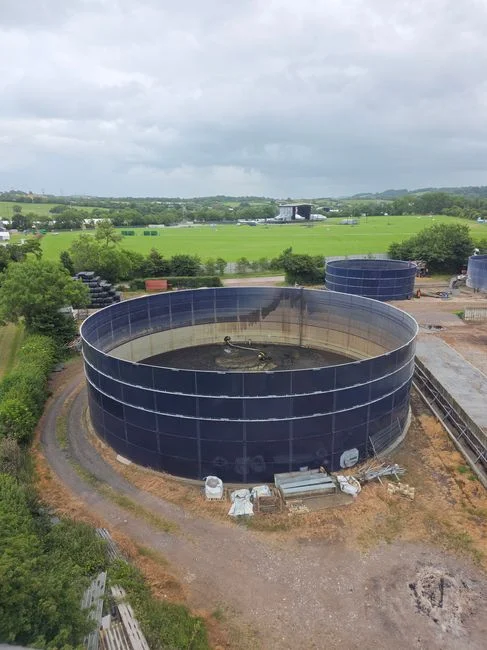
A gravity clarifier does the opposite. It depends on quiescent settling in a tank sized for the target hydraulic loading rate (typically 600–1,200 gpd/ft² for primary clarification). Heavier inorganic solids and sludge blanket settle into a bottom cone, where a rake or scraper concentrates them for pumping. Free oil that does not coalesce and emulsified oil with a specific gravity within ±0.05 of water largely passes through. This is why a clarifier alone removes 70% of oil & grease on a typical petroleum stream, compared with 90–95% for a DAF (per Ecologix 2026 and Hahn 2010). On inorganic sediment — sand, rust, scale — the clarifier outperforms a DAF because it was designed for that job.
Bubble quality matters in Phoenix. DAF Corp's Micro Bubble Generator delivers consistent 20–40 µm bubbles without coarse air entrainment 24/7, 365 days a year (DAF Corp). For a Phoenix plant running continuous summer shifts with hot saturation-tank water, consistent bubble size is what holds the 90–95% removal rate on a July afternoon when influent viscosity drops and emulsions shift.
A practical note for procurement: equalization upstream of either technology is cheap insurance. Hahn (2010) flags equalization tanks as a key DAF design variable, and the same logic applies to a clarifier fed by monsoon surges — a 4–8 hour buffer turns a 3× flow spike into a manageable 1.3× bump.
DAF vs. Clarifier: Head-to-Head Parameter Comparison
This is the 30-second scan. Match your influent numbers against the table before you walk into a vendor meeting.
| Parameter | DAF System | Gravity Clarifier |
|---|---|---|
| Target contaminants | Emulsified oil, FOG, fine TSS, light colloids | Heavy inorganic TSS, sand, scale, settleable solids |
| Oil & grease removal | 90–95% (Ecologix 2026; Hahn 2010) | ~70% (Ecologix 2026) |
| TSS removal | 85–98% (DAF Corp FC Maximizer 92–98%; RC UniMax 85–90%) | 50–80% on organic-light streams; higher on inorganic-heavy |
| Typical effluent TSS | 20–50 mg/L with chemical conditioning | 50–150 mg/L without downstream polishing |
| Footprint | Compact, shallow — skid units from 6 ft diameter | Large diameter/depth; civil basin dominates pad area |
| CAPEX class | Higher (skid, saturator, compressor, controls) | Lower equipment cost; higher civil cost |
| OPEX class | Moderate — air compressor, recycle pump power | Low energy; periodic sludge pump-out events |
| Climate sensitivity | Warm feed water helps saturation efficiency | Hot water reduces viscosity, worsens oil carryover |
| Best-fit stream | Refinery wastewater, produced water, terminal wash water with emulsified oil | Tank-bottom sludge, sand-laden wash water, cooling-tower basin sediment |
| Maintenance | Skimmer service, compressor, sat-tank inspection | Rake drive, sludge pump, scum baffles |
Two Phoenix-specific readouts from the table: DAF's warm-feed-water advantage is real — a hot influent reduces the heating load on a saturator and keeps dissolved-air efficiency stable through August. Clarifier's hot-water penalty is equally real — lower viscosity lets emulsified oil slip through the overflow weir, which is exactly when the monsoons hit and a permit excursion becomes expensive.
Matching Technology to Your Phoenix Wastewater Profile
The decision rule is short. The wastewater profile is the only thing that should drive the equipment choice.
- Free and emulsified oil > 200 mg/L O&G: Default to DAF as primary. A clarifier alone will not hit the 40 CFR 435 monthly-average limit on this stream (per EPA 40 CFR 435). Ecologix's oil & gas applications page specifically identifies DAF as "ideal for the oil and gas industry" because emulsified oils and low-density particles resist gravity settling (Ecologix, 2026).
- Heavy inorganic sediment, low oil (tank-bottom wash water with sand): A lamella or conventional clarifier can work as a low-OPEX pre-thickener upstream of DAF polishing. The clarifier protects the DAF from grit overload, and the DAF polishes the FOG that the clarifier lets through.
- Produced water from upstream operations: DAF is the primary answer, with downstream media filtration or membrane polishing if the goal is reuse. Produced water is the largest waste stream in oil & gas and contains emulsified oils, suspended solids, and dissolved organics (per Ecologix 2026).
- Refinery wastewater (Subpart G): DAF as primary treatment reduces COD and oil load significantly before biological polishing, per Ecologix's refining applications guidance. A conventional API separator followed by DAF is the standard 2026 train for refineries targeting AZPDES permit compliance.
- Bulk-terminal stormwater and tank-farm wash: A skid-mounted DAF in the 48–450 gpm range (DAF Corp skid offering) fits the pad-space constraints of most Phoenix terminals. The skid arrives pre-piped and pre-wired, which shortens the permit-to-commissioning window for a 2026 CAPEX line item.
A practical threshold: if the influent O&G is consistently below 100 mg/L and the TSS is dominated by inorganic grit above 200 mg/L, a clarifier-led train starts to make economic sense. Above 200 mg/L O&G, DAF is the safer answer for 40 CFR 435 compliance and AZPDES permit defense.
The 2026 Phoenix CAPEX and OPEX Reality
CAPEX and OPEX classes are well understood; verified 2026 Phoenix-specific dollar figures are not in the public research, and any vendor who quotes a number without a feed analysis is guessing. Treat the table below as a planning framework, then request a formal quote tied to your influent data.
| Cost Driver | DAF System | Gravity Clarifier |
|---|---|---|
| Equipment CAPEX | Higher — saturator, recycle pump, air compressor, skimmer, controls | Lower equipment cost |
| Civil / installation | Low — skid-mounted, shallow basin, small pad | High — large-diameter or deep basin, concrete work dominates |
| Power load | Recycle pump and air compressor (moderate continuous draw) | Sludge pump and rake drive (low continuous, peak on pump-out) |
| Chemicals (coagulant / flocculant / polymer) | Required for >90% oil removal on emulsified streams | Optional; sometimes used as a coagulation aid |
| OPEX class (per Ecologix 2026) | Higher upfront and operational costs | Lower operational cost |
| 2026 Phoenix-specific note | Hot summer feed water slightly reduces saturation energy penalty; monsoon equalization upstream is essential | Hot water lowers oil-removal efficiency; civil/land cost on tight Phoenix pads can erase equipment savings |
On flow range, the dissolved air flotation (DAF) system covers 4–300 m³/h (approximately 17–1,320 gpm) across 13 models, which spans the bulk of Phoenix-metro terminal and small-refinery flows in a single skid. The equipment-savings gap between a clarifier and a DAF often narrows once civil work, pad preparation, and Phoenix-metro installation labor are priced in — a real number for the procurement manager to pull from a quote, not from a vendor brochure.
Because no verified 2026 Phoenix-specific dollar figures were available in the research, do not commit CAPEX on a per-gpm rule of thumb. Pull a feed sample, run a jar test, and request a formal engineering quote against the actual influent.
When a Hybrid DAF + Clarifier Train Beats Either Alone
For Phoenix refineries and larger terminals, the 2026 default is not DAF or clarifier — it is DAF followed by a polishing clarifier or lamella unit. Ecologix's 2026 guide explicitly confirms that hybrid systems are valid and often necessary for complex streams (Ecologix, 2026). The split is straightforward: the DAF handles the 90–95% FOG removal and the bulk of the TSS, and a downstream high-efficiency lamella clarifier polishes residual TSS and thickens DAF float for haul-off. This train also matches DAF Corp's own hybrid configurations, which pair a DAF unit with a downstream clarifier for high-purity recycle loops. For facilities targeting partial reuse or ZLD in the Phoenix metro, this is the configuration that gets effluent TSS low enough to feed an RO unit without pretreatment fouling.
2026 Selection Checklist for Phoenix Petroleum Plants
- Pull a representative influent sample — measure O&G, TSS, COD, temperature, and flow variation. Capture a monsoon-spike sample, not just a base-flow sample.
- Compare your O&G and TSS concentrations to 40 CFR 435 Subpart limits and to your facility's AZPDES permit limits (per EPA 40 CFR 435 and ADEQ AZPDES).
- Default to DAF if O&G is above 200 mg/L or the stream carries emulsified oil. Default to a clarifier (or hybrid clarifier-DAF) if inorganic sediment dominates and oil is below 100 mg/L.
- Plan space and utilities: a DAF needs compressed air, a saturator, and a small pad; a clarifier needs a civil basin volume and a sludge pump-out route.
- Run a jar test and a pilot before scaling. DAF Corp's FC-60 pilot at 48 gpm is a realistic entry point for a Phoenix terminal before committing to a 500+ gpm production skid.
For cross-regional context, the same decision logic appears in our Nashville petroleum DAF vs. clarifier guide and in the pretreatment-focused Chicago petroleum pretreatment compliance guide. For a regulatory deep-dive on the oil & grease number itself, the oil and grease discharge limit compliance guide walks through the math that drives the 200 mg/L rule of thumb above.
Frequently Asked Questions
What oil and grease concentration should drive a Phoenix terminal toward DAF instead of a clarifier?
For streams with sustained O&G above 200 mg/L — typical of API separator effluent, desalter brine, and tank-bottom wash water — a DAF is the safer answer because it removes 90–95% of emulsified oil versus 70% for a clarifier (per Ecologix 2026 and Hahn 2010), which is what 40 CFR 435 monthly-average limits typically require. Below 100 mg/L O&G with inorganic-dominated TSS, a clarifier-led train can be cost-effective.
Is a hybrid DAF + lamella clarifier train the 2026 default for Phoenix refineries?
For most Phoenix refineries and larger terminals targeting AZPDES compliance and any form of reuse or ZLD, yes. Ecologix's 2026 guide explicitly endorses hybrid DAF-plus-clarifier configurations for complex streams, and a downstream high-efficiency lamella clarifier polishes TSS and thickens float for haul-off while the DAF handles the FOG load.
Do Phoenix summer temperatures above 100 °F change the DAF vs. clarifier decision?
They reinforce it. Warm feed water improves DAF saturation efficiency, which is a small OPEX gain, while hot water lowers viscosity and worsens oil carryover in a clarifier — exactly when monsoon surges hit and permit excursions become expensive. For continuous-shift summer operation, the DAF's bubble-size stability (20–40 µm, per DAF Corp) is the spec that holds the 90–95% removal rate through August.
What flow range does a skid-mounted DAF cover for Phoenix bulk terminals?
DAF Corp's skid-mounted FC Maximizers span 48–450 gpm in standard configurations, and the dissolved air flotation (DAF) system extends to approximately 17–1,320 gpm across 13 models, which covers the majority of Phoenix-metro terminal and small-refinery flows in a single pre-piped, pre-wired skid.