
Why Terre Haute Chemicals Plants Are Rethinking Primary Separation in 2026
The Wabash Valley chemicals cluster along the Indiana–Illinois border produces a mix of organic chemicals, plastics and synthetic fibers (OCPSF), inorganic chemicals, and agricultural formulations, all of which fall under 40 CFR Part 414 (OCPSF) or 40 CFR Part 415 (Inorganic Chemicals) federal effluent guidelines. The Indiana Department of Environmental Management implements those categorical limits through NPDES permits issued under Indiana Rule 327 IAC 5, and on reaches where the Wabash River is impaired for organics, nutrients, or metals, site-specific limits in the permit run tighter than the federal floor. Two influent streams drive the primary-separation decision in this cluster: raw process wastewater carrying emulsified oils, free FOG, and slow-settling colloids from resin, surfactant, and plasticizer operations; and pH-adjusted effluent from chemical precipitation that carries metal-hydroxide floc. Rising polymer prices, volatile electricity costs, and tighter discharge limits have made the DAF-vs-clarifier choice an OPEX question with multi-year consequences, not just a CAPEX line item. Plants that overspec a clarifier for an oily stream pay for it in polymer, and plants that overspec a DAF for hydroxide sludge pay for it in compressed air and recycle-pump energy.
How a DAF and a Clarifier Actually Separate Solids
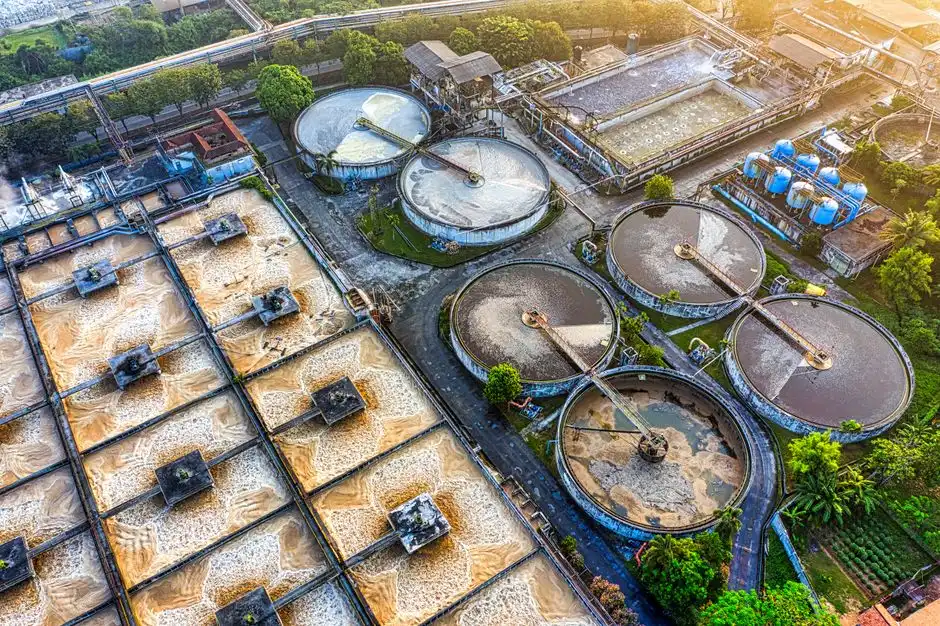
A DAF system saturates a side stream of recycle water with air at 4–6 bar, then depressurizes it through a needle-valve manifold inside the flotation cell; the dissolved air comes out of solution as a cloud of 10–100 μm microbubbles that attach to suspended particles, oil droplets, and floc, reducing their effective density and floating them to the surface where a top skimmer removes the float layer. The mechanism is fundamentally a buoyancy process, and it works best on material that "normally settles slowly, persists in suspension, or has a tendency to float" (Komline-Sanderson, DAF product description, 2026). A lamella clarifier uses gravity sedimentation, but the inclined plate packs multiply the effective settling area so surface loading rates reach 20–40 m³/m²·h in a footprint a fraction of a conventional basin. DAFs struggle with dense, fast-settling grit and high-specific-gravity metal-hydroxide sludge because the residence time is too short for the bubbles to lift heavy material before it falls to the floor. Clarifiers struggle with emulsified oils and FOG because the buoyancy force on a 5–20 μm oil droplet never overcomes the hydraulic residence time, and the oil exits the overflow weir instead of the underflow. A practical hybrid exists: a DAF can be fitted with bottom collectors to capture the heavy-solids fraction that drops out before the bubbles attach, which is useful in mixed chemicals streams (Komline-Sanderson, 2026).
DAF vs Clarifier: Side-by-Side Parameter Matrix for Chemicals Plants
This is the comparison to lift directly into an internal evaluation memo. Numbers below combine vendor field data and EPA cost-curve references; cite both when you reproduce the table.
| Parameter | Dissolved Air Flotation (DAF) | Lamella / Conventional Clarifier |
|---|---|---|
| Physical principle | Microbubble attachment reduces particle density; float skimmed from surface | Gravity sedimentation; inclined plates multiply settling area |
| Target contaminant | Emulsified oils, free FOG, low-density colloids, surfactant-stabilized dispersions | Heavy suspended solids, metal-hydroxide floc from precipitation, settleable inorganics |
| Oil & grease removal | ~95% (Ecologix 2026 field benchmark, food-processing stream) | ~70% (Ecologix 2026 field benchmark, same stream) |
| TSS removal | 60–80% on raw process water; higher on chemically conditioned streams | ~90% (Ecologix 2026, mining/solids benchmark); well matched to hydroxide floc |
| Footprint (per unit flow) | Compact; small tank volume due to short residence time | Very compact for lamella; conventional clarifiers need 3–5× the area |
| Surface loading rate | N/A (vertical separation) | 20–40 m³/m²·h (lamella); ~1 m/h (conventional) |
| Hydraulic residence time | 15–30 min typical | 2–4 h (conventional); 30–60 min (lamella) |
| Flow surge sensitivity | Moderate; recycle system buffers some hydraulic variation | High; clarifiers wash out under surge >2× design flow |
| Chemical demand (coagulant + polymer) | Coagulant (ferric or alum) plus polymer typical on FOG streams | Polymer-only typical downstream of precipitation; coagulant if fed raw emulsified stream |
| Dominant CAPEX driver | Air-saturation vessel, recycle pump, skimmer mechanism (EPA 821-R-98-016, §2.8) | Tankage and plate pack; lower baseline equipment cost (EPA 821-R-98-016, §2.2.2) |
| Dominant OPEX driver | Electricity for compressed air and recycle; 0.5 kWh/1,000 gal base (EPA 821-R-00-021) plus saturation-recycle load | Polymer dose and sludge hauling; lower kWh per gallon |
For a chemicals plant, the relevant "solids" are usually metal hydroxides from pH-adjusted precipitation rather than the mining sediment the 90% TSS benchmark is drawn from — but lamella clarifiers still outperform DAFs on that stream because the hydroxide floc settles fast once the pH window is correct. Polymer is the dominant OPEX line for both technologies; DAFs typically consume a coagulant plus a polymer on FOG streams, while clarifiers downstream of precipitation consume polymer only.
Matching Equipment to Terre Haute Influent Profiles
Three plant profiles cover the bulk of the Terre Haute cluster. Profile A — Organic or specialty chemicals with high FOG or surfactant load (resin manufacturers, plasticizer producers, surfactant formulators): install a DAF as the primary separation step. Komline-Sanderson explicitly recommends DAF for material that "settles slowly, persists in suspension, or tends to float" (2026), and the 95% oil-and-grease removal figure (Ecologix, 2026) is the only technology that will reliably meet the oil limits in the OCPSF subparts. A DAF system sized to 4–300 m³/h matches the flow range typical of single-process-line chemicals plants. Profile B — Inorganic chemicals with acidic or caustic neutralization and metal precipitation (legacy Terre Haute plants producing pigments, catalysts, or specialty inorganics): install a lamella clarifier downstream of pH adjustment and chemical precipitation, where surface loading of 20–40 m³/m²·h is well matched to the settling velocity of metal-hydroxide floc. Profile C — Mixed stream with both oil carryover and precipitation sludge: install a DAF first, then a clarifier, which is the same train EPA published cost curves for under the Oils 8/9 regulatory options (EPA 821-R-98-016, §2.7 and §2.8). The DAF strips the FOG before it coats the hydroxide floc and inhibits settling; the clarifier then handles the metal sludge cleanly. Because 40 CFR Part 414 subcategories differ in BOD and TSS limits, the "primary separation" choice should always be cross-checked against the plant's SIC code and the specific subpart that applies to the discharge.
40 CFR Part 414, IDEM Rule 327 IAC 5, and Why Equipment Choice Is a Compliance Question
For a chemicals manufacturer in Terre Haute, the equipment choice is a compliance choice before it is a process choice. 40 CFR Part 414 (OCPSF) and 40 CFR Part 415 (Inorganic Chemicals) set the federal baseline of BAT and PSES effluent limits, and IDEM implements those limits through NPDES permits issued under Indiana Rule 327 IAC 5. Where the Wabash River is impaired — the Indiana 2024 303(d) list still flags reaches for E. coli, nutrients, and PCBs in segments adjacent to the Vigo County outfalls — IDEM applies site-specific limits that are tighter than the federal categorical floor, particularly for metals, oil and grease, and BOD. A clarifier alone will not reliably meet oil and grease limits in most OCPSF subparts; a DAF alone will not reliably meet the TSS limits in the Metals Option trains that EPA's own costing document pairs it with. That is why EPA's Centralized Waste Treatment (CWT) Detailed Costing Document (EPA 821-R-98-016, December 1998; updated EPA 821-R-00-021, 2000) lists the Oils 8/9 model train as DAF plus downstream gravity separation, not as either unit operation alone. The practical consequence for a Terre Haute RFQ: request removal-efficiency guarantees tied to the plant's actual influent and the applicable 40 CFR Part 414/415 limit, not nameplate flow rates. Vendors that will not put a number on oil-and-grease or TSS removal against the categorical limit are not the right vendors.
CAPEX and OPEX: Reading the EPA Cost Curves for Terre Haute Sizing
For a defensible budget range, the open-source baseline is the EPA CWT Detailed Costing Document — Section 2.2.2 (Clarification, Metals Options 2/3/4) and Section 2.8 (Dissolved Air Flotation). EPA structures annual O&M as maintenance at 4% of total capital cost plus taxes and insurance at 2%, plus labor at $30,300–$31,200 per man-year, electricity at $0.08/kWh with a 0.5 kWh/1,000 gal baseline (EPA 821-R-00-021, 2000), and the chemical line items that matter for Terre Haute: lime at $57/ton, polymer at $3.38/lb, caustic at $560/ton, and sulfuric acid at $80/ton. Those unit prices are 1989 dollars; for 2026 budgeting, escalate them with the EPA construction cost index or a comparable PPI series, but keep the algorithm shape. Directionally, a DAF carries higher CAPEX because the air-saturation vessel, recycle pump, and skimmer drive are bolted onto every unit, and higher electricity per gallon because the recycle compressor and recycle pump run continuously on 20–50% of the flow. A lamella clarifier has lower CAPEX and the smallest footprint per unit flow, but it pulls more polymer when fed raw emulsified streams, because it must coagulate the oil droplets before gravity can settle them. For Terre Haute buyers, the cleanest RFQ practice is to bid both technologies sized to the same design flow and the same influent characterization, then sanity-check the vendor numbers against the EPA cost curves — if a vendor's CAPEX is more than ~2× the EPA curve at the same flow, ask why. Pairing the comparison with an automatic chemical dosing system is the cheapest way to keep the polymer line under control once the equipment is in service.
Decision Framework: Choosing DAF, Clarifier, or Both for Your Terre Haute Plant
Three questions resolve the equipment choice for most Terre Haute chemicals plants. Question 1: Is your influent oil- or FOG-dominated (resin manufacture, plasticizers, surfactants, specialty coatings)? → Specify a DAF as the primary separation unit; expect ~95% oil-and-grease removal (Ecologix, 2026) and verify against the OCPSF subpart limit. Question 2: Is your stream primarily metal-hydroxide floc from pH-adjusted precipitation (legacy inorganic chemicals, pigment production, catalyst manufacture)? → Specify a lamella clarifier at 20–40 m³/m²·h surface loading; expect ~90% TSS removal on well-conditioned hydroxide sludge. Question 3: Do you have both, or does the influent swing (mixed process lines, batch production, or variable surfactant and metal loads)? → Specify a DAF system followed by a lamella clarifier, which matches the EPA Oils 8/9 model train (EPA 821-R-98-016, §2.7/§2.8). Before issuing the RFQ, cross-check the chosen configuration against the plant's 40 CFR Part 414/415 subcategory limits and the site-specific oil, metal, and TSS limits in the IDEM NPDES permit issued under 327 IAC 5. The equipment choice should be defensible against the permit, not just the lab jar test.
Frequently Asked Questions
DAF or clarifier for chemicals wastewater — which is better?
For a chemicals plant, the answer depends on the dominant contaminant. A DAF removes ~95% of oils and greases from an emulsified stream, versus ~70% for a clarifier on the same stream (Ecologix, 2026). A clarifier removes ~90% of TSS from a settleable-solids stream and is the lower-OPEX option. Specify a DAF when the load is emulsified oil or FOG; specify a lamella clarifier when the load is metal-hydroxide floc from precipitation.
What is the cost difference between a DAF and a clarifier for chemicals wastewater?
Directionally, a DAF carries higher CAPEX (air-saturation system, recycle pump, skimmer) and higher electricity per gallon because it compresses air and recycles 20–50% of the flow; a lamella clarifier has lower CAPEX and the smallest footprint per unit flow but pulls more polymer when fed raw emulsified streams. Use the EPA CWT Detailed Costing Document (EPA 821-R-98-016, §2.2.2 and §2.8; updated EPA 821-R-00-021) as a sanity check against vendor bids at the same design flow and influent.
Can a DAF and a clarifier be used together for chemicals wastewater?
Yes. The DAF-then-clarifier train is the EPA-validated configuration for chemicals streams with both FOG and metal sludge, and is exactly the model train published in the EPA CWT Detailed Costing Document under the Oils 8/9 regulatory options (§2.7 Secondary Gravity Separation followed by §2.8 Dissolved Air Flotation). DAF first strips the oil so it does not coat the hydroxide floc; the clarifier then settles the metal sludge cleanly.
What regulations govern DAF-vs-clarifier selection for chemicals plants in Indiana?
Federal effluent guidelines 40 CFR Part 414 (OCPSF) and 40 CFR Part 415 (Inorganic Chemicals) set the baseline BAT/PSES limits. IDEM implements them through NPDES permits under Indiana Rule 327 IAC 5, and adds site-specific limits on impaired reaches of the Wabash River. Equipment choice should be defensible against both the categorical limit and the site-specific permit limit before the RFQ goes out.
What flow range and footprint should a Terre Haute plant expect from each technology?
The DAF covers 4–300 m³/h across 13 models, making it a fit for single process lines in a mid-size chemicals plant. The lamella clarifier operates at 20–40 m³/m²·h surface loading, which gives a very small footprint per unit flow compared to a conventional clarifier at ~1 m/h. For a mixed train, expect roughly the DAF footprint plus 30–60% additional clarifier area, depending on the metal loading.