Why Fort Lauderdale Transportation Plants Face a Different Wastewater Matrix
Fort Lauderdale transportation equipment factories generating oily parts-wash wastewater, metal-bearing coolants, and paint booth blowdown should choose a DAF as primary pretreatment in 2026. DAF delivers roughly 95% oil and grease removal versus about 70% for a gravity clarifier, and the float layer captures free and emulsified oils that would otherwise blind a clarifier. A lamella clarifier is then added downstream only if TSS polishing to 30 mg/L — the 40 CFR 133 secondary treatment standard — is required before discharge to the Broward County POTW.
The Fort Lauderdale/Pompano Beach/Hollywood corridor concentrates five transportation sub-sectors on a narrow strip: marine hardware fabricators serving Port Everglades, auto and truck parts remanufacturers, rail car repair shops, aerospace component finishers, and forklift/material-handling rebuilders. Each generates a wastewater matrix dominated by petroleum oils and lubricants, emulsified cutting fluids, zinc and chromium from galvanizing and plating rinses, copper and nickel coolants, solvent cleaners, paint booth water, and detergent-bearing parts-wash streams. EPA vessel graywater characterization lists the same contaminant family — oil/grease, metals (cadmium, chromium, lead, copper, zinc, silver, nickel, mercury), solids, nutrients, and pathogens (EPA NEPIS, 2011).
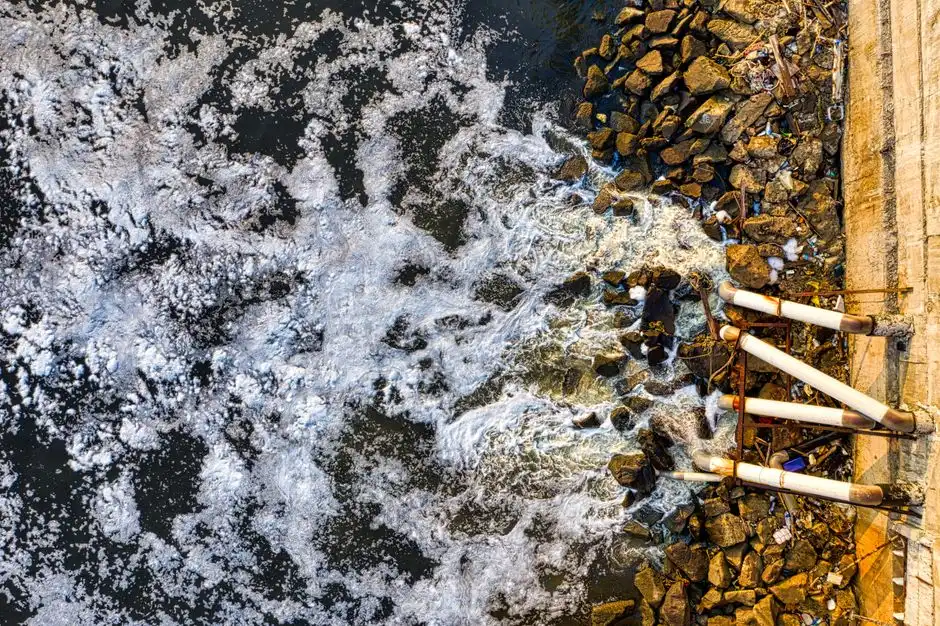
Geographic adjacency to Port Everglades and the Intracoastal Waterway pushes many of these plants within reach of vessel-discharge expectations modeled on the 2008 Vessel General Permit. EPA reports that 78% of VGP-regulated vessels operate on the Mississippi River System and Gulf Intracoastal Waterway, while only 21% ply the Atlantic, Pacific, and Gulf Coasts (EPA NEPIS, 2011). Fort Lauderdale's marine suppliers sit in that 21% Atlantic coastal cohort, where discharge scrutiny is tighter. Broward County FOG ordinance enforcement adds a domestic-style fat, oil and grease ceiling on top of the federal NPDES pretreatment framework, so a clarifier alone is rarely a defensible primary for this matrix.
How a DAF Works vs How a Clarifier Works
Dissolved air flotation systems saturate a pressurized side stream (typically 4–6 bar) with air and release the stream through needle valves at the bottom of a flotation tank. The pressure drop nucleates 20–80 µm micro-bubbles that attach to oil droplets and coagulated floc, lifting a 0.5–3% solids scum to the surface for skimming every 1–3 minutes. A HydropureWater dissolved air flotation system sized to 4–300 m³/h handles the full range from a single machine shop to a multi-line remanufacturing plant.
A gravity clarifier relies on Stokes-law settling: heavier particles fall to the bottom of a tank while clarified water overflows at the perimeter. The design lever is surface overflow rate, typically 1–2 m/h for primary clarifiers handling industrial wastewater, with sludge raked to a central hopper. A lamella (inclined-plate) clarifier stacks plates inside the tank to multiply the effective settling area, reaching 20–40 m/h effective hydraulic loading — an order of magnitude above a conventional clarifier, as published in the HydropureWater lamella clarifier design envelope.
Hydraulic retention drives the operational contrast: DAF runs at 20–40 minutes, conventional clarifier at 2–4 hours, and lamella clarifier at 60–90 minutes. DAF is the clear winner when production schedules demand fast turnaround on batch parts-wash dumps. The DAF pays for that speed with an air compressor, saturated recycle pump, and coagulant/polymer dosing; a clarifier needs only a sludge rake and intermittent polymer but pays for it in much larger tankage and floor space.
Head-to-Head: DAF vs Clarifier on Transportation Equipment Wastewater
The matrix below consolidates the operating envelope for the three configurations a Fort Lauderdale transportation plant engineer will actually evaluate.
| Parameter | DAF | Conventional Clarifier | Lamella Clarifier |
|---|---|---|---|
| FOG removal | ~95% (Ecologix, 2026) | ~70% (Ecologix, 2026) | ~70–80% on free oil; poor on emulsified |
| TSS removal | 70–85% | Up to 90% on heavy mineral solids | 80–90% with coagulant |
| Free oil capture | Excellent — float layer | Poor — oil coats settling surfaces | Marginal — plates foul |
| Dissolved metals with coagulant | Good via floc | Moderate | Moderate |
| Footprint for 50 m³/h | ~15 m² | ~60 m² | ~25 m² |
| Sludge solids % | 3–5% float | 1–2% underflow | 2–4% underflow |
| CAPEX band (50 m³/h, 2026) | 1.0× baseline | 0.55–0.75× baseline | 0.60–0.80× baseline |
| OPEX drivers | Air compressor, polymer, sludge hauling | Rake power, polymer, sludge hauling | Rake power, polymer, sludge hauling |
| Hits 40 CFR 133 alone (BOD5 30 / TSS 30 / pH 6–9) | Misses TSS on parts-wash matrix | Misses FOG ceiling | Misses FOG ceiling |
| Best fit | Oily parts-wash, cutting fluid, batch dumps | Heavy inorganic TSS, no oil | TSS polish downstream of DAF; small flows without oil |
For the mixed FOG + metals matrix typical of transportation plants, DAF outperforms because free oil blinds clarifier settling surfaces within hours of operation. A 50 m³/h DAF occupies roughly 15 m² versus 60 m² for a conventional clarifier and 25 m² for a lamella at the same hydraulic load, derived from the 20–40 m/h lamella surface loading and the DAF 4–300 m³/h published range. CAPEX for a DAF runs 1.3–1.8× a lamella clarifier of equal hydraulic capacity, but OPEX savings on sludge hauling and polymer typically recover the delta in 18–30 months for plants with FOG above 200 mg/L. The single-vendor configuration that hits 40 CFR 133 secondary standards on transportation wastewater is a DAF-primary plus lamella-polish hybrid, because neither unit alone clears the FOG ceiling and the TSS ceiling simultaneously on this matrix (EPA NEPIS, 2011).
When a Clarifier Alone Still Wins in 2026
A clarifier remains the right call in three Fort Lauderdale scenarios. First, heavy inorganic TSS with negligible oil — shot-blast dust and grinding swarf from a rail wheel shop, for example — settles more economically in a clarifier, hitting the 90% TSS reduction benchmark at lower cost per the Ecologix data. Second, small shops under 5 m³/h with consistent flow and no FOG should default to a single HydropureWater lamella clarifier: lower CAPEX, no compressed-air utilities, and a maintenance profile that fits a two-person maintenance team. Third, pilot plants and short-term R&D lines benefit from a packaged lamella clarifier on a rental skid that keeps utilities simple.
Operating temperature is another constraint; when influent temperature exceeds 50 °C — a condition seen at some hot rinse baths in plating and heat-treat lines — DAF micro-bubble efficiency drops because bubble size grows and attachment kinetics weaken. A clarifier is the more robust primary in that envelope, and DAF can still be considered downstream as a polish step once temperature is tempered.
The 2026 Recommendation for Fort Lauderdale Transportation Plants
For a 2026 facility expansion or NPDES renewal, the defensible decision framework is a three-rule logic the engineer can present to Broward County pretreatment staff.
Rule 1 — Specify a DAF as primary if any of the following apply: FOG above 100 mg/L, visible free oil, emulsified cutting fluids in the waste stream, pH swings during batch dumps, metals-bearing coolants, or shared discharge with vessel graywater subject to VGP expectations. The HydropureWater dissolved air flotation system covers 4–300 m³/h, which fits the dominant Fort Lauderdale plant sizes from single-line rebuilders to multi-line aerospace finishers.
Rule 2 — Add a lamella clarifier downstream whenever the Broward County pretreatment limit or the plant's NPDES permit requires TSS ≤30 mg/L or BOD5 ≤30 mg/L before discharge to the POTW, per 40 CFR 133 secondary treatment standards (EPA NEPIS, 2011). The HydropureWater lamella clarifier, operating at 20–40 m/h surface loading, polishes the DAF effluent into the 40 CFR 133 envelope without doubling the floor space.
Rule 3 — Skip DAF entirely when the plant is below 5 m³/h with no FOG, no emulsified oils, and no VGP adjacency. A single lamella clarifier is then the lower-CAPEX, lower-maintenance answer.
Pair the DAF with a HydropureWater automatic chemical dosing skid to stabilize TSS removal across load swings from batch parts-wash dumps and shift changes. The combined DAF-primary + lamella-polish configuration is the only single-vendor layout that clears both the FOG ceiling and the 40 CFR 133 TSS/BOD5 ceilings on transportation wastewater, which is why it is the configuration most 2026 plant engineers in the Fort Lauderdale corridor will specify. Engineers building the controls layer around this hybrid should also review the engineering guidance on a SCADA system for wastewater treatment plants to keep Broward County reporting auditable. For plants in adjacent logistics corridors evaluating parallel decisions, the framing tracks the petroleum-sector analysis in this DAF vs clarifier for petroleum wastewater in Mobile, AL guide and the fabricated-metals analysis in this DAF or clarifier for fabricated metals plants piece.
Frequently Asked Questions
What is the simplest rule for choosing between a DAF and a clarifier on Fort Lauderdale transportation equipment wastewater?
If the stream contains free oil, emulsified cutting fluid, or FOG above 100 mg/L — typical of parts-wash, coolant, and paint-booth flows — specify a DAF as primary. A clarifier is the right primary only when the stream is heavy inorganic TSS with negligible oil.
Do DAF or clarifier alone hit 40 CFR 133 secondary treatment standards on transportation wastewater?
No single unit does. 40 CFR 133 sets BOD5 at 30 mg/L monthly average, TSS at 30 mg/L monthly average, and pH 6.0–9.0 (EPA NEPIS, 2011). A DAF-primary plus lamella-polish hybrid is the configuration that clears both the FOG ceiling and the 40 CFR 133 TSS/BOD5 ceilings on this matrix.
How does Port Everglades adjacency change the pretreatment design?
Marine suppliers in the Fort Lauderdale/Pompano Beach/Hollywood corridor sit in the 21% Atlantic coastal VGP cohort, which faces tighter discharge scrutiny than the 78% Mississippi/Gulf Intracoastal cohort (EPA NEPIS, 2011). Broward County FOG ordinance enforcement layered on top of NPDES pretreatment makes a DAF-primary configuration the defensible default.