Why Chemical Plant Wastewater in Walton Is a Different Decision
Walton sits inside the Boone County industrial corridor between Cincinnati and northern Kentucky's organics and toll-manufacturing cluster, where organic chemicals, plastics compounding, agrochemical batch operations, and adjacent metal-finishing shops co-locate. Their combined waste streams do not behave like food-processing or refinery effluent: chemical-plant wastewater routinely swings pH from 1 to 13 between batches, carries solvent micro-emulsions, surfactant-stabilized organics, and fine colloidal API or polymer residues, and arrives at the pretreatment headworks in slug flows rather than steady streams. The compliance anchor is categorical: 40 CFR Part 414 (OCPSF — Organic Chemicals, Plastics, and Synthetic Fibers) sets the federal pretreatment bar for most of these facilities, while 40 CFR Part 433 governs adjacent metal-finishing lines, and both are enforced through local POTW Significant Industrial User (SIU) permits in the northern Kentucky service area. Generic DAF-vs-clarifier content misses the point because the decision is rarely either/or — chemical plants almost always need one unit for colloidal and FOG removal and another for heavy-metal hydroxide floc polishing, which is why most of the reference 40 CFR Part 414 pretreatment compliance guide for chemical plants frameworks recommend hybrid trains.
How DAF and Clarifiers Actually Separate Chemical Contaminants
DAF works by dissolving air into a pressurized recycle stream at 4–6 bar (per Komline-Sanderson design description) until the water holds roughly 6–10% air by volume, then releasing that recycle through needle valves into the contact zone where 10–100 µm micro-bubbles nucleate on emulsified oil, FOG, and fine colloidal particles. The attached bubble-particle agglomerate has effective density below water and floats to the surface in a thick scum layer that a top skimmer sweeps into a discharge hopper. Clarifiers rely on gravity; a lamella clarifier stacks inclined plates at 55–60° inside a rectangular tank to cut effective settling depth, which lets the unit run at surface loadings of 20–40 m/h while still delivering 85–90% TSS removal on conditioned floc (HydropureWater catalog, 2026). The published removal bands are consistent across vendors: DAF typically removes 60–80% TSS, 90–95% FOG, and 30–50% dissolved COD on chemical streams, while gravity/lamella clarifiers rarely exceed 30% FOG removal because emulsified oil droplets are too small and too neutrally buoyant to settle (Ecologix comparison, 2026). For a sizing sanity check, Hand et al. and the EPA fine-pore aeration manual (EPA/625/1-89/023, cited in Green and Sustainable Chemistry 2013) place diffused-aeration contact tanks at 2.74–4.57 m (9–15 ft) depth, which is the same envelope DAF contact zones fall into when saturated. Chemical conditioning is not optional at these loadings — coagulant (alum, PAC, or ferric chloride at 50–150 mg/L) and a polymer flocculant at 0.5–2 mg/L are typically required ahead of either unit to make the floc floatable or settleable rather than colloidal.
DAF vs Clarifier: 2026 Comparison for Chemical Plant Effluent
| Parameter | DAF (e.g., HydropureWater) | Lamella / Gravity Clarifier |
|---|---|---|
| Best-fit contaminant | Emulsified oils, FOG, surfactants, fine colloids, plasticizers, glycols | Heavy metal hydroxide floc, bulk TSS, polymer-conditioned biological sludge |
| TSS removal | 60–80% on chemical streams | 85–90% on conditioned floc |
| FOG / oil removal | 90–95% (Ecologix benchmark 95% on industrial stream) | Typically <30–70% (Ecologix benchmark 70% on comparable stream) |
| Dissolved COD reduction | 30–50% | Negligible without biological stage |
| Surface / hydraulic loading | 5–25 m/h depending on recycle ratio | 20–40 m/h on inclined plates |
| Typical polymer dose | 0.5–2 mg/L (cationic or anionic depending on charge) | 1–5 mg/L (often higher for hydroxide floc) |
| Footprint per m³/h | Compact; recycle pump dominates auxiliary load | Larger plan area; gravity-driven |
| Flow range (vendor catalog) | 4–300 m³/h across 13 standard models | 10–200 m³/h equivalent (vendor range) |
| OPEX drivers | Recycle pump + saturator power, polymer, nozzle/skimmer service | Polymer (up to 30% less than conventional clarifier per lamella design), rake torque |
| Sludge character | Thick float (2–5% DS), easy to dewater with filter press | Settled sludge (1–3% DS), often needs thickening |
| CAPEX tier (qualitative) | Higher — 1.5–2.5× equivalent lamella unit, before civil works | Lower — simpler tankage and rake mechanism |
| Hybrid option | Add bottom collectors to capture settled fraction (per Komline-Sanderson) | Often used as polish after DAF or biological stage |
For chemical-plant CAPEX reviews, the HydropureWater DAF system covers the FOG/emulsion side, while the HydropureWater lamella clarifier handles the settled-solids polish. Most Walton facilities that need both will run them in series, not in parallel.
Which Contaminant Profile in Walton Points to DAF First
Three chemical-plant scenarios justify DAF as the primary unit, with lamella relegated to polish duty:
Scenario A — Emulsified oils, surfactants, plasticizers, glycol carryover. Plastics compounding and resin batch reactors in the Boone County corridor generate stable oil-in-water emulsions that lamella plates cannot break; DAF delivers 90–95% FOG removal and 30–50% COD reduction before any biological polishing stage (Ecologix 2026 benchmarks).
Scenario B — Pesticide or pharma active-ingredient wash water. Fine suspended API residues behave as colloids; coagulant pretreatment with alum or PAC at 50–150 mg/L plus 0.5–2 mg/L polymer lets DAF float the API fines out before they pass through to the POTW. An automated chemical dosing system keeps the polymer-to-coagulant ratio stable across batch swings.
Scenario C — High-FOG resin or polymer-emulsion batch reactors. DAF sized at 20–30 minute hydraulic retention with a 15–25% recycle ratio handles peak FOG loads from emulsion polymerization reactors without foaming over, which a clarifier cannot do because the float layer simply re-enters the underflow.
When a Lamella or Conventional Clarifier Wins on Chemical Plant Sludge
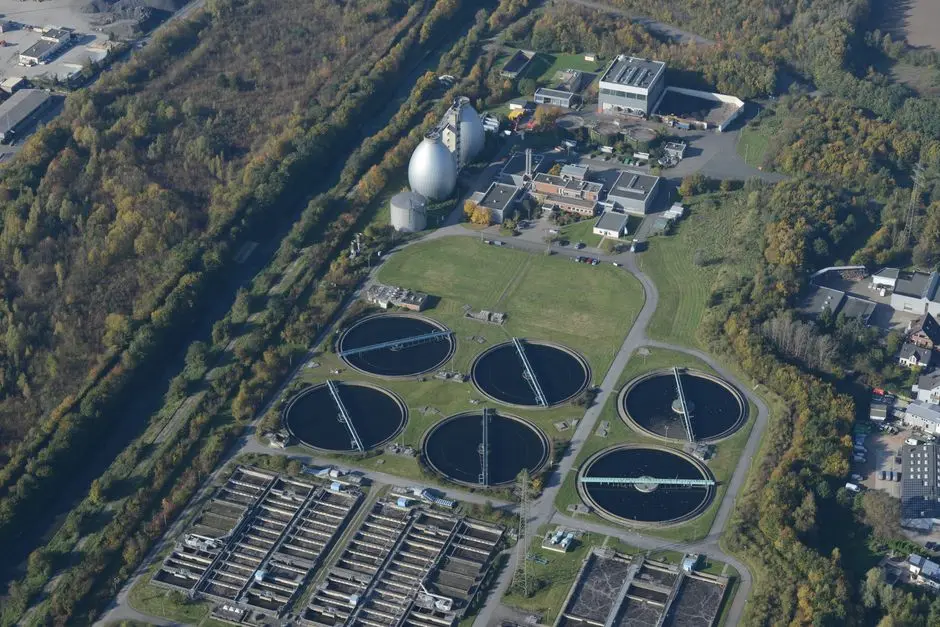
Not every chemical stream is a DAF candidate. Two profiles are clarifier-first:
Scenario D — pH-adjusted (8.5–10) heavy-metal-bearing wastewater from plating, catalyst, or pigment manufacture. Nickel, copper, zinc, and chromium hydroxide flocs settle rapidly once pH is controlled in this band; a lamella clarifier at 20–40 m/h surface loading gives 85–90% TSS removal at the lowest chemical dose of any primary unit, because the metal floc itself is the weighting agent and polymer demand is modest. The HydropureWater lamella clarifier is sized for exactly this duty.
Scenario E — Polymer-conditioned biological sludge from upstream MBR or activated sludge. When a chemical plant already runs biological treatment for dissolved COD load reduction, the downstream separator is clarifying conditioned biosolids, not raw FOG — and a lamella or conventional gravity thickener is the correct unit. In a hybrid DAF → equalization → MBR integrated wastewater treatment → lamella polish train, the lamella protects the discharge compliance point on TSS while the upstream MBR strips dissolved organics. Dewatering the combined sludge stream with a plate-frame filter press brings cake solids to 25–35% DS for offsite disposal.
Sono-electrocoagulation (SEC) is being promoted as a polymer-free alternative for chemical plants trying to cut sludge volume (Power & Water LinkedIn post, 2025-11). It is real engineering but still early in the chemical-sector reference base, so treat it as a pilot option rather than a primary recommendation.
2026 OPEX and Compliance Math for a Walton Chemical Plant
DAF OPEX is dominated by recycle pump and air saturator electrical load — typically 30–60% higher than an equivalent clarifier on a kW/m³-treated basis — plus polymer/coagulant dose and periodic nozzle and skimmer maintenance. Lamella clarifiers cut chemical consumption by up to 30% versus conventional clarifiers because the inclined plates shorten the settling path and reduce the polymer needed to grow pin floc (HydropureWater catalog, 2026). On CAPEX, a DAF unit runs roughly 1.5–2.5× the cost of a similarly rated lamella clarifier before civil works, but the gap narrows once you add the equalization basin, polymer feed skid, and saturator building a DAF requires. Meeting 40 CFR Part 414 OCPSF limits on organics and 40 CFR Part 433 limits on metals almost always requires FOG/emulsion control and a metal/TSS polish, so a single-unit solution is rare. Before final sizing, run a jar test on the actual plant effluent and, where possible, a DAF pilot rental (Komline-Sanderson explicitly offers this service) to confirm bubble-particle attachment on the real chemical stream rather than a synthetic lab surrogate.
Frequently Asked Questions
What is the primary difference between DAF and a lamella clarifier for chemical plant wastewater?
DAF floats emulsified oils, FOG, and fine colloids to the surface on 10–100 µm micro-bubbles generated from a 4–6 bar pressurized recycle, while a lamella clarifier settles heavier TSS and conditioned floc by gravity on 55–60° inclined plates at 20–40 m/h surface loading. On the same chemical stream, expect 90–95% FOG removal from DAF versus 60–80% TSS removal from a clarifier, which is why most chemical plants run them in series (per Ecologix 2026 and HydropureWater catalog 2026).
When should a Walton chemical plant choose DAF as the primary clarifier?
Choose DAF as the primary unit when the influent carries emulsified oils, surfactants, plasticizers, glycols, or fine colloidal API residues — typical of plastics compounding, resin batch reactors, and pharma wash water. Expect 90–95% FOG removal and 30–50% dissolved COD reduction ahead of biological polishing, sized at 20–30 minute hydraulic retention with 15–25% recycle ratio.
When is a lamella clarifier the correct primary unit for chemical effluent?
Use a lamella clarifier as the primary when the load is pH-adjusted heavy-metal hydroxide floc (Ni, Cu, Zn, Cr at pH 8.5–10) from plating, catalyst, or pigment lines, or polymer-conditioned biological sludge from an upstream MBR. Surface loading of 20–40 m/h on the inclined plates delivers 85–90% TSS removal at the lowest OPEX of any primary unit, with polymer demand typically lower than a conventional clarifier.