Why La Habra Chemicals Plants Are Re-evaluating Solids Removal in 2026
A La Habra plant manager reading a noncompliance letter from OC San in 2026 is facing a choice between dissolved air flotation and a lamella clarifier forced by the local Sewer Use Ordinance layered on top of 40 CFR Part 414 organic chemicals, plastics, and synthetic fibers subcategory (per EPA 40 CFR 414, 2026). OC San's 2026 Sewer Use Ordinance enforces a 100 mg/L FOG cap, a 250 mg/L TSS daily-max limit for noncategorical industrial users, and metals ceilings that often read tighter than the federal floor, which is why many specialty-chemicals, coatings, adhesives, and batch-formulation plants along the La Habra industrial corridor are re-evaluating the unit operation upstream of their DAF. The 40 CFR Part 414 organics subcategory effluent guidelines set BOD, TSS, COD, and pH limits that apply to most chemical manufacturing SIC codes 2869, 2899, 2821, and 2911 discharging to a POTW, and a noncompliant sidestream will trigger a written notice from OC San's Source Control division within 30 days. Equipment selection is the lowest-cost way to stay inside both layers of limits: a 40 CFR Part 414 pretreatment compliance playbook for chemical plants shows that retrofitting a clarifier when the stream is oil-bearing costs more than sizing the right unit the first time.
How a DAF Actually Treats Chemical Wastewater
Dissolved air flotation (DAF) removes suspended material by attaching 10–80 μm microbubbles to particles so their effective density drops below 1.0 g/cm³ and they float to the surface in 3–5 minutes of hydraulic residence time. The microbubbles are produced by saturating a recycle sidestream with air at 4–6 bar (typically 20–50% of forward flow), then depressurizing through a needle valve at the DAF inlet, where the dissolved air comes out of solution as a fine cloud (per Komline-Sanderson DAF product reference, 2026). Bubble-particle attachment is what makes the difference for chemical plant streams: emulsified oils, resins, latex residues, and low-density floc all float readily once a bubble sheath forms, which is why DAF typically achieves 90–95% FOG removal on oil-bearing chemical plant effluent. Standard auxiliaries on a packaged DAF include a 5–15 kW air compressor, a carbon-steel or stainless saturation tank, a recycle pump, a top skimmer, a sludge hopper, and an automatic coagulant and flocculant dosing skid for the chemistry that bonds bubbles to fine colloids. Without that chemistry, the bubble-particle collision efficiency drops and TSS removal falls below 50%, so coagulant + flocculant conditioning is a hard requirement on every chemical plant DAF. The packaged dissolved air flotation system integrates the saturator, recycle pump, and skimmer on a single skid for capacities from 5–30 m³/h.
How a Lamella Clarifier Treats Chemical Wastewater
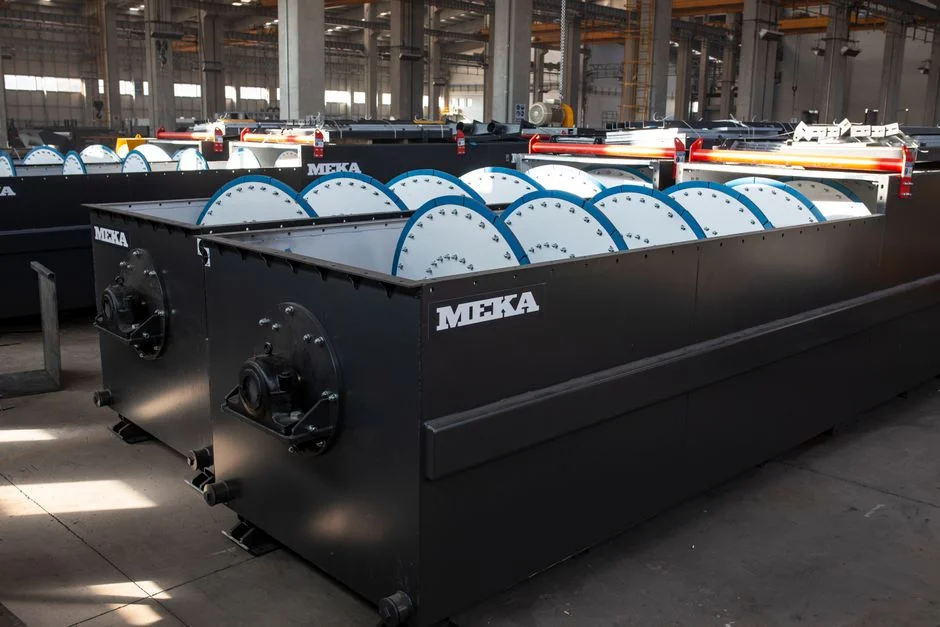
A lamella clarifier removes suspended solids by gravity sedimentation across an inclined-plate pack operating at 20–40 m/h surface loading rate, with the 55–60° plate angle letting settled sludge slide back to a cone-bottom hopper while clarified water rises through the plates (per HydropureWater lamella clarifier spec, 2026). These units provide a gravity-based alternative to flotation systems for heavier, non-emulsified particles. Residence time in the plate pack is 15–25 minutes, which is roughly four to five times longer than a DAF contact zone, so the clarifier trades time for energy — no compressed air, no saturation tank, and no recycle pump. Upstream flocculation is mandatory for fine chemical colloids, because raw feed at 50–100 μm particle size will pass straight through the plate spacing; a polymer dose of 1–5 mg/L plus a coagulant dose of 20–80 mg/L is typical for inorganic TSS streams from metal-finishing rinse, catalyst prep, or crystallization mother liquor. Standard auxiliaries are a sludge recirculation pump, a cone-bottom sludge hopper, and an optional plate-pack flushing system for calcium carbonate or silica scaling, but the unit has roughly half the auxiliary equipment count of an equivalent DAF. A HydropureWater lamella clarifier with sludge recirculation can cut coagulant demand by up to 30% by returning precipitated solids as seed floc.
DAF vs Clarifier: Side-by-Side for Chemical Plant Streams
The decision matrix below compares the two technologies on the eight parameters that drive a 2026 capital-projects selection for a chemical plant discharging to OC San. Removal efficiencies are drawn from a 2026 industry comparison; OPEX bands reflect typical coagulant, flocculant, energy, and maintenance spend for industrial units in the 5–30 m³/h range (HydropureWater field data, 2026).
| Parameter | Dissolved Air Flotation (DAF) | Lamella Clarifier |
|---|---|---|
| Removal mechanism | Microbubble flotation; density reduction | Gravity sedimentation across inclined plates |
| FOG / oil removal | 90–95% | ~70% |
| TSS removal | 60–85% (chemistry-dependent) | 85–95% |
| Footprint (m² per 10 m³/h) | 8–12 m² (incl. saturation tank + recycle skid) | 5–8 m² |
| CAPEX band (5–30 m³/h, 2026) | ~$35,000–$120,000 | ~$20,000–$80,000 |
| OPEX band (chemicals + energy + maintenance) | $0.08–$0.15 per m³ treated | $0.04–$0.08 per m³ treated |
| Chemical demand | Coagulant 30–100 mg/L + flocculant 2–8 mg/L | Coagulant 20–80 mg/L + flocculant 1–5 mg/L |
| Operator attention | Moderate — compressor, saturator, skimmer | Low — sludge pump, plate flushing |
| Sensitivity to flow surges | Low — 3–5 min residence buffers slugs | Moderate — plate pack scouring above 40 m/h |
The single most-cited gap in the table is the FOG row: 90–95% for DAF versus ~70% for a clarifier (per Ecologix 2026 DAF-vs-clarifier update). If the stream is going to push the OC San 100 mg/L FOG cap, the lamella clarifier cannot hold the line by itself and a DAF retrofit becomes inevitable. Conversely, on a heavy inorganic TSS stream the lamella clarifier hits 85–95% TSS at half the OPEX and roughly 60% of the CAPEX, with no air compressor to maintain.
Matching Technology to Your Influent: A La Habra Decision Flow
The right unit is determined by the dominant contaminant class, not by plant preference. Three branches cover nearly every batch-formulation and specialty-chemicals sidestream in the La Habra corridor, and each is anchored to the OC San or 40 CFR Part 414 limit it must hit.
- Oil, resin, or solvent-borne stream (coatings, adhesives, polymer batches, cleaning solvents): Choose DAF. Typical 2026 influent thresholds are oil > 200 mg/L, FOG > 100 mg/L, or specific gravity < 1.0. The 40 CFR Part 414 organics subcategory caps TSS at 250–375 mg/L depending on subpart, and OC San's 100 mg/L FOG cap is the binding constraint — DAF's 90–95% FOG removal is the only single-stage way to land under that ceiling.
- Heavy inorganic TSS stream (metal-finishing rinse, catalyst prep, crystallization mother liquor, pigment slurries): Choose a lamella clarifier. Trigger thresholds are TSS > 500 mg/L with FOG < 50 mg/L and specific gravity > 1.05. The 40 CFR Part 414 NOC subcategory and OC San's metals ceilings (e.g. copper 1.0 mg/L, zinc 2.6 mg/L daily-max) are usually the binding constraints, and a clarifier hits 85–95% TSS removal at half the OPEX of DAF.
- Mixed batches with intermittent slug loads (multi-product batch reactors, contract manufacturers, toll processors): Run a hybrid DAF → clarifier train. The DAF buffers the 3–5 minute slug response, the clarifier polishes residual TSS, and the combined train reliably hits both the 40 CFR Part 414 daily-max limits and OC San's local caps even on the worst batch of the week. Reference the Mojave chemicals-factory DAF vs clarifier guide for a parallel case in a different receiving POTW.
2026 Cost, Footprint, and Reuse Considerations
The 2026 CAPEX delta between a DAF and a lamella clarifier of the same hydraulic capacity is roughly $15,000–$40,000 in the 5–30 m³/h range, with a typical DAF skid landing at $35,000–$120,000 and an equivalent lamella clarifier at $20,000–$80,000 (HydropureWater field data, 2026). OPEX favors the clarifier by about 50% — $0.04–$0.08/m³ versus $0.08–$0.15/m³ for DAF — because the clarifier has no air compressor duty and a smaller pump inventory. Footprint is 30–50% larger for DAF once the saturation tank, recycle pump skid, and air compressor pad are counted, which matters on the older La Habra parcels where bay frontage is constrained. The reuse angle is where the CAPEX delta pays back: DAF effluent typically meets the inlet spec for an MBR polish step for in-plant water reuse, so a DAF → MBR train can replace 40–60% of fresh process water on a coating or adhesive line, while clarifier effluent almost always needs a secondary polishing stage before RO or reuse. The automatic coagulant and flocculant dosing skid on either technology is the single biggest controllable OPEX line, and a sludge-recirculation lamella design can cut coagulant use by up to 30% (HydropureWater lamella clarifier spec, 2026).
Frequently Asked Questions
When is a DAF mandatory over a clarifier for a La Habra chemicals plant discharging to OC San?
A DAF is effectively mandatory when the stream exceeds the OC San 2026 Sewer Use Ordinance 100 mg/L FOG cap, because lamella clarifiers only reach ~70% FOG removal versus 90–95% for DAF (per Ecologix 2026 DAF-vs-clarifier update), so the clarifier cannot hold the line on oil-bearing batches.
What 40 CFR Part 414 subcategory limits drive the technology choice for chemical plants in 2026?
40 CFR Part 414 organics and NOC subcategories cap TSS at 250–375 mg/L daily-max and COD at 400–1,600 mg/L depending on subpart
Frequently Asked Questions
Is DAF or a clarifier better for chemical plant wastewater in La Habra?
The choice between Dissolved Air Flotation (DAF) and a clarifier depends on the specific gravity and settleability of the suspended solids in your waste stream. DAF is generally superior for chemical wastewater containing emulsified oils, fats, or low-density particulates that have a specific gravity close to or less than 1.0, as it utilizes micro-bubbles to float contaminants to the surface for skimming.
Conversely, conventional clarifiers are more effective for heavier inorganic solids or high-density precipitates that settle rapidly via gravity. In the La Habra industrial context, chemical facilities often favor DAF systems if the effluent contains high concentrations of surfactants or hydrocarbons, whereas clarifiers are preferred for metal-heavy streams that require chemical flocculation and sedimentation.
What are the OC San discharge limits for chemical manufacturers in 2026?
Chemical manufacturers discharging into the Orange County Sanitation District (OC San) system must comply with stringent Local Limits defined in the Sewer Use Ordinance. As of 2026, typical industrial discharge limits include a pH range between 5.0 and 12.0, and specific mass-based or concentration-based limits for heavy metals such as Total Chromium, Copper, Nickel, and Zinc, which are often capped in the range of 1.0 to 5.0 mg/L depending on the facility’s specific industrial user permit.
Additionally, chemical plants must maintain Total Suspended Solids (TSS) and Biological Oxygen Demand (BOD) levels below the surcharge thresholds—typically 300 mg/L—to avoid significant monetary penalties. Facilities are required to conduct regular self-monitoring and submit quarterly reports to ensure compliance with the National Pollutant Discharge Elimination System (NPDES) requirements mandated by the Santa Ana Regional Water Quality Control Board.
How much does an industrial DAF system cost in 2026?
In 2026, the capital expenditure for a skid-mounted industrial DAF system typically ranges from $85,000 to $250,000, depending on the required flow capacity (ranging from 10 to 500 gallons per minute) and the complexity of the integrated chemical dosing skids. Systems constructed with 316L stainless steel to withstand corrosive chemical environments occupy the higher end of this price spectrum.
Beyond initial procurement, facilities should budget approximately 10-15% of the total system cost annually for operational expenses, including flocculant and coagulant consumption, electricity for the saturation pump and air compressor, and the disposal of thickened sludge. Custom engineering for hazardous area classifications (Class I, Div 1/2) required in certain chemical zones can increase total project costs by an additional 20-30%.
Can a DAF and clarifier be used together in a chemicals plant?
Yes, utilizing a DAF and a clarifier in series is a highly effective treatment train for complex chemical wastewater. In this configuration, the clarifier is typically placed upstream to remove the bulk of heavy settleable solids and large particulate matter, while the DAF unit serves as a secondary polishing stage to remove light, non-settleable suspended solids, emulsified oils, and residual colloidal matter that escaped the primary sedimentation process.
This combined approach significantly reduces the chemical demand in the secondary treatment stage and extends the operational life of downstream membrane systems or discharge filters. By splitting the load, the plant can achieve higher effluent consistency, ensuring that strict local discharge limits are met even during process upsets or variable influent loading scenarios.
What is 40 CFR Part 414 and which subcategory covers my chemical process?
40 CFR Part 414 constitutes the Effluent Limitations Guidelines and Standards for the Organic Chemicals, Plastics, and Synthetic Fibers (OCPSF) category. This federal regulation sets technology-based standards for wastewater discharges from industrial facilities involved in the production of organic chemicals, requiring the implementation of Best Practicable Control Technology (BPT) and Best Available Technology (BAT) to control pollutant discharge.
To determine your specific subcategory, you must identify your primary production process under the OCPSF framework, which is divided into six subcategories: (A) Non-complexed OCPSF, (B) Complexed OCPSF, (C) Plastics Molding and Forming, (D) Synthetic Fibers, (E) Non-continuous OCPSF, and (F) Miscellaneous Processes. Facilities must consult the specific SIC or NAICS codes assigned to their chemical synthesis or manufacturing line to confirm which subcategory—and its corresponding numerical effluent limit—applies to their specific facility in La Habra.