
Why Brownsville Chemicals Factories Are Re-Evaluating Clarification in 2026
Brownsville chemicals factories discharging to the Rio Grande basin face tighter pretreatment pressure in 2026 than they did five years ago, and the primary clarifier is where that pressure shows up first. The Brownsville Navigation District anchors a petrochemical, organic-chemical, and plastics-resin cluster whose wastewater streams contain free oil, emulsified hydrocarbons, FOG with chemical dispersants, flocculated metals, and high-TDS brine. Texas Commission on Environmental Quality (TCEQ) Chapter 305 and 307 surface-water discharge rules, plus EPA categorical pretreatment standards under 40 CFR Part 414, set the numeric envelope for TSS, oil and grease, and metals. Any comparison of DAF vs clarifier must be benchmarked against those limits, not generic food-processing removal percentages.
South Texas is moving toward closed-loop reuse and zero-liquid-discharge pilots, which means the primary unit must deliver tighter effluent than legacy designs were specified for. For a 2026 capex decision, this pushes buyers away from legacy technology and toward a system that explicitly handles chemical-industry contaminants under TCEQ/EPA limits. This guide provides engineers and procurement teams with that technology map.
How a DAF Actually Works on a Chemical Waste Stream
Dissolved air flotation injects pressurized recycle water saturated with air into the flotation tank, where the pressure drop nucleates 20-40 µm microbubbles (per the DAF Corp Micro Bubbler spec) that attach to oil droplets, FOG globules, and chemically flocculated solids. The bubble-particle aggregate becomes buoyant and rises to the surface, where a top-mounted skimmer removes the float layer; bottom collectors handle the small fraction that settles. Komline's design documentation confirms this architecture, including chemical pretreatment tanks, mixers, and metering pumps as standard ancillaries on a complete DAF system.
The mechanical principle matters because chemical-plant streams rarely arrive "float-ready." Emulsified oil, surfactant-stabilized latex, and colloidal metals require coagulant and flocculant chemistry to bridge particles before bubbles can attach. On an oily chemical stream documented by Ecologix, DAF hit 95% oil/grease removal versus 70% for a clarifier on the same feed. On free-floating hydrocarbons the gap is wider, as gravity cannot lift a buoyant droplet, causing a clarifier to let it pass downstream. DAF Corp's FC Maximizer line is rated at 92-98% TSS removal across 10-11,000 GPM, and the rectangular RC UniMax covers 10-1,000 GPM at 85-90% TSS removal, providing a single vendor family that scales from pilot to full-plant duty. A DAF system built on the same microbubble principle suits chemical streams where buoyant and fine-colloidal contaminants dominate the load.
How a Clarifier Behaves on Chemical Wastewater (and Where It Loses)
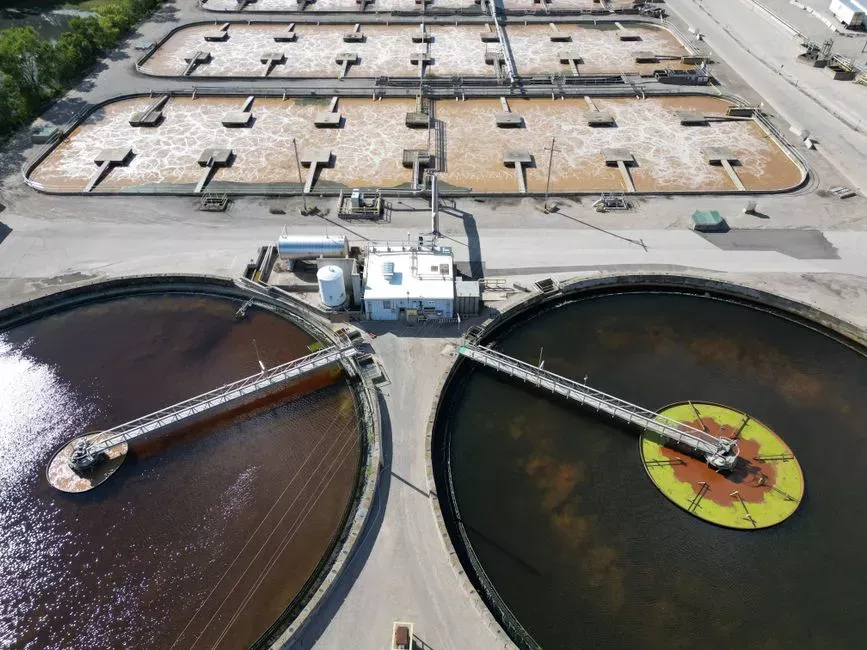
A gravity clarifier — circular, rectangular, or inclined-plate (lamella) — relies on differential settling velocity, so it outperforms DAF only when particles have a specific gravity well above 1.0 and sufficient footprint is available for long residence time. Ecologix documents a mining clarification case at 90% solids reduction with lower operating cost than a comparable DAF; the analogous logic in a Brownsville context applies to catalyst fines, lime slurries, gypsum-laden scrubber blowdown, and other heavy settleable solids common in fertilizer and inorganic-chemical plants. A HydropureWater lamella clarifier operating at 20-40 m/h surface loading compresses that footprint, but the physics still cannot float free oil.
Clarifiers are also sensitive to conditions that chemical plants produce routinely, such as hydraulic shock from batch discharges, short-circuiting when inlet baffles fail, and rising sludge caused by gasification or oily surface films. On an oily chemical stream, these failure modes are the steady state. A clarifier alone is rarely the right primary for a petrochemical or organic-chemical plant; it performs best downstream of a DAF or upstream as a thickener for heavy settleables.
DAF vs Clarifier: Head-to-Head Comparison for Chemical Streams
The fastest way to choose is to match the contaminant family to the technology that effectively removes it. The table below ties DAF and clarifier performance to the specific chemical-industry streams a Brownsville plant encounters.
| Parameter / Stream | Dissolved Air Flotation (DAF) | Gravity / Lamella Clarifier |
|---|---|---|
| Free oil & FOG | ~95% removal (Ecologix case data); 92-98% TSS at 20-40 µm bubble size (DAF Corp FC Maximizer) | ~70% removal on the same oily feed; buoyant oil passes through |
| Emulsified oil / surfactants | Strong, with coagulant + flocculant chemistry; standard ancillaries per Komline | Poor; emulsified droplets do not settle without long residence time |
| Heavy settleable solids (catalyst fines, lime, gypsum) | Bottom collectors available, but not the primary design point (Komline) | ~90% reduction at lower OPEX (Ecologix mining case) |
| Flocculated metals (pH-adjusted) | High removal when floc strength is good; sensitive to underdosing | Comparable if flocs are dense; better if solids have settled fraction |
| High-TDS brine / slurries | Not the right primary; DAF does not remove dissolved salts | Handles settleable fraction; RO/crystallizer handles dissolved load |
| Hydraulic sensitivity | Tolerates surges; recycle flow buffers the flotation cell | High; short-circuiting and rising sludge are routine failure modes |
| Footprint | Compact; circular DAFs 6-70 ft diameter (DAF Corp) | Large; lamella reduces area but still needs depth/volume |
| CAPEX tier | $$$ (skid, recycle pump, air-dissolving system, compressor) | $$ (tank, scraper, drives) |
| OPEX tier | $$ (energy + coagulant/flocculant dosing) — higher than clarifier "generally" (Ecologix) | $ (energy, sludge hauling) — lower OPEX "generally" (Ecologix) |
| Rule of thumb (decision framework) | Pick DAF if buoyant or fine-colloidal contaminants exceed ~20% of the load; pick clarifier if settleables dominate; pick hybrid if mixed — Ecologix confirms hybrid trains address complex streams by combining DAF oil removal with clarifier sedimentation. | |
Matching the Right Technology to Common Brownsville Chemical Streams
The matrix above translates into named plant scenarios that a procurement or process engineer can match against their own P&ID.
Petrochemical and organic-chemical raffinate — high free oil, light solvents, and dispersed hydrocarbons. DAF is the correct primary; a downstream clarifier functions as a sludge thickener rather than a polish step. Reference benchmark: DAF Corp FC-150 class, designed for 500 GPM with 2,000 ppm TSS reduced to 50 ppm.
Resin and polymer plants — emulsified latex, surfactant carriers, and wash-water with sub-100 µm droplets. DAF with coagulant dosing is the only credible primary; a clarifier alone leaves emulsified solids in the overflow and breaches TCEQ Chapter 305 limits. A automatic coagulant and flocculant dosing skid is mandatory.
Agrochemical and fertilizer plants — gypsum, lime slurry, ammonia-laden condensate, occasional pesticide carrier oils. Clarifier first to drop the heavy settleables; DAF polish if FOG or carrier oils appear in the waste stream. This is the one Brownsville scenario where a clarifier can legitimately be the primary.
Lubricant and oil-blending facilities — predominantly free oil, low TSS. DAF is the obvious primary, often with no clarifier at all in the train. A DAF system sized to peak GPM and 95% O&G removal covers compliance for most small-to-mid lube plants in the district.
2026 CAPEX and OPEX Framework for Brownsville Buyers
Procurement and engineering teams often balance different priorities, but the table below provides a clear comparison of cost drivers. DAF carries higher CAPEX (skid, recycle pump, air-dissolving system, compressor) and ongoing chemical dosing. The clarifier is cheaper to build but requires more footprint and sludge handling. Because clarifiers have lower OPEX "generally," but DAF is more cost-effective for oily contaminants, the decision should be driven by the primary compliance risk: if oil drives your risk, DAF is cheaper per kilogram removed.
| Cost Driver | DAF | Clarifier |
|---|---|---|
| Skid / tank + mechanical | $$$ | $$ |
| Recycle pump, air saturator, compressor | $$$ | $ (none) |
| Footprint / civil work | $ (compact) | $$$ (large basin) |
| Chemical dosing (coagulant, flocculant, pH adjust) | $$ (standard on chemical streams per Komline) | $ (only if metals precipitation) |
| Energy (compressors, recycle, skimmer drive) | $$ | $ |
| Sludge handling | $ (2-4% thickened float per DAF Corp) | $$ (larger volume, wetter) |
| OPEX per kg contaminant removed (oil-heavy stream) | $ (better — Ecologix) | $$$ (worse on oil) |
WesTech's mobile DAF (47'-6" x 8'-6" trailer, single-day setup, no foundation) is a 2026 option for short-term or pilot duty at Brownsville plants before committing to a permanent install — useful for proving O&G removal on a real feed before signing the capex PO.
Hybrid DAF + Clarifier Trains: The 2026 Default for Mixed Streams
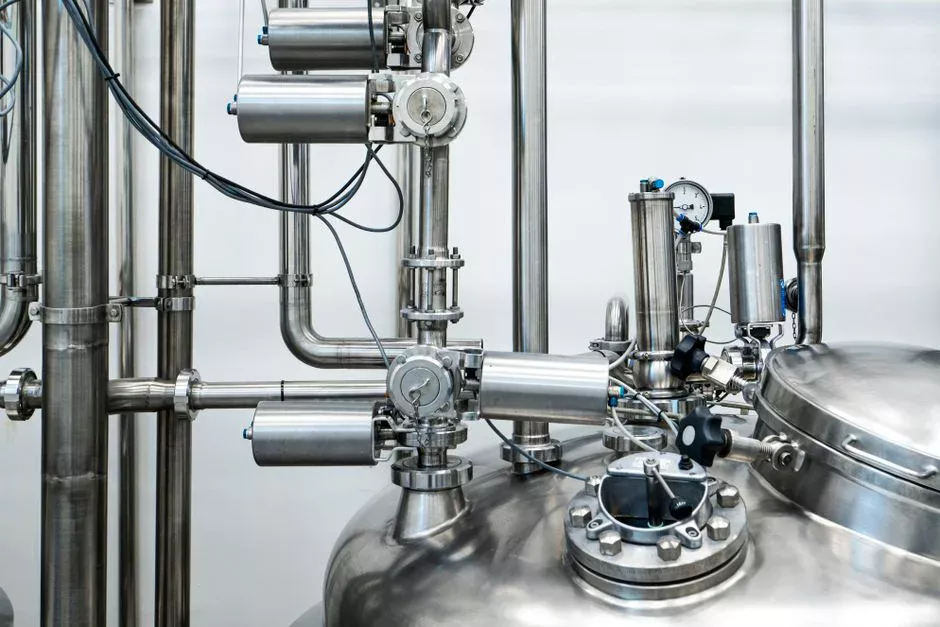
Most Brownsville chemical plants run a blend of contaminants that changes by shift. Ecologix confirms that hybrid systems address complex streams by combining DAF oil removal with clarifier sedimentation. The 2026 default train for chemicals wastewater in Brownsville is: equalization → pH adjustment → coagulant/flocculant dosing → DAF system → HydropureWater lamella clarifier → biological/RO polishing.
DAF Corp's flow envelope — FC Maximizer 10-11,000 GPM, RC UniMax 10-1,000 GPM — allows the same vendor family to cover pilot through full-plant duty, simplifying spares and process control. Frame the hybrid as a compliance hedge: if influent shifts from oil-heavy one week to solids-heavy the next, the train still meets TCEQ O&G and TSS limits without re-engineering. This hedge is the strongest argument for the hybrid default over a single-unit spec for a 2026 capex review.
Frequently Asked Questions
Which is better for oily chemical wastewater in Brownsville — DAF or clarifier?
DAF. On an oily chemical stream, DAF hit 95% oil/grease removal versus 70% for a clarifier (Ecologix case data), and DAF Corp FC Maximizer systems reach 92-98% TSS removal at the same time. Gravity clarifiers cannot float buoyant oil, so they let the compliance-driving contaminant pass through.
Does a hybrid DAF + clarifier train actually meet TCEQ Chapter 305 and 40 CFR Part 414 limits?
Yes, for TSS, oil & grease, and flocculated metals, the DAF-primary, clarifier-secondary train is the most compliance-robust layout for chemical-industry streams. DAF carries the
Frequently Asked Questions
DAF or clarifier for chemicals wastewater in Brownsville, TX — which is better?
The choice depends on the specific gravity and particle size of your chemical waste stream. Dissolved Air Flotation (DAF) is generally superior for chemical wastewater containing emulsified oils, fats, and low-density suspended solids that do not settle readily by gravity. Because Brownsville facilities often deal with fluctuating hydraulic loads and varying chemical concentrations, DAF units offer a smaller footprint and faster startup times compared to traditional circular clarifiers.
Clarifiers are more effective if your wastewater contains high concentrations of heavy, inorganic solids or metal hydroxides with high specific gravity. If your facility processes heavy chemical precipitates, a clarifier is often more cost-effective and energy-efficient, as it lacks the power-intensive air saturation systems required by DAF units.
What removal rates does a DAF achieve on chemical-plant oily wastewater?
A properly optimized DAF system can achieve Total Suspended Solids (TSS) removal rates between 80% and 95% and Oil and Grease (O&G) removal rates ranging from 90% to 98%. These rates are highly dependent on the effective use of coagulants and flocculants, which must be titrated to the specific chemical profile of the wastewater to destabilize emulsions.
Efficiency in 2026 systems is often bolstered by advanced dissolved air micro-bubble generation, which maintains bubble sizes between 10 and 100 microns. Maintaining a consistent air-to-solids ratio of 0.01 to 0.05 is critical to achieving these high-performance benchmarks in chemical plant applications.
Can a DAF and a clarifier be used together in a chemical plant?
Yes, utilizing both technologies in a series configuration is a common strategy for complex chemical waste streams. In this setup, the clarifier acts as a primary treatment stage to remove heavier, settleable inorganic solids, reducing the loading on the downstream DAF unit. This prevents the DAF system from becoming overwhelmed by high-density sludge, which can cause internal clogging and excessive sludge volume.
The DAF then functions as a secondary polishing stage, targeting emulsified oils, surfactants, and light-density chemical particles that pass through the clarifier. This hybrid approach ensures compliance when effluent must meet stringent discharge parameters for both heavy metals and chemical oxygen demand (COD).
What TCEQ or EPA pretreatment limits apply to chemicals factories in Brownsville?
Chemical factories in Brownsville must adhere to the EPA’s General Pretreatment Regulations (40 CFR Part 403), which prohibit the discharge of pollutants that pass through or interfere with the local Publicly Owned Treatment Works (POTW). Specific local limits are enforced by the Brownsville Public Utilities Board (BPUB), which regulates parameters such as pH (typically 6.0–9.0), oil and grease (often capped at 100 mg/L), and specific heavy metals like chromium, copper, and zinc.
Facilities must also comply with the Texas Commission on Environmental Quality (TCEQ) standards under 30 TAC Chapter 307 regarding surface water quality. Depending on the specific chemical processes, facilities may be subject to Categorical Pretreatment Standards under 40 CFR Parts 414 (Organic Chemicals, Plastics, and Synthetic Fibers) or similar subparts, requiring documented monitoring and periodic reporting of effluent toxicity.
How much does a DAF system cost for a small chemicals plant in 2026?
For a small chemical facility, a turnkey DAF system—including the flotation tank, air saturation pump, compressor, and chemical dosing skids—typically ranges from $85,000 to $220,000 in 2026. The wide price variance is driven by materials of construction, such as 316L stainless steel for corrosive chemical environments versus carbon steel, and the level of automated PLC integration required for real-time monitoring.
Beyond the capital expenditure, facilities should budget for annual operating costs, including electricity for aeration, chemical reagents (coagulants/flocculants), and sludge disposal fees. Total cost of ownership should also account for the high maintenance requirements of DAF systems, including periodic nozzle cleaning and seal replacements on saturation pumps, which can add 10% to 15% to the annual operational budget.