What Shipshewana transportation equipment factories actually discharge
Shipshewana, Indiana sits inside one of the densest clusters of small-to-mid-size transportation equipment manufacturing in the Midwest — a mix of RV and travel-trailer laminators, chassis and axle plants, and specialty-vehicle body shops, with most sites running between 10 and 80 m³/day. The waste streams are messier than the size suggests: lamination wash water carries fiberglass resin overspray, wax release agents, and floor-coat rinse residue; chassis and axle lines generate cutting oils, soluble coolants, and parts-washer discharge; and the powder-coat pretreatment lines upstream of paint spray add phosphate and chromate conversion-coating rinse water. A reasonable parameter envelope for this cluster is oil and grease 200–2,000 mg/L, TSS 300–1,500 mg/L, COD 500–3,000 mg/L, with pH excursions from acid pickling that can swing a day's worth of equalization capacity if not properly buffered. Flow is batchy, with sharp spikes during shift change and process tank dumps — a single floor-sweep at an RV laminator or a coolant sump dump at a chassis plant can double the influent loading for two hours.
These plants typically discharge to the LaGrange County Regional Sewer District POTW (or, for a few sites, the Topeka WWTF) under an IDEM-administered Industrial Pretreatment Program permit. The federal anchor is 40 CFR Part 433 for the metal-finishing wash lines and 40 CFR Part 438 for aqueous parts-cleaning operations, and the local POTW typically layers on a small surcharge schedule for oil and grease, zinc, lead, and total phosphorus. The discharge profile is dominated by emulsified oil and TSS, not heavy metals or nutrients — which is exactly the corner of the treatment map where a DAF system outperforms a conventional clarifier, while a HydropureWater lamella clarifier remains a credible alternative when the oil shifts toward free-phase or flow climbs above 80 m³/day.
The 2026 regulatory frame: 40 CFR 433, 40 CFR 438, and IDEM pretreatment
Two federal categorical standards do most of the compliance work for this cluster. 40 CFR Part 433 — the Metal Finishing Point Source Category — covers the phosphate and chromate conversion-coating rinse lines that nearly every transportation equipment plant runs in front of its paint operation, and it sets daily maximum limits and monthly average limits for oil and grease, TSS, total metals, and pH. 40 CFR Part 438 — the Transportation Equipment Cleaning Point Source Category — was written for aqueous parts-cleaning operations and is the better fit for chassis wash bays and engine-degrease stations. The boundary between 433 and 438 is a frequent audit question, and the practical rule is: if the waste comes off a metal-finishing or pretreatment line, it falls under 433; if it comes from a parts washer or aqueous cleaning station, it falls under 438. Many Shipshewana plants have both, and IDEM will apply whichever subcategory governs each individual waste stream before they are combined.
The Indiana Department of Environmental Management (IDEM) administers the Industrial Pretreatment Program for the LaGrange County Regional Sewer District and the smaller Topeka WWTF. Most local limits in the area follow the federal categorical standards directly, with modest local additions — typically a tightened oil and grease ceiling (often 50 mg/L daily max), a total phosphorus watch-out for plants discharging into nutrient-sensitive receiving waters, and a 24-hour composite sampling requirement for flow above 50 m³/day. The compliance implication is straightforward: oil and grease is the parameter most likely to trip a small POTW surcharge, and a technology with a higher oil/FOG removal margin — a DAF at 80–95% versus a clarifier at 40–60% — gives the plant more headroom in the audit binder. For a deeper dive on the categorical structure and how peer plants in adjacent counties are handling it, the transportation equipment 2026 pretreatment compliance guide for Decatur plants and the 2026 pretreatment guide for transportation equipment plants near Russellville lay out the same framework for comparable industrial clusters.
How a DAF actually separates oil and solids in a transportation equipment plant
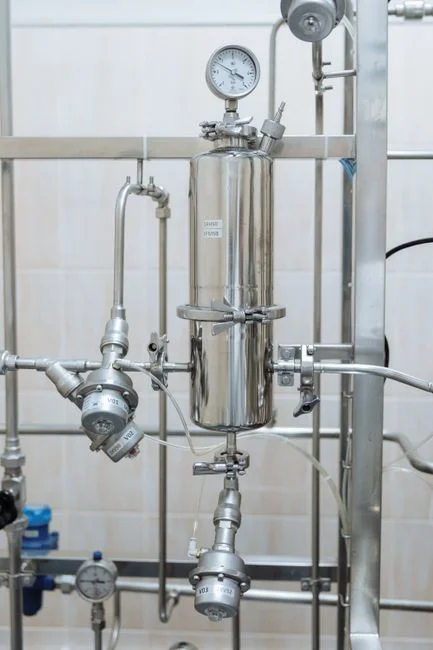
On the plant floor, a dissolved air flotation unit does its work in three coupled stages. First, the influent is dosed with a coagulant (typically a ferric or aluminum salt) and a polymer to agglomerate fine oil droplets and suspended solids into pin-floc. Second, a saturator pump pressurizes a sidestream of clarified water to 5–7 bar with air, and that air-saturated recycle stream is released into the flotation cell through needle valves or special nozzles — the pressure drop flashes the dissolved air out as a dense cloud of 10–50 µm micro-bubbles. Third, those bubbles attach to the oil-coated floc, the aggregate becomes buoyant, and the float rises to the surface in 3–5 minutes where a surface skimmer drives it into a sludge hopper; the clarified underflow exits the bottom of the cell.
Published research on oily industrial streams backs the design. A Durban University of Technology study on optimising DAF for separating industrial mineral oil from water (per DUT 2023) demonstrated that bubble–particle attachment efficiency is the rate-limiting step, which is exactly what the saturator design and recycle ratio control. The ASABE pre-DAF membrane study (Abboah-Afari and Kiepper, 2012) used raw poultry processing wastewater as a model for high-strength organic industrial waste and showed that DAF reliably does the heavy lifting on bulk COD and TS removal — up to 89% COD reduction at the membrane polishing stage built on top of a DAF — which mirrors the role DAF plays as the primary FOG and TSS step in a transportation equipment treatment train. For Shipshewana plants that need the same oil-and-solids reduction in a small indoor footprint, the DAF system packages those three stages into a single skid.
How a clarifier works — and why it struggles with Shipshewana-type waste streams
A conventional clarifier is a simple gravity-settling basin — circular with a center-feed well and rotating sludge scraper arms, or rectangular with chain-and-flight collectors. The hydraulic retention time is typically 1–2 hours at design flow, and the basin is sized on a surface overflow rate of 1–3 m/h for primary treatment. A lamella clarifier stacks a series of inclined plates (typically 55–60° from horizontal) inside a compact tank, and the plates multiply the effective settling area by 5–10× compared with a conventional basin of the same footprint. The HydropureWater lamella clarifier, for example, is rated for a surface loading of 20–40 m/h, which is why it pulls the same clarification work into a tenth of the floor area.
The physics limit both variants when the influent is emulsified oil. Oil droplets below ~20 µm settle too slowly for gravity-driven removal without aggressive upstream chemical treatment, and even with polymer dosing, free-oil recovery on a clarifier is typically 40–60% — roughly half the 80–95% a DAF achieves, because DAF's micro-bubbles are actively transporting oil to the surface rather than waiting for gravity to do it. The lamella plates improve oil capture modestly by shortening the path a droplet has to rise, but they do not change the fundamental physics. There is also a real Shipshewana-specific operational risk: a conventional outdoor clarifier in January, with ambient temperatures dropping below −20 °C, faces ice damage to skimmer arms, weirs, and launder channels. A lamella clarifier placed indoors or in an insulated enclosure largely eliminates that risk, but it still leaves the emulsified-oil removal gap.
DAF vs clarifier head-to-head: the five engineering axes that matter in Shipshewana
The table below organises the comparison along the five engineering axes a Shipshewana procurement lead will actually feel in 2026: removal performance, footprint and HRT, chemical use, freeze vulnerability, and capital cost. Numbers are engineering-typical ranges for a 30 m³/day plant (per HydropureWater product-class specifications, 2026; Durban University of Technology DAF optimisation, 2023).
| Parameter | DAF | Conventional clarifier | Lamella clarifier |
|---|---|---|---|
| Oil & grease removal | 80–95% | 40–60% | 50–70% |
| TSS removal | 70–90% | 50–70% | 60–80% |
| FOG removal | 80–95% | 35–55% | 45–65% |
| Hydraulic retention time | 3–5 minutes | 1–2 hours | 20–40 minutes |
| Footprint at 30 m³/day | 8–15 m² (single skid) | 60–120 m² open basin | 6–12 m² indoor unit |
| Polymer/coagulant use | Lower dose — micro-bubbles do much of the floc transport | Higher dose — relies on floc weight for settling | Moderate dose — shortened settling path reduces polymer demand |
| Freeze vulnerability (IN winter) | Low — enclosed insulated tank, can sit indoors | High — open basin, exposed weirs and skimmers | Low if indoors; moderate if outdoor enclosure |
| Siting flexibility | Single skid fits inside an existing production building | Requires outdoor civil works and a larger site footprint | Requires indoor headroom (3–5 m) for the plate pack |
| Typical CAPEX at 30 m³/day (USD) | 80,000–180,000 skid + civil + dosing + instrumentation | 40,000–90,000 tank + significant civil works | 60,000–120,000 unit + civil + dosing |
The headline comparison is the roughly tenfold footprint advantage of a DAF or a lamella clarifier over a conventional settling basin, paired with the DAF's roughly doubled oil-removal margin. For a plant on a tight Shipshewana lot with no room to pour an outdoor concrete basin, or for a plant whose audit binder is being graded on a 50 mg/L oil and grease ceiling, those two differences are the decision.
When a clarifier still wins: the 2026 decision rule
A clarifier is the right pick in three specific Shipshewana scenarios. First, when flow exceeds ~80 m³/day and the oil is predominantly free-phase (separated at the source or skimmed easily from an upstream interceptor), the surface-loading economics of a large concrete basin start to outweigh DAF's removal-margin advantage. Second, when the plant already has a heated indoor space with 3–5 m of headroom — common in older chassis plants with high-bay production — a HydropureWater lamella clarifier compresses the footprint of a conventional clarifier by 5–10× and captures 50–70% of the oil at moderate cost, which is acceptable if the downstream POTW local limit is forgiving. Third, when the plant is already running a DAF as primary treatment and needs a downstream equalization/polishing step, a small lamella clarifier is a legitimate, low-energy polishing stage.
The decision rule, in one line: Shipshewana transportation equipment plants under 50 m³/day with emulsified oil, phosphate rinse, or limited indoor space should specify a DAF system as primary; plants over 80 m³/day with predominantly free oil, outdoor civil space, and indoor siting available should specify a lamella clarifier. Many real plants in the cluster end up with a hybrid — a small DAF as primary, followed by a lamella as polishing/equalization before POTW discharge — which is a defensible 2026 configuration when the permit requires a tight oil and grease ceiling and the flow has noticeable diurnal variation.
2026 cost picture for a typical 30 m³/day Shipshewana plant
Translating the technical comparison into the dollar figures a procurement manager needs to move forward: the order-of-magnitude CAPEX for a 30 m³/day DAF system in 2026 is roughly USD 80,000–180,000 for the DAF skid alone, plus USD 30,000–60,000 for civil work, a chemical dosing skid, and basic instrumentation — call it USD 110,000–240,000 fully installed. A lamella clarifier at the same flow is typically USD 60,000–120,000 for the unit, but the civil scope (foundation, piping, equalization) is comparable, so the total installed cost is often within 10–15% of a DAF installation. A conventional outdoor concrete clarifier is the lowest equipment cost (USD 40,000–90,000 for the tank and scraper mechanism) but the highest civil cost once excavation, rebar, and weirs are priced in cold-weather concrete work.
The 5-year OPEX delta is dominated by sludge disposal and polymer consumption. DAF float is typically 3–6% dry solids — thick enough to handle with a small filter press or a dewatering bag — while clarifier underflow is more dilute and produces 2–3× the liquid volume to haul. The table below sketches the order-of-magnitude economics for a 30 m³/day Shipshewana plant.
| Cost line | DAF | Lamella clarifier | Conventional clarifier |
|---|---|---|---|
| Equipment CAPEX (USD) | 80,000–180,000 | 60,000–120,000 | 40,000–90,000 |
| Installed CAPEX (USD) | 110,000–240,000 | 110,000–220,000 | 140,000–280,000 |
| Polymer use | Lower dose | Moderate | Higher dose |
| Sludge dry solids | 3–6% (handleable) | 1–3% | 1–2% |
| Sludge volume hauled | Baseline | 1.5–2× baseline | 2–3× baseline |
| Downstream dewatering | Small filter press or dewatering bag | Larger dewatering unit | Largest dewatering unit |
| Chemical dosing skid | Required — see automatic chemical dosing system | Required | Required |
One financing hook worth flagging: the 2026 federal low-interest clean-water infrastructure programme referenced in the 2026 Jasper Indiana wastewater infrastructure funding case is a realistic path for small LaGrange County plants that need to upgrade primary treatment — a 30 m³/day DAF or lamella installation can often be packaged into a similar tri-government funding application with the local POTW as a co-applicant.
Frequently Asked Questions
Does a DAF work in an unheated Indiana building in January?
Yes, with a basic enclosure and 50–100 mm of insulation on the saturator and recycle lines, a DAF skid operates reliably at ambient temperatures down to roughly −15 °C, and with trace heating on the saturator pump head it tolerates sub-zero conditions indefinitely. An open outdoor clarifier is the higher freeze risk — ice on weirs and skimmer arms is a structural and operational hazard that a DAF simply does not have.
Which categorical standard applies to an RV laminator versus a chassis parts washer?
Most RV body operations — lamination wash, phosphate conversion coating, paint pretreatment rinse — fall under 40 CFR Part 433 (Metal Finishing). Aqueous parts-cleaning operations at a chassis plant fall under 40 CFR Part 438 (Transportation Equipment Cleaning). When a single plant has both, IDEM applies whichever subcategory governs each individual waste stream before they are combined, and the higher standard typically controls for overlapping parameters like oil and grease and TSS.
Can a DAF handle phosphate and chromate rinse water?
DAF removes the oil and TSS load that often carries precipitated metals, and it consistently produces effluent well inside the categorical oil and grease limits. Metals precipitation (pH adjustment, ferric coagulant, and clarifier or media filtration) is a separate downstream step that IDEM typically requires for chromate and other regulated metals — DAF is the primary FOG/TSS stage, not a complete metals-removal system on its own.
How often does the float sludge need to be removed?
For a 30 m³/day plant running one or two shifts, a DAF skims float continuously to a sludge hopper, and the desludging interval is typically once per shift — about 15–30 minutes of operator time. A downstream filter press or dewatering bag handles the hopper contents in batch.
Is a DAF or a clarifier better for a brand-new plant in 2026?
For most brand-new Shipshewana transportation equipment plants, a DAF is the better primary specification: smaller footprint, better oil removal margin, easier permitting, and a defensible audit trail against 40 CFR 433/438. The final answer still depends on the influent characterisation that IDEM requires as part of the permit application, but for a generic 10–50 m³/day RV or trailer plant with emulsified oil and phosphate rinse, a DAF is the default-correct choice in 2026.