
Phase 1: Permit Transferability & Regulatory Gap Audit
Belt mistracking and compliance failures in legacy facilities frequently stem from the oversight that an Environmental Protection Act 1986 (WA) license is not automatically assignable upon asset acquisition. The primary regulatory risk involves the Section 52 transfer application, where the Department of Water and Environmental Regulation (DWER) assesses whether the incoming entity satisfies the 'fit and proper person' test, a process typically requiring 60-90 business days of administrative review. Failure to secure this transfer prior to operational handover can result in immediate shutdown orders if discharge limits are breached under the legacy license.
Due diligence must include a formal audit of the Contaminated Sites Act 2003 status. Any premises listed on the DWER contaminated sites database may carry mandatory investigation or remediation notices that attach to the land, not the operator. Engaging a DWER-accredited contaminated sites auditor to review historical monitoring data and site soil/groundwater reports is a standard requirement, with audit costs ranging from $50,000 to $150,000. Licenses issued prior to 2015 often lack modern financial assurance clauses; expect DWER to impose new closure and rehabilitation bonding requirements as a condition of license novation.
- Green (Routine): License is current, zero non-compliance reported in 24 months, no contamination notices on title.
- Amber (Conditional): Minor historical exceedances, license requires minor amendments for current production rates, or DWER mandates a site management plan update.
- Red (High Risk): Active remediation notice, pending prosecution for unauthorized discharge, or license conditions incompatible with proposed production throughput.
Phase 2: Mining-Specific Wastewater Characterization Protocol
Standard municipal wastewater sampling fails to capture the chemical complexity of mining operations, where Acid Mine Drainage (AMD) parameters—specifically pH ranging from 2.0 to 4.0 and heavy metal loads (Fe, Al, Zn, Cu) reaching 50-5,000 mg/L—can fluctuate by orders of magnitude based on rainfall. A 30-day independent sampling program is mandatory to establish a design basis, as historical seller data often masks peak loads during storm events or production surges. In the Pilbara region, pit dewatering flows can vary between 10 and 50 times depending on seasonal recharge, while Total Dissolved Solids (TDS) profiles may shift by 200-500% between dry and wet seasons.
Effective characterization requires stream segregation mapping. Mixing pit dewatering, tailings decant, and waste rock seepage into a single influent point creates a blended profile that obscures the specific treatment requirements for each stream. The following table outlines the minimum parameters required for a 95th percentile design basis:
| Parameter | Mining Influent Range | Significance for Design |
|---|---|---|
| pH | 2.0 – 12.0 | Determines chemical dosing for neutralization |
| TDS | 5,000 – 50,000 mg/L | Drives RO vs. ZLD technology selection |
| Dissolved Metals (Fe, Al, Zn, Cu) | 50 – 5,000 mg/L | Influences precipitation/coagulation kinetics |
| Sulfate | 1,000 – 10,000 mg/L | Dictates ettringite or biological sulfate removal |
| TSS | 100 – 2,000 mg/L | Determines primary clarifier/DAF sizing |
Phase 3: Treatment Gap Analysis & Technology Selection
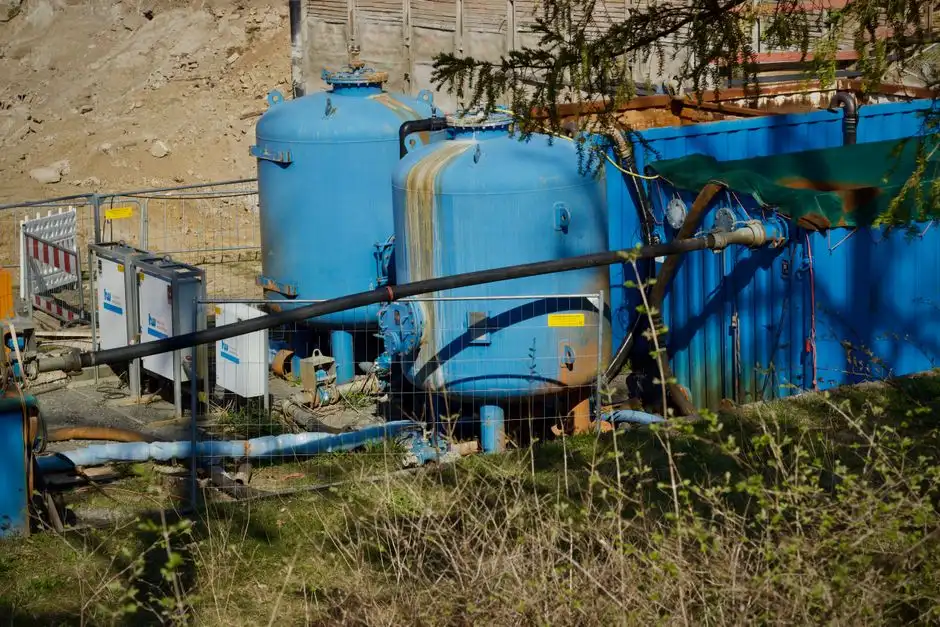
Mining wastewater treatment efficacy depends on the compatibility between the chosen technology and the specific chemical speciation of the influent, such as the Fe2+/Fe3+ ratio which governs oxidation requirements. For facilities requiring high-clarity effluent, a DAF for mining hydroxide/sulfide sludge clarification is often necessary to handle the high density of metal precipitates, which standard clarifiers may struggle to settle. If the objective is water reuse, an Integrated MBR system for water reuse and stringent discharge compliance can effectively manage organic loads, provided the upstream pretreatment effectively removes scaling ions.
The gap analysis must quantify the sludge disposal liability, as mining hydroxide sludge is typically classified as Class II or III waste, while sulfide-rich sludge often elevates the classification to Class III or IV under WA landfill standards, with disposal costs ranging from $180 to $320 per tonne. The following table provides a CAPEX/OPEX framework for technology selection:
| Treatment Technology | Estimated CAPEX ($M) | OPEX ($/kL) | Primary Application |
|---|---|---|---|
| Active Chemical/Lime Dosing | 0.5 – 2.0 | 0.80 – 1.50 | pH adjustment; Hydroxide precipitation |
| Passive/Semi-Passive Systems | 1.0 – 5.0 | 0.30 – 0.80 | Long-term seepage management |
| Hybrid MBR-RO-ZLD | 8.0 – 15.0 | 2.50 – 3.50 | High-TDS reuse; Zero liquid discharge |
Where sludge handling is a bottleneck, a High-pressure filter press for mining sludge dewatering to 35-50% solids is essential to minimize the mass of material requiring transport to Class IV disposal sites.
Phase 4: CAPEX/OPEX Modeling & Liability Provisioning Framework
Financial provisioning for legacy wastewater liabilities must utilize a 20-30 year discounted cash flow (DCF) model to account for the full lifecycle cost of ownership, including membrane replacements and periodic chemical infrastructure upgrades. When modeling OPEX, operators must account for fluctuating chemical costs, including lime ($180-250/t) and specialized PLC-controlled multi-chemical dosing for lime, polymer, antiscalant precision to ensure efficient reagent utilization. Power consumption must be modeled at current WA grid rates of $0.12-0.18/kWh.
The total liability provision is calculated as the NPV of the ownership cost plus site-specific remediation and closure provisions. A 1.3x contingency factor is applied to all CAPEX estimates to mitigate the risks associated with brownfield integration, such as space constraints and piping modifications.
| Provision Category | Calculation Driver | Liability Impact |
|---|---|---|
| Immediate Compliance (Y0-1) | P&ID Gap Register | 100% of Upgrade Cost |
| Replacement Reserves (Y10, 20) | Equipment Life Cycle | NPV of CAPEX |
| Operational OPEX (20yr) | Chemicals, Power, Sludge | NPV of Annual O&M |
| Closure Provision | Demolition/Rehab | Estimated Site Liability |
Phase 5: Data Room Package & Board-Ready Memo Structure
The final due diligence output must function as a technical deal document, providing the board with a clear "Green/Amber/Red" impact statement based on the total liability provision. The data room index should include the regulatory audit summary, the 95th percentile characterization raw data, the treatment gap register, and the DCF model with an assumptions tab. A 2-page executive memo is required, detailing key conditions precedent, such as vendor indemnity for historical non-compliance, and a 100-day post-acquisition action plan to stabilize wastewater operations. Any undisclosed contamination or pending environmental litigation must be flagged in a red-flag register for purchase price adjustment or escrow holdback.
Frequently Asked Questions
How long does the full due diligence take?
A comprehensive assessment typically requires 6 weeks. This includes 2 weeks for site access and regulatory record collection, 4 weeks for independent sampling and laboratory analysis, and 2 weeks for financial modeling and report finalization. Parallel workflows can compress this to 4 weeks if data room documentation is mature.
What if the target has no ETP at all?
If no treatment infrastructure exists, the project transitions to a greenfield build model. CAPEX can range from $5M to $25M depending on discharge flow rates (100–5000 m³/day) and the complexity of the required treatment. Construction timelines typically span 6-12 months, during which interim compliance measures must be implemented.
Can we rely on the seller's historical monitoring data?
Seller-provided data serves only for trend analysis. It is unreliable for liability quantification because it often excludes unlicensed discharge points, uses inadequate detection limits for heavy metals, or fails to capture peak pollutant loads during production upsets. Independent 30-day sampling is a non-negotiable requirement for accurate risk provisioning.
How do we handle shared infrastructure?
If the facility utilizes a central ETP shared with other tenants, the audit must review capacity allocation agreements and verify the legal basis for the cost-sharing ratio. The liability model must include a standalone fallback scenario, calculating the cost of a private ETP should co-tenants exit or the central facility fail to meet evolving regulatory standards.
What's the typical holdback for wastewater liabilities?
For brownfield acquisitions with legacy wastewater issues, a holdback or escrow of 5-15% of the enterprise value is standard. The release of these funds is usually tied to the successful commissioning of required upgrades or the expiry of a 12-24 month transition period during which historical non-compliance issues are identified.