Why the Texas / TCEQ Playbook Does Not Travel to Hungary
A Tyson meat or poultry plant acquisition in Hungary is governed by the EU Industrial Emissions Directive 2010/75/EU (IED), the FDM BAT Reference Document (2019), Hungarian Government Decree 219/2004 on water protection charges, and the national NE environmental permit. There is no TPDES transfer and no 40 CFR Part 432; instead, BAT-AEL ranges set BOD₅ 25–100 mg/L, COD 80–250 mg/L, total nitrogen 15–50 mg/L, and total phosphorus 2–10 mg/L at the discharge point, and the 30-day change-of-ownership notification is to the Hungarian environmental inspectorate (környezetvédelmi hatóság), not TCEQ.
The TCEQ, TPDES, 30 TAC §305.64, CORE-103 form, and 40 CFR Part 432 framework do not apply in Hungary. A deal team inheriting a Tyson diligence model built on Texas compliance rails will mis-size both the legal work and the CAPEX envelope on Day 1. Hungary runs on a five-rail stack built around the IED, the FDM BAT conclusions adopted under Commission Implementing Decision 2019/2031, the NE permit, the water authority permit, and the OKIR reporting system.
Because Hungary is an EU Member State, the IED is binding and BAT-AEL ranges are not optional guidance. Once the permit references the FDM BAT conclusions, those ranges become legally enforceable. A closing-day checklist built on Texas logic misses the Hungarian 30-day change-of-ownership notification duty, the BAT-AEL retrofit gap on total nitrogen and total phosphorus, and the Decree 219/2004 water-pollution charge exposure that begins the day the buyer's first self-monitoring report is filed.
The Hungarian and EU Legal Stack on Day 1
A Hungarian meat or poultry acquisition runs on five legal rails. Missing any one of them is successor exposure on Day 1.
| Rail | Instrument | Competent Authority | Day 1 Action |
|---|---|---|---|
| 1 | IED permit under EU 2010/75/EU, Annex I, activity 6.4(b); BAT conclusions via Commission Implementing Decision 2019/2031 (FDM BREF) | County-level környezetvédelmi hatóság | File IED permit modification to transfer to buyer's legal entity; existing permit is modified, not reissued |
| 2 | Hungarian environmental permit (környezetvédelmi engedély) and Act CLXXXV of 2012 on waste | County-level környezetvédelmi hatóság | File change-of-ownership notification within the deadline set by the permit text (typically 30 days) |
| 3 | Water management permit and Decree 219/2004 (XI. 21.) Korm. rendelet on water-pollution charges (vízszennyezési bírság) | Vízügyi hatóság (water authority) | Confirm the buyer's self-monitoring obligation and first-year water-pollution charge liability |
| 4 | Discharge consent to receiving water body or municipal sewer (POTW equivalent) | Receiving sewer operator and/or water authority | Verify local limits — ammonia and total P are frequently tighter than BAT-AEL ranges |
| 5 | IED Article 12 reporting and Hungarian PRTR (OKIR — Országos Környezetvédelmi Információs Rendszer) | County-level környezetvédelmi hatóság | First annual environmental report filed under buyer's legal name becomes baseline for the next permit revision |
Rail 1 is the IED permit itself. A meat or poultry throughput above 50 t/day of product places the site in Annex I, activity 6.4(b), and the existing permit must be transferred to the buyer's legal entity through a modification, not a reissue. The county-level environmental inspectorate is the single point of contact for both Rail 1 and Rail 2 — verify the exact notification deadline from the existing permit text rather than from a US template, because the IED modification and the change-of-ownership notification are filed in parallel and the inspectorate coordinates them.
Rail 3 is the most underestimated. Decree 219/2004 sets the water-pollution charge formula on the buyer's first-year self-monitoring report — exceedances of BAT-AEL ranges translate directly into a calculated fine, not a warning. Rail 4 frequently tightens ammonia and total P below the BAT-AEL ceiling. Rail 5 is the successor-liability equivalent of the EPA ECHO 8-quarter DMR pull in the US: the OKIR self-monitoring data and the most recent inspection report travel with the asset and become the buyer's opening baseline.
Cross-Walking 40 CFR Part 432 to EU FDM BAT-AEL
The engineer who already knows 40 CFR Part 432 can translate that knowledge directly into the EU parameter set. SIC 2011 (meat packing), 2013 (sausages and other prepared meats), and 2015 (poultry slaughter) all map into the FDM BREF activity 4.1 (animal by-products processing) and activity 4.3 (slaughterhouses and meat processing), both inside the scope of the 2019 FDM BAT conclusions.
| Parameter | US: 40 CFR Part 432 Subpart D (poultry, process stream) | EU: FDM BAT-AEL (effluent at discharge, after on-site biological treatment) | Design Implication |
|---|---|---|---|
| BOD₅ | Categorical on process stream; concentration-based limits by subcategory | 25–100 mg/L | MBR effluent polishing required; raw process-stream BOD₅ is irrelevant at the discharge |
| COD | Not the primary US categorical driver | 80–250 mg/L | Adds a parameter the US design may not have closed the mass balance on |
| TSS | Categorical on process stream | No BAT-AEL range stated; local limit typically 30–60 mg/L | Lamella or MBR polish drives the TSS floor |
| Oil & Grease | Categorical on process stream | No BAT-AEL range stated; local limit typically 5–20 mg/L | DAF front end mandatory, not optional |
| Ammonia (as N) | Categorical on process stream, typically 4–8 mg/L range at compliance point | Total N 15–50 mg/L | Denitrification mandatory, not nitrification alone |
| Total Phosphorus | Not the primary US categorical driver | 2–10 mg/L | Chemical precipitation stage required; polyphosphate detergents become a binding constraint |
| Chlorides / Conductivity | Not categorical | BAT-AEL applies for sites with rendered-product streams | RO polish required to meet chloride ceiling |
The ammonia-to-total-nitrogen translation is where EU CAPEX diverges from US CAPEX. The US categorical focuses on ammonia (as N) on the process stream; the EU BAT-AEL on total N is 15–50 mg/L at the discharge. A single-stage nitrification train will not hit that range — a nitrification-plus-denitrification train is mandatory, and the denitrification reactor volume is a real line item in the financial model. Phosphorus is the stricter EU driver and is frequently the binding local limit imposed by the receiving municipal treatment plant. The influent characteristics do not change: the same Tyson plant in Hungary runs similar numbers to the US site — BOD₅ 800–2,500 mg/L, TSS 600–1,800 mg/L, oil & grease 200–800 mg/L, and TKN 100–250 mg/L (industry-typical values, verify with site-specific sampling) — but it must hit materially tighter effluent numbers.
The Hungary-Specific Equalization-Basin Diagnostic
The single highest-leverage due-diligence diagnostic on a Hungarian meat-plant acquisition is the equalization-basin influent channel count, adapted from US field practice to EU compliance. Count the number of segregated inlet channels feeding the equalization basin during the first site walk — this is a one-hour observation any non-engineer can collect. One channel means process streams were never segregated, and Phase 1 CAPEX is wrong: biological reactors are sized to mixed-strength flow that would be much smaller if paunch, blood, and rendering condensate were kept separate and treated on a sidestream. Five or more channels means the prior owner already paid for segregation discipline; retrofit CAPEX typically drops, and integration risk falls because the permit-limit envelope is closer to design.
Add the EU-specific extension: confirm whether blood, paunch manure, and rendering condensate are routed to separate sidestreams. Without segregation, the MBR + denitrification volume required to hit total N 15–50 mg/L is materially larger. Confirm the cooling prerequisite on rendering and scalding streams — a 50 °C ceiling before biological treatment is both an FDM BREF energy-efficiency BAT and a Hungarian engineering constraint, not a comfort feature. Add a Hungarian legal overlay: pull the site's OKIR self-monitoring data and the most recent környezetvédelmi inspection report before signing. These are the EU equivalents of the EPA ECHO 8-quarter DMR pull, and they travel with the asset as successor liability. For a parallel visual diagnostic in a different process sector, see the TI Arizona plant acquisition wastewater compliance guide.
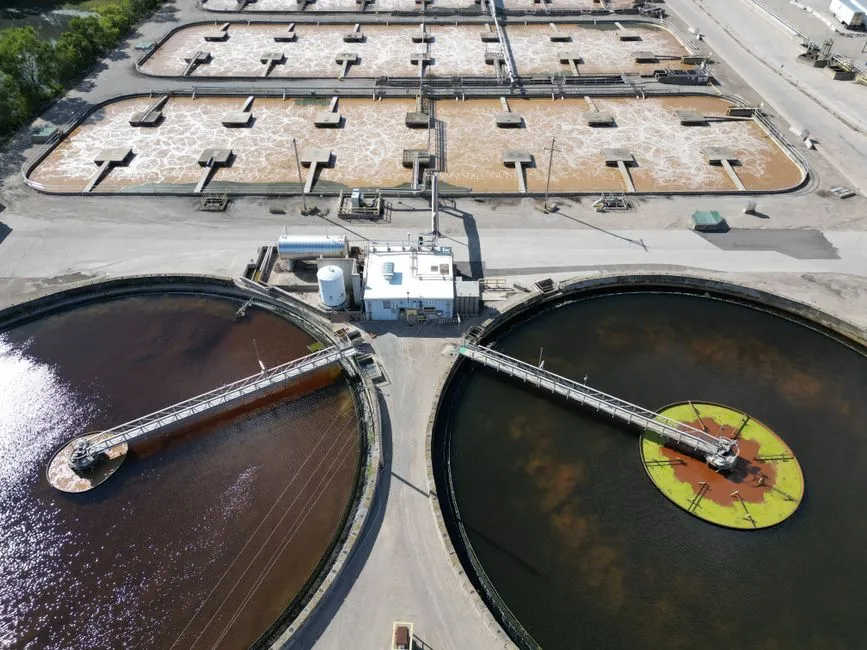
ETP Unit-Process Train for a 1,000–5,000 m³/day Hungary Plant
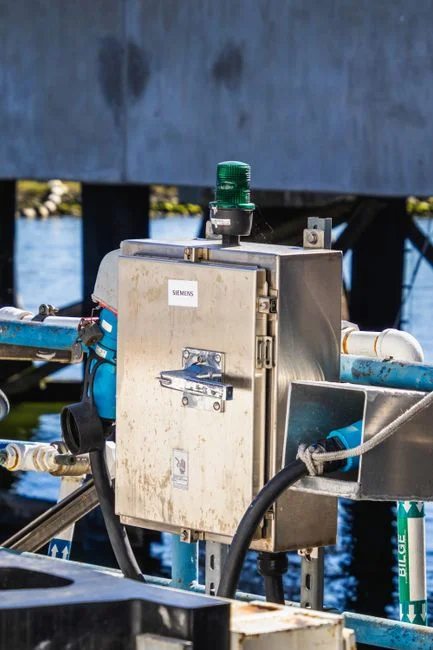
The reference P&ID below is the benchmark a buyer's engineer should gap any acquired site's drawings against. It is reverse-engineered from EU IED permit structures, FDM BREF BAT conclusions, and documented best practice at comparable European meat and poultry sites. Use it to size retrofit CAPEX, not to copy a vendor proposal.
| Unit Process | Specification | Design Function |
|---|---|---|
| Screening + DAF front end | Dissolved air flotation (DAF) system, 4–300 m³/h, 80–95% FOG removal, TSS <100 mg/L downstream | Removes blood, FOG, and suspended solids in the front end; sized for O&G 200–800 mg/L |
| Equalization basin | 6–12 h HRT; PLC-controlled pH 6.5–7.5 and temperature <50 °C | Absorbs pH 4–12 swings from caustic hot cleaning and acid descaling; buffers blood and rendering slug loads |
| Primary precipitation | Ferric chloride or polyaluminum chloride at pH 9–10; HydropureWater lamella clarifier at 20–40 m/h surface loading | Phosphate precipitation and residual organics removal; drops P to the 2–10 mg/L BAT-AEL range |
| MBR biological stage | HydropureWater MBR membrane bioreactor system, PVDF hollow-fiber, MLSS 8,000–12,000 mg/L, effluent turbidity <1 NTU, 1,000–5,000 m³/day peak | Nitrification + denitrification; sized for total N 15–50 mg/L — where EU CAPEX diverges from US CAPEX |
| RO polish | HydropureWater industrial RO system, 70–85% recovery, 15–30% reject, permeate <50 µS/cm | Cooling-tower makeup; reduces hauled-brine volume; addresses chlorides for rendered-product streams |
| Final disinfection | HydropureWater chlorine dioxide generator or UV bank, 50 g/h to 20,000 g/h | Final disinfection at reuse or discharge point |
| Sludge dewatering | HydropureWater plate and frame filter press, 25–35% DS cake | Nutrient-rich biological sludge; treat as a discrete budget line, not a buried cost |
The biology stage is where meat-plant design diverges most from a generic industrial template. High-TKN sidestreams from rendering condensate require dedicated nitrification volume, and the MBR MLSS window must be held at 8,000–12,000 mg/L to keep FOG and blood residuals from fouling the membranes. RO reject becomes a meaningful brine-management line item at 15–30% of total hydraulic load — plan the evaporator decision on the basis of that rejected volume, not on a generic ZLD target.
CAPEX Envelope and Hidden OPEX Lines for Hungary
The US baseline CAPEX envelope for the DAF + MBR + RO train on a 1,000–5,000 m³/day Tyson meat or poultry plant is $1M–$4M, or roughly $1,000–$4,000 per m³/day of design capacity (HydropureWater field data, 2026). Hungary requires an explicit EU CAPEX uplift.
| Line Item | EU/Hungary Adjusted Value | Basis |
|---|---|---|
| DAF + MBR + RO base train (1,000–5,000 m³/day) | $1.2M–$5.6M (20–40% uplift on US baseline) | BAT-AEL tightening on total N 15–50 mg/L, total P 2–10 mg/L, denitrification volume, RO polishing for water reuse |
| ZLD-ready (evaporator / crystallizer) | Add 1.5x–2.5x base-train CAPEX | Aligns with 2030 corporate zero-liquid-discharge targets |
| Brine hauling (off-site disposal) | 225–450 m³/day at 1,500 m³/day plant; US anchor $0.40–$0.90 per 1,000 gal | Confirm Hungarian site-specific tariff with the receiving licensed waste operator — regional variation is material |
| Biological sludge disposal | 25–35% DS via filter press; hauled to licensed waste facility | Discrete annual line item, not a CAPEX item and not buried in treatment upgrades |
The 20–40% EU CAPEX uplift factor accounts for the denitrification reactor volume, the chemical precipitation stage for phosphorus, the RO polish on rendered-product streams, and the higher instrumentation density demanded by the OKIR self-monitoring report. Brine hauling is the hidden OPEX line that breaks models built on US data: at a 15–30% reject ratio on a 1,500 m³/day plant, that is 225–450 m³/day of liquid leaving the site. The US anchor tariff of $0.40–$0.90 per 1,000 gallons does not transfer — confirm the Hungarian site-specific tariff with the regional licensed waste operator before locking the financial model. Biological sludge at 25–35% DS via filter press is a steady-state annual OPEX line, not a transition cost. For a parallel CAPEX framing in a different legacy-wastewater sector, see the UMC factory acquisition ETP due diligence guide.
The 90-Day Hungary Integration Roadmap
The 90-day integration roadmap is the sequence a defensible environmental handoff looks like in 2026 on the Hungarian IED + Decree 219/2004 rail.
- Day 0–30: File the change-of-ownership notification to the county környezetvédelmi hatóság; submit the IED permit modification request; confirm the existing IED permit and the Decree 219/2004 water-pollution self-monitoring obligations are formally in the buyer's legal name. Filing late does not pause the compliance clock — it stacks a late-filing penalty on top of any pre-existing exceedances already inherited.
- Day 30–60: Commission the equalization-basin channel count, pull the OKIR self-monitoring data, and complete the first site walk with the receiving municipal sewer operator — confirm local ammonia and total P limits, which are frequently tighter than the BAT-AEL ceiling.
- Day 60–90: Lock the Phase 1 CAPEX envelope against the BAT-AEL effluent targets, size the MBR denitrification volume, and confirm the brine- or sludge-hauling tariff with the regional licensed waste operator.
Closing is the moment the compliance ledger becomes yours. The 90 days after closing are the window where diligence becomes either good decisions or expensive surprises. For an analogous checklist in a different EU-Member-State context, see the SMIC factory ETP due diligence checklist.
Frequently Asked Questions
Does 40 CFR Part 432 apply to a Tyson plant in Hungary?
No. The US categorical pretreatment standards under 40 CFR Part 432 do not apply in Hungary. The legal driver is the EU Industrial Emissions Directive 2010/75/EU and the FDM BREF (2019) BAT conclusions, which become binding once the permit references Commission Implementing Decision 2019/2031. US categorical limits are a useful engineering reference but not the legal standard.
What is the Hungarian equivalent of EPA ECHO for due diligence?
The OKIR (Országos Környezetvédelmi Információs Rendszer) self-monitoring data and the most recent county környezetvédelmi hatóság inspection report. These are the documents the inspectorate uses to set the next permit revision, and they travel with the asset as successor liability. Pull both before signing.
What are the EU FDM BAT-AEL effluent limits for poultry processing?
FDM BAT-AEL ranges at the discharge point after on-site biological treatment: BOD₅ 25–100 mg/L; COD 80–250 mg/L; total N 15–50 mg/L; total P 2–10 mg/L. Local limits imposed by the receiving municipal sewer or water authority are frequently tighter, particularly on ammonia and total phosphorus.
How long does the change-of-ownership notification take?
The standard Hungarian environmental-permit duty is 30 days from closing. The exact window is set in the existing permit text and under Act CLXXXV of 2012 on waste — confirm both before filing, and file the IED permit modification in parallel because the inspectorate coordinates the two.
Is a denitrification stage mandatory?
Yes. The FDM BAT-AEL range on total N is 15–50 mg/L, and a single-stage nitrification train will not meet it. A nitrification-plus-denitrification train with dedicated anoxic volume is mandatory for any Hungarian meat or poultry plant that needs to hit the BAT-AEL effluent range. The denitrification reactor volume is a real CAPEX line, not an optional upgrade.