Why Airport Wastewater Is a Distinct Design Problem
IFAS (Integrated Fixed-film Activated Sludge) is a hybrid biological treatment that combines suspended activated sludge with free-floating biofilm carrier media in the same aeration tank. For airport wastewater — which behaves like dilute domestic sewage with extreme diurnal passenger-driven flow swings (terminals at OR Tambo, São Paulo, and seven CDC-surveilled U.S. hubs handle 21M–1B passengers per year) — IFAS delivers BOD removal above 95%, ammonia-nitrogen reduction typically below 5 mg/L, and a 30–50% capacity uplift over conventional activated sludge without adding new tankage.
Airport terminal WWTPs receive a composite stream that the Brazilian surveillance study at a major São Paulo hub described as "similar to domestic sewage, more diluted" — influent from passenger terminals, cargo terminals, administrative buildings, kitchens, sanitary facilities, and aircraft maintenance (per S3, MDPI 2026). That dilution is the first design clue: BOD₅ in the 150–300 mg/L band is normal, but peakings dominate the design envelope. U.S. airports alone move close to one billion travelers per year, and CDC's Traveler-based Genomic Surveillance program runs at seven major hubs — Seattle, San Francisco, Los Angeles, Boston, New York, Newark, and Washington D.C. — that together processed roughly 300 million passengers in 2022 (S5, Baker Institute 2024).
Pathogen load is continuous rather than episodic. The NICD's aircraft wastewater work at OR Tambo found ~22% of aircraft samples positive for SARS-CoV-2 and ~7% for influenza A, with comparable detection rates for measles (S1, Nature 2026). For a design engineer, that means consistent upstream viral shedding — the biological stage must reliably nitrify and reduce BOD so the downstream chlorine contactor or ClO₂ disinfection generator sized for IFAS effluent polishing is not asked to compensate for poor upstream work. Flow peaking is the second design driver: terminal wastewater routinely swings 4:1 to 8:1 between red-eye arrivals and midday peak, which forces a 2.5–3.0× ADF peaking factor on the biological stage if nitrification is to be held through the surge window.
What IFAS Actually Is and How It Works
IFAS is a hybrid of conventional activated sludge and attached-growth biofilm carried out in a single aeration basin, with downstream settling (per S4, IJSAT 2025-09). Two biomass populations operate in parallel: free-floating MLSS drives BOD removal and denitrification, while biofilm on polyethylene carrier media — typically Kaldnes-style or AccuPac-type with 500–1,200 m²/m² specific surface area — anchors the slow-growing nitrifiers (Nitrosomonas, Nitrobacter) that conventional activated sludge struggles to retain at low temperatures or short SRT.
The hydraulic benefit is what makes IFAS attractive for terminal retrofits. Because the biofilm adds effective biomass without raising the clarifier solids loading rate, plant capacity can be increased 30–50% inside existing aeration tankage — no new basins, no new clarifiers, and the existing RAS loop is preserved. In a 2026 IFAS layout, carriers are held at 30–50% volumetric fill inside the aeration grid, and wedge-wire retention screens at the downstream end of each cell keep the media inside the basin.
Operationally, IFAS behaves like conventional activated sludge for an operator who already runs a CAS plant — same blowers, same RAS/WAS pumps, same clarifier — but the biofilm compartment acts as a buffer against hydraulic and toxic shocks, which matters at airports where morning ramp-ups compress 6–8 hours of daily loading into 90 minutes of flow.
IFAS Design Parameters for Airport Terminal Flows
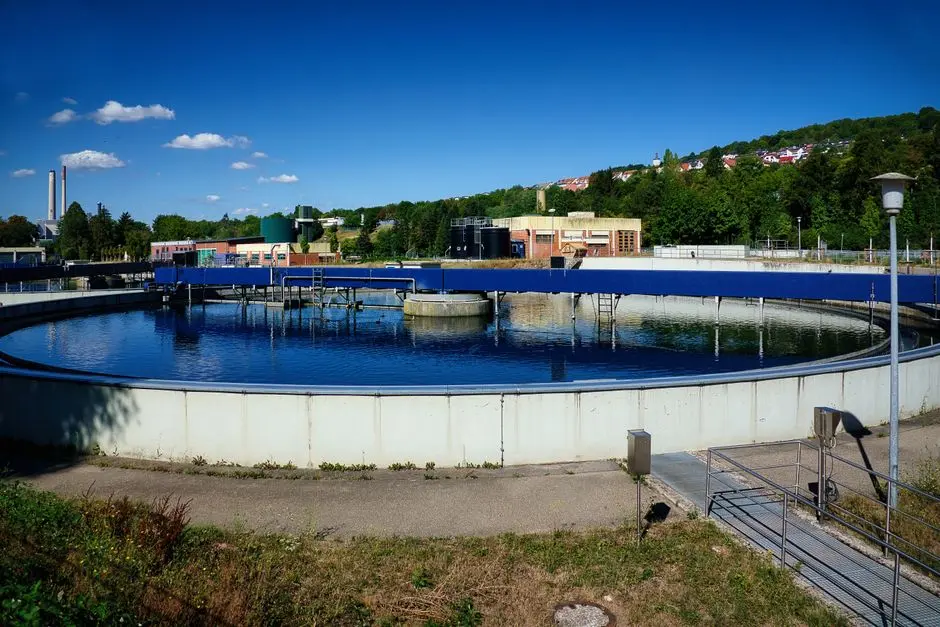
A defensible 2026 parameter set for a 1,000–20,000 m³/day terminal WWTP treating dilute domestic sewage in the range described by S3 is summarized below. The table values are sized for a flow-weighted average of 2.5–3.0× ADF hydraulic peaking and 2.0–2.5× BOD load peaking.
| Parameter | Design Target | Comment |
|---|---|---|
| Influent BOD₅ | 150–300 mg/L | Dilute domestic (per S3) |
| Influent COD | 300–600 mg/L | BOD:COD ≈ 0.5 |
| Influent TSS | 150–300 mg/L | Domestic-strength |
| Influent NH₃-N | 20–40 mg/L | Drives nitrification SRT |
| Influent TKN | 30–50 mg/L | Includes organic-N |
| MLSS | 3,000–5,000 mg/L | Higher than CAS due to biofilm |
| Carrier fill | 30–50% by volume | PE media, 500–1,200 m²/m² |
| HRT (avg flow) | 6–10 hr | Drop to 4–5 hr at peak flow |
| SRT | 10–20 days | ≥15 days at <13 °C |
| DO (aerobic zone) | 1.5–2.5 mg/L (raise to 3.0 for nitrification) | DO probe per cell |
| Effluent BOD₅ | <20 mg/L (>93–95% removal) | EU UWWT 91/271/EEC compliant |
| Effluent COD | <60 mg/L (>85% removal) | — |
| Effluent NH₃-N | <5 mg/L | Most U.S. airport NPDES permits |
| Effluent TSS | <30 mg/L post-clarifier | Pre-filtration to reuse |
| Temperature envelope | 10–25 °C comfort; nitrification rate drops ~50% below 12 °C | Climate-controlled basins or sidestream MBBR for cold hubs |
Two design consequences are worth flagging for the airport context. First, the biofilm compartment lets the basin absorb the morning passenger surge without losing nitrification — the same trick works for cargo-area deicing washwater spikes, provided equalization is sized for at least 4 hours at peak flow. Second, the temperature envelope matters more than most airport engineers expect: below 12 °C, nitrifier growth rate halves, so the SRT must climb to 18–20 days or the basin must be covered; for hubs in northern Europe, Canada, or the upper U.S. Midwest, that often means enclosed or buried tanks rather than the open concrete basins common in warmer regions. A compact packaged biological treatment unit for small terminal or remote airport facilities can be a useful reference for envelope sizing on smaller terminals.
IFAS vs MBBR vs MBR: Which Fits an Airport WWTP?
IFAS retains the activated-sludge recycle loop and the secondary clarifier, so it drops into an existing aeration basin with minimal civil work — the cheapest path to 30–50% capacity uplift for an aging terminal plant. MBBR (Moving Bed Biofilm Reactor) carries no sludge recycle, runs simpler hydraulics, and demands less operator skill, but is harder to push into denitrification or to recover from a fuel or deicing-agent shock. MBR (Membrane Bioreactor) delivers the best effluent — TSS below 1 mg/L, near-reuse quality — but at 2–3× the OPEX of IFAS, because membrane aeration alone consumes roughly 0.3–0.5 kWh/m³ and membranes need replacement every 7–10 years (per the MBR troubleshooting and fouling-control guide).
| Criterion | IFAS | MBBR | MBR |
|---|---|---|---|
| Footprint (relative) | 1.0× | 1.1–1.2× | 0.4–0.5× |
| Effluent BOD₅ / TSS | <20 / <30 mg/L | <20 / <30 mg/L | <5 / <1 mg/L |
| Operator skill needed | Moderate (CAS experience transferable) | Low–moderate | High (membrane care) |
| CAPEX (relative, 5,000 m³/d) | 1.0× | 0.9–1.0× | 2.0–2.5× |
| OPEX (per m³, 2026) | USD 0.08–0.18 | USD 0.07–0.15 | USD 0.22–0.40 |
| Best-fit airport scenario | Retrofit +30–50% capacity, standard discharge, airport NPDES permit | Greenfield small/medium terminal, low operator headcount | Reuse for toilet flush / cooling tower / irrigation, strict TSS or turbidity limits |
For airports targeting reuse for toilet flushing, aircraft wash, landscape irrigation, or cooling-tower make-up, an MBR system for airports targeting water reuse or sub-1 μm effluent is the right pick — paired with the MBR membrane bioreactor module to size the membrane cassette for the airport's peak-day flux. For standard discharge to municipal sewer or surface water under an airport NPDES discharge permit, IFAS offers the best CAPEX/OPEX balance. MBBR sits in the middle and is most often chosen for greenfield builds where there is no CAS legacy to protect.
2026 CAPEX and OPEX Benchmarks for an Airport IFAS Retrofit
For a 2026 board submission or EPC bid, the following benchmark applies. CAPEX for an IFAS retrofit lands in the range of USD 0.25–0.40M per 1,000 m³/day of installed capacity (HydropureWater field data, 2026), excluding civil works and any clarifier upgrade. A 5,000 m³/day airport terminal retrofit therefore sits in the USD 1.2–2.0M total CAPEX band, dominated by carrier media (~15–20% of CAPEX), blower upgrades for turndown (~10–15%), and instrumentation (~5–8%).
| Design flow | CAPEX (USD, 2026) | OPEX (USD per m³) | Main OPEX driver |
|---|---|---|---|
| 1,000 m³/day | 0.25–0.40M | 0.10–0.18 | Aeration energy (~60%) |
| 5,000 m³/day | 1.2–2.0M | 0.08–0.15 | Aeration + sludge hauling |
| 20,000 m³/day | 5.0–8.0M | 0.07–0.12 | Aeration + carrier-screen maintenance |
OPEX is dominated by aeration energy at roughly 60% of total, with carrier-screen maintenance, polymer, and excess sludge handling making up the balance. Versus MBR, IFAS OPEX is typically 20–30% lower because fine-bubble aeration suffices and no membrane replacement is on the 7–10 year cycle. Versus MBBR, IFAS CAPEX is similar but OPEX is slightly higher due to recycle pumps and MLSS control; the trade is paid back in effluent stability under shock loads and the ability to nitrify/denitrify in a single basin. Capacity-uplift retrofits of this type typically pay back in 3–5 years versus building a parallel aeration train. For airports already running a surveillance program, pairing the IFAS upgrade with a sample tap on the aeration tank influent is a low-cost way to keep the biological wastewater treatment airport program running through construction.
Designing an IFAS Retrofit: Practical Steps and Common Pitfalls
For a terminal WWTP, the deployment sequence is: influent screening → flow equalization (essential, not optional, at airports) → IFAS aeration tank with carrier retention screens → secondary clarifier → tertiary filtration (if reuse or low-TSS permit) → disinfection. Each step has airport-specific sizing rules. A rotary mechanical bar screen for IFAS headworks with 3–6 mm openings is the right starting point to strip wipes and cabin waste before they reach the carriers. Equalization must be sized for at least 4 hours at peak flow — that single number is the difference between a stable IFAS and a chronic ammonia excursion.
Inside the basin, specify wedge-wire retention screens with 5–8 mm openings to keep PE carriers in the cell; undersized screens are the number-one cause of carrier loss and the early performance decay that follows. Baffles should be arranged for plug-flow nitrification — a single CSTR-style basin rarely achieves the <5 mg/L NH₃-N airports are typically held to. The blower room should be sized for turndown ratios of 4:1 to handle overnight low-flow periods without overdosing DO, which would waste aeration energy and strip carriers.
The pitfalls that derail most airport IFAS projects: skipping equalization, under-sizing the carrier retention screens, failing to baffle for plug-flow, and ignoring cold-weather SRT adjustment. Operator-side, monitor carrier fill percentage quarterly — biofilm sloughing and accidental carrier loss both erode performance before effluent numbers shift visibly. Foam control is a routine concern in IFAS basins; the foam control in activated-sludge and IFAS basins reference covers surfactant-driven foaming from catering wastewater and deicing residues, both of which are common at airport sites. For airframe-side pathogen detection, see the parallel MABR for airport wastewater engineering guide if a sidestream polishing stage is on the table.
Frequently Asked Questions
What is the minimum flow to justify an IFAS upgrade at an airport WWTP?
IFAS is generally economic from around 500 m³/day upward when an existing CAS basin is being retrofitted for capacity uplift. Below that flow, packaged MBBR or a small compact packaged biological treatment unit for small terminal or remote airport facilities usually wins on CAPEX, because the carrier-media and screen overhead become a disproportionate share of the bill at very low flow.
How does IFAS perform in cold weather at northern airport hubs?
IFAS holds nitrification down to roughly 10 °C in covered or buried basins, but the nitrification rate drops about 50% below 12 °C. For airports in cold climates, the practical answer is to extend SRT to 18–20 days, cover or bury the aeration basin, and avoid uncontrolled cold shocks from ramp-area meltwater. An MBBR sidestream polishing stage is a common add-on for sub-10 °C conditions.
Can IFAS be retrofitted into an existing activated-sludge tank without building new aeration basins?
Yes — that is the primary use case. IFAS carriers drop into an existing aeration basin behind wedge-wire retention screens, and the existing RAS loop and clarifier stay in service. Typical capacity uplift is 30–50% with no new tankage, and clarifier upgrades are usually limited to launder and scum-baffle work rather than a new clarifier.
When is MBR the right pick over IFAS for an airport?
MBR is the right pick when the airport needs water reuse for toilet flushing, aircraft wash, landscape irrigation, or cooling-tower make-up, or when the discharge permit sets TSS below 5 mg/L. In those cases, the OPEX premium of USD 0.10–0.20 per m³ over IFAS is justified by avoided fresh-water purchase.
What does IFAS do to sludge production and handling at an airport?
IFAS typically reduces waste-activated sludge production by 20–30% compared to conventional activated sludge at the same BOD load, because the biofilm compartment mineralizes a portion of the slowly biodegradable COD. For airports, that means smaller sludge-storage volumes and lower hauling frequency — a meaningful OPEX line at remote hub locations.