
Why Airport Wastewater Is a Hard Problem for Conventional Treatment
Airport wastewater is a composite stream with no steady-state assumption. A single terminal collects flows from public toilets, staff dormitories, VIP lounges, catering kitchens, restaurants, retail back-of-house, fire-training wash pads, and seasonal deicing fluid runoff from aprons. BOD and COD swing 2-3× between the 04:00-05:00 low-flow window and the 07:00-09:00 morning flight-bank surge, which forces conventional activated-sludge designs to either oversize aeration for peak loads or accept effluent excursions during banking. NH3-N typically lands in the 30-60 mg/L range from catering grease interceptors and human-waste streams, and the bulk C/N ratio drops further when deicing glycol — biodegradable but high-strength — dominates in winter, pushing designers toward external carbon dosing for denitrification. FOG from airport catering routinely measures 100-300 mg/L oil and grease, which coats diffusers, fouls membranes, and strips oxygen-transfer efficiency from any biofilm or membrane system that sees it un-pretreated. The source design basis for the containerized airport MABR unit published by Liding explicitly lists terminal, dormitory, restaurant, lounge, and supporting-facility streams as the design envelope, which validates the framing that airport wastewater cannot be treated as municipal sewage at half the load.
How MABR Works and Why It Suits Airport Flows
A membrane aerated biofilm reactor delivers oxygen bubble-free through a gas-transfer membrane — typically hollow-fiber or a spirally wound envelope — directly into mixed liquor. An aerobic biofilm colonizes the membrane outside, while the bulk liquid remains anoxic, so simultaneous nitrification-denitrification (SND) occurs in a single vessel without a separate anoxic zone. Oxygen enters the biofilm by counter-diffusion, inward from the membrane, while BOD, NH3-N, and nitrate diffuse outward from the bulk liquid through stratified redox layers — a geometry that conventional aeration cannot replicate. Because air passes through the membrane passively at near-atmospheric pressure, MABR cuts aeration energy by up to 90% and overall plant energy by up to 50% versus blower-driven activated sludge (Fluence, 2026). For airport variability, the attached-growth architecture is the decisive property: a biofilm does not wash out when a 07:30 flight bank dumps catering effluent into the headworks, which is exactly the failure mode that disqualifies suspended-growth designs at hub-scale terminals. The technology is bankable: commercial MABR has been in service since 2016, with containerized Aspiral™ units deployed from 300 m³/d village plants up to the 15,100 m³/d three-plant SUBRE installation at the Port of Sihanoukville, Cambodia (Fluence, 2026) — establishing the size envelope that covers anything from a regional terminal to a major international hub.
MABR Design Parameters for Airport Wastewater Plants
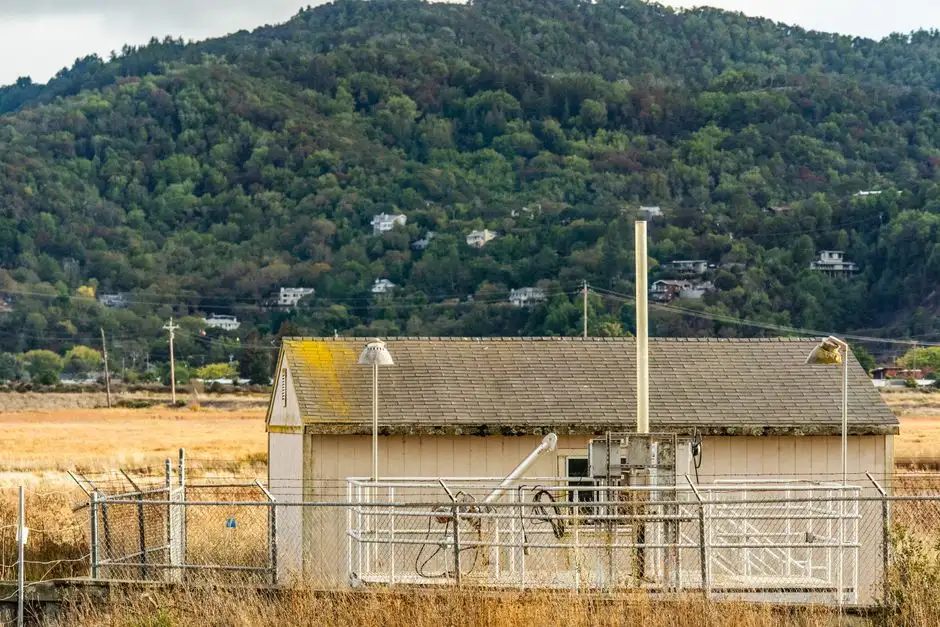
Three airport case sizes are sized for typical decentralized to mid-hub flows, with effluent targets aligned to pilot data — TN 4.1 mg/L at CENTA (Spain) and TN <3 mg/L at Stanford CR2C (California) (Fluence, 2026).
| Parameter | 100 m³/d (concourse node) | 500 m³/d (terminal side) | 2,000 m³/d (hub train) |
|---|---|---|---|
| Influent BOD (mg/L) | 250-400 | 250-400 | 250-400 |
| Influent NH3-N (mg/L) | 30-60 | 30-60 | 30-60 |
| HRT (h) | 8-12 | 6-10 | 5-8 |
| MABR module count (SUBRE/Aspiral) | 1 cassette | 3-4 cassettes | 12-16 cassettes |
| Effluent target TN (mg/L) | ≤5 | ≤5 | ≤5 |
| Effluent target NH3-N (mg/L) | ≤1 | ≤1 | ≤1 |
| Effluent target TP (mg/L) | ≤0.5 | ≤0.5 | ≤0.5 |
| Footprint (m², MABR + EQ) | 20-30 | 80-120 | 280-400 |
| Aeration pressure | Near-atmospheric, passive | Near-atmospheric, passive | Near-atmospheric, passive |
| Equalization basin (% daily flow) | 25-40% | 25-40% | 25-40% |
Pretreatment is required to protect the system. A rotary mechanical bar screen at 3-5 mm aperture followed by a dissolved air flotation (DAF) system for FOG removal protects the gas-transfer membrane envelope from grease coating and oxygen-transfer loss. A 4-8 hour equalization basin sized at 25-40% of daily flow smooths flight-bank peaks so the biofilm sees a dampened load profile. MABR effluent is then routed to a chlorine dioxide disinfection system for terminal reuse (toilet flush, landscape irrigation, cooling-tower make-up) — ClO2 is preferred over chlorine for ammonia-bearing effluent because it does not form chloramines and holds residual across a wider pH range. Containerized architecture (per the Liding product brief, 2026) packages screen + equalization + MABR + disinfection inside a single 20-ft or 40-ft ISO container for flows up to ~500 m³/d, enabling plug-and-play deployment at remote aprons, cargo terminals, or staff villages.
MABR vs SBR vs MBBR: Which Wins for Airport Applications?
The following matrix compares primary treatment technologies for airport procurement panels. The SBR baseline is the parallel-indexed airport treatment topic; cross-reference the SBR for airport wastewater engineering guide for the CAPEX-led counterpoint.
| Criterion | MABR | SBR | MBBR |
|---|---|---|---|
| Footprint (per m³/d) | 0.15-0.25 m² | 0.4-0.6 m² | 0.25-0.4 m² |
| Energy use (kWh/m³) | 0.15-0.25 | 0.4-0.6 | 0.35-0.5 |
| TN ≤5 mg/L without external carbon | Yes (SND in one tank) | Yes (batch anoxic phase) | No (methanol typically required at C/N <6) |
| Hydraulic shock resilience | High (attached biofilm) | Low (sludge washout risk) | Moderate (carrier retention) |
| O&M complexity | Low (passive aeration, no recycle pumps) | Moderate (decanters, timers) | Moderate (sieve retention, carrier inventory) |
| CAPEX order of magnitude (US$/m³/d) | 800-1,800 containerized; 400-900 permanent | 300-700 | 500-1,000 |
SBR is the proven incumbent — simple sequence, lower CAPEX, mature contractor base — but its batch operation inflates footprint and aeration energy, and a FOG spike from catering can upset settleability. MBBR is the retrofit favorite because carriers drop into existing concrete tanks, but at typical airport C/N ratios of 4-6, denitrification requires methanol dosing, which adds OPEX and an explosion-risk chemical inventory. MABR wins on footprint, energy, and SND-in-one-tank, at the cost of higher membrane CAPEX and a hard dependency on pretreatment to protect the gas-transfer membrane. The decision rule: choose MABR when energy cost is high, land is constrained by apron geometry, hydraulic surges are frequent, and reuse is required; choose SBR when CAPEX dominates and flows are steady; choose MBBR when retrofitting an existing concrete basin with available head.
Containerized vs Permanent MABR: Airport Deployment Scenarios
Containerized MABR — defined in the Liding product brief (2026) as a 20-ft or 40-ft ISO enclosure housing screen, MABR module, disinfection, and PLC control — arrives factory-commissioned and connects to influent and power on site. Speed is the procurement argument: the Taiping village project in Henan Province installed a 300 m³/d Aspiral™ plant within a 10-day window (Fluence, 2026), and the same envelope translates directly to a new terminal gate or modular concourse expansion where downtime has a hard cost in gate availability. Permanent MABR uses cast-in-place or panel-tank basins with SUBRE-style cassette towers rated for 2,000-100,000 m³/d, suited to a central airport treatment works handling more than 5,000 m³/d. The deployment fork is straightforward: containerized for terminal-side decentralized nodes (each concourse, cargo terminal, or staff village as its own treatment point), permanent for hub-scale centralized plants. Containerized units can be redeployed if a temporary terminal is later decommissioned, which is a CAPEX-protection argument finance teams understand — compare this trade-off in the containerized vs permanent wastewater plant comparison.
2026 Compliance, Reuse, and ROI for Airport MABR Projects
Typical airport discharge permits in major jurisdictions require TN ≤10-15 mg/L and BOD ≤30 mg/L, which MABR meets comfortably given pilot data of TN 4.1 mg/L (CENTA) and TN <3 mg/L (Stanford CR2C) (Fluence, 2026). IATA Airport Sustainability guidance and ICAO water-stewardship expectations push operators toward reuse, and the Stanford pilot met California Title 22 reuse criteria with TP <0.3 mg/L — directly relevant to airports seeking zero-liquid-discharge or water-positive certifications for toilet flushing, landscape irrigation, and cooling-tower make-up. Quantify ROI in two lines: a 1,000 m³/d airport MABR plant saves an estimated 0.3-0.5 GWh/year versus an equivalent SBR plant (50% overall energy reduction per Fluence, 2026), which translates to a 4-7 year payback in high-tariff markets. Climate resilience is a second ROI layer — the Bordeaux MABR plant on St. Thomas restored service with a generator after Hurricane Irma before the island grid recovered (Fluence, 2026) — and the 50% energy cut supports Scope 2 emissions reporting aligned with IATA Fly Net Zero by 2050. A CAPEX sanity check for the procurement file: order-of-magnitude US$800-1,800 per m³/d for containerized MABR, US$400-900 per m³/d for permanent in-ground MABR at airport scale, with OPEX dominated by membrane replacement every 8-12 years and disinfection chemical. For very small terminal-side flows or staff villages under 50 m³/d, an integrated WSZ underground packaged plant can be considered as a lower-CAPEX alternative where Title 22 reuse quality is not required.
Frequently Asked Questions
Why use MABR for airport wastewater?
MABR delivers simultaneous nitrification-denitrification in a single tank, producing effluent total nitrogen below 5 mg/L while cutting aeration energy by up to 90% and overall energy by up to 50% versus conventional
Frequently Asked Questions
Is MABR suitable for airport wastewater treatment?
Yes, Membrane Aerated Biofilm Reactor (MABR) technology is highly suitable for airports due to its ability to handle fluctuating hydraulic and organic loads characteristic of aviation facilities. The biofilm-based process provides high biomass retention, allowing the system to remain stable during the variable influent conditions caused by intermittent terminal activity and seasonal deicing operations.
What effluent quality can an airport MABR plant achieve?
MABR systems consistently achieve high-level nutrient removal, typically producing effluent with total nitrogen (TN) concentrations below 10 mg/L and total phosphorus (TP) levels below 1 mg/L. By utilizing simultaneous nitrification and denitrification within the biofilm, these systems meet stringent discharge standards, often exceeding the requirements set by the Clean Water Act and local NPDES permits for sensitive receiving waters.
How much energy does MABR save compared to conventional wastewater treatment?
MABR technology reduces aeration energy consumption by 50% to 80% compared to conventional activated sludge processes. This efficiency gain is achieved through oxygen transfer via gas-permeable membranes, which deliver oxygen directly to the biofilm at high transfer efficiencies, eliminating the need for energy-intensive mechanical bubble aeration.
Can MABR handle deicing fluid and catering FOG at airports?
MABR systems can process airport-specific contaminants, including high-COD deicing fluids like propylene glycol, provided the system is sized for the increased organic load. While Fats, Oils, and Grease (FOG) from catering facilities should be pre-treated through grease interceptors to prevent membrane fouling, the robust biofilm in an MABR is capable of degrading high-strength biodegradable organics more effectively than suspended growth systems.
How long does it take to install a containerized MABR unit at an airport?
Containerized MABR units can typically be deployed and commissioned within 8 to 12 weeks from the date of site arrival. Because the modular units are pre-fabricated and factory-tested, on-site work is limited to utility connections, piping integration, and electrical hookups, significantly reducing the downtime and construction footprint compared to traditional concrete tank infrastructure.