
What an AAO Retrofit Actually Changes in 2026
An AAO process retrofit and upgrade in 2026 keeps the existing anaerobic–anoxic–aerobic train and drops in biofilm or membrane modules to cut aeration energy by up to 90% and push effluent to TN <5 mg/L and TP <0.5 mg/L. Documented full-scale AAO+MBR retrofits achieve 0.46 kWh/m³ electricity use, 100–200% anoxic-to-anaerobic return, 300% aerobic-to-anoxic return, and 400% membrane-to-aerobic return, with a 6–9 month pilot-to-commissioning window at flow rates from 2,000 to 100,000 m³/d (aquasustfactory.com AAO+MBR case data; Fluence SUBRE documentation).
An AAO (or A2O) train is the canonical activated-sludge layout for biological nutrient removal: anaerobic for phosphorus release, anoxic for denitrification, aerobic for nitrification and BOD oxidation. The three binding constraints in 2026 are effluent total nitrogen, effluent total phosphorus, and aeration energy — hydraulic capacity is rarely the limiter once a plant is built. A retrofit drops biofilm or membrane modules into the existing basins; an upgrade replaces a unit operation. Most 2026 AAO projects are retrofits (MABR, MBBR) with one upgrade item (MBR replacing the secondary clarifier), and the land-use envelope is the clearest single proof: the 140,000 m³/d AAO+MBR retrofit reports 0.25 m²/(m³·d) versus the 0.80–0.95 m²/(m³·d) typical of new secondary+tertiary builds (aquasustfactory.com, 2017 operating data). That is a 70–75% footprint reduction without pouring new concrete.
| Parameter | 2026 AAO retrofit envelope | Source |
|---|---|---|
| Flow range | 2,000–100,000 m³/d (0.5–25 MGD); below ~20 m³/d use containerized MABR | S4 |
| Basin depth | 1.5–6 m (5–20 ft) | S4 |
| Land-use indicator | 0.25 m²/(m³·d) vs 0.80–0.95 for new secondary+tertiary | S3, 140,000 m³/d AAO+MBR |
| Energy envelope | 0.46 kWh/m³ (AAO+MBR) vs 0.50–0.60 kWh/m³ (comparable MBR plants) | S3 |
| Pilot-to-commissioning | 6–9 months (MABR); 18–36 months (new CAS build) | S4 |
Tank-by-Tank Retrofit Menu: Anaerobic, Anoxic, Aerobic, Clarifier
The four binding decisions in any AAO retrofit are made zone by zone; each zone has one preferred drop-in option and one fallback. Walking the existing P&ID in this order is faster than screening the entire technology stack.
Anaerobic zone. Typically retained as-is. The binding upgrade is the anoxic-to-anaerobic return, which the AAO+MBR case set at 100–200% to push enough nitrate-free mixed liquor back for EBPR to function (aquasustfactory.com, 140,000 m³/d case). Anaerobic HRT in that plant is 1.0 h at 3.9 m effective depth. Six 3.7 kW submersible mixers per tank keep the contents in suspension without aerating them.
Anoxic zone. Candidate for MABR module submersion. Bubble-less oxygen transfer delivers passive nitrification to a biofilm on the membrane surface while the bulk liquid stays anoxic for denitrification, which is what enables simultaneous nitrification-denitrification in a single reactor (Fluence SUBRE documentation). In the AAO+MBR case, the anoxic zone runs 2.7 h HRT with twelve 2.3 kW low-speed mixers per tank. Where no anoxic zone exists in the existing layout, an internal dividing wall must be priced into CapEx before sign-off.
Aerobic zone. Three defensible paths: (a) keep fine-bubble diffusers and add MABR modules upstream for energy and SND; (b) replace diffusers with MBBR carriers for a BOD/nitrification polish without membrane risk; (c) convert the aerobic zone into an MBR membrane tank with 400% return to the upstream anoxic zone. The AAO+MBR case uses option (c): 1,216 tubular aerators per tank × 2 tanks at 7.2 m³/h each, 2.4 h HRT at 6.0 m effective depth, and a 300% aerobic-to-anoxic return (aquasustfactory.com, S3).
Secondary clarifier. The most common 2026 swap is to MBR — eliminates the clarifier footprint, lifts MLSS to 8,000–12,000 mg/L, and adds a reuse-eligible effluent line. The reference case uses an integrated MBR membrane bioreactor system with membrane tank depth 5 m, effective water depth 3.7 m, eight cells per tank, and an air-to-water ratio of 8.7:1, with PVDF hollow-fiber DF-series flat-sheet MBR modules rated at 897.5 m³/d each (S3).
Return-sludge architecture. Aerobic→anoxic 300%, anoxic→anaerobic 100–200%, membrane→aerobic 400% are the load-bearing control parameters and must be re-validated in Biowin against the post-retrofit volume, not the original volume (S3, S2). On the sludge side, retrofit increases mixed-liquor yield; a plate and frame filter press should be sized to handle the higher cake volume rather than retrofitting the existing belt or centrifuge.
Technology Matrix: MABR vs MBBR vs MBR vs Expanded CAS for AAO Retrofits
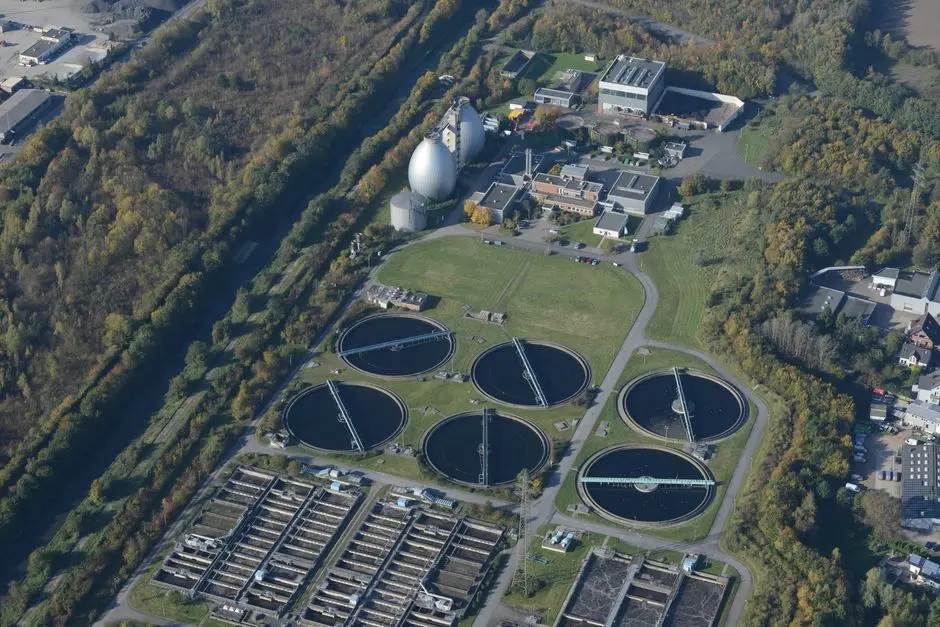
The technology pick is set by the binding constraint at the site — energy, reuse clarity, simplicity, or permanence — not by the strongest marketing deck. The matrix below is the procurement-grade version of that decision (S4 framework, AAO+MBR cross-check from S3).
| Technology | Oxygen transfer | Energy delta vs legacy CAS | Tankage | Reuse eligibility | Primary risk |
|---|---|---|---|---|---|
| MABR retrofit | Bubble-less membrane diffusion, passive | Up to 90% aeration cut; up to 50% plant-wide | Modules in existing basin; dividing wall if no anoxic zone | Reuse-eligible after disinfection (TN <3, TP <0.3) | Biofilm sensitivity to toxic shock, temperature |
| MBBR retrofit | Fine-bubble diffusers + carrier scour | Higher than CAS due to scour | Carriers in existing aerobic tank | Secondary clarifier polish still required | Blower and diffuser maintenance, no reuse clarity |
| MBR retrofit | Fine-bubble diffusers in new tankage | Higher than CAS (membrane air scour) | New membrane tank replacing clarifier | Near-reuse quality direct from membranes | Membrane fouling, replacement cost |
| Expanded CAS | Fine-bubble diffusers | Baseline | New concrete basin, longest schedule | Secondary clarifier polish required | Footprint, 18–36 month build |
MABR retrofit wins on energy: up to 90% aeration energy cut, up to 50% plant-wide energy cut, 1–3 weeks to measurable TN/TP improvement. Pilot data: TN 4.1 mg/L and TP 0.4 mg/L at the CENTA test center in Spain; TN below 3 mg/L and TP below 0.3 mg/L at Stanford's Codiga Resource Recovery Center, meeting California Title 22 (Fluence pilot data, 2019). Industrial sites must pilot first, apply a winter temperature factor to the ammonia load, and install influent equalization upstream — biofilm is more sensitive to toxic shock than suspended-growth CAS, and the MABR maintenance cost in 2026 profile assumes steady-state loading.
MBR retrofit wins on reuse-grade clarity: near-reuse quality direct from membranes with sub-micron filtration, 60% smaller footprint than conventional secondary+tertiary trains. Trade-off is membrane fouling control, air-scour energy, and replacement cost (S3 AAO+MBR case). MBBR retrofit wins on small-flow BOD/nitrification simplicity: drop-in carriers in the existing aerobic tank, no membrane, lower operator skill. Expanded CAS wins when biofilm-based retrofits are infeasible because the basin is shallower than 1.5 m, the influent is toxic, or operator capability is limited — at the cost of an 18–36 month design-to-commissioning schedule (S4).
The hybrid MABR+MBR combination is the 2026 default for tight footprints: MABR in the anoxic/aerobic zone, MBR replacing the secondary clarifier. That is exactly the architecture documented in the 140,000 m³/d AAO+MBR case, which retained the existing oxidation ditches as anaerobic/anoxic basins and built MBR structures in the clarifier footprint (S3, S4).
Process Parameters That Must Be Re-Validated After Retrofit
A retrofit that does not re-validate HRT, return rates, DO setpoints, and aeration capacity against the post-retrofit volume will fail consent even with the right hardware in the tank. The table below is the published 2026 reference set for the 140,000 m³/d AAO+MBR case; treat it as the starting point for Biowin or GPS-X re-simulation (S3, S2).
| Parameter | Setpoint | Source |
|---|---|---|
| Anaerobic HRT | 1.0 h at 3.9 m effective depth | S3 |
| Anoxic HRT | 2.7 h at 3.9 m effective depth | S3 |
| Aerobic HRT | 2.4 h at 6.0 m effective depth | S3 |
| Anoxic→anaerobic return | 100–200% | S3 |
| Aerobic→anoxic return | 300% | S3 |
| Membrane→aerobic return | 400% | S3 |
| Aeration blower | 223 kW large / 112 kW small, 7.5 m head | S3 |
| Membrane air-to-water ratio | 8.7:1 | S3 |
| PAC dose (chemical P polish) | ≤30 mg/L | S3 |
| Sodium acetate (external C) | ≤30 mg/L | S3 |
| ClO₂ disinfection | 8 mg/L, 30.78 min contact | S3 |
Return rates must be re-checked against the retrofitted tank volume, not the original — if the aerobic zone is shortened to make room for an MBR membrane tank, the 300% return is now pulling from a smaller working volume and the actual solids flux changes. Chemical doses are upper bounds; with optimized biological P and N removal the AAO+MBR case stays at or below 30 mg/L for both PAC and acetate versus ~50 mg/L in similar projects, saving ~1,000 t/yr of chemicals (S3). Dosing is delivered by an automatic chemical dosing system sized to the post-retrofit load, with pH correction and alkalinity supplementation to keep nitrification stable. S2's MCDM–MOO framework reports 46.7–68.3% sustainability improvement when weights are correctly assigned; the practical implication is that a Biowin pass against the post-retrofit configuration is mandatory before procurement.
2026 Retrofit Economics: CapEx, kWh/m³, and Payback Levers
The capital-memo math rests on three lines, not on the module sticker price. Operating savings carry the ROI; avoided CapEx is the second lever; reuse optionality is the third.
| Economic lever | 2026 number | Source |
|---|---|---|
| Electricity use, AAO+MBR | 0.46 kWh/m³ vs 0.50–0.60 kWh/m³ comparable MBR | S3 |
| Aeration energy cut, MABR retrofit | Up to 90% (Fluence SUBRE documentation) | S4 |
| Plant-wide energy cut, MABR retrofit | Up to 50% | S4 |
| Avoided CapEx (reused structures) | ~80 million CNY in AAO+MBR case | S3 |
| Land saved vs new secondary+tertiary | ~77,000 m² at 140,000 m³/d | S3 |
| Tap water offset from reuse | ~4 million m³/yr | S3 |
| Annual pollutant reduction (140,000 m³/d) | 13,100 t CODCr; 4,740 t BOD₅; 8,320 t SS; 960 t TN; 140 t TP | S3 |
| Schedule | 6–9 months pilot-to-commissioning (MABR); 18–36 months (new CAS) | S4 |
At industrial tariffs, the operating-savings line is the dominant payback lever. The AAO+MBR case logs ~2 million kWh/yr saved against comparable MBR plants, worth ~1.6 million CNY/yr at local tariffs (S3). Avoided CapEx is the second lever: the retrofit defers or cancels a new aeration basin, a secondary clarifier expansion, and external methanol dosing for denitrification that consent compliance would otherwise force; the AAO+MBR case reuses the existing guardhouse, main building, pretreatment area, oxidation ditches, sludge dewatering room, and central control room, saving ~80 million CNY (S3). Reuse optionality converts a compliance cost into a cost-avoidance line: TN <5 mg/L and TP <0.5 mg/L opens irrigation, dust suppression, and toilet-flushing reuse streams, and the AAO+MBR case conservatively saves ~4 million m³ of tap water per year by reusing effluent as lake water (S3).
For procurement scheduling, an MABR retrofit pilot-to-commissioning runs 6–9 months versus 18–36 months for a new CAS build, and the cut-over is staged basin-by-basin so the rest of the plant keeps treating throughout (S4). On the sludge side, retrofit increases mixed-liquor yield; a plate and frame filter press sized to the post-retrofit cake volume protects the dewatering line from the higher solids loading that intensified biological treatment produces.
Frequently Asked Questions
Can an existing AAO basin be retrofitted without building new tanks?
Yes. MABR modules anchor to the existing basin floor and the retrofit is non-destructive: no new excavation, the existing coarse-bubble diffusers are retained for periodic mixed-liquor mixing, and installation is staged basin-by-basin so only one tank is offline at a time (Fluence SUBRE documentation). If the existing layout has no anoxic zone, an internal dividing wall is a real line item that must be priced into CapEx before sign-off (S4).
What TN and TP can a retrofitted AAO hit in 2026?
TN below 5 mg/L and TP below 0.5 mg/L are achievable on MABR retrofits. Documented pilot data: TN 4.1 mg/L and TP 0.4 mg/L at the CENTA test center in Spain; TN below 3 mg/L and TP below 0.3 mg/L at Stanford's Codiga Resource Recovery Center, meeting California Title 22 reuse criteria (Fluence pilot data, 2019).
How long does an AAO retrofit take?
6–9 months pilot-to-commissioning for MABR retrofits, dominated by the 8–12 week pilot and the procurement lead time on blower skids and modules. Biofilm is established by week 6–8, with stabilization typically complete by week 8 (S4). Full AAO+MBR plant retrofits run in the same envelope once the MBR cassette procurement is on the same critical path (S3).
What flow range is in scope?
2,000–100,000 m³/d (0.5–25 MGD) with basin depth 1.5–6 m. Below roughly 20 m³/d, containerized Aspiral-class MABR units are the alternative rather than a basin retrofit (Fluence SUBRE documentation, S4). At the upper end, the 140,000 m³/d AAO+MBR case is the published full-scale proof point (S3).
Do AAO retrofits work for industrial wastewater with toxic shock?
Industrial sites must pilot first, apply a winter temperature factor to the ammonia load, and install influent equalization upstream to dampen toxic spikes. The fixed MABR biofilm is more sensitive to toxic shock than suspended-growth CAS, so equalization and toxicity screening are prerequisites, not options (S4). For the hospital WWTP application space, an extended-aeration-to-MBBR retrofit has been documented at full scale in 2026; the same biofilm caveats apply (S1).