Why Denver Food & Beverage Wastewater Is Not a Generic Solids-Separation Problem
Denver food and beverage factories should choose DAF over a conventional or lamella clarifier in 2026 when the wastewater carries high FOG, emulsified solids, or BOD above roughly 1,000 mg/L — which covers most breweries, dairies, meat processors, and bottling plants in the Metro area. DAF's micro-bubble flotation (90% of bubbles under 10 µm per WSI's diffuser data) removes floating FOG and TSS in a fraction of the footprint, while clarifiers lose performance on emulsified oil and in cold Colorado winter conditions.
F&B wastewater is not a generic industrial stream. Per Ecologix, processing, cleaning, and CIP generate FOG, TSS, and BOD concentrations high enough to trigger "significant discharge surcharges" and pretreatment non-compliance when primary separation is under-sized (Ecologix, F&B DAF systems). Typical operating ranges sit at FOG 200–3,000 mg/L, TSS 500–5,000 mg/L, and BOD 1,000–10,000 mg/L, varying by sub-sector: breweries trend toward the low end on FOG but spike on carbohydrate BOD; dairies and meat processors push the upper end on FOG and TSS; bottling plants run the cleanest streams dominated by sugar and CIP chemistry.
Denver adds two layers the generic comparison misses. First, climate: winter wastewater temperatures drop to 5–10°C, which thickens the stream and slows clarifier settling while also lowering the air-dissolution efficiency of a DAF saturation tank — both technologies need winterization. Second, regulation: the Metro Wastewater Reclamation District pretreatment program enforces a FOG cap typically at 100 mg/L and applies BOD/TSS surcharges above local limits, and a clarifier alone rarely holds the FOG line on F&B streams in winter. The right primary separator is sub-sector and loading-specific, not a default pick.
How a DAF Actually Removes Solids — and Why That Matters for F&B
A dissolved air flotation unit removes suspended matter by floating it, not by letting it sink. The mechanism, as WSI describes it, starts with a recirculated side-stream: the DAF pump pulls clarified effluent, aspirates ambient air on the suction side, and dissolves that air under pump pressure. The air-saturated solution then passes through a saturation tank for additional dissolution time before expanding across diaphragm control valves into WSI's proprietary diffusers inside the flotation chamber (WSI International, 2026). The rapid pressure drop forces dissolved air out of solution as micro-bubbles.
The bubble size is the engineering point that separates DAF from every clarifier on the market. Per WSI, 90% of the bubbles formed are less than 10 µm in diameter — small enough to attach to emulsified oil droplets and fine chemical floc that would pass straight through a sedimentation basin. Those bubbles nucleate on floc particles, lift them to the surface, and form a thickened sludge blanket that is raked directly to a downstream dewatering step. A DAF system in this configuration typically produces underflow solids at 3–6% dry solids, compared with 1–2% from a clarifier underflow — a halving of sludge volume that drives hauling cost down 30–50% in most F&B plants.
The F&B relevance is straightforward: FOG and colloidal organics don't settle well, but they do attach to micro-bubbles. A clarifier's quiescent zone gives emulsified oil nothing to grab onto; a DAF's bubble cloud gives it exactly the surface it needs. That is the mechanism behind Ecologix's claim that DAF "excels at removing lighter, emulsified pollutants that tend to float rather than settle" in food and beverage streams.
How a Conventional or Lamella Clarifier Handles F&B Streams
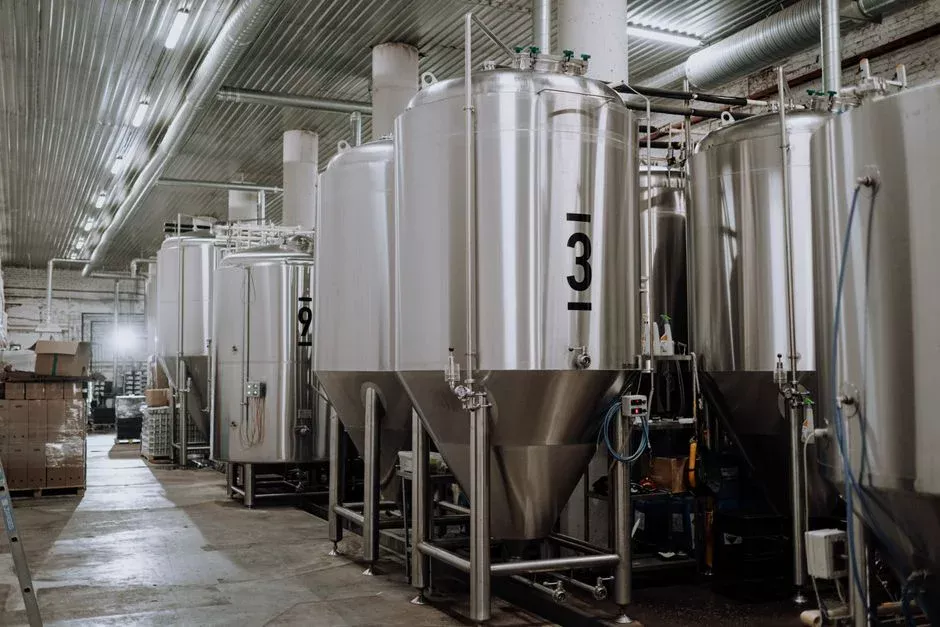
A conventional clarifier is a large quiescent tank where gravity does the work. Heavier particles settle to a sludge hopper, surface scum overflows to a separate grease trap, and clarified effluent leaves over a peripheral weir. A lamella clarifier variant stacks the same settling process onto inclined plates at 55–60°, multiplying effective surface area inside a much smaller footprint. Per HydropureWater product data, surface loading on a high-efficiency lamella clarifier runs 20–40 m³/m²·h, with footprint roughly one-third of an equivalent conventional basin.
Clarifiers earn their keep on dense, settleable solids. In bottling plants where TSS is mostly fruit pulp, grain solids, or settled CIP chemistry, a lamella clarifier is often the right primary step because CAPEX is lower, no compressed-air system is required, and controls are simpler. The weaknesses are equally well-defined: poor removal of emulsified FOG, large footprint for a given hydraulic load, underflow at 1–2% dry solids (driving up hauling cost), and settling velocity that drops measurably as winter wastewater viscosity rises.
The threshold where a clarifier still wins is narrow but real: low-FOG streams under roughly 500 mg/L TSS where floor space is available, the POTW surcharge schedule is forgiving, and CAPEX is the binding constraint. Outside that window — which describes most Denver breweries, dairies, and meat processors — a clarifier is a polishing step at best, not a primary separator.
DAF vs Clarifier: 2026 Side-by-Side Comparison for Denver F&B
The table below is the single artifact most readers will screenshot. Numbers are anchored to the WSI bubble-size and process data, the HydropureWater DAF hydraulic range (4–300 m³/h), and the HydropureWater lamella loading rates cited above.
| Parameter | DAF (industrial) | Lamella clarifier | Conventional clarifier |
|---|---|---|---|
| FOG removal efficiency | 80–95% | 30–60% | 20–50% |
| TSS removal efficiency | 80–95% | 50–80% | 40–70% |
| Hydraulic loading rate | 5–25 m/h | 5–8 m/h (lamella) | 1–3 m/h |
| Footprint per m³/h (relative) | ~0.3–0.5× baseline | ~0.35–0.5× baseline | 1.0× baseline |
| CAPEX index (per m³/h) | 1.5–2.5× | 1.0–1.2× | 0.9–1.1× |
| OPEX index (energy + polymer + sludge haul) | 0.6–0.9× baseline | 1.0× baseline | 1.0–1.1× baseline |
| Cold-weather sensitivity (5–10°C wastewater) | Moderate — needs insulated/enclosed saturation tank | High — viscosity drops settling velocity | High — same, plus larger surface area exposed |
| Sludge dryness (underflow DS) | 3–6% | 1–2% | 1–2% |
| O&M complexity | Medium (compressors, recycle pump, polymer system) | Low–Medium | Low |
| Best fit in Denver F&B | Brewery, dairy, meat, fry/cooking oil streams | Bottling, low-FOG beverage, polishing after DAF | Legacy retrofits, polishing only |
The WSI process narrative explicitly states the DAF "provides greater thickening of the sludge as well as a reduced footprint from a conventional clarifier" — that is the column that decides most Denver projects once land cost is factored in. The lamella clarifier remains the most defensible pick when FOG is genuinely below 200 mg/L and TSS is below 500 mg/L, which is rarely the case outside beverage bottling.
Match the Technology to Your Denver F&B Sub-Sector
Self-selection by sub-sector is faster than working the comparison matrix in the abstract. The table below maps the four dominant Denver F&B plant types to a recommended primary separator and a defensible reason.
| Sub-sector | Wastewater fingerprint | Recommended primary | Why |
|---|---|---|---|
| Brewery / craft beer | High carbohydrate BOD (1,500–5,000 mg/L), moderate FOG (200–800 mg/L) from grain handling, TSS 500–2,000 mg/L | DAF | Removes floatable grain and FOG in a small footprint; lamella works as polish if BOD alone is the issue |
| Dairy processing (milk, butter, cheese) | Very high FOG (500–3,000 mg/L), high BOD (2,000–8,000 mg/L), TSS 1,000–4,000 mg/L | DAF (mandatory as primary) | Clarifier will not meet Metro Wastewater Reclamation District FOG cap reliably; DAF with optimized automatic polymer dosing skid cuts FOG to <50 mg/L |
| Meat processing / slaughterhouse | Very high FOG (1,000–3,000 mg/L), very high TSS (2,000–5,000 mg/L) including blood and paunch, high BOD | DAF with coagulation/flocculation | Emulsified blood and fat will not settle; DAF with proper polymer program handles both loadings and protects downstream biology |
| Beverage bottling / soft drink | Low FOG (<200 mg/L), mostly sugar TSS (300–1,000 mg/L), CIP chemicals | Lamella clarifier (often sufficient) | DAF is over-spec; lamella's lower CAPEX and simpler controls fit the wastewater fingerprint |
| Distillery / ethanol | High BOD (5,000–10,000 mg/L), moderate TSS, low-to-moderate FOG from stillage | DAF if FOG present; otherwise MBR/SBR dominates | DAF still helps on TSS load reduction before biological treatment |
Dairy and meat are the two sub-sectors where the choice is effectively forced by Denver's FOG cap. Brewing and bottling leave room for engineering judgment — and bottling is where a lamella clarifier usually wins on cost.
2026 Cost Reality: CAPEX, OPEX, and Footprint per m³/h in Denver
CAPEX on the equipment line favors the clarifier: a DAF unit costs roughly 1.5–2.5× a comparable lamella clarifier at the same m³/h. But CAPEX in Denver rarely lives on the equipment line alone. Urban land cost, building shell, and footing work for a conventional clarifier often erase the equipment premium once footprint is factored in — a DAF at 30–50% of a conventional clarifier's footprint can drop the total installed cost to within 10–15% of the clarifier option, and below it on constrained sites.
OPEX tells the more decisive story. A DAF's recycle pump and saturation air system draw roughly 0.3–0.5 kWh/m³ across industrial units. That energy buys 3–6% dry sludge versus 1–2% from a clarifier, which typically cuts sludge hauling cost — usually the largest OPEX line for a Denver F&B plant — by 30–50%. Pair the DAF with a plate-and-frame filter press for sludge dewatering and the cake can be pushed to 18–25% dry solids before haul-off, further compressing OPEX. Polymer dose is comparable or lower for DAF when the chemistry is matched to the F&B stream.
For a typical 50 m³/h Denver brewery, a properly sized DAF system typically pays back the CAPEX premium against a clarifier in 2–4 years through sludge and surcharge savings — order-of-magnitude only, request a site-specific quote. In 2026, energy and polymer costs in Colorado are flat-to-rising, which tilts the OPEX calculation further toward whichever technology minimizes sludge volume and polymer dose, both of which favor DAF on F&B streams.
Denver Compliance Checklist: Metro Wastewater Reclamation District Pretreatment in 2026
Confirm the local FOG cap (typically 100 mg/L) and the surcharge schedule for BOD/TSS exceedance — these are the financial drivers behind choosing DAF on F&B streams. DAF effluent typically runs below 50 mg/L FOG and below 100 mg/L TSS consistently when polymer and hydraulic loading are dialed in, while clarifier effluent on F&B streams routinely fails the FOG cap in winter. The Colorado Department of Public Health and Environment (CDPHE) pretreatment coordinator requirements for F&B discharges should be reviewed before final equipment selection; a formal wastewater characterization and treatability study is the standard defensible path. For a broader view beyond Denver, the BOD and TSS global discharge limits reference and the related F&B pretreatment compliance guide put local numbers in context. Plants comparing Denver conditions to other US sites can also reference the Hanceville F&B DAF vs clarifier buyer's guide.
Frequently Asked Questions
What FOG level requires DAF instead of a clarifier in Denver?
When FOG exceeds roughly 500 mg/L on a routine basis — or when winter wastewater temperatures push the stream below 10°C — a DAF is the defensible primary. Clarifier FOG removal on F&B streams routinely drops below the Metro Wastewater Reclamation District's 100 mg/L cap under those conditions.
How much smaller is a DAF than a conventional clarifier for the same flow?
For the same m³/h, a DAF typically occupies 30–50% of a conventional clarifier's footprint, per WSI's published process claim that DAF provides a "reduced footprint from a conventional clarifier." A lamella clarifier narrows the gap to roughly 35–50% of conventional but does not match DAF on FOG or sludge dryness.
What is the 2–4 year payback estimate for DAF over a clarifier at a 50 m³/h Denver brewery?
At 50 m³/h, the typical DAF CAPEX premium of 1.5–2.5× over a clarifier is recovered in 2–4 years through 30–50% lower sludge hauling cost and avoided Metro Wastewater Reclamation District BOD/TSS/FOG surcharges. Order-of-magnitude only — site wastewater characterization is required before sizing or quoting.