

Why Winery Wastewater Breaks Conventional Biological Treatment
Winery wastewater is generated at 3–5 kL per ton of grapes crushed, which placed the 2008–2009 Australian crush of 1.7 million tonnes at a national total of 5–9 billion litres for a single vintage (Wiley review, 2011). The same review documented a 5–10 million L/year South Australian facility losing $2.4–3.4 million AUD/yr in product to drain — a useful proxy for what a harvest-spike of waste really costs a mid-size cellar. The design envelope that a process engineer has to plan around is captured in the Francis Ford Coppola Winery operating data (S3, 2016):
| Parameter | Influent (avg / max) | Vineyard reuse target | Cooling-tower reuse target |
|---|---|---|---|
| BOD | 2,000 / 8,000 mg/L | <30 mg/L | <30 mg/L |
| TSS | 200 / 600 mg/L | <30 mg/L | <30 mg/L |
| DO | 2 mg/L | — | — |
| pH | 4–10 | 6.5–7.5 | 6.5–8.5 |
| Chloride | <140 mg/L | <200 mg/L | — |
| TDS | — | <500 mg/L | <500 mg/L |
| Sodium | — | <100 mg/L | <100 mg/L |
The Coppola facility runs three facultative ponds totaling 6 million gallons (≈22,700 m³) with 60–90 day retention — a wide footprint that works in dry California but fouls when high-strength side-streams arrive during crush. Those side-streams are the real problem: 1% citric acid at 7,496 mg/L BOD, lees around 20,000 mg/L BOD, juice at 245,850 mg/L BOD, and finished wine at 265,810 mg/L BOD (S3, 2016). Any biofilm reactor downstream of those streams without source separation will see toxic and organic shocks that legacy CAS absorbs in the 60–90 day residence time but a fixed-film reactor cannot. Conventional activated sludge, facultative ponds, and even a well-run MBR will all struggle when the influent swings from under 1,000 mg/L BOD in the off-season to 8,000 mg/L during harvest — which is why the MABR retrofit conversation has to start with equalization, not the membrane modules.
What MABR Is and How It Differs From MBR and MBBR
A membrane aerated biofilm reactor (MABR) is a self-respiring biofilm reactor in which oxygen diffuses passively through a spirally-wound, gas-pressurized membrane directly to a nitrifying biofilm growing on the wastewater side of that membrane (Fluence SUBRE documentation; S2). Because transfer is diffusive rather than convective, the bulk liquid surrounding the spiral stays anoxic, and denitrifying bacteria keep working in the same tank. That single-tank aerobic-biofilm-plus-anoxic-bulk ecology gives MABR its simultaneous nitrification-denitrification (SND) advantage — the same reactor that legacy CAS normally splits into two or three stages.
The practical differences against the alternatives the EPC keeps getting asked about come down to oxygen transfer and biomass state. MBBR uses fine-bubble diffusers to scour moving plastic carriers with a fixed biofilm; MBR uses fine-bubble diffusers in a tank coupled to submerged PVDF ultrafiltration membranes that physically retain the mixed liquor. MABR removes the bubble entirely — passive diffusion to a fixed nitrifying biofilm — which is the root of the up-to-90% aeration energy reduction versus CAS reported in Fluence pilot data (2019). A working engineer can find a deeper treatment-train breakdown in How Submerged Membrane Bioreactors Work: Engineering Process, Efficiency Data & Zero-Risk Selection Guide, which lays out the MBR/MBBR envelopes side by side.
The trade-off is sensitivity. A fixed biofilm is more vulnerable to toxic shock than a suspended-growth CAS, which is why S2 lists influent equalization as a mandatory prerequisite for industrial retrofits, not an option. For a winery that swings between 1,000 and 8,000 mg/L BOD on a weekly basis during harvest, that prerequisite is the design variable that decides whether MABR works at all.
The 2026 MABR Retrofit Envelope Applied to Wineries
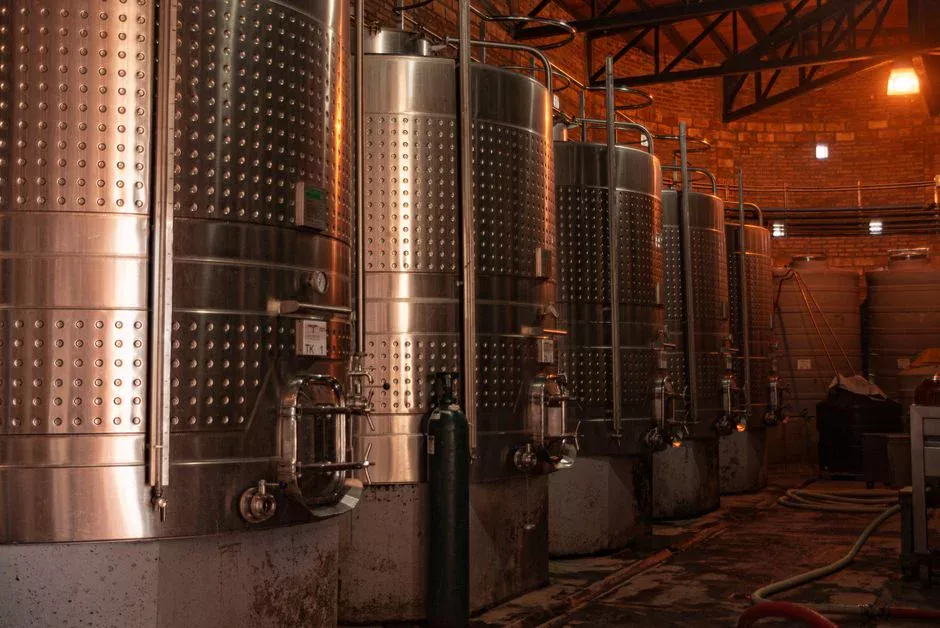
The binding SUBRE retrofit envelope is 2,000–100,000 m³/d (0.5–25 MGD) at 1.5–6 m basin depth, with up to 4 stacked MABR spiral levels per module anchored to the existing basin floor and fed by a separate low-pressure blower (S2, S4). Below roughly 20 m³/d the engineer should route to containerized Aspiral-class packaged MABR units rather than a basin retrofit, because the spiral stack height and blower static pressure no longer justify a basin cut-over at boutique scale. Inside the envelope, pilot performance has set the benchmark the winery reuse targets have to be measured against.
| Design parameter | SUBRE retrofit envelope | Winery reuse translation |
|---|---|---|
| Flow range | 2,000–100,000 m³/d (0.5–25 MGD) | Covers mid-size seasonal (20–2,000 m³/d) and industrial cellars (>2,000 m³/d) |
| Basin depth | 1.5–6 m (5–20 ft) | Matches typical facultative-pond depths used in California wineries |
| Below cutoff | Route to Aspiral containerized units (<20 m³/d) | Boutique wineries and tasting-room cellars |
| Module mounting | Up to 4 stacked spirals, anchored to floor | Drops into existing anoxic zone; dividing wall if basin is fully aerobic |
| Blower | Separate low-pressure, low-flow blower | Near-atmospheric membrane feed; existing coarse-bubble diffusers retained for mixing |
| TN performance | 4.1 mg/L at CENTA Spain; <3 mg/L at Stanford Codiga | Meets California Title 22 reuse criteria (Fluence 2019 pilots) |
| TP performance | 0.4 mg/L at CENTA; <0.3 mg/L at Stanford Codiga | Comfortably below typical irrigation TP guidance |
| Reuse threshold | TN <5 mg/L, TP <0.5 mg/L | Opens vineyard irrigation, dust suppression, toilet flushing |
The winery reuse numbers in S3 — BOD <30 mg/L, TSS <30 mg/L, TDS <500 mg/L, Na <100 mg/L — sit comfortably inside the MABR envelope provided the upstream chemistry is controlled. The binding constraint is sodium, not nitrogen: a Na <100 mg/L ceiling means the cellar has to switch away from NaOH-based cleaners (the universal problem called out in the 2011 Wiley review) before any MABR module can claim reuse eligibility. The TDS <500 mg/L target is the second constraint, and the third is the BOD/TSS finish — all of which the SUBRE envelope hits when the existing basin is between 1.5 and 6 m deep and equalization upstream is correctly sized.
MABR vs MBBR vs MBR vs Facultative Ponds for Wineries
Procurement typically positions MABR in isolation; what the EPC needs is a matrix against the three alternatives that always come up at a capital review — MBBR, MBR, and expanded facultative ponds — adapted to the winery's binding constraint. The matrix below uses the Coppola operating data as the realistic 2026 hybrid: sanitary wastewater on a 2 million gal/year MBR with UV + 120 µm disk filter, process wastewater still on facultative ponds.
| Parameter | Facultative pond | MBBR | MBR | MABR retrofit (SUBRE) |
|---|---|---|---|---|
| Aeration energy vs CAS | Low (atmospheric OTR) | Higher than CAS (carrier scour) | Higher than CAS (membrane air scour) | Up to 90% reduction (Fluence) |
| Effluent clarity | Secondary clarifier polish needed | Secondary clarifier polish needed | Near-reuse direct from membranes | Reuse-eligible at TN <3, TP <0.3 mg/L |
| Footprint | Largest (60–90 day HRT) | Small addition to existing tank | Moderate new membrane cassette | Existing basin retained |
| Seasonal shock tolerance (8,000 mg/L BOD) | High (HRT buffers shock) | Moderate (biofilm) | High (membrane retains biomass) | Moderate (equalization mandatory) |
| Na <100 mg/L reuse compliance | Hard to meet at long HRT | Achievable with chem. precipitation | Achievable with RO polish | Achievable with upstream source control |
| Civil scope | New pond excavation, longest schedule | Minimal — carrier addition | Moderate — tank + cassette | Modules + low-pressure blower skid |
The decision rule of thumb from S2 maps cleanly onto a winery's three size bands. Boutique operations under 20 m³/d go to containerized Aspiral/MBR packaged units, where the small footprint and the 2 million gal/year Coppola-MBR precedent make MBR the lower-risk answer. Mid-size seasonal cellars in the 20–2,000 m³/d band are MBBR or MBR territory: the flow is too low to justify SUBRE basin cut-overs, and biofilm or membrane cassettes drop into existing tanks without civil work. Industrial cellars above 2,000 m³/d with a reuse mandate are the MABR retrofit envelope, and the up-to-90% aeration energy cut converts the compliance cost into an operating-savings line. A complete MBR scope for a mid-size cellar is laid out in the MBR membrane bioreactor system product specification. The Coppola facility is the realistic reference point: sanitary on MBR, process on facultative ponds, and MABR as the candidate upgrade for the process side once source separation cuts the harvest spike below the biofilm's toxic-shock threshold.
Designing the Upstream and Downstream Train Around an MABR

MABR is a process island, not a turnkey plant. The upstream and downstream equipment decides whether the biofilm stays healthy and whether the reuse-quality effluent is actually reusable. Rotary mechanical bar screening protects the spiral membrane surface from rags, plastics, and label fragments that would foul the modules; a rotary mechanical bar screen with 6 mm aperture is the standard protection upstream of any spiral-wound biofilm reactor. DAF pretreatment upstream of the MABR strips FOG, TSS, and colloidal load that would otherwise stress the biofilm and force recovery cycles — for a winery this is the step that captures pomace, lees carryover, and DE filter solids before they reach the spiral stack. The right unit for a mid-size cellar is a DAF system sized to the harvest-week peak, not the annual average.
Equalization is the prerequisite that makes or breaks the MABR fit for a winery. The basin must be sized to dampen the 8,000 mg/L harvest BOD spike and absorb the juice/wine side-stream loads documented in S3 (2016) — without it, the fixed biofilm's toxic-shock sensitivity (S2) will drive the reactor into recovery cycles. The Coppola facility's existing three-pond train already provides 6 million gallons of hydraulic buffering; an MABR retrofit would re-purpose Pond 1 as the equalization zone and drop SUBRE modules into Pond 2 once source separation is in place. Downstream, an automatic chemical dosing skid handles pH correction, phosphorus precipitation polishing, and alkalinity supplementation to keep nitrification stable under variable seasonal loads, and a plate and frame filter press handles the increased mixed-liquor yield from intensified biological treatment without flooding the sludge line. The MABR retrofit only delivers its 90% aeration energy claim when the surrounding train is correctly specified.
Pilot, Procurement, and the 6–9 Month Path to Commissioning
Total elapsed time from pilot start to full-scale performance verification runs 6–9 months, dominated by an 8–12 week pilot and the procurement lead time on blower skids and spiral modules (S2). The retrofit-only CapEx stack is drop-in MABR modules, a low-pressure blower skid, mixing diffusers, an optional internal dividing wall if the existing basin is fully aerobic, and installation — at 5,000–100,000 m³/d this lands at a fraction of a new concrete basin build at the same flow, with the civil scope reduced to the dividing wall where one is needed.
The operating-savings line is what carries the ROI: up to 90% aeration energy reduction and up to 50% overall plant energy reduction versus the legacy CAS baseline (Fluence SUBRE documentation), which at industrial California electricity tariffs is the dominant payback lever for a winery. The avoided-CapEx lever is the second: the retrofit defers or cancels a new aeration tank, a secondary clarifier expansion, and external carbon (methanol) dosing for denitrification that nutrient compliance would otherwise force. The third lever is reuse optionality — effluent at TN <5 mg/L and TP <0.5 mg/L opens vineyard irrigation, dust suppression, and toilet-flushing reuse streams, converting a compliance cost into a cost-avoidance or revenue line that maps directly onto the Coppola sustainability mandate (S3).
The prerequisite is non-negotiable for industrial sites: wineries must pilot first, apply a winter temperature factor to the ammonia load before sizing the module count, and install influent equalization upstream to dampen the toxic spikes that the fixed biofilm cannot absorb (S2). Without those three steps the 6–9 month timeline slips and the aeration-energy claim disappears into recovery cycles.
Frequently Asked Questions
Is MABR proven for winery wastewater?
The 2011 Wiley review explicitly flagged MABR and MBR as "not proven for winery wastewater applications" because the pilot record at the time was thin. The 2019 Fluence pilot record (TN <3 mg/L, TP <0.3 mg/L at Stanford Codiga) plus the 2 million gal/year MBR already operating at Francis Ford Coppola Winery (S3, 2016) close that gap for the technology class. What remains winery-specific is the equalization and source-separation envelope — not the reactor itself.
What flow rate should route a winery to packaged MABR versus a SUBRE retrofit?
Wineries below roughly 20 m³/d should be routed to containerized Aspiral-class packaged MABR units rather than a SUBRE basin retrofit, because the spiral stack height and blower static pressure no longer justify the basin cut-over at boutique scale (S2, S4). The 20 m³/d cutoff aligns with the smallest Aspiral model size and the lower bound of the SUBRE 2,000–100,000 m³/d retrofit envelope.
How does MABR compare to MBR for a mid-size seasonal winery?
MABR retrofit wins on aeration energy (up to 90% reduction vs CAS) and total nitrogen at existing-basin retrofit scope; MBR wins when reuse-water clarity or suspended solids is the binding effluent parameter (S2). The decision rule is binding-constraint driven: pick MBR for TSS <30 mg/L direct to irrigation, pick MABR for TN compliance and energy on a 2,000–100,000 m³/d basin retrofit.